


 Front End Development
  Back End Development
  CMS / ECommerce Development
  Mobile Apps Development
  Cloud Services
  Fullstack Services
  Solution


BNPL App Development: Features, Cost & Development Process
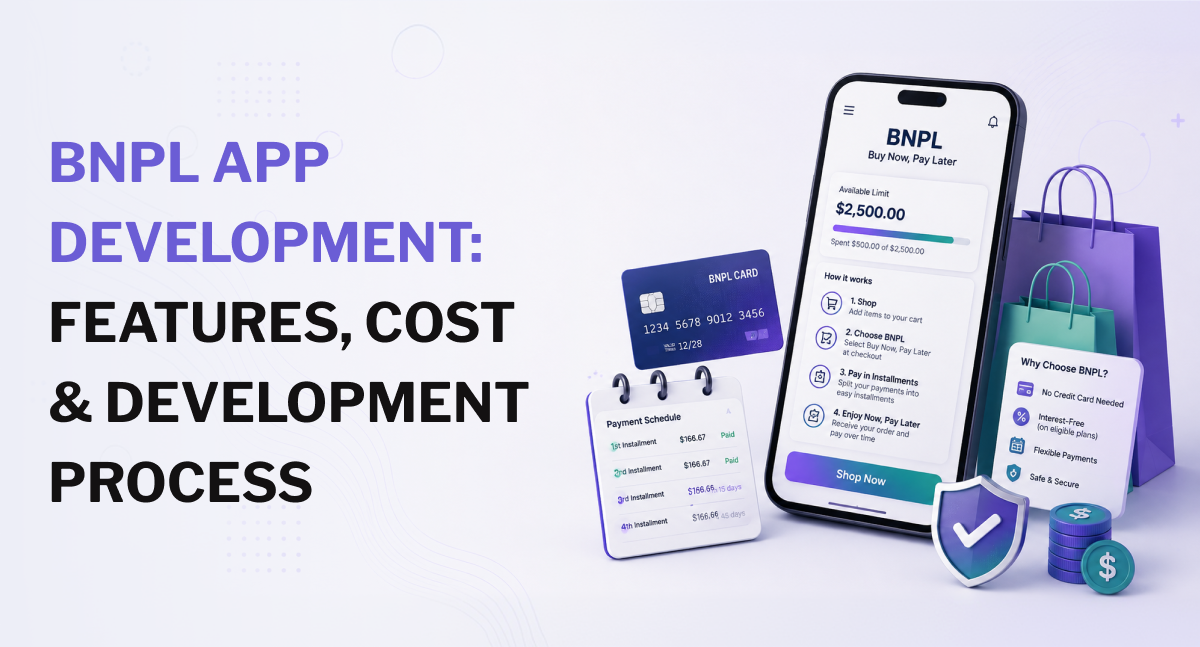
Buy Now, Pay Later (BNPL) has become an important part of the digital payments market, giving customers the option to split a purchase into several payments instead of paying the full amount upfront. Grand View Research estimates that the global BNPL market reached $11.9 billion in 2025 and projects it to reach $14.9 billion in 2026 and $80.1 billion by 2033, at a projected CAGR of 27.0% from 2026 to 2033.
For a business planning a BNPL product, the opportunity is only one part of the decision. The bigger question is how to build an application that can handle customer onboarding, eligibility checks, merchant transactions, installment schedules, repayments, fraud controls, payment integrations, and regulatory requirements without making the user experience difficult.
The cost of BNPL app development can range from roughly $4,000 for a basic MVP to $25,000 or more for an enterprise BNPL ecosystem, depending on the feature set, integrations, security requirements, platforms, and target markets. A serious MVP can take around four to seven months, while a larger multi-market platform may require considerably more time.
This guide explains the main BNPL app features, development process, technology choices, cost factors, timeline, security requirements, business models, and the practical decisions that should be made before development begins.
What Is BNPL App Development?
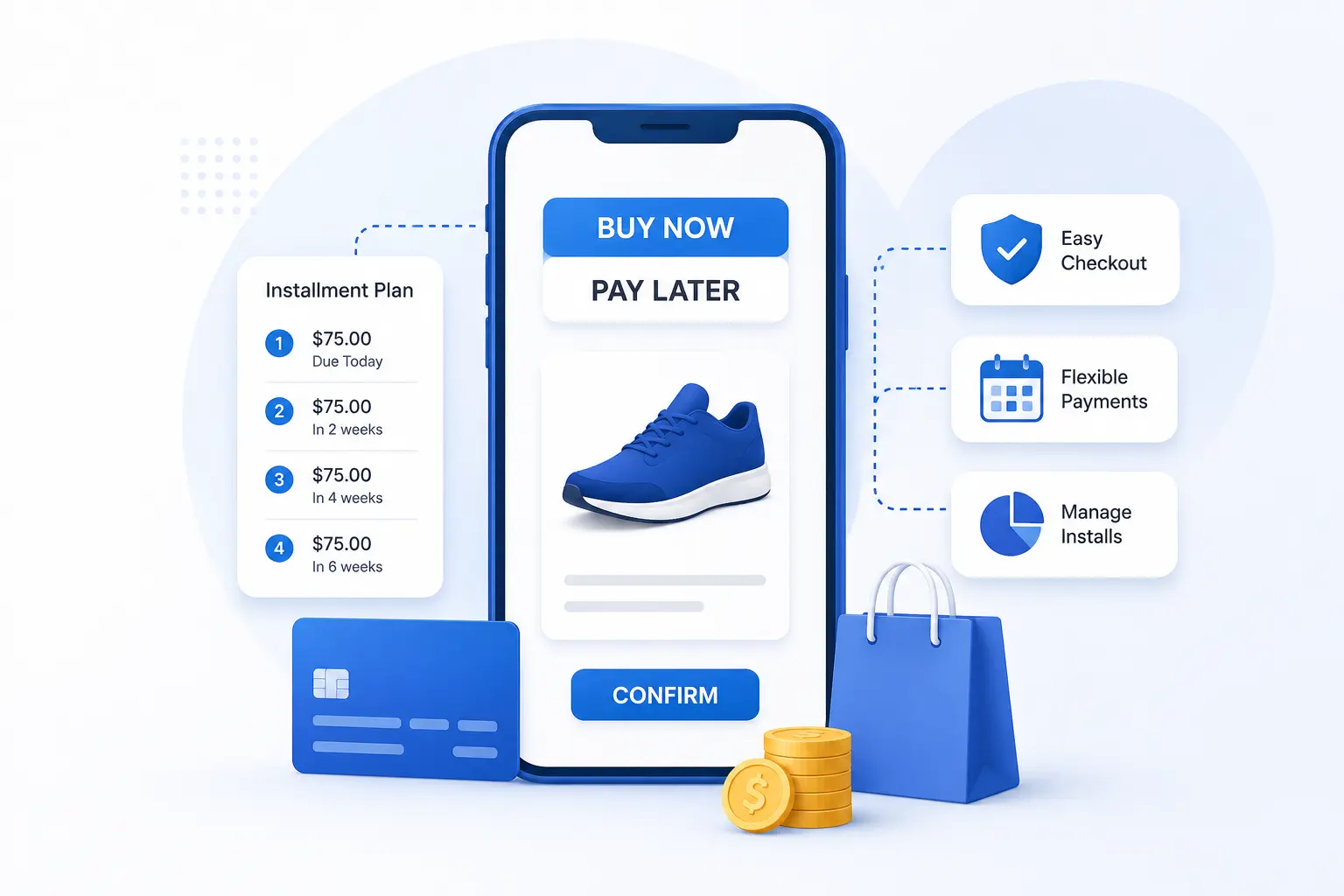
BNPL app development involves building a digital platform that allows customers to purchase products or services and pay for those purchases through installments.
A typical BNPL ecosystem has several connected components:
- Customer mobile or web application
- Merchant checkout integration
- Backend application
- Eligibility and credit decisioning system
- Payment gateway
- KYC and identity verification
- Fraud detection
- Repayment management
- Merchant dashboard
- Admin panel
- Reporting and reconciliation tools
The exact structure depends on the business model. Some businesses provide the technology layer while a financial institution provides the credit. Others operate a lending business themselves or integrate with existing payment and financing providers.
That distinction needs to be established early because it affects the application's architecture, payment flow, compliance responsibilities, data requirements, and third-party integrations.
A BNPL transaction can be as simple as a customer purchasing a $400 product and selecting four installments. Behind that simple checkout experience, the system still needs to verify the customer, assess eligibility, authorize the transaction, create the repayment schedule, record the merchant transaction, and track future payments.
This is why BNPL software sits at the intersection of fintech, payments, lending, risk management, and eCommerce.
Businesses exploring digital lending workflows can also look at an instant loan and micro finance platform to understand features such as digital verification, credit scoring, automated decisions, repayment options, fraud monitoring, and lending rules.
How Does a BNPL App Work?
The customer sees a simple checkout option, but several systems usually operate behind it.
1. Customer Registration and Verification
The customer creates an account using a mobile number, email address, or another supported identity method.
Depending on the market and business model, the application may collect:
- Full name
- Date of birth
- Address
- Government-issued identification
- Contact information
- Payment details
- Other information required for eligibility
KYC and identity verification can be integrated through third-party providers.
2. Eligibility Assessment
The platform then determines whether the customer and transaction qualify for BNPL.
The decision may consider:
- Customer information
- Previous repayment behavior
- Credit information
- Purchase amount
- Existing BNPL exposure
- Income or financial information
- Device signals
- Fraud indicators
- Internal lending rules
The result can be an approval, rejection, spending limit, or request for additional verification.
3. Purchase Authorization
Once the customer receives approval, the transaction moves through the merchant checkout.
The merchant needs confirmation that the transaction has been authorized, while the platform records the purchase and creates the associated repayment schedule.
4. Installment Creation
The application calculates the customer's payment schedule based on the selected BNPL plan.
The customer should be able to see:
- Amount due today
- Number of installments
- Amount of each installment
- Future payment dates
- Total amount payable
- Applicable fees
Clear information is especially important in financial products because customers should understand their obligation before completing the purchase.
5. Repayment and Account Management
After the purchase, the application manages scheduled payments, successful transactions, failed payments, refunds, cancellations, disputes, and account balances.
A good BNPL product therefore needs to work well after checkout, not only during the purchase.
Planning a BNPL App?
Turn your BNPL idea into a clear product plan with the right customer journey, payment flow, integrations, and technical architecture.
Key Features of a BNPL App
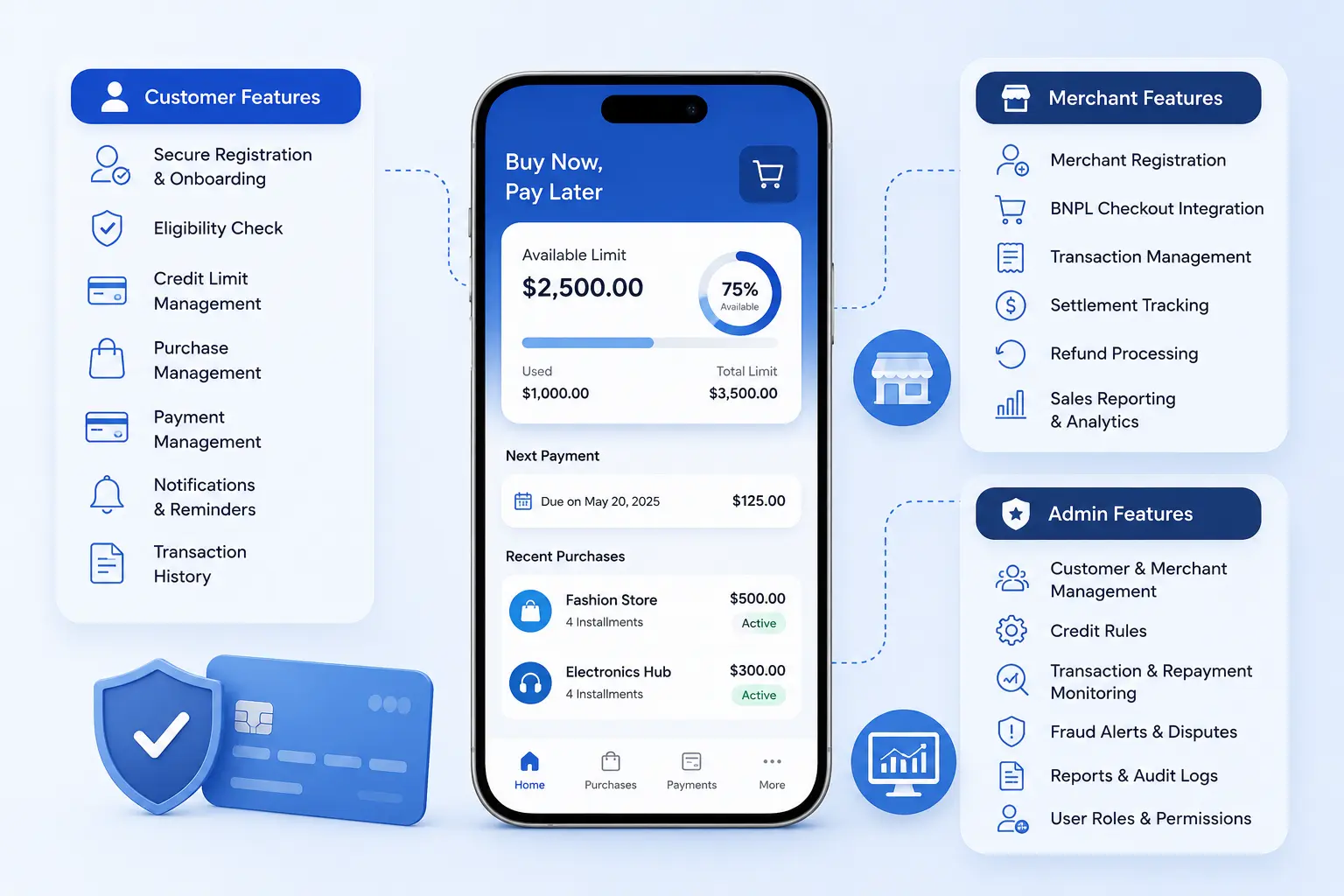
The feature set should be divided between customers, merchants, and administrators. Each group interacts with a different part of the platform.
Customer-Side Features
Secure Registration and Onboarding
The registration process should be quick while still collecting the information needed for identity verification and eligibility assessment.
OTP verification, passwordless authentication, biometric login, and multi-factor authentication can be considered depending on the product's security requirements.
BNPL Eligibility Check
Customers should be able to find out whether they are eligible without going through an unnecessarily long process.
The eligibility result should also explain what happens next rather than simply showing an approval or rejection message.
Credit Limit Management
Users should be able to see their available credit, used amount, remaining limit, and active repayment obligations.
Purchase Management
A dedicated section can show all active BNPL purchases, including installment amounts, due dates, payment status, and outstanding balances.
Payment Management
The application can support cards, bank accounts, or other approved payment methods.
Automatic payments can reduce missed installments, while manual repayment options give customers additional control.
Notifications and Reminders
Useful notifications include:
- Purchase approval
- Payment confirmation
- Upcoming installment
- Failed payment
- Refund status
- Account security alert
- Credit limit update
Notifications should be useful rather than excessive.
Transaction History
Customers should have access to previous purchases, repayments, refunds, and account adjustments.
A clear history also reduces support requests because users can verify what happened without contacting customer service.
Merchant Features
A BNPL application cannot depend entirely on the customer-facing app. Merchant functionality is equally important.
A merchant dashboard can include:
- Merchant registration
- BNPL checkout integration
- Transaction management
- Order status
- Settlement tracking
- Refund processing
- Reconciliation
- Customer transaction lookup
- Sales reporting
- Merchant analytics
For larger platforms, merchants may connect through APIs, SDKs, plugins, or hosted checkout solutions.
Admin Features
The administration panel controls the operational side of the platform.
It can include:
- Customer management
- Merchant management
- Credit rules
- Transaction monitoring
- Repayment monitoring
- Fraud alerts
- Dispute management
- User roles and permissions
- Audit logs
- Reports
- Account controls
A strong admin panel can also help operations teams identify failed payments, suspicious activity, and unusual transaction patterns without manually reviewing every account.
Businesses building a wider financial product can also explore fintech app development to see how features such as loan management, repayments, background verification, fraud detection, admin controls, and AI-based approval workflows can fit into a financial application.
Which BNPL Features Does Your App Need?
From customer onboarding and eligibility checks to merchant checkout, repayments, fraud controls, and admin tools, the right feature set depends on your business model.
Get help defining the features that belong in your BNPL MVP and the capabilities that can be added later.
Advanced BNPL App Features
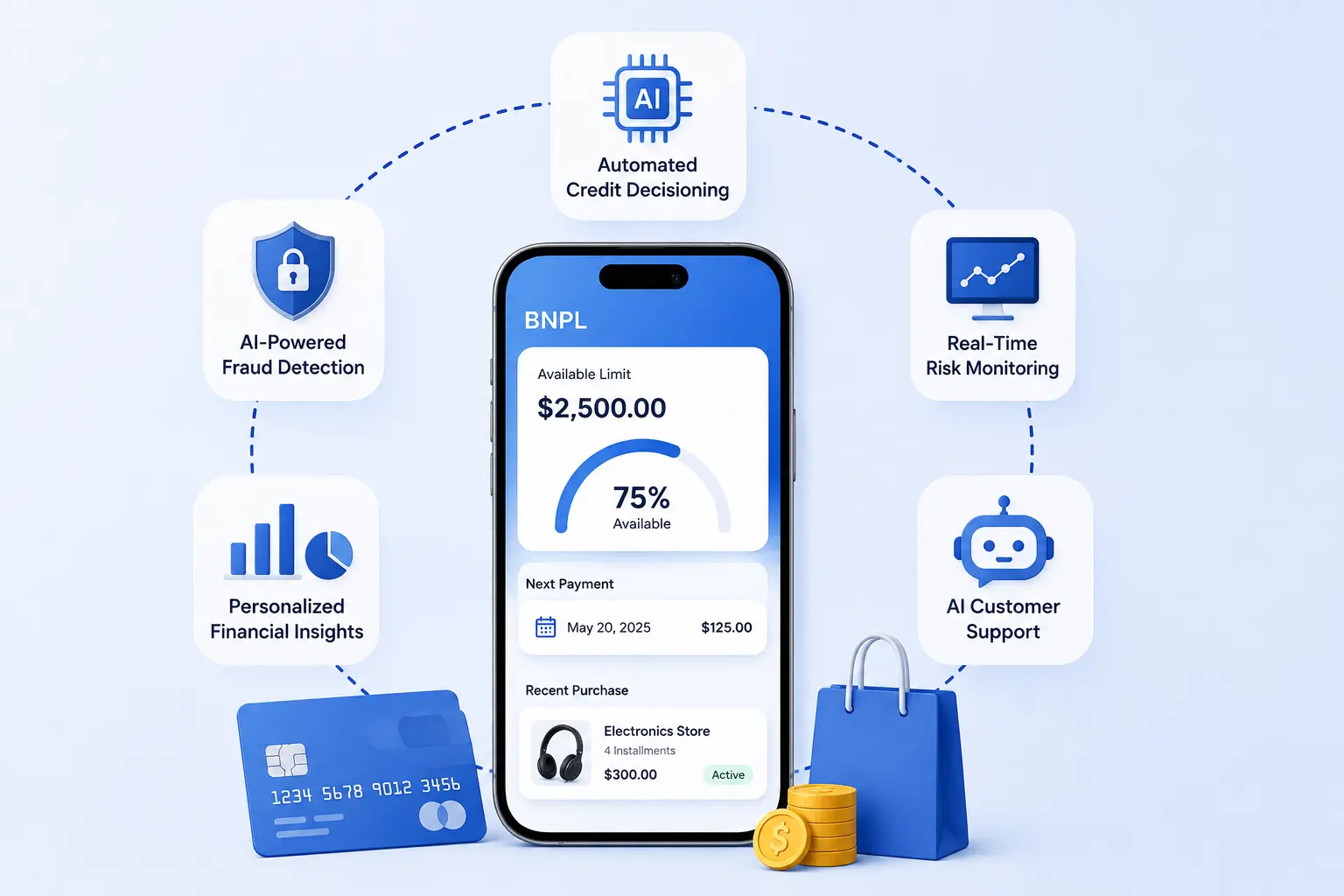
A basic MVP can support the core transaction flow. A larger platform may require additional capabilities as transaction volume and customer numbers grow.
Automated Credit Decisioning
Fraud prevention is important because BNPL platforms can be targeted through fake accounts, stolen payment methods, account takeover attempts, and other forms of abuse.
A fraud system can monitor:
- Unusual transaction activity
- Device behavior
- Repeated applications
- Multiple accounts
- Transaction velocity
- Suspicious payment patterns
- Changes in account behavior
Machine learning can be introduced when there is enough reliable data to support it. A simple rules-based fraud layer can be appropriate for an early MVP.
Real-Time Risk Monitoring
A customer who passed an initial eligibility check may behave differently over time.
Real-time monitoring can track:
- Current exposure
- Repayment performance
- Transaction frequency
- Account activity
- Merchant behavior
- Unusual purchasing patterns
This allows risk teams to identify issues earlier.
Personalized Financial Insights
A mature application can provide useful information about upcoming payments, spending patterns, repayment obligations, and available credit.
These features should help customers understand their financial commitments rather than encourage unnecessary borrowing.
AI Customer Support
A chatbot can handle routine questions about payment dates, account information, transaction status, refunds, and repayment schedules.
An AI chatbot development approach can support this type of customer service layer, particularly when the chatbot needs to connect with account data, payment systems, or backend workflows.
Sensitive decisions such as credit approval should remain governed by controlled application logic and approved business rules.
Security and Compliance Considerations for BNPL Apps
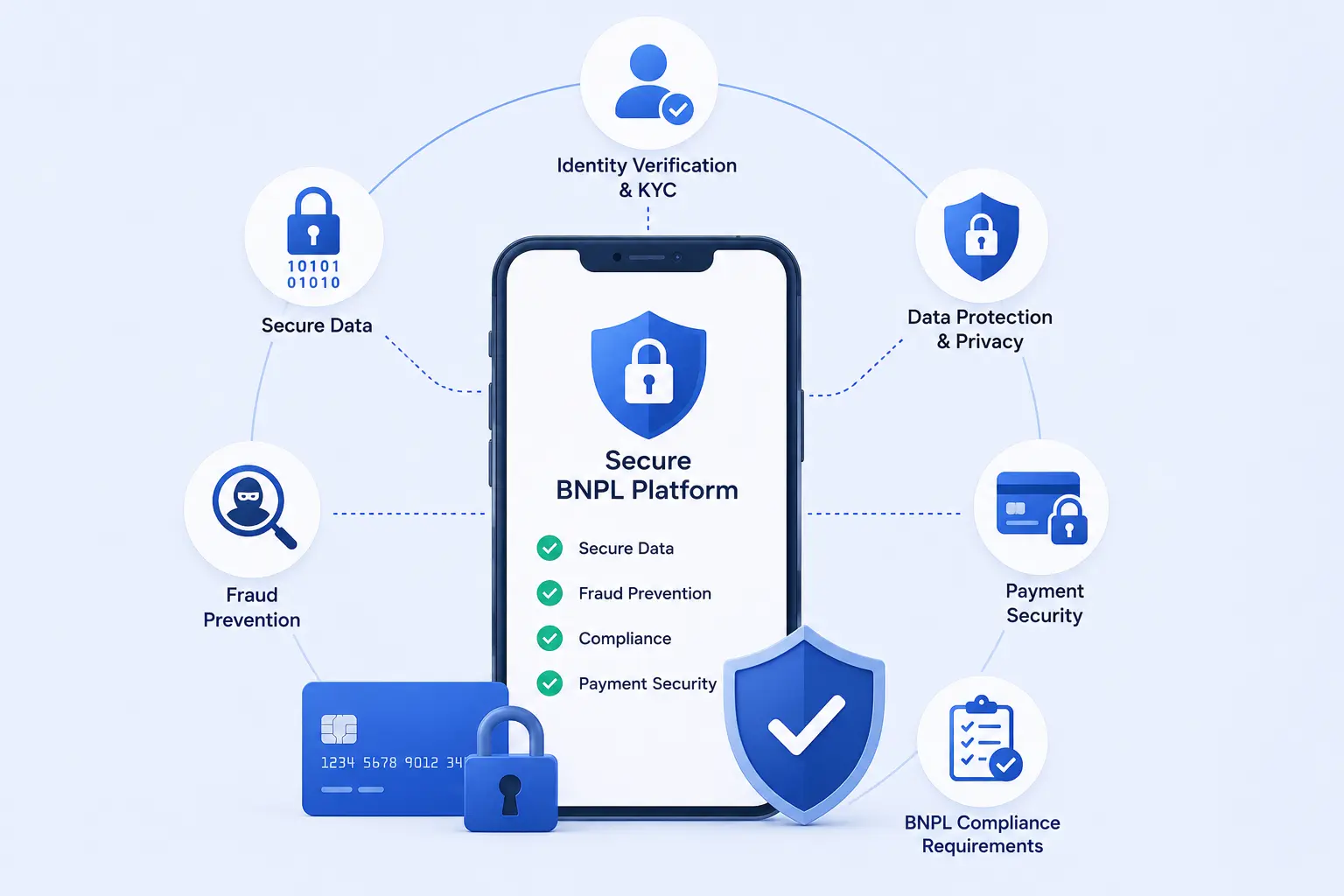
Security and compliance need to be considered from the beginning because BNPL applications can process identity information, payment details, transaction records, credit-related information, and other financial data. The exact requirements depend on the country, lending structure, payment model, and role of the business in the transaction.
Identity Verification and KYC
The onboarding process may include document verification, identity validation, address verification, biometric checks, age verification, or other controls depending on the target market and business model.
A BNPL platform should also have clear procedures for handling failed verification, suspicious applications, duplicate accounts, and changes to customer information.
The specific KYC and customer verification obligations should be established during product discovery with appropriate legal and compliance guidance.
Data Protection and Privacy
BNPL platforms need to protect personal and financial information throughout its lifecycle. Common technical controls include:
- Encryption in transit
- Encryption at rest
- Secure authentication
- Multi-factor authentication
- Tokenization
- Role-based access control
- API security
- Audit logging
- Secure secrets management
- Data retention controls
- Backup and disaster recovery
- Secure deletion procedures
Data minimization is also important. The application should collect and retain only the information needed for legitimate business and regulatory purposes.
For example, businesses operating in markets covered by the UK GDPR need to consider principles such as lawfulness, transparency, purpose limitation, data minimization, storage limitation, and security when processing personal information. The UK's Information Commissioner's Office also states that organizations should use appropriate technical and organizational measures to protect personal data.
Payment Security
If a BNPL platform stores, processes, or transmits payment card information, payment security requirements also need to be considered.
PCI DSS provides a global baseline of technical and operational requirements for protecting payment account data. The PCI Security Standards Council states that the standard applies to entities involved in storing, processing, or transmitting cardholder data, including merchants, processors, issuers, and service providers.
A practical approach is to minimize the amount of sensitive payment information handled directly by the application. Using established payment processors and tokenization can reduce the amount of card data that enters the BNPL platform's own environment.
Fraud Prevention
Fraud prevention should be built into the platform rather than added after the first version is released.
Common controls can include:
- Device analysis
- Transaction velocity rules
- Duplicate-account detection
- Suspicious behavior monitoring
- Identity verification
- Transaction risk scoring
- Account takeover detection
- Unusual payment pattern detection
- Multiple-account monitoring
The Consumer Financial Protection Bureau has reported significant BNPL usage in the United States. Its research found that approximately 21% of consumers with a credit record used a pay-in-four BNPL loan from one of six major providers in 2022, while about 63% of BNPL borrowers originated multiple simultaneous loans at some point during that year.
For a BNPL platform, this highlights why risk monitoring should look beyond individual transactions. The system may need to evaluate a customer's overall exposure, repayment behavior, and activity across multiple purchases.
BNPL Compliance Requirements
Compliance requirements vary significantly between markets, so there is no single checklist that applies to every BNPL application.
Depending on the target country and business model, a BNPL provider may need to consider areas such as:
- Consumer credit and lending requirements
- Licensing or authorization
- Customer disclosures
- Affordability or creditworthiness assessments
- Fair lending and non-discrimination requirements
- Credit reporting obligations
- Payment regulations
- Data protection and privacy
- Marketing and advertising rules
- Complaint handling
- Record keeping
- Transaction monitoring
- Anti-fraud and financial crime controls
- Electronic communications and consent
- Data retention and deletion
For example, in the United States, BNPL providers may need to assess requirements under federal and state consumer financial laws depending on how their product is structured. The Consumer Financial Protection Bureau has published specific BNPL compliance resources and has addressed how certain BNPL digital accounts can fall within existing credit rules.
In the UK and other markets, data protection and consumer-credit obligations can introduce additional requirements. The relevant framework should be determined based on where the product operates and which entity is providing the credit.
Technology Stack for BNPL App Development
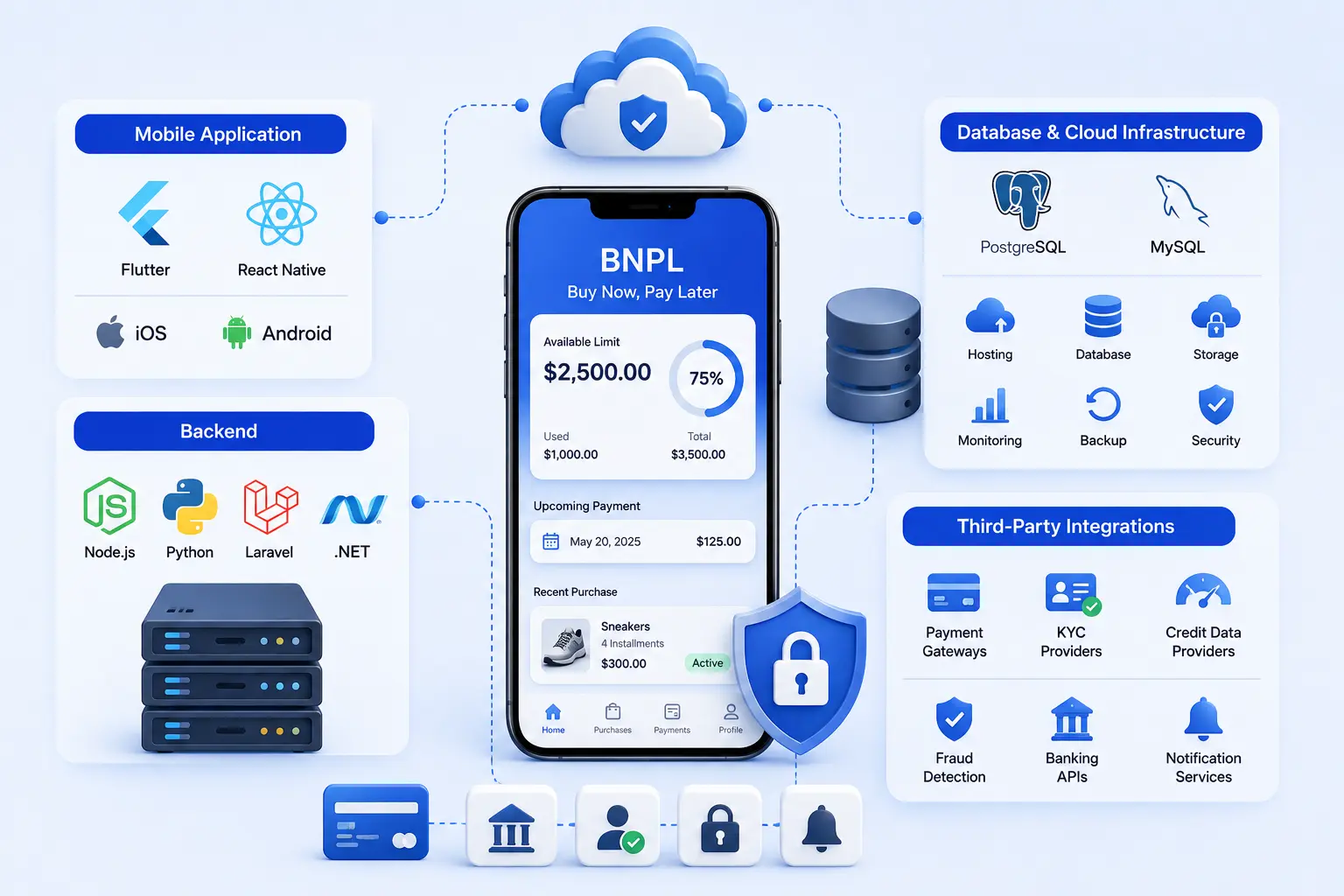
The technology stack needs to support secure transactions, reliable APIs, fast response times, and future growth.
Mobile Application
A BNPL application can be built using native iOS and Android technologies or cross-platform frameworks such as Flutter and React Native.
Cross-platform development can be useful for an MVP because a shared codebase can reduce duplicate development work. Native development can make sense when platform-specific capabilities or deeper device integration are priorities.
A broader mobile app development approach can cover cross-platform applications, custom software, cloud infrastructure, and ongoing application support.
Backend
Common backend technologies include:
The backend should manage users, authentication, transactions, repayment schedules, credit rules, merchant accounts, notifications, reports, and external integrations.
Database and Cloud Infrastructure
A relational database such as PostgreSQL or MySQL can handle structured financial records.
Cloud infrastructure can provide:
- Application hosting
- Database services
- Secure storage
- Monitoring
- Backups
- Scaling
- Disaster recovery
The architecture should also separate sensitive services and apply appropriate access controls.
Third-Party Integrations
BNPL platforms commonly require connections with:
- Payment gateways
- KYC providers
- Credit data providers
- Fraud detection systems
- Banking APIs
- Notification services
- Merchant platforms
These integrations can significantly affect both development cost and maintenance requirements.
Worldpay reported that digital payment spending across eCommerce and in-person shopping increased from $1.7 trillion in 2014 to $18.7 trillion in 2024, and projected total digital payment value to exceed $33.5 trillion by 2030. Its research identifies BNPL alongside digital wallets and real-time account-to-account payments as part of the broader transformation in payment methods.
BNPL App Development Process
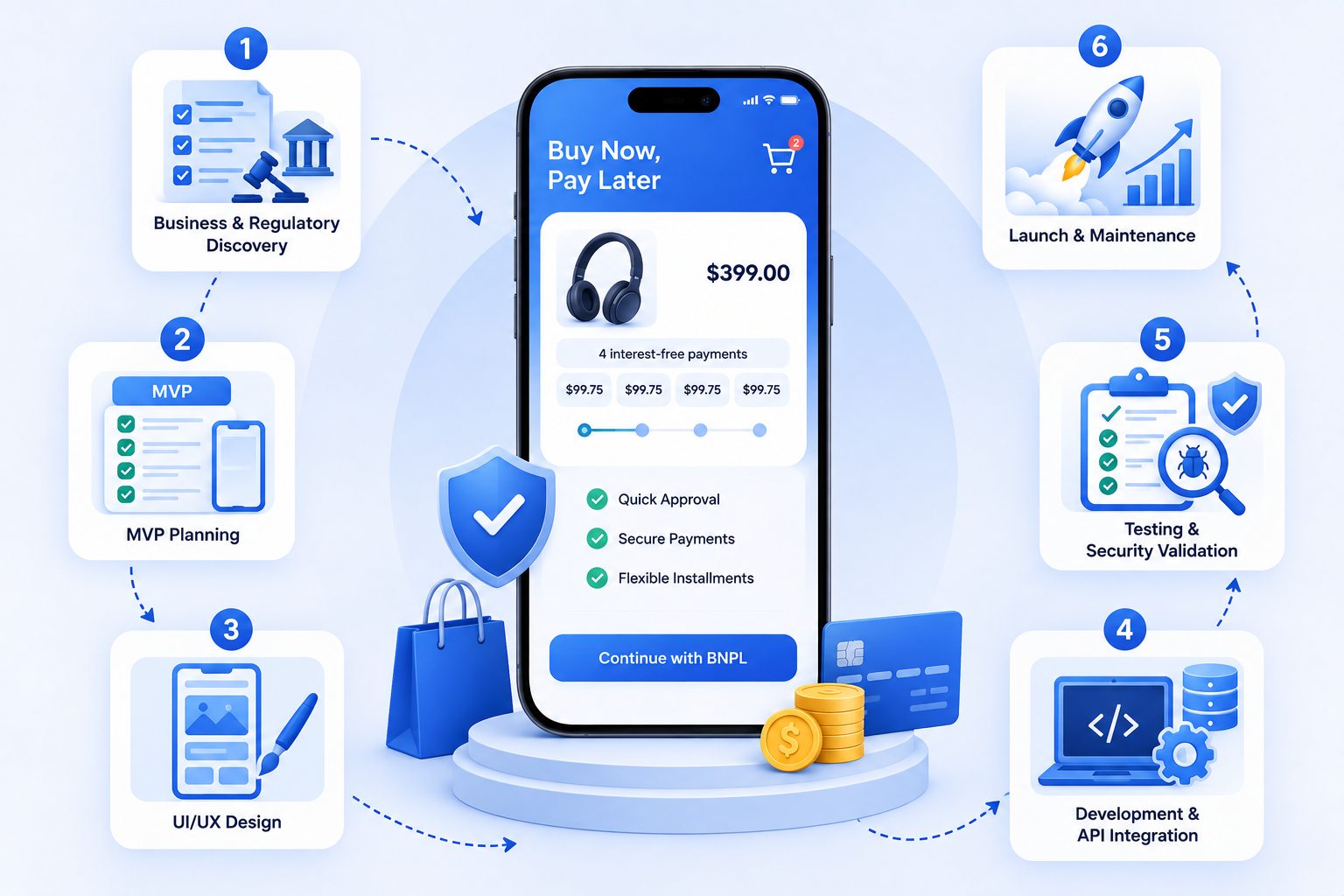
A reliable development process begins with business decisions before the team starts building screens.
1. Business and Regulatory Discovery
Start by defining:
- Target customers
- Geographic market
- Merchant model
- Lending structure
- Payment flow
- Revenue model
- Compliance requirements
One of the most important decisions is identifying who actually provides the credit and how the transaction moves between the customer, merchant, payment provider, and lender.
2. MVP Planning
The first version should prove the core business model.
A practical BNPL MVP can include:
- Registration
- Identity verification
- Eligibility assessment
- Credit limit
- Merchant checkout
- BNPL purchase
- Installment schedule
- Payment processing
- Notifications
- Transaction history
- Basic fraud controls
- Merchant dashboard
- Admin dashboard
Advanced analytics, loyalty programs, AI recommendations, and multi-country support can be added later.
3. UI/UX Design
Financial applications need particularly clear interfaces.
The customer should immediately understand:
- Purchase price
- Amount due today
- Installment amount
- Number of payments
- Payment dates
- Total repayment
- Applicable fees
The checkout should not hide important financial information behind multiple screens.
4. Development and API Integration
The development team builds the mobile or web application, backend, databases, APIs, payment connections, KYC integration, risk logic, notification system, merchant tools, and admin panel.
Merchant checkout deserves particular attention because poor integration can create friction even when the consumer application works well.
5. Testing and Security Validation
Testing should cover both normal and unusual situations.
Important test scenarios include:
- Successful registration
- Failed KYC
- Approval
- Rejection
- Payment failure
- Duplicate transactions
- Refunds
- Cancellations
- Missed repayments
- Fraud scenarios
- API failures
- High transaction volumes
- Security vulnerabilities
Security testing should include vulnerability assessment and penetration testing before production deployment.
6. Launch and Maintenance
After launch, the platform still requires regular maintenance.
This can include:
- Security updates
- API changes
- Bug fixes
- Performance monitoring
- Payment provider updates
- Operating system compatibility
- Regulatory changes
- New payment methods
- Fraud-rule updates
A digital lending case study involving automated loan processing and real-time reporting demonstrates the type of backend and operational infrastructure required when lending workflows move online.
How Much Does BNPL App Development Cost?
BNPL app development costs vary widely because a basic installment-payment MVP and a multi-country financial platform are very different products.
For initial planning, these ranges are reasonable:
| BNPL Product Type | Estimated Development Cost |
| Basic BNPL MVP | $3000 - $6000 |
| Mid-level BNPL application | $4000 - $10,000 |
| Advanced BNPL platform | $10,000 - $15,000 |
| Enterprise BNPL ecosystem | $15,000 - $25,000+ |
These are planning estimates rather than fixed development quotes.
A broader financial product may also require features found in personal finance app development, particularly when the product expands into spending analysis, financial dashboards, account information, or broader money-management tools.
How Long Does It Take to Build a BNPL App?
A focused BNPL MVP can take approximately four to seven months from discovery through launch.
A typical schedule may look like this:
| Development Stage | Estimated Time |
| Discovery and planning | 2-3 weeks |
| UI/UX design | 3-5 weeks |
| Core development | 8-14 weeks |
| Third-party integrations | 3-6 weeks |
| Testing and security | 3-5 weeks |
| Deployment | 1-2 weeks |
These stages can overlap.
A larger platform with multiple payment providers, merchant integrations, advanced risk models, several geographic markets, or extensive compliance requirements can take longer.
Third-party approval processes can also affect the schedule. The application code may be ready while a payment, KYC, banking, or credit-data provider is still completing its own review.
Ready to Estimate Your BNPL App Development Cost?
Get a development estimate based on your required features, platforms, payment and KYC integrations, security requirements, and target market.
Share your requirements to get a clearer view of the development scope, estimated cost, and resources needed for your BNPL platform.
Common Mistakes to Avoid in BNPL App Development
Building the Payment Flow Before Defining the Lending Model
The payment and application architecture depend on who provides the credit and how money moves through the system.
Define that structure first.
Treating Fraud Prevention as an Optional Feature
Fraud controls should be part of the architecture from the beginning, even if the first version uses relatively simple rules.
Making Repayment Information Difficult to Understand
Customers should know exactly what they owe and when they owe it.
Adding Too Many Features to the MVP
A large feature list can delay launch without proving whether customers actually want the product.
Start with the complete purchase-to-repayment journey.
Ignoring Merchant Requirements
A BNPL platform needs a strong merchant experience covering checkout, settlement, refunds, reporting, and reconciliation.
Underestimating Third-Party Dependencies
Payment gateways, KYC providers, credit data services, fraud tools, and notification systems can all affect development time and operating costs.
BNPL App Business Models
The revenue model should be decided alongside the technical architecture.
Merchant Fees
Merchants can pay a fee for offering BNPL at checkout. This model can work when installment payments are expected to improve conversion or average order value.
Consumer Fees
Depending on the product structure and applicable regulations, certain consumer fees may form part of the revenue model.
The exact structure needs to be designed for the target market.
Premium Accounts
Some products can offer optional premium features, such as additional account tools, financial insights, or other benefits.
Merchant Partnerships
Partnerships with retailers and eCommerce businesses can provide another route to customer acquisition and transaction volume.
The business model affects payment flows, reporting, merchant agreements, and customer communication, so it should not be treated as a separate decision made after development.
What Should You Include in a BNPL MVP?
A BNPL MVP should focus on one complete and reliable transaction journey.
The core feature set can include:
- Customer registration
- Identity verification
- Eligibility assessment
- Credit limit management
- Merchant checkout
- BNPL purchase processing
- Installment schedules
- Payment processing
- Repayment reminders
- Transaction history
- Basic fraud controls
- Merchant dashboard
- Admin dashboard
- Reporting
Advanced features such as predictive analytics, sophisticated AI models, loyalty programs, multi-country support, and highly customized merchant integrations can be added after the core product has been validated.
The most important question is simple: can a verified customer make an eligible purchase, understand the repayment terms, complete the installments, and receive accurate account information throughout the process?
If the answer is yes, the MVP is doing its primary job.
Final Takeaway
BNPL app development brings together mobile technology, payments, lending, risk management, merchant integrations, security, and compliance. The customer-facing application may look simple, but the infrastructure behind eligibility decisions, transaction processing, repayments, refunds, fraud monitoring, and reporting determines how well the product works at scale.
The most practical approach for many businesses is to start with a focused MVP covering onboarding, eligibility, checkout, installment management, payments, notifications, merchant operations, and administration. Advanced risk models, analytics, AI-powered support, additional payment methods, and broader merchant coverage can then be introduced as the product grows.
Nyusoft can help businesses plan and develop BNPL applications with the appropriate fintech architecture, integrations, mobile experience, security considerations, and development roadmap for their target market.
FAQs
1. How much does it cost to develop a BNPL app?
BNPL app development can cost around $3,000 to $25,000+, depending on the product type. A basic BNPL MVP may cost 3,000-6,000, while a mid-level application can cost 4,000-10,000. Advanced platforms may cost 10,000-15,000, and enterprise BNPL ecosystems can reach $25,000 or more.
2. How long does it take to develop a BNPL app?
A BNPL MVP can generally take around 2 to 7 months to develop. The timeline depends on the number of platforms, UI/UX requirements, payment and KYC integrations, credit decisioning, security testing, and other third-party services.
3. What features should a BNPL app have?
Essential BNPL app features include customer registration, identity verification, eligibility assessment, credit limit management, BNPL checkout, installment schedules, payment processing, notifications, transaction history, fraud controls, merchant management, and an admin dashboard.
4. How does a BNPL app work?
A BNPL app allows a customer to select an installment payment option during checkout. The platform checks eligibility, approves or declines the transaction, processes the purchase, creates a repayment schedule, and tracks installments until the balance is paid.
5. Can a BNPL app integrate with payment gateways?
Yes. BNPL applications can integrate with payment gateways, banking APIs, digital wallets, cards, and other payment infrastructure. The required integrations depend on the target market, payment methods, lending structure, and business model.
6. Is KYC required for a BNPL app?
KYC requirements depend on the country, financial structure, and role of the BNPL provider. Where identity verification is required, the application can integrate with third-party KYC providers to verify customer information before approving transactions.
7. What technology is used to develop a BNPL app?
BNPL applications can use technologies such as Flutter or React Native for mobile development and Node.js, Python, Laravel, or .NET for backend development. PostgreSQL or MySQL can be used for structured financial data, while cloud platforms can provide hosting, storage, monitoring, and scalability.
8. How can a BNPL app prevent fraud?
A BNPL app can use identity verification, transaction monitoring, device analysis, velocity checks, duplicate-account detection, risk scoring, and suspicious-activity monitoring. More advanced platforms can also use machine learning models to identify unusual transaction patterns.
9. Can a BNPL app support multiple merchants?
Yes. A BNPL platform can support multiple merchants through APIs, SDKs, plugins, hosted checkout solutions, or custom integrations. Merchant dashboards can provide access to transactions, settlements, refunds, reporting, and reconciliation.
10. Can I build a BNPL app for multiple countries?
Yes, but a multi-country BNPL platform requires additional planning. Each market may have different lending regulations, KYC requirements, payment methods, currencies, consumer-protection rules, and data regulations. These requirements can increase both development time and ongoing maintenance costs.
Ready to Build Your BNPL Platform?
Whether you are starting with an MVP or planning a larger BNPL ecosystem, the first step is defining the right product scope, technology architecture, integrations, security requirements, and development roadmap.
We help you plan and develop a BNPL application around your business requirements and target market.