


 Front End Development
  Back End Development
  CMS / ECommerce Development
  Mobile Apps Development
  Cloud Services
  Fullstack Services
  Solution


Hiring Fintech Developers? Questions You Should Ask First
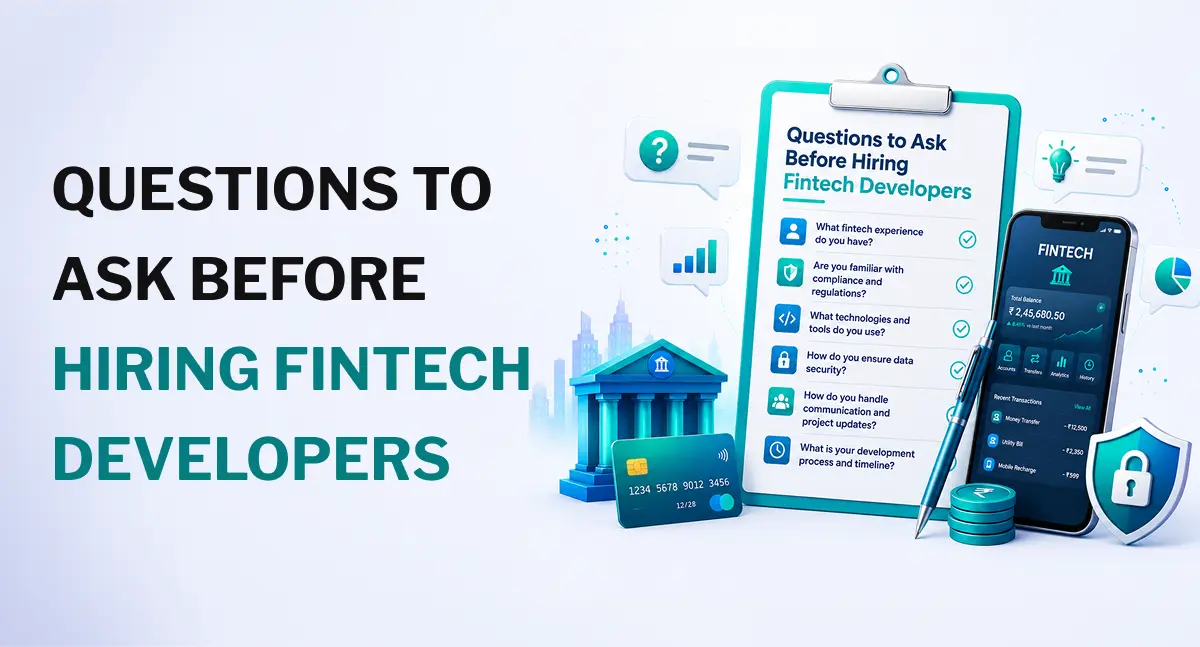
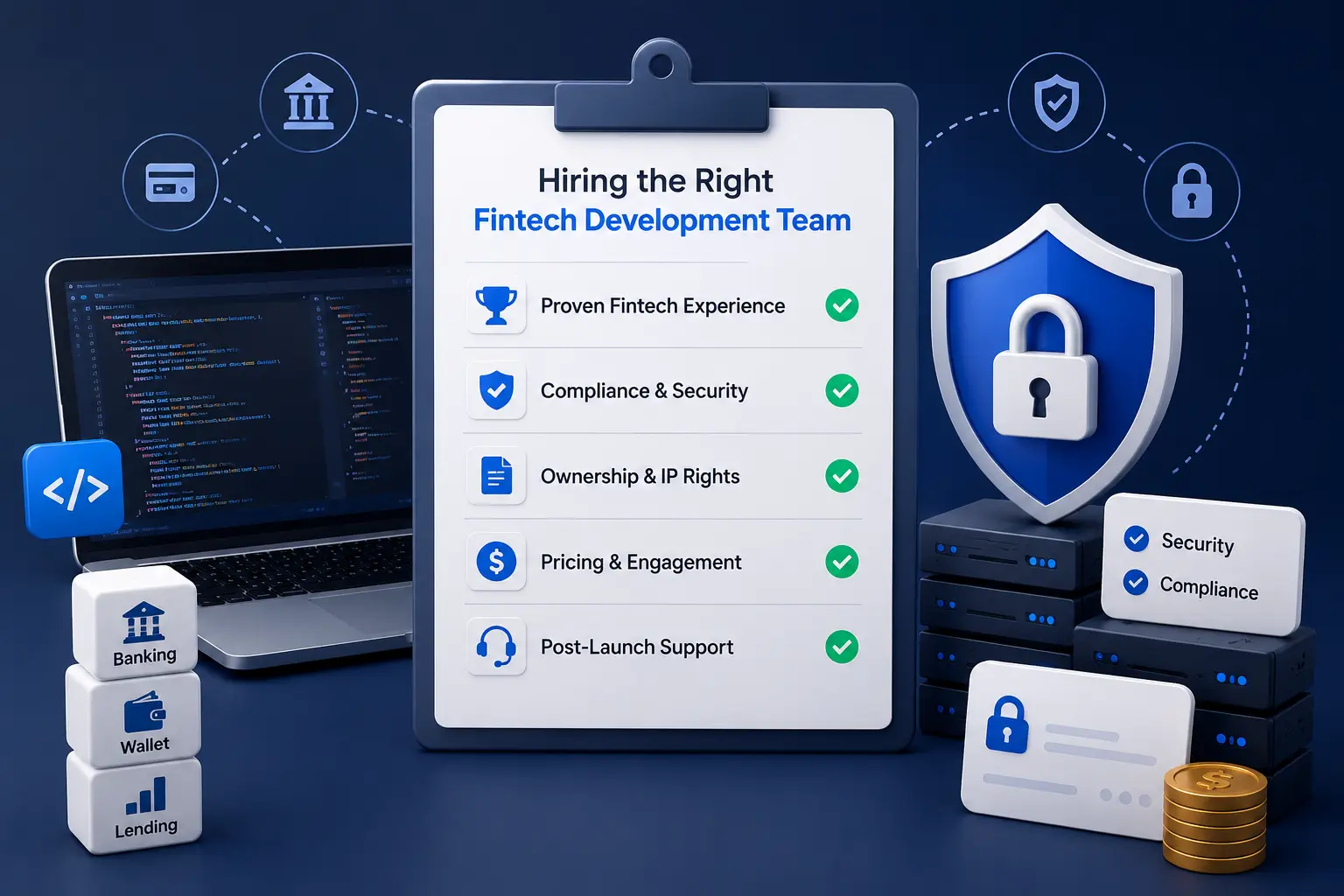
Hiring the wrong development team for a fintech product doesn't just cost you time. It can cost you a banking partnership, a regulatory audit, or your users' trust in a single data breach. Before you sign anything, you need clear answers on five things: their track record with regulated financial products, how they handle compliance and security, what you'll actually own at the end, how they price and structure engagements, and what support looks like after launch.
This isn't a list to memorize and recite in an interview. It's a working checklist. Go through it with every developer, agency, or freelancer you're evaluating, and pay close attention to how confidently they answer, not just what they say.
Fintech hiring mistakes are expensive in a way regular software hiring mistakes aren't. A buggy KYC flow can get your app pulled from app stores or flagged by a banking partner. That gap in stakes is why this list looks different from a generic "how to hire developers" guide.
Whether you're building a lending tool, a wallet, or a full-scale fintech app, the questions below apply the same way. The category changes the specifics. The underlying risk of hiring the wrong team doesn't.
Why Hiring for Fintech Is Different From Hiring for a Regular App
A general-purpose app developer can be excellent at their craft and still be the wrong fit for a fintech product.
Fintech development touches things most software categories don't: real money movement, personally identifiable financial data, KYC and AML checks, and regulatory frameworks that vary by state and country. A developer who's never worked in this space doesn't know what they don't know, and that gap tends to show up after launch, not during the demo.
This is why the questions below go deeper than "can you build this." They're built to surface whether the person or team in front of you actually understands the weight of what they're building.
If you're still deciding between building something fully custom or licensing an existing platform before you even get to the hiring stage, it's worth reading through our comparison of a custom fintech app versus a white label solution first. It changes what kind of team you actually need to hire.
Build Your Fintech Product with the Right Development Team
Hiring fintech developers is about more than technical skills. The right team should understand financial regulations, security, compliance, and scalable architecture from day one. Talk to our fintech specialists to discuss your project requirements and avoid costly development mistakes.
Schedule a Free Consultation
What Is a Fintech Developer?
A fintech developer is a software professional who builds financial technology applications such as digital wallets, payment platforms, lending systems, investment apps, and online banking solutions. Unlike general software developers, fintech developers must understand financial regulations, data security, compliance standards, and payment integrations to build secure and reliable financial products.
Questions About Technical Expertise and Domain Experience
Start here, because this is where most bad hires reveal themselves fastest.

Have they actually built regulated financial products before?
Ask for specifics. Not "we've done fintech projects," but which ones, what the product did, and what regulatory framework it operated under.
- Ask what category of fintech product they've built: lending, wallets, trading, budgeting, or something else
- Ask what compliance standards that product had to meet, and how they approached them
- Ask what went wrong on a past project and how they handled it
A team that can't name a specific compliance requirement they've worked with before is telling you something important, even if they don't say it directly.
Which specific technologies and integrations do they actually know?
Fintech apps lean on a fairly specific stack: secure backend frameworks, encrypted data storage, third-party KYC and payment APIs, and often real-time transaction processing.
Ask which languages and frameworks they use for fintech builds specifically, not just their general stack. A team confident in backend work with something like Node.js, for example, should be able to explain how they'd structure a transaction ledger, not just that they've "used it before." If mobile is part of your product, ask the same question about their mobile development approach.
Ask directly what payment gateways, KYC providers, and banking APIs they've integrated in past projects. Real answers include named vendors. Vague answers include phrases like "various providers."
Questions About Compliance and Regulatory Knowledge
This is the section most hiring checklists skip, and it's the one most likely to bite you later if you skip it too.
Financial software carries obligations that don't apply to most other app categories. KYC (Know Your Customer) and AML (Anti-Money Laundering) requirements, PCI DSS for anything touching card data, GLBA and state-level money transmitter rules in the US, PSD2 and open banking rules in the UK and EU.
Ask these directly:
- How do you approach KYC and AML implementation, and who owns that logic once the app is live?
- What's your experience with PCI DSS requirements if the app handles card data?
- How do you handle data residency requirements when users are in different states or countries?
- Who is responsible if a compliance gap is found after launch, you or us?
A team with real fintech experience will have specific, confident answers here. A team without it will either go quiet or start talking in generalities about "best practices" without naming an actual standard.
Our guide on how to develop a fintech app walks through the full compliance and development process in more depth, and it's a useful benchmark to compare against whatever answer you get in an interview.
Need Fintech Developers with Compliance Expertise?
From KYC and AML implementation to PCI DSS, PSD2, and secure payment integrations, our experienced fintech developers build solutions designed around security, compliance, and long-term business growth. Let's discuss your project and compliance requirements.
Talk to a Fintech Expert
Questions About Security Practices

Security in fintech isn't a feature you add later. It has to be built into the architecture from day one, which means the developer's security habits matter as much as their coding skill.
Ask how they handle:
- Encryption for data at rest and in transit
- Tokenization of sensitive fields like account numbers and identity documents
- Access control and role-based permissions across the team
- Penetration testing, and how often it happens during development, not just before launch
- Incident response, meaning what happens if a vulnerability is found after the app is live
A team that treats security as an ongoing practice, with testing built into every release cycle rather than a one-time checklist, is usually the safer bet. This is closely tied to how a team runs its development pipeline generally. Ask whether security scanning is part of their DevOps and deployment process, or something bolted on separately at the end.
Don't accept "we take security seriously" as an answer on its own. Ask for the specific tools and processes behind that statement.
Questions About Portfolio and Proof of Work
Anyone can put logos on a website. Proof of work is different, and it's worth being firm about seeing it.
What have they actually shipped in this space?
Ask to see live products, not just mockups or case study slides. If a team says they've built lending platforms, ask to see one that's actually in production, with real users, not a prototype that never launched.
Ask what specific role they played on each project. Did they build the whole product, or handle one piece of a larger team's work? Both are fine, but you need to know which one you're getting.
Do they have experience in your specific category?
Fintech isn't one thing. A team strong in payment apps isn't automatically strong in lending compliance, and a team that's built budgeting tools isn't automatically ready to handle a trading platform's real-time data requirements.
If your product is a lending or micro-finance tool, ask specifically about their experience with something like an instant loan and micro-finance platform, since underwriting logic and KYC depth look very different from a standard wallet app.
If you're building something closer to a digital wallet or payment product, ask the same question but pointed at digital payment and wallet platform work specifically.
And if your product involves investment or advisory features, ask about their experience with something like an AI-powered portfolio management system, because that category leans heavily on data modeling most general developers haven't touched.
Ask to speak with a past client directly if possible. A confident team will offer this without hesitation. Our own case studies page is the kind of thing worth asking any vendor for, a place where you can see real project outcomes rather than marketing language.
Questions About Engagement Model and Pricing
This section decides how the working relationship actually functions day to day, and it's where a lot of budget surprises come from later.

What engagement model do they offer?
Most fintech development happens under one of three models:
- Dedicated team, where developers work exclusively on your project under your direction
- Staff augmentation, where you add specific skill sets to your existing in-house team
- Fixed-price project, where scope is defined upfront and priced as a whole
Ask which model fits a fintech build best, in their experience, and why. A team that pushes one model regardless of your situation is optimizing for their convenience, not your project.
What's actually included in the price?
Ask directly what's covered and what isn't. Does the quoted price include compliance review, security testing, and post-launch bug fixes, or are those billed separately later?
Ask how change requests are priced once development starts. Fintech projects shift as compliance requirements get clarified mid-build, and you want to know the cost of that flexibility before you need it, not after.
If your project involves systems beyond just the core fintech app, internal admin panels, reporting dashboards, integrations with existing business software, it's worth asking whether the team's custom software development capabilities extend that far, or whether you'll need a second vendor for that piece.
Get a Specific Estimate for Your Fintech Project
Every fintech application has unique technical, security, and compliance requirements. Share your project goals with our team, and we'll provide a customized development roadmap, transparent pricing estimate, and recommended engagement model.
Request a Free Estimation
What Fintech Developers Typically Cost
Pricing varies widely, and it's worth going into hiring with realistic expectations rather than anchoring on the first number you hear.
- Freelance or individual developers typically run $25 to $60 an hour, depending on region and experience. This can work for small, well-defined pieces of work, but it's a risky fit for a full compliance-heavy build, since accountability tends to be thin.
- Small agencies and dedicated teams typically run $30 to $80 an hour, often billed as a monthly retainer for a dedicated team rather than pure hourly work. This is the most common model for a full fintech MVP or platform build.
- Established fintech-focused firms often charge more, sometimes $80 to $150 an hour, but bring compliance and security experience that reduces the odds of a costly rebuild later.
None of these numbers mean much without context. A cheaper hourly rate paired with a longer, less efficient build can cost more in total than a higher rate from a team that gets it right the first time. Ask any vendor for a full project estimate, not just an hourly number, so you're comparing total cost rather than a number that looks good in isolation.
Also ask how they price ongoing maintenance after launch. A common structure is 15% to 20% of the original build cost per year, covering security patching, dependency updates, and minor fixes. If a team can't give you a rough maintenance figure upfront, that's usually a sign they haven't planned that far ahead either.
Common Mistakes Businesses Make When Hiring Fintech Developers
A few patterns show up again and again in fintech hiring, and most of them are avoidable.
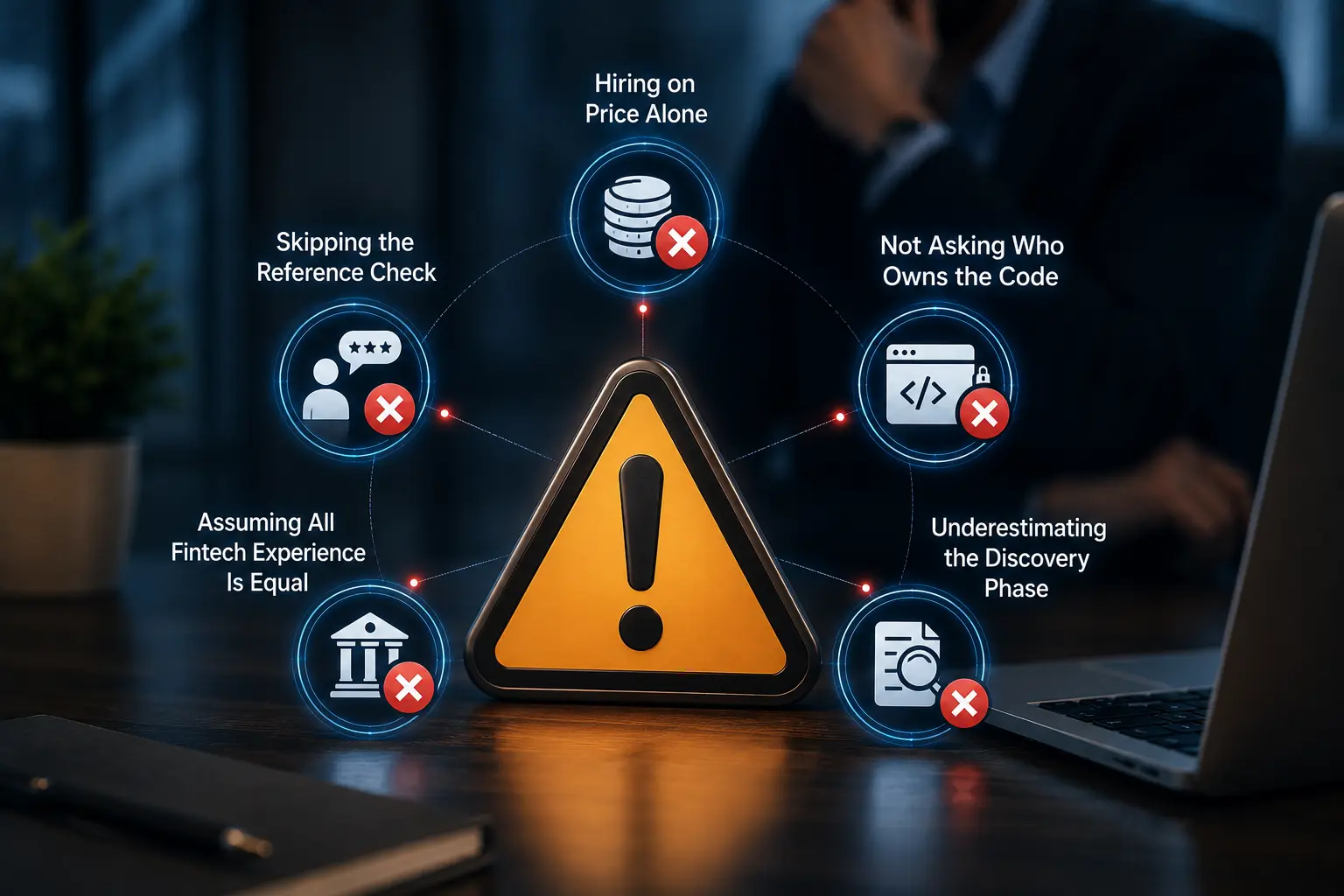
Hiring on price alone. The cheapest quote rarely accounts for compliance review, security testing, or post-launch support, which means the real cost shows up later, after you've already committed.
Skipping the reference check. A polished portfolio page is easy to put together. A quick call with a past client, asking specifically about communication and how issues were handled, tends to reveal far more.
Not asking who owns the code. Some agencies build on proprietary frameworks or retain partial rights to reusable components. Get ownership terms confirmed in writing before development starts, not after.
Assuming all "fintech experience" is equal. A team that's built a budgeting app isn't automatically ready to handle a lending platform's underwriting and KYC depth. Ask about experience in your specific category, not just the broader fintech label.
Underestimating the discovery phase. Teams that jump straight into development without a real discovery and compliance-scoping phase tend to produce apps that need significant rework once real regulatory requirements surface.
Questions About AI and Fraud Detection Capabilities
AI is doing real work in fintech now, not just appearing in pitch decks. Fraud detection, credit risk scoring, and transaction anomaly detection all increasingly rely on models trained on transaction data, not static rule sets.
Ask whether the team has actually built fraud detection or risk-scoring models before, or whether they're proposing to use a third-party tool without much customization. Both are legitimate approaches, but you need to know which one you're getting, since off-the-shelf fraud tools tend to miss patterns specific to your user base.
If AI-driven fraud detection or underwriting logic is part of your roadmap, ask specifically about their generative AI development experience and how they've applied it to financial risk problems before, not just chatbots or content generation.
Questions About Design and User Experience
Fintech design carries more weight than it does in most other app categories. Trust gets built or lost in the first few screens, especially during onboarding and identity verification.
Ask how the team approaches onboarding flows specifically. A confusing verification step causes real drop-off, and a team with fintech experience should be able to talk through how they balance thorough KYC checks against a smooth signup experience, without treating the two as opposites.
Ask to see examples of onboarding or verification flows they've designed before. If UI/UX design is handled by a separate team or subcontractor, ask how design and development stay coordinated throughout the build, since disconnected design and dev teams are a common source of delays.
Questions About Build Approach: Custom vs Existing Frameworks
Some development teams default to heavily templated builds because it's faster and cheaper for them to deliver, even when it's not the right fit for your product.
Ask directly whether they're proposing a fully custom build, or one built substantially on top of existing frameworks, white label components, or third-party platforms. Neither answer is automatically wrong, but you need to know which one you're getting and why they're recommending it for your specific case.
Ask what you'll actually own once the project is done. Source code, database structure, and any proprietary logic should belong to you, not remain licensed through a platform the developer controls. Get this in writing before you sign anything, not after the project starts.
Questions About Communication, Process, and Timeline
How a team communicates during development tells you a lot about how they'll handle problems later, when something inevitably needs to change.
Ask these directly:
- How often will we get updates, and in what format?
- Who is our actual point of contact if something goes wrong?
- What does your typical fintech project timeline look like, from discovery to launch?
- How do you handle scope changes once development is underway?
A team with real fintech experience should be able to walk you through a realistic timeline without hand-waving. Builds that touch real transactions typically run longer than data-only apps, and a team that quotes the same timeline for both isn't being straight with you.
Questions About Post-Launch Support and Maintenance
Launch isn't the finish line in fintech. Compliance requirements change, security patches need to go out fast, and dependency updates need consistent attention.
Ask what post-launch support actually includes. Is it bug fixes only, or does it cover ongoing compliance monitoring and security patching too? Ask what response time looks like if a critical security issue turns up after launch, since a slow response to a security flaw in a financial app carries real consequences.
Ask what happens if you want to add features six months after launch. Do you go back to the same team automatically, or does that require a new contract and a new onboarding process? Get clarity here early, it saves a lot of friction later.
Red Flags to Watch For When Hiring Fintech Developers
A few warning signs are worth taking seriously, even if everything else about a team looks strong on paper.
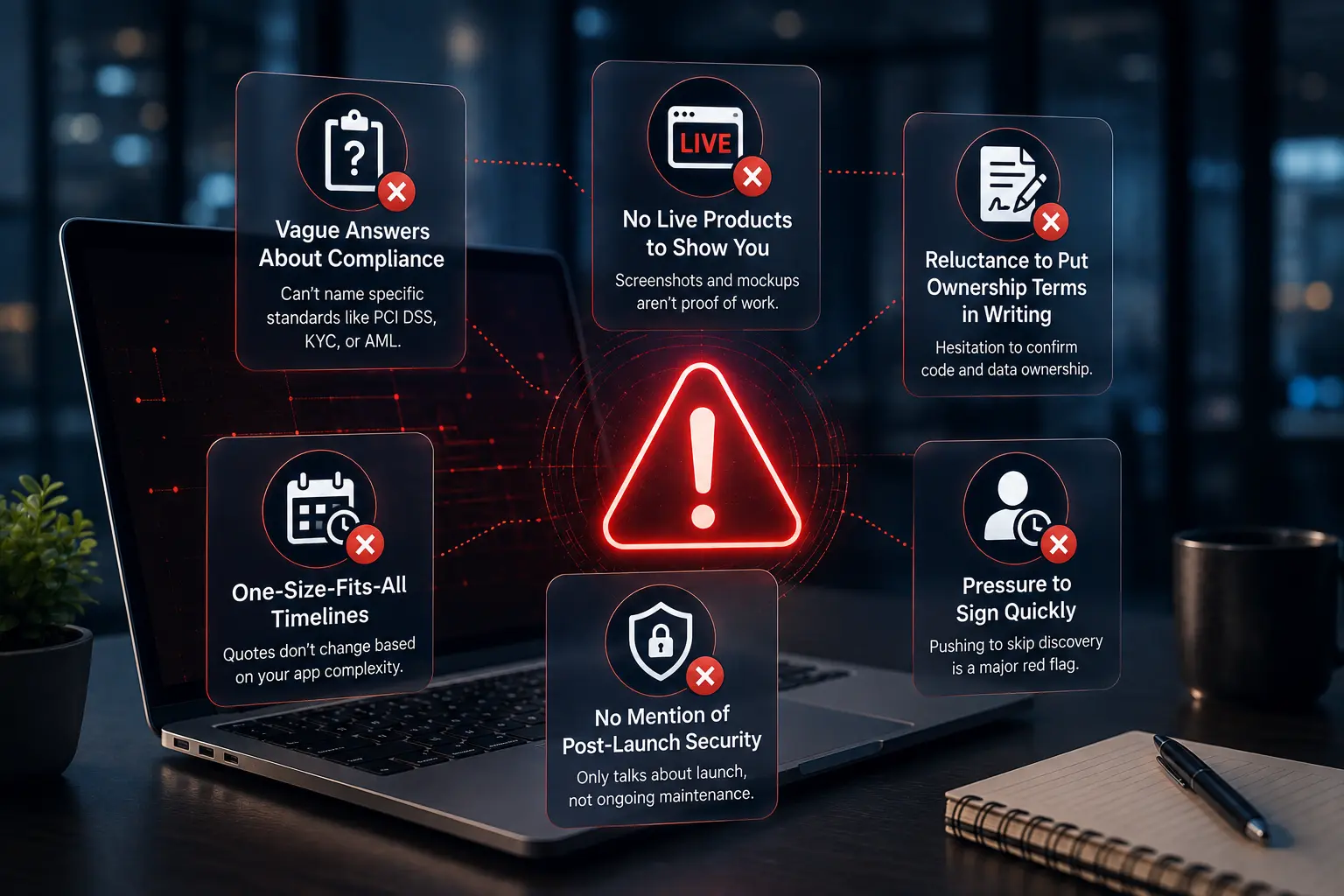
- Vague answers about compliance. If a team can't name specific standards like PCI DSS, KYC, or AML without prompting, that's a real gap, not a communication style.
- No live products to show you. Screenshots and mockups aren't proof of work. Ask for something real, in production, that you can actually use.
- Reluctance to put ownership terms in writing. If a team hesitates to confirm in writing that you'll own the code and data, that's worth pausing on.
- One-size-fits-all timelines. A quote that doesn't change based on whether your app is transactional or data-only suggests they haven't actually scoped your project.
- No mention of post-launch security. A team that only talks about launch and never brings up ongoing maintenance is planning to hand you a product and disappear.
- Pressure to sign quickly. Fintech builds require real discovery. A team pushing you to skip that step is optimizing for their sales cycle, not your product.
A Simple Framework for Running the Interview
Instead of asking every question above in one sitting, spread them across a short structured process:
- Discovery call. Cover their general fintech experience and the categories of products they've worked on.
- Technical deep dive. Bring in your most technical stakeholder to ask the security, compliance, and integration questions directly.
- Portfolio review. Get access to live products and, if possible, a reference call with a past client.
- Proposal review. Read the engagement model, pricing structure, and ownership terms line by line before agreeing to anything.
- Small paid trial, if possible. A short paid engagement on a defined piece of work tells you more about how a team actually operates than any interview can.
This process takes longer than picking the first team that sounds confident. That extra time is a lot cheaper than fixing a compliance gap or a security failure after your app is already live with real users on it.
The Bottom Line
Hiring fintech developers isn't just a technical decision. It's a decision about who's going to be accountable for your users' money and data, months and years after launch.
The teams worth hiring will answer these questions clearly, without dodging the harder ones about compliance, security, and ownership. The teams worth avoiding tend to give you confident answers about design and speed, and much vaguer answers about everything else on this list.
Take the time to ask these questions properly. It's the difference between a launch that holds up under a compliance audit and one that doesn't.
At Nyusoft, we've built fintech products across lending, digital wallets, portfolio management, and budgeting, and we're used to fielding exactly these questions from founders before they commit to a build. If you're in the process of evaluating a development partner, get in touch with our team and ask us the same list. We'd rather earn the project by answering directly than by sounding impressive.
FAQs
1. How do I choose the right fintech developers for my project?
Start by evaluating their experience with financial applications, security practices, regulatory knowledge, and previous fintech projects. Ask for real examples, discuss ownership of the source code, and ensure they understand compliance requirements relevant to your product.
2. What skills should fintech developers have?
Fintech developers should have expertise in secure software development, payment gateway integrations, API development, cloud infrastructure, encryption, and financial compliance standards. They should also understand technologies used in digital banking, lending, payments, or investment platforms.
3. Why is fintech development experience important?
Fintech applications handle sensitive financial data and must meet strict security and regulatory requirements. Developers with fintech experience are more likely to build secure, compliant, and scalable solutions while reducing project risks and costly mistakes.
4. What questions should I ask before hiring fintech developers?
Ask about their fintech portfolio, security practices, compliance knowledge, technology stack, payment integrations, pricing model, project ownership, post-launch support, and experience with projects similar to yours.
5. How much does it cost to hire fintech developers?
Hourly rates typically range from around $25 to $200 or more, based on the complexity of the work and the level of expertise required. Simple tasks like building basic UI components or internal tools sit at the lower end, while specialized fintech work involving payments, KYC/AML flows, or core banking integrations commands a premium because of the added compliance and security expertise involved. Systems that are regulated and high-stakes naturally cost more to build than straightforward features. Beyond the hourly rate itself, it's worth confirming what's actually included in that price, whether compliance review, QA, and post-launch support are bundled in or billed separately.
6. What should I look for when hiring a fintech development team?
Look for proven experience with financial compliance (KYC, AML, PCI DSS), a track record with secure architecture and data handling, familiarity with your specific banking rails or payment integrations, and an engagement model that fits your project size, whether that's a dedicated team for an ongoing product or a fixed-scope build for an MVP.
7. What security practices should fintech developers follow?
Experienced fintech developers should implement data encryption, regular security testing, and vulnerability management, all aligned with relevant compliance frameworks such as GDPR, PCI DSS, CCPA, BSA and GLBA, throughout the software development lifecycle.
8. What are the biggest mistakes businesses make when hiring fintech developers?
Common mistakes include choosing developers based only on price, overlooking compliance experience, failing to clarify code ownership, skipping client reference checks, and ignoring post-launch maintenance and security support.
9. How can I verify a fintech developer's experience?
Review their live fintech products, request relevant case studies, ask for client references, discuss the technologies and compliance standards they've worked with, and evaluate how confidently they explain their development process.
10. What should be included in a fintech development agreement?
A fintech development agreement should clearly define project scope, pricing, timelines, deliverables, intellectual property ownership, confidentiality, security responsibilities, post-launch support, maintenance terms, and change request procedures.
Ready to Hire the Right Fintech Development Team?
Choosing fintech developers is one of the most important decisions for your product's success. Whether you're building a digital wallet, lending platform, investment app, or payment solution, our experienced team is ready to help you build a secure, scalable, and compliant fintech application.
Book Your Free Discovery Call