


 Front End Development
  Back End Development
  CMS / ECommerce Development
  Mobile Apps Development
  Cloud Services
  Fullstack Services
  Solution


Custom Fintech App vs White Label Solution: Which Is Better?
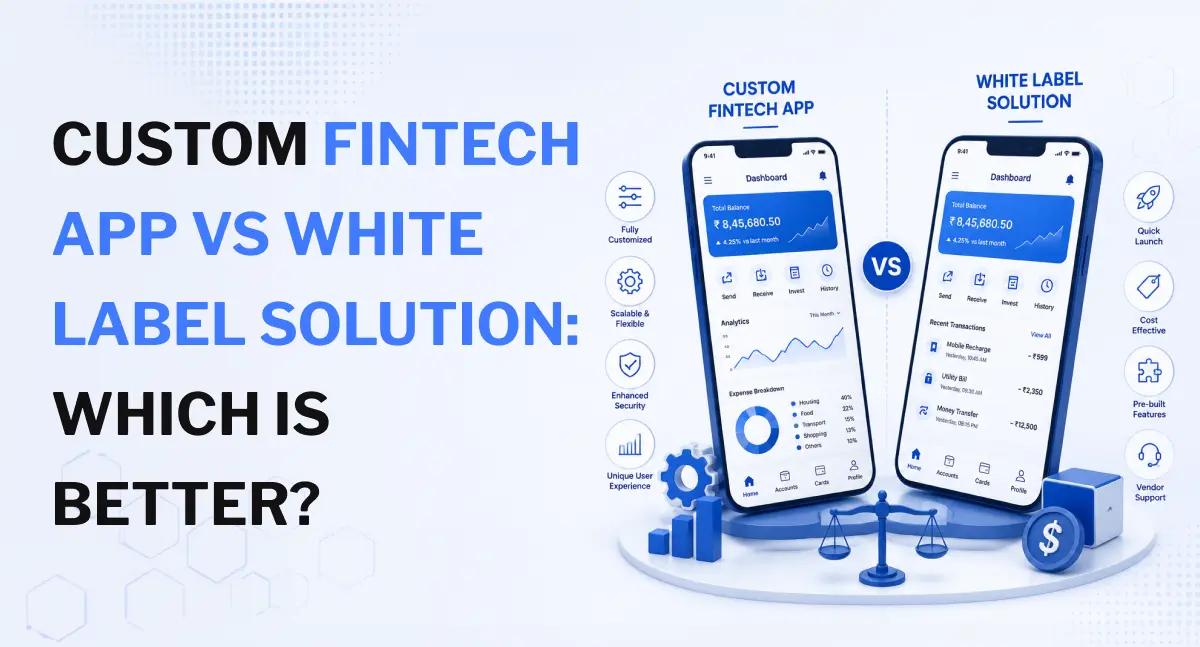
If you're trying to decide between building a custom fintech app and licensing a white label solution, here's the direct answer: neither one wins outright. A white label platform gets you live in weeks with a much smaller upfront check. A custom build costs more and takes longer, but you walk away owning the code, the data, and the compliance posture behind it.
The part most comparisons skip is the one that actually matters most in this category. In fintech, the platform you choose doesn't just decide how the app looks or how fast you launch. It decides who is legally answerable when a customer's money, or their financial data, is on the line. That's a different kind of decision than picking a website builder or a CRM.
This guide walks through the real cost math over three to five years, who actually carries compliance risk in a white label arrangement, what happens to your data, how each option holds up as you scale, and a practical framework for deciding which path fits your business right now. If you're earlier in the process and want the full build-out roadmap once you've picked a custom, our guide on how to develop a fintech app covers that separately. This piece stays focused on the decision itself.
What Is a White Label Fintech App?
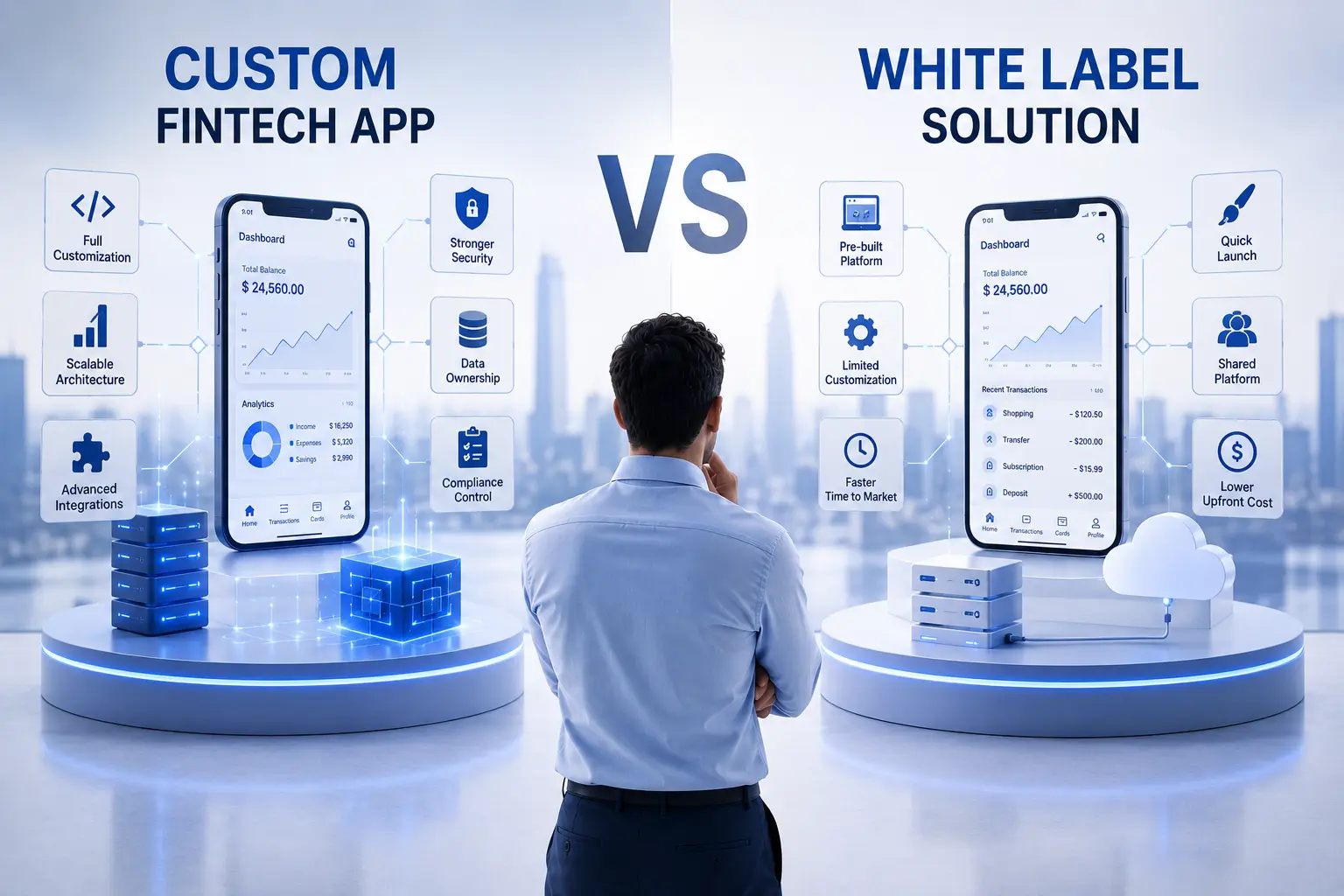
A white label fintech app is a pre-built financial software platform that you license and rebrand as your own.
You don't own the underlying code. You license the right to use it, apply your logo and colors, load in your own content, and launch it under your brand name. The vendor keeps building, maintaining, and hosting the actual product underneath.
There are two versions of this, and the difference matters more than most articles on this topic let on.
- UI-layer white label. The vendor has a finished consumer app. You're licensing the front end and some configuration options, on top of infrastructure the vendor already runs.
- BaaS-backed white label. Your app is built on top of a Banking-as-a-Service provider or a sponsor bank relationship. This means part of your compliance posture is inherited from that underlying banking partner, not just from the software vendor you signed a contract with.
That second category is where a lot of founders get surprised later. They think they've licensed software. What they've actually done is plug into a banking relationship they don't control and can't fully audit.
White label fintech shows up most often in a handful of categories: neobank shells, digital wallet templates, robo-advisory dashboards, lending origination tools, and budgeting apps. If you're specifically scoping a budgeting product, it's worth comparing the tradeoffs against what a purpose-built AI-powered budgeting platform can offer instead, since that category in particular tends to hit template limits fast.
Pricing is typically structured as a one-time setup fee plus a monthly or yearly subscription, sometimes with per-user or per-transaction charges layered on top as your volume grows. Since you're licensing the platform directly rather than paying for development time, this is billed on a recurring subscription basis, not an hourly one.
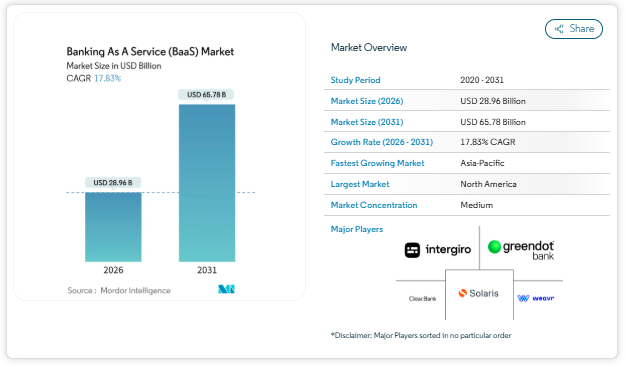
The Banking-as-a-Service market underneath a lot of these white label products is growing fast. Mordor Intelligence values the BaaS market at roughly $28.96 billion in 2026, projecting growth to $65.78 billion by 2031 at a compound annual growth rate near 17.83%. That growth is exactly why so many white label fintech options exist today, and why the underlying banking relationships behind them are getting more scrutiny from regulators, not less.
What Is a Custom Fintech App?
A custom fintech app is built from scratch, specifically around your business, your users, and your compliance scope.
There's no shared codebase and no template UX. No feature set inherited from someone else's idea of what your category of app should do.
A custom build can include everything a white label baseline offers, plus things a template simply can't support: proprietary risk-scoring models, KYC and AML flows tuned to the specific geographies you operate in, integrations with the exact banking rails or processors you've chosen, and AI-driven fraud detection trained on your own transaction data rather than a generic ruleset. Work like this typically sits within a broader generative AI development practice, where fraud models get built around a product's actual data instead of bolted on as an off-the-shelf feature.
Timeline runs roughly 2 to 9 months, depending on whether the app is data-only or actually moves money. That range holds steady whether you're building a tracker or a full transactional platform. The transactional side simply carries more weight in compliance, security review, and integration testing.
Ownership is the real difference here. The source code, the database, the intellectual property, and the compliance architecture all belong to you. Nobody else's roadmap, pricing changes, or acquisition decisions can pull the rug out from under your product.
Quick Comparison: Custom Fintech App vs White Label
Here's the high-level picture before we get into the details.
| Factor | White Label Fintech App | Custom Fintech App |
| Launch time | Days to a few weeks | 2 to 9 months |
| Upfront investment | Lower | Higher |
| Ongoing fees | Monthly or yearly subscription, often with per-user charges | Maintenance only, no licensing fee |
| Compliance liability | Often shared or inherited, frequently ambiguous | Defined and owned from day one |
| Feature flexibility | Limited to what the vendor supports | Built around your exact requirements |
| Data ownership | Controlled by vendor or its banking partner | Fully owned by your business |
| Third-party integrations | Limited to vendor's existing partners | Any integration you need |
| Scalability | Costs and features constrained by vendor roadmap | Scales with your architecture, on your timeline |
| Competitive differentiation | Shared with every other business on the platform | Unique to your product |
| Long-term value | Rental model | Owned digital asset |
White label may fit if you:
- Need to validate demand before committing real budget
- Have a limited launch timeline, measured in weeks
- Are building a fairly standard product category
- Have a small enough user base that per-user fees stay manageable
Custom may fit if you:
- Have a validated model and a growing user base
- Depend on proprietary underwriting, scoring, or workflow logic
- Face investor or banking partner expectations around direct compliance ownership
- Need full control over customer financial data
Need Help Choosing the Right Fintech Development Approach?
Every fintech business has different goals, compliance requirements, and growth plans. Talk to our fintech specialists to compare custom development and white label solutions based on your business model, budget, and long-term vision, so you can make a confident decision.
Schedule a Free Consultation
The Real Cost Comparison: Upfront vs. Total Cost of Ownership
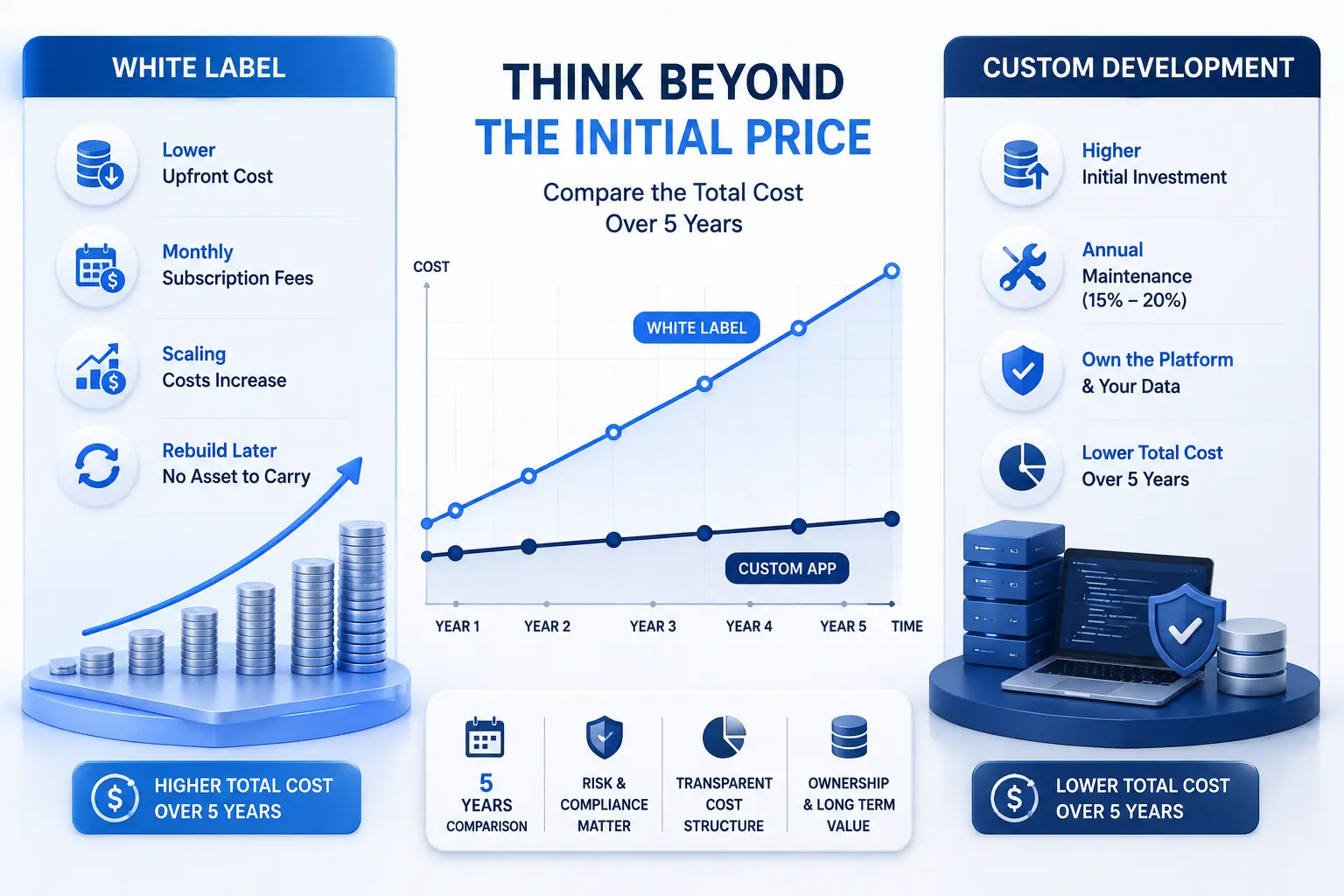
Most comparisons stop at the sticker price. That's the wrong place to stop, because the more useful number is what you'll actually spend over three to five years.
White Label Costs
Setup and onboarding fees typically run from a few hundred to a few thousand dollars, depending on the vendor and how much configuration your launch requires. On top of that sits a monthly or yearly subscription fee, plus per-user or per-transaction fees that climb as your customer base grows. Because this is a licensed platform rather than a staffed build, billing runs on that recurring monthly or yearly basis rather than hourly rates.
There are a few costs that don't show up on the pricing page. Tier upgrades to unlock features that were locked behind a higher plan. Payment processor pass-through fees. App store fees on in-app purchases, which run 15% to 30% depending on the platform. And the biggest one: if you outgrow the platform, you're not upgrading, you're rebuilding, because there's no asset to carry forward.
There's also a risk specific to fintech that doesn't apply to most other software categories. If the BaaS provider or sponsor bank behind your white label product changes its terms, gets hit with a regulatory enforcement action, or exits the space, you absorb that disruption with zero say in the matter. This isn't a hypothetical. Regulatory scrutiny of sponsor bank relationships has increased noticeably in recent years, with enforcement actions against several sponsor banks pushing fintech programs to scramble for new banking partners on short notice.
Custom App Costs
A focused MVP typically runs $4,000 to $10,000 or more. A mid-complexity build with deeper integrations lands somewhere between $10,000 and $15,000. A full platform with AI-driven risk scoring, multiple integrations, and a full compliance audit can reach $18,000 to $20,000 or beyond.
Annual maintenance, covering security patching, dependency updates, and regulatory changes, typically runs 15% to 20% of the original build cost. There's no licensing fee sitting on top of that. The app is yours, and the ongoing spend is upkeep, not rent.
For businesses weighing a fully custom transactional platform against something closer to a broader B2B offering, custom software development is the right conversation to have early, since it shapes how the architecture gets scoped from the start.
The Five-Year Math
Run the numbers side by side and the gap becomes obvious fast.
A white label subscription at roughly $1,000 a month, before per-user fees start climbing, adds up to about $60,000 over five years. At the end of that stretch, you own nothing. You're still dependent on the vendor's roadmap and pricing decisions.
A custom build with an upfront cost around $8,000 to $10,000, plus 15% to 20% annual maintenance, lands closer to $15,000 to $20,000 total over the same five years. And at the end of it, you're holding a digital asset your business actually owns.
These figures are directional. Your actual numbers depend on transaction volume, licensing scope, and how many integrations your product needs. A tailored estimate from a team that's scoped fintech projects before will get you a real number faster than any general comparison can.
These figures are directional. Your actual numbers depend on transaction volume, licensing scope, and how many integrations your product needs. A tailored estimate from a team that's scoped fintech projects before will get you a real number faster than any general comparison can.
Get a Custom Fintech Development Cost Estimate
Wondering what your fintech app will actually cost? Share your project requirements with our experts and receive a tailored estimate covering development, integrations, security, compliance, and future scalability without hidden surprises or unnecessary expenses.
Request a Free Cost Estimate
Who Actually Owns the Compliance and Regulatory Liability?
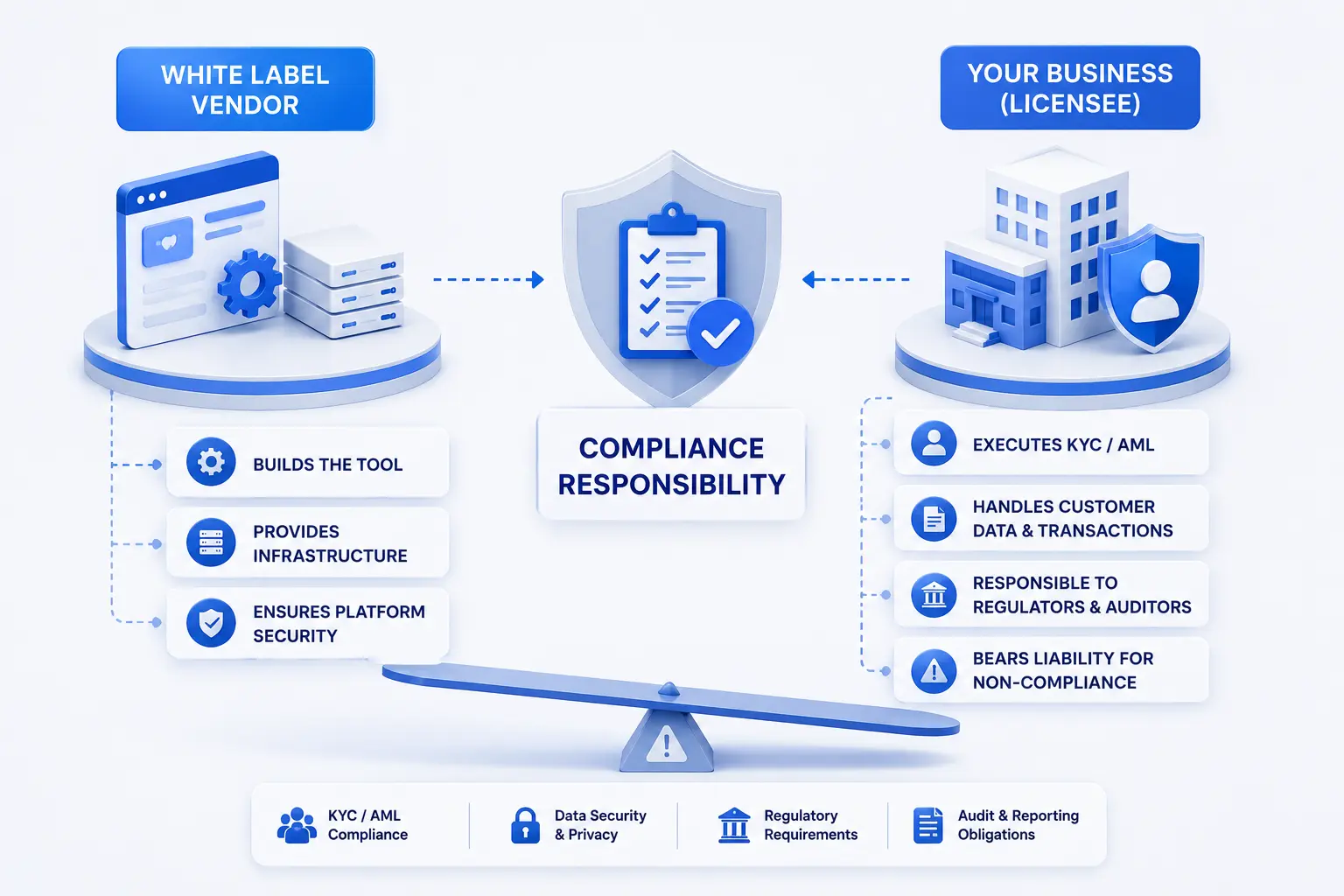
This is the section most comparison articles skip entirely, and it's the one that should carry the most weight in your decision.
White label vendors market compliance as built in. Built in doesn't mean the liability moves with it. Read the licensing agreement closely, because a lot of these agreements position your business, the licensee, as the party responsible for actually executing KYC and AML checks, even while you're using the vendor's tools to do it.
SOC 2 audits, PCI DSS reviews, and banking partner due diligence almost always name the licensee as accountable for how customer-facing flows are handled. The vendor built the tool. You're still the one answering for how it's used.
Sponsor bank risk has become a live issue in this space, not a theoretical one. Regulators including the OCC and FDIC have increased scrutiny of third-party risk at bank sponsors since 2023, and consent orders against sponsor banks like Evolve Bank have already forced multiple fintech programs to find new banking partners with little notice. If your white label product sits on top of one of these relationships, that risk sits on top of your business too, whether or not it shows up clearly in your contract.
Regional rules add another layer. In the US, state-level money transmitter licensing and the Gramm-Leach-Bliley Act shape what's required. In the UK and EU, PSD2 and open banking regulation set the terms for how apps can access and move financial data. Neither a white label license nor a custom build removes the need to map this out market by market. What changes is who's doing that mapping and who's accountable for getting it right.
With a custom build, compliance scope gets defined at the start, by you, with your legal and security advisors. That sounds like more upfront work, and it is. But it means there's no ambiguity later about who answers to a regulator or a banking partner during an audit.
The practical move before signing anything: ask the vendor, in writing, exactly who is named as the responsible party in a KYC failure, a data breach, or a license non-renewal. If the answer is vague, that's the answer.
Data Ownership and Custody: The Part Most Founders Skip
With a white label product, customer financial data typically lives on the vendor's infrastructure, or on the infrastructure of whatever banking partner sits underneath the vendor. What happens to that data if the vendor gets acquired, changes its pricing, or shuts down comes down entirely to contract terms you agreed to at signup.
With a custom build, you own the database outright. Encryption at rest and in transit, key management, tokenization of sensitive fields like account numbers and identity documents, and access control are all decisions your business makes directly, not terms you inherit from someone else's platform.
This matters more in fintech than in almost any other software category. GDPR, CCPA, and GLBA exposure applies to financial data regardless of whether your app is transactional, and a financial data breach carries reputational damage that outpaces most other categories of data loss.
Consider a lending platform relying on a white label vendor to handle identity verification storage. That business has no direct control over how long that data is retained or where it physically sits, which can create a real conflict with a specific state's data residency expectations. This is exactly the kind of gap teams building an instant loan and micro finance platform need to think through early, since lending products carry some of the heaviest KYC and data retention obligations in the entire fintech category.
Feature Flexibility: What You Can and Cannot Change
What White Label Lets You Customize
Branding is genuinely yours to shape: logo, color palette, app name, some UI theming. Content is yours too, product descriptions, plan structures, notification copy. You can usually configure existing workflows within limits, like adjusting loan terms inside pre-built lending logic, without touching the logic itself.
What White Label Does Not Let You Change
The underlying UX and navigation structure stay fixed. Core transaction logic and the data model underneath it are the vendor's, not yours. Integrations are capped at whatever the vendor has already built, a specific KYC provider, a specific card issuer, a specific accounting system. And anything genuinely proprietary, a unique underwriting model, a custom fraud-scoring approach, a specific multi-party payment split, simply isn't on the table.
What Custom Development Gives You
Any integration your business actually needs: specific banking rails, specific identity verification vendors, internal systems, embedded finance partners. Proprietary logic your competitors on the same white label platform can't replicate, because they're literally not running your code.
Categories like crowdfunding and investment platforms make this especially visible. A crowdfunding platform needs workflow logic around campaign structures, backer tiers, and payout timing that most generic templates simply don't support well. The same goes for anything approaching an AI-powered portfolio management system, where the actual value of the product lives in a proprietary model, not in a rebranded dashboard.
Scalability: What Happens When the Business Actually Grows
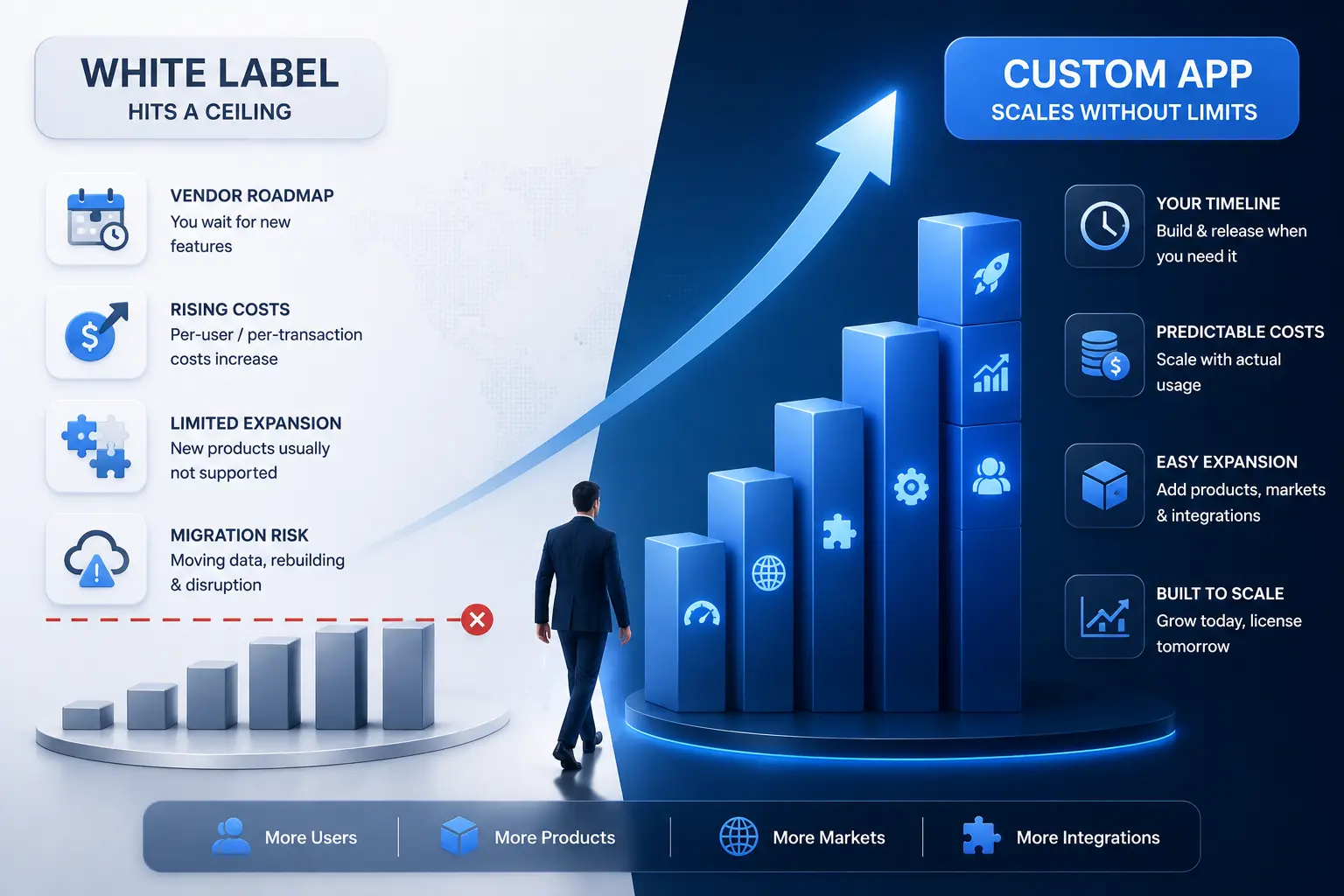
Where White Label Hits a Ceiling
The feature roadmap belongs to the vendor. You get new capabilities when they decide to build them, not when your business needs them. Per-user or per-transaction costs tend to climb as volume grows, sometimes sharply once you cross into a higher pricing tier. Adding a new product line, say moving from budgeting into lending, usually isn't supported by the same platform at all. And if you eventually outgrow the platform entirely, migration means moving client data, rebuilding functionality, and living through a real disruption window.
How Custom Apps Scale Differently
New features ship on your own timeline, not a vendor's release schedule. Infrastructure costs scale predictably with actual usage instead of jumping between fixed pricing tiers. Expanding into a new product, a new market, or a new integration is an extension of what already exists rather than a fresh licensing negotiation with someone else's sales team.
Some fintech businesses reach a point where the roles reverse entirely, where they become the platform other businesses license from rather than staying a licensee themselves. If that's part of your longer-term plan, SaaS product development is the more relevant conversation to have early, since the architecture decisions look different when you're building something meant to be licensed out.
Build a Fintech Platform That Grows With Your Business
Whether you're launching an MVP or expanding an established fintech product, our team designs secure, scalable solutions that support future growth, advanced integrations, evolving compliance needs, and a seamless customer experience from day one.
Talk to Our FinTech Expert
Time to Market: Where White Label Genuinely Wins
This deserves a fair hearing, because it's real. A white label fintech app can go live in weeks. The infrastructure exists. The compliance tooling exists. The hosting exists. You upload your content, configure your plans, and you're live.
There are situations where that speed is exactly the right call. A team validating whether people actually want a budgeting or lending product before spending real development money. A traditional financial business testing a digital extension of what it already offers. A founder proving the concept ahead of a funding round.
Speed stops being the right priority once your differentiation depends on proprietary logic a template can't replicate, once your banking or investor partners expect you to demonstrate direct compliance ownership, or once the brand experience itself is part of what you're selling, which is common in neobanks and premium advisory products.
Embedded finance adoption gives some sense of how fast this space is moving overall. A 2026 industry survey by Green Dot found that nearly all decision-makers surveyed had already adopted embedded finance capabilities, with a majority of fintechs planning to add new banking features within the year. Getting to market a few weeks earlier matters far less than getting the underlying architecture right, especially with that much competitive activity already in motion.
Branding and User Experience: Surface Layer vs. Structural Difference
Branding on a white label product is a surface treatment. The navigation, the onboarding flow, the interaction patterns were all designed for a generic financial audience, not specifically for yours.
Users in this space increasingly recognize shared platform patterns. When a lending app or a wallet feels identical to two or three competitors, the sense that they're using something built specifically for them starts to fade, and trust in fintech is disproportionately tied to that sense of specificity.
With a custom app, every touchpoint reflects your actual users. Onboarding matches how you actually think about risk and reassurance. Terminology matches how your team actually talks to customers. The visual design comes from your brand identity, not from adapting someone else's template. Getting onboarding and verification flows to feel trustworthy without feeling like an interrogation is a specific skill, and it's one our UI/UX design team has worked through repeatedly on fintech products, where every extra form field costs you signups and every skipped verification step costs you trust.
Which Option Is Right for Your Business?
White Label Is Likely the Right Starting Point If:
You're still validating demand for a financial product before committing real development budget. Budget is tight and you need to launch within weeks, not months. Your product fits a fairly standard category, basic budgeting, basic lending, basic wallet, without a workflow unique to how you operate. Your transaction volume is still small enough that per-user fees remain manageable.
Custom Development Is Likely the Right Move If:
You've validated your model and your user base has outgrown what a white label platform can properly support. Your product depends on proprietary underwriting, fraud detection, or workflow logic. Investors or banking partners expect you to demonstrate direct compliance ownership rather than an inherited relationship. Full ownership of customer data is a business, legal, or competitive requirement. You've already hit the ceiling on an existing platform and need to move.
The move from white label to custom happens often in fintech specifically, and it's frequently triggered by a banking partner or an investor requiring direct compliance control that a white label arrangement structurally can't provide. If you're weighing a wallet or payments product specifically, our digital payment and wallet platform page covers what that build actually involves.
Questions Worth Answering Before You Decide
Questions Worth Answering Before You Decide
Work through these honestly before signing anything:
- How many active users do you have now, and what's a realistic projection for 12 and 24 months out?
- Does your product depend on a proprietary underwriting, scoring, or matching model?
- What does the full budget picture look like across three to five years, not just the launch cost?
- Who is named, in writing, as the responsible party in your vendor's contract if a KYC or AML check fails?
- Do you need to own customer financial data outright for compliance, investor, or competitive reasons?
- What happens to your business if your white label vendor raises prices sharply, gets acquired, or its underlying banking partner exits the market?
None of these have a universal answer. Working through them honestly will get you closer to the right call than any comparison chart, including this one.
Common Mistakes Businesses Make in This Decision
Choosing based only on upfront cost. Recurring monthly or yearly fees and per-user scaling frequently make white label more expensive than the sticker price suggests once you run the numbers past year one.
Assuming compliance is fully outsourced. Plenty of licensing agreements still name the licensee as accountable for KYC and AML execution, regardless of whose tools are running underneath.
Underestimating future growth. A platform that handles 500 users comfortably can become a real bottleneck at 5,000.
Skipping the data custody terms. Few founders actually read the data ownership clauses before signing a white label agreement, and it's usually the clause that matters most later.
Overbuilding before validating demand. Committing to a fully custom transactional platform before confirming real users want the product wastes both time and capital.
Waiting too long to migrate. The longer a business stays on a platform it's outgrown, the more disruptive and expensive the eventual move becomes.
The Bottom Line
White label moves fast and costs less to start. Custom builds ownership, compliance clarity, and long-term flexibility that a licensed platform structurally can't offer.
The right call depends on where your business actually is, not where you'd like it to be. Validating an idea calls for one answer. Scaling a proven one calls for another. And the point that gets missed most often in this conversation: in fintech, this isn't just a build-versus-buy decision about software. It's a decision about who holds regulatory and data liability when things go well, and when they don't.
At Nyusoft, we've worked through this exact decision with founders across lending, digital wallets, portfolio management, and budgeting platforms, some arriving after outgrowing a white label platform, others building their first version from a clear product vision. Our case studies show how a few of those projects came together end to end.
If you want a straight answer on which path fits your specific situation, get in touch with our team. Bring your compliance scope, your growth plans, and your questions, and we'll walk you through an honest assessment rather than a sales pitch.
FAQs
1. Is a custom fintech app better than a white label solution?
A custom fintech app is better if your business needs unique features, full ownership of the source code, and complete control over customer data and compliance. A white label solution is often the better choice for startups or businesses that want to launch quickly with a lower initial investment and a predictable monthly or yearly subscription fee.
2. How much does it cost to build a custom fintech app?
The final development cost depends on factors such as feature complexity, third-party integrations, security requirements, compliance (KYC, AML, PCI DSS), and the overall scope of the project.
= MVP Fintech App: USD $4,000–$10,000 – Ideal for validating your idea with essential features.
= Mid-Level Fintech App: USD $10,000–$15,000 – Includes advanced integrations, improved security, and additional user features.
= Advanced Fintech App: USD $18,000-$20,000+ – Suitable for enterprise-grade platforms with AI features, complex integrations, high scalability, and extensive compliance requirements.
3. When should a business choose a white label fintech platform?
A white label fintech platform is a good option when speed to market is the top priority. It works well for businesses that want to validate an idea, launch a standard financial product, or minimize development costs before investing in a fully custom solution. Pricing is typically structured as a monthly or yearly subscription rather than an hourly rate.
4. Who owns the customer data in a white label fintech solution?
Data ownership depends on the agreement with the vendor. In many cases, customer data is stored on the vendor's infrastructure or through its banking partners. Before choosing a white label platform, businesses should carefully review the contract to understand data ownership, storage, access rights, and migration policies.
5. Can a business migrate from a white label platform to a custom fintech app later?
Yes. Many fintech businesses start with a white label platform to validate their product and later migrate to a custom solution as they grow. However, migrating becomes more complex as the customer base, transaction history, and integrations expand, so planning for future scalability is important.
6. Which option offers better scalability for a growing fintech business?
A custom fintech app generally offers better scalability because the architecture, integrations, and features can evolve alongside your business. White label platforms may have limitations related to pricing tiers, supported features, and vendor-controlled product roadmaps.
7. What compliance factors should businesses consider before choosing a fintech platform?
Businesses should evaluate compliance requirements such as KYC, AML, data protection regulations, payment security standards, and regional financial regulations. It's also important to understand who is responsible for compliance obligations under the vendor agreement before making a decision.
8. Are white label fintech apps secure?
A white label app can be secure, but you're inheriting someone else's security decisions — their patch schedule, their encryption choices, their incident response. You also inherit the limits: if the core logic stays licensed through the provider's platform, you can't independently audit it or fix a vulnerability on your own timeline. Before committing, get it in writing who's liable if a breach or compliance gap surfaces after launch, and confirm the platform meets the standards your product needs, such as PCI DSS. If you're handling real money movement or sensitive underwriting, a custom build gives you more control over both.
9. What are the biggest disadvantages of using a white label fintech solution?
The main disadvantages include limited customization, recurring monthly or yearly licensing fees, dependency on the vendor's roadmap, restricted integrations, and less control over customer data and infrastructure. These limitations can become more noticeable as the business grows.
10. How do I decide between a custom fintech app and a white label solution?
The right choice depends on your business goals, budget, launch timeline, compliance requirements, and long-term growth plans. If you need to launch quickly and validate your idea, a white label solution may be the right starting point. If your business requires unique functionality, full ownership, and greater scalability, investing in a custom fintech app is often the better long-term decision.
Ready to Build Your Fintech App with Confidence?
Choosing between a custom fintech app and a white-label solution is a strategic decision that affects your product, compliance, and future growth. Our fintech development experts will evaluate your requirements, answer your questions, and recommend the best approach for your business, all without obligation.
Book Your Strategy Call