


 Front End Development
  Back End Development
  CMS / ECommerce Development
  Mobile Apps Development
  Cloud Services
  Fullstack Services
  Solution


How to Develop a Fintech App: A Step-by-Step Guide

Building a fintech app generally takes 2 to 9 months and costs somewhere between $4,000 and $25,000 or more, depending almost entirely on one factor: how much regulated financial activity the app actually touches.
That's the real fork in the road. An app that displays financial data is a different project from an app that moves money. Both get called "fintech apps," but the moment your product starts holding a balance, initiating a transfer, or extending credit, the entire build changes shape. The compliance load gets heavier, the security architecture gets stricter, and the timeline stretches out.
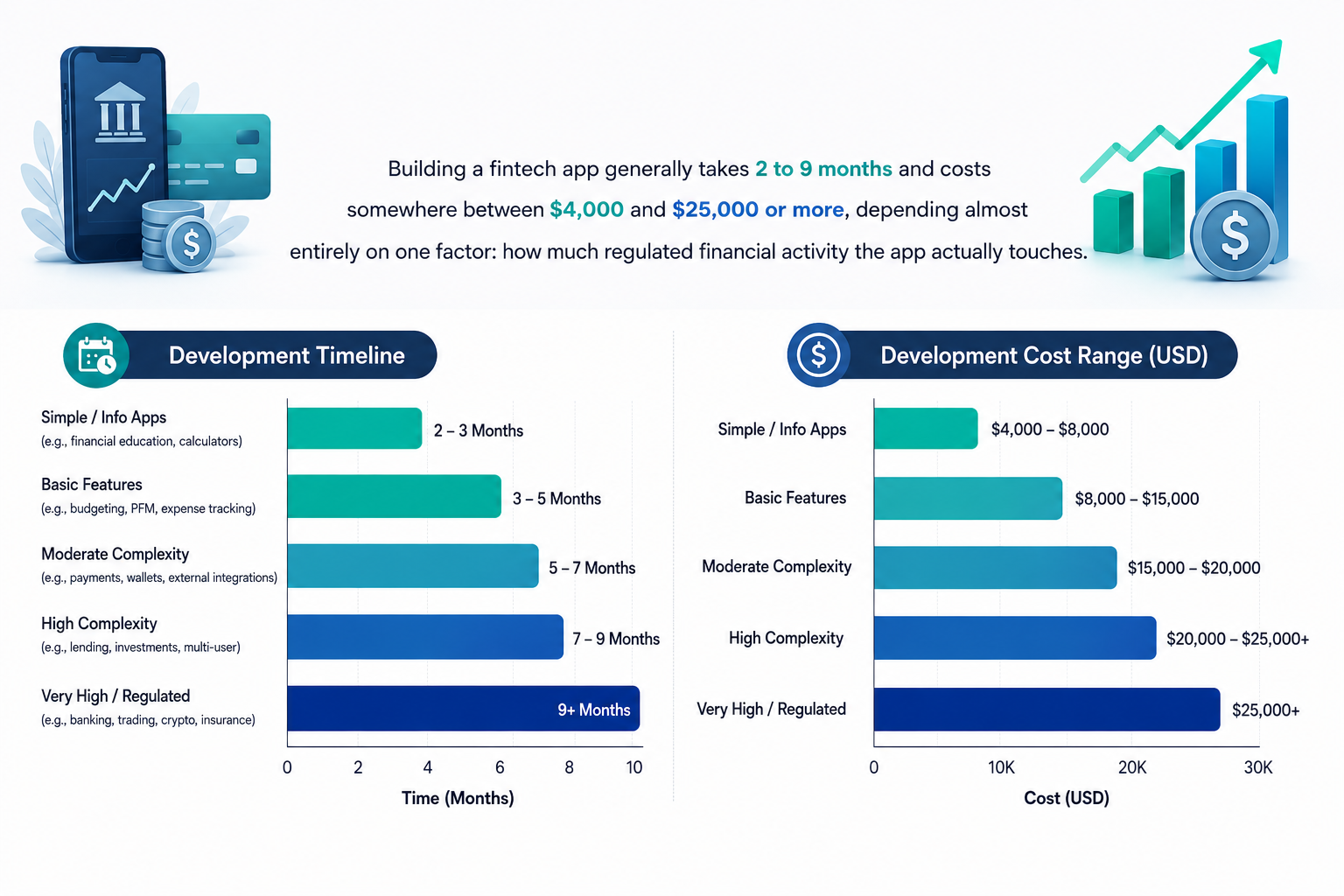
The category itself isn't slowing down. Digital financial services have become the default way most people interact with their money, and founders keep entering this space because the demand is genuinely there. What trips a lot of teams up isn't the idea. It's underestimating what happens after the idea, once regulation, security, and third-party integrations enter the picture.
This guide walks through what actually counts as a fintech app, the features that matter, where compliance kicks in, the tech stack, the real development process, and what it costs. By the end, you should have a clear, realistic picture of what building one actually involves.
What Actually Counts as a Fintech App
A fintech app is software that lets people or businesses manage, move, borrow, invest, or track money digitally. That's a wide net, and it covers everything from a simple expense tracker to a full digital bank.
The useful way to split this category isn't by feature list. It's by what the app actually does with money:
- Data and insight apps: these display, track, or analyze financial information without directly moving funds. Think dashboards, trackers, and analytics tools.
- Transactional apps: these actually move money. They hold balances, initiate transfers, extend credit, or execute trades.
This distinction is the single biggest driver of scope, compliance, and cost. It's worth pinning down on paper before any design or development work starts, because it changes almost every decision that follows, including which regulations apply, how much security review is needed, and how long the project realistically takes.
Types of Fintech Apps You Might Be Building
Fintech covers a lot of ground, and it's worth knowing where your idea fits before you start scoping the build:
- Personal finance and budgeting apps help individuals track spending, set budgets, and monitor net worth. We've covered this category in detail in our guide on personal finance app development.
- Digital wallets and payment apps handle transfers, bill payments, and card storage. Our digital payment and wallet platform page covers what goes into building one.
- Lending and micro-finance platforms connect borrowers and lenders or automate loan origination. See our instant loan and micro finance platform page for more.
- Investment and portfolio management apps help users track or manage holdings across accounts, sometimes with AI-driven insights layered on top, which our portfolio management system page goes into.
- Crowdfunding platforms connect backers with projects or businesses raising capital, covered in our crowdfunding platform page.
- Neobanking apps offer full digital-only banking experiences, often built on top of a licensed banking-as-a-service partner rather than a traditional banking charter.
- Insurtech apps apply the same digital-first approach to insurance: quoting, claims, and policy management handled entirely through software.
Whichever type you're building, the process, compliance requirements, and cost drivers covered in the rest of this guide apply across all of them. The specifics shift, but the fundamentals don't.
Core Features Every Fintech App Needs
Regardless of which type you're building, a handful of features are non-negotiable. Miss any of these and the app won't hold up against user expectations shaped by the banking and payment apps people already use daily.
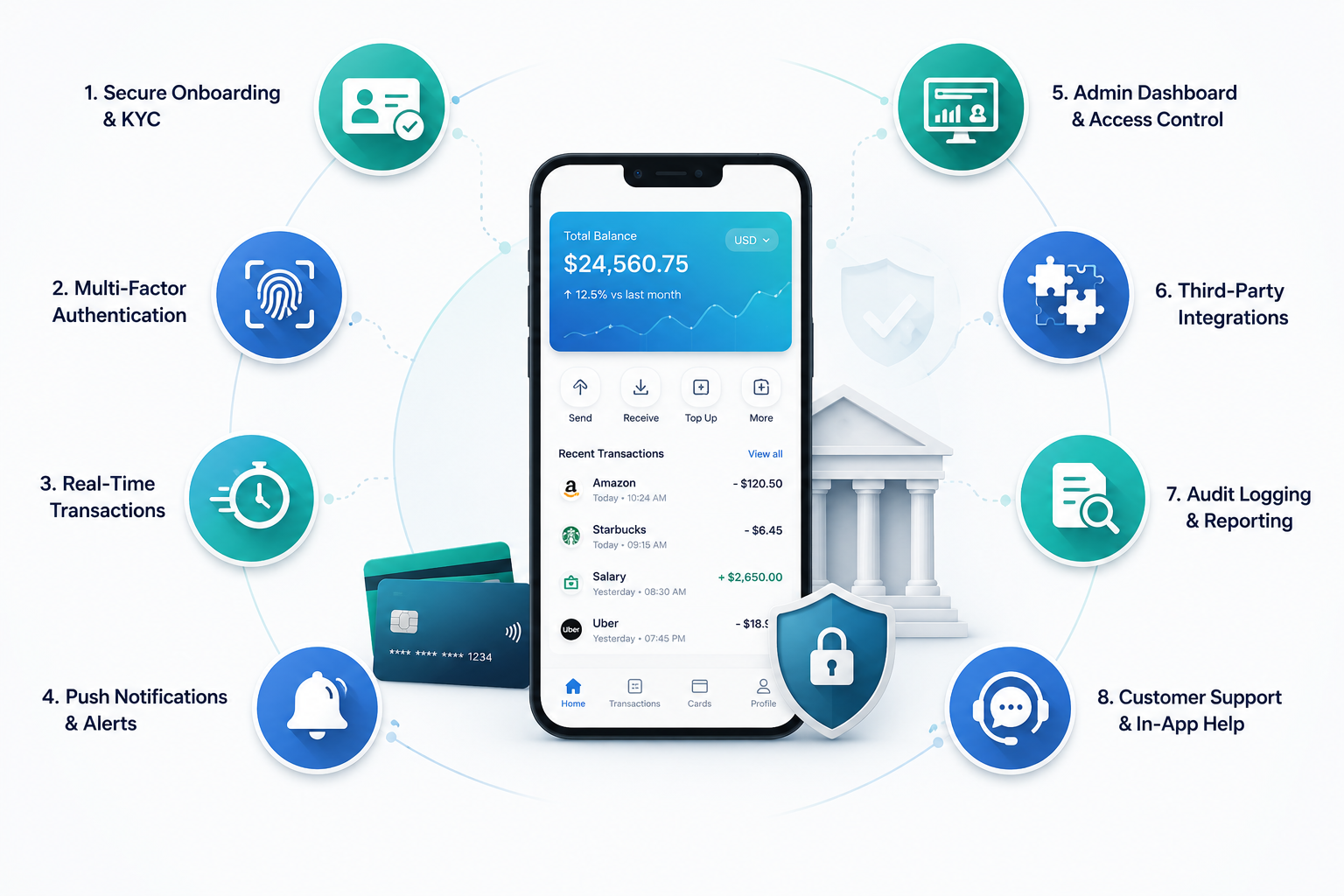
- Secure user onboarding and identity verification. Know Your Customer (KYC) checks confirm who's signing up before any financial activity happens. This is table stakes for nearly every fintech category, transactional or not.
- Multi-factor authentication and biometric login. Face ID, fingerprint login, and two-factor authentication aren't optional extras anymore. Users expect them by default in anything touching their money.
- Real-time transaction processing and history. A clear, accurate log of every transaction, updated instantly rather than on a delay, is one of the most basic expectations users bring to a financial app.
- Push notifications and account alerts. Balance updates, suspicious activity warnings, and confirmation messages keep users informed without requiring them to open the app constantly.
- Role-based access control and an admin dashboard. Internal teams need visibility into user activity, transaction monitoring, and account management, with permissions that scale as the team grows.
- Third-party API integrations. Most fintech apps connect to banking rails, identity verification providers, or payment processors rather than building all of that infrastructure from scratch. Choosing reliable partners here matters as much as the app's own code.
- Audit logging and reporting. Every action needs a record. This isn't just good practice, it's often a regulatory requirement, and it's far easier to build in from the start than to retrofit later.
- Customer support and in-app help. Financial apps generate more support questions than most categories, since users are dealing with real money and real anxiety when something looks wrong.
Designing onboarding and security flows that feel trustworthy without feeling like an interrogation is a genuine skill. Our UI/UX design team has worked through this balance on fintech products specifically, where every extra form field costs you signups but every skipped verification step costs you trust.
Advanced Features That Set Fintech Apps Apart
Once the basics are covered, this is where a fintech app starts to feel genuinely modern instead of merely functional.
- AI-driven fraud detection. Pattern recognition that flags unusual transactions in real time, rather than relying purely on static rule-based checks, catches more fraud with fewer false positives.
- Predictive analytics for risk scoring and personalization. Using historical data to assess credit risk or tailor the user experience, rather than treating every user identically.
- Conversational AI for account queries. A chatbot that can answer "what's my balance" or "when did this charge post" in plain language cuts down support load and speeds up simple requests. This kind of feature usually gets built through a proper LLM integrations approach, layering a language model on top of the app's actual transaction data rather than a generic script.
- Open banking connectivity. Pulling data from external financial institutions through secure APIs, letting your app work with a user's full financial picture instead of just what lives inside your own system.
- Blockchain-based transaction transparency. Worth considering for specific use cases like cross-border payments or asset tokenization, though it's not a fit for every fintech product and shouldn't be added just because it sounds current.
- Embedded finance capability. Exposing your app's financial features through an SDK or API so other platforms can plug them in directly, turning your product into infrastructure other businesses build on top of.
For the AI-heavy features specifically, this work sits within a broader generative AI development practice, where fraud detection models and recommendation engines get trained around a product's actual data rather than deployed as an off-the-shelf tool.
Planning to build a fintech app?
Whether you're scoping a lending platform, a digital wallet, or something entirely new, getting the compliance and architecture decisions right early saves real money down the line. Our team can help map the right feature set, tech stack, and regulatory approach for your specific build.
Talk to Experts
Fintech Compliance and Regulatory Requirements
This is the section a lot of "how to build a fintech app" guides gloss over, and it's genuinely the part that determines whether a project stays on budget or spirals.
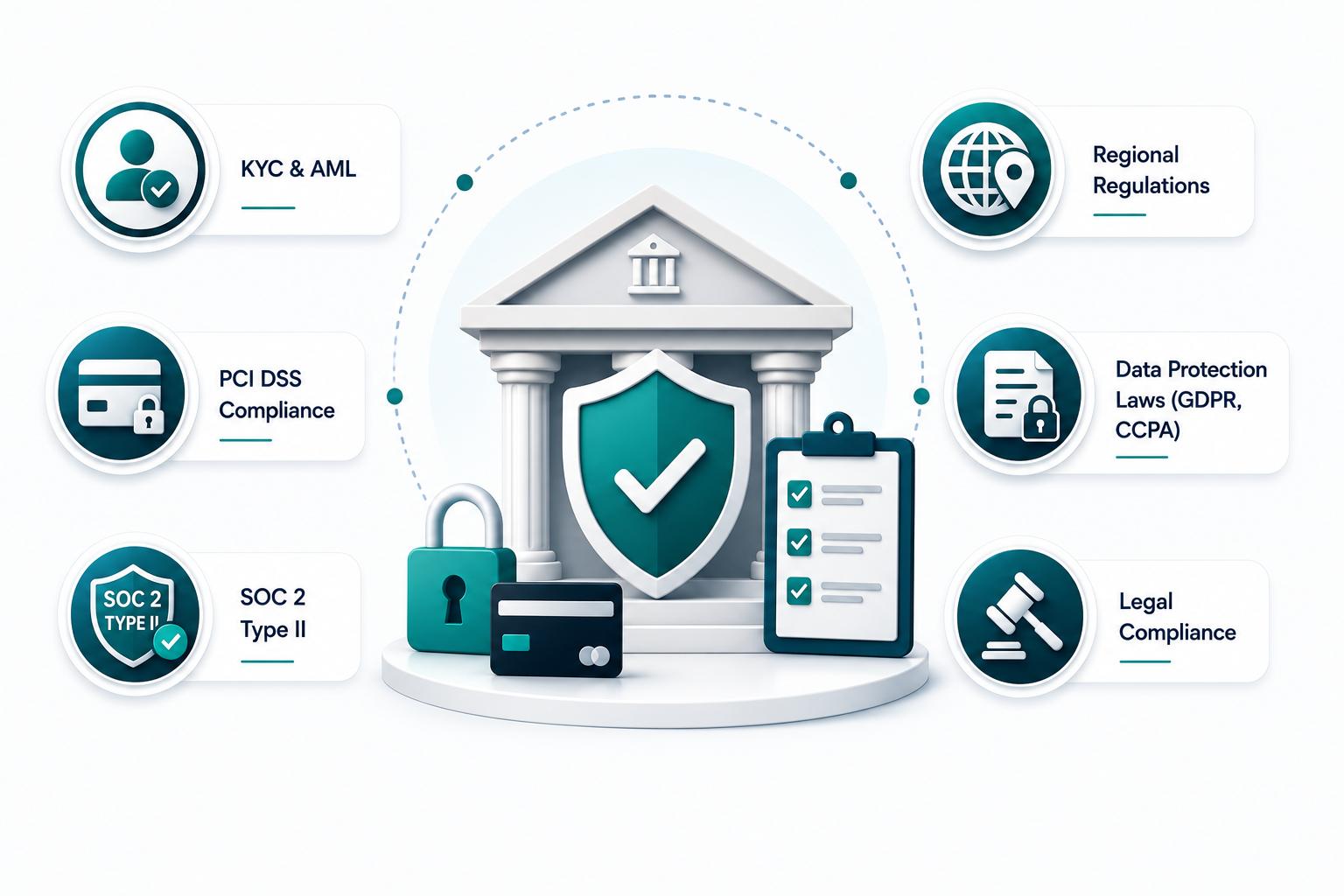
KYC (Know Your Customer) and AML (Anti-Money Laundering) requirements apply to nearly any app onboarding users into financial activity, and they get significantly stricter once the app is transactional. These aren't optional compliance checkboxes. They're legal requirements enforced by regulators like FinCEN in the US, and skipping proper implementation can shut a product down entirely.
PCI DSS compliance kicks in once an app touches card data directly, rather than routing it through a compliant payment processor. Most fintech teams avoid handling raw card data themselves for exactly this reason, since it dramatically increases the security and audit burden.
SOC 2 Type II isn't always legally mandated, but it's functionally required. Banking partners, payment processors, and investors routinely ask for it before they'll integrate with your app or fund it. Treating this as a "we'll get to it later" item is one of the most common and most expensive mistakes founders make in this space.
Regional variation matters a lot. In the US, state-level money transmitter licensing and the Gramm-Leach-Bliley Act shape what's required. In the UK and EU, PSD2 and open banking regulation set the rules for how apps can access and move financial data. Every market you plan to launch in needs its own regulatory review, and this needs to happen during discovery, not after the app is built.
Data protection laws like GDPR and CCPA apply regardless of whether your app moves money. If you're collecting personal or financial data from users, these laws apply to you the same way they'd apply to any other app handling sensitive information.
Here's the practical takeaway, and it's worth repeating because it's the single most expensive mistake in this category: the earlier you map compliance requirements against your specific feature set, the cheaper and less disruptive they are to build around. Retrofitting compliance into a system that's already been built is consistently more expensive, and more painful, than designing around it from day one.
Tech Stack for Fintech App Development
Frontend and Mobile Development
Cross-platform frameworks like React Native or Flutter work well for most fintech apps, letting you build for iOS and Android at the same time without maintaining two separate codebases. Native development using Swift or Kotlin directly becomes the stronger option once deep biometric integration or heavy security auditing becomes central to the product.
Web Application Layer
For web dashboards and admin panels, frameworks like React.js or Vue.js give you a responsive, maintainable front end. This matters as much for your internal admin tools as it does for the user-facing product, since your team will be living inside that dashboard daily.
Backend and API Architecture
Node.js handles real-time processing and notification delivery well, given its strength with concurrent, event-driven workloads. Python tends to be the better fit for risk scoring models, fraud detection algorithms, and any machine learning work. For larger enterprises with existing infrastructure, .NET development is a common choice, particularly where the organization already runs a Microsoft-centric stack.
Database and Security Infrastructure
Encrypted storage, both at rest and in transit, is a baseline requirement rather than a nice-to-have. Sensitive fields like account numbers and identity documents typically need tokenization, meaning the actual sensitive value never sits directly in your primary database. Secure key management, with regular rotation and strict access controls, rounds out the foundation.
Cloud, DevOps, and Infrastructure
Cloud infrastructure on AWS, GCP, or Azure, built with SOC 2 alignment from the start rather than added later, gives you a defensible security posture from day one. A solid DevOps setup with automated security scanning and continuous integration matters more here than in most app categories, given how much scrutiny fintech apps face during both development and post-launch review.
The Fintech App Development Process, Step by Step
Step 1: Market Research and Idea Validation
Before writing a single requirement document, confirm the specific financial problem your app solves and that real demand exists for solving it your way. Review the competitive landscape honestly. A crowded category isn't automatically a dead end, but it does mean your differentiation needs to be genuinely clear from the start.
Step 2: Regulatory and Compliance Scoping (Weeks 1–2)
This is where you decide transactional versus data-only scope, lock down your target geography, and identify what licensing your specific feature set actually requires. Get this wrong or skip it, and every later phase inherits the problem.
Step 3: Product Strategy and Feature Prioritization
Define what actually ships in version one versus what waits for validated demand. Most fintech products fail not because the core idea was wrong, but because the team tried to build too much before proving the core use case worked.
Step 4: UI/UX Design (Weeks 3–7)
Financial apps carry a different psychological weight than most consumer software. Users are more anxious, more cautious, and more likely to abandon a flow that feels even slightly uncertain. Clarity beats visual flourish here, every time. This phase typically runs alongside early backend architecture work rather than waiting for it to finish first.
Step 5: MVP Development (Months 3–5)
The core build phase, covering onboarding, the essential transactional or data logic, and a functional admin dashboard. Resist the urge to build every planned feature into the MVP. The goal here is validating the core product with real users, not shipping the finished vision on day one.
Step 6: Security Testing and Compliance Audit
Penetration testing, third-party security audits, and formal compliance sign-off need to happen before any real financial data flows through the system in production. This isn't a step to compress under deadline pressure, and it's genuinely one of the phases most likely to reveal problems that are far cheaper to fix now than after launch.
Step 7: Launch and App Store Submission
Fintech apps face extra scrutiny during Apple and Google's review process, including closer attention to how the app describes its own security and financial claims. Build extra time into your launch timeline specifically for this stage, since it often takes longer than teams expect.
Step 8: Post-Launch Monitoring and Iteration
Ongoing fraud monitoring, performance tracking, and a real maintenance budget, typically 15–20% of build cost annually, keep the app secure and current as security patches, regulatory changes, and platform updates roll in. This work doesn't taper off after launch the way it might in other app categories.
If you're weighing a fully custom transactional platform against a broader B2B offering, custom software development is the right conversation for the former, while SaaS product development fits better if you're building something other businesses will subscribe to and build on top of.
How Much Does Fintech App Development Cost
Costs scale directly with how much regulated financial activity the app touches, and how many integrations and compliance requirements come with it. Here's a realistic breakdown by complexity tier:
| Complexity Tier | What It Typically Includes | MVP Cost | Full Platform |
| Basic data/tracking app | Read-only data display, no money movement | $4,000 – $6,000 | $7,000 – $9,000 |
| Standard transactional app | Payments, transfers, or basic lending logic | $6,000 – $9,000 | $11,000 – $14,000 |
| Advanced fintech platform | AI-driven risk and fraud detection, multiple integrations | $10,000 – $14,000 | $15,000 – $18,000+ |
| Regulated or licensed platform | Full banking-adjacent or securities-adjacent scope | $16,000 – $20,000+ | $20,000+ |
The main cost drivers: whether the app is transactional or data-only, the number of third-party integrations, how much compliance and licensing work is required, how many platforms you're launching across, and how much AI or analytics work is involved.
Compliance and security review is consistently the most underestimated line item in fintech budgets specifically. Teams often price out the visible product work, the screens, the features, the integrations, and treat legal review and security audits as an afterthought that gets squeezed into whatever budget is left. That approach almost always costs more in the end, not less.
Plan for annual maintenance around 15–20% of build cost, covering security patching, regulatory updates, and the ongoing upkeep that third-party financial integrations require as their own APIs evolve.
For a broader look at what shapes app development budgets generally, our mobile app development page covers the underlying cost drivers that apply across categories, not just fintech.
Looking for a realistic cost estimate?
Every fintech app has its own compliance scope, integration needs, and feature complexity. Share your project details with our team, and we'll walk you through a tailored roadmap and cost estimate based on what you're actually building.
Request a Cost Estimate
Common Mistakes Companies Make When Building a Fintech App
- Treating compliance as a post-launch task instead of a design input. This is the most expensive and most common mistake in the entire category, and it's almost always avoidable with earlier planning.
- Underestimating third-party integration timelines. Banking APIs, identity verification providers, and payment processors all run their own approval and review cycles, and those timelines rarely line up neatly with an internal development schedule.
- Overbuilding the MVP. Trying to ship payments, lending, and investing features all in version one, instead of proving a single use case works first, stretches both budget and timeline further than most teams expect.
- Skipping security testing until the end. Penetration testing needs to run continuously through development, not as a single pre-launch checkbox that gets rushed under deadline pressure.
- Underestimating ongoing maintenance costs. Regulatory changes and security patching don't slow down after launch in this category the way they might for a typical consumer app.
- Ignoring trust-driven design. A fintech app can look beautiful and still fail if it doesn't feel secure. Users are unusually quick to abandon a financial app the moment something feels off.
Building a Fintech App That Earns User Trust
The decision that opened this guide is worth returning to: data-only versus transactional. Get that call right early, and nearly everything downstream, your compliance scope, your security architecture, your timeline, your budget, falls into place around it far more smoothly than trying to figure it out mid-build.
Trust and regulatory discipline outperform feature count in this category, consistently. A fintech app with fewer features that feels genuinely secure and behaves predictably will outlast a feature-packed app that cuts corners on compliance or security review.
At Nyusoft, we've worked through this exact set of decisions with fintech clients across lending, digital wallets, portfolio management, and budgeting platforms. Our team has helped founders scope everything from a first MVP to a fully licensed transactional platform, and our case studies show how those projects have come together end to end. If you're scoping your own fintech app, that's a solid place to start the conversation.
FAQs
- How much does it cost to develop a fintech app?
Fintech app development typically costs between $4,000 and $20,000 or more, depending on whether the app is transactional or data-only. A basic tracking app can start around $4,000, while a fully regulated, transactional platform with AI-driven risk scoring can exceed $20,000. - How long does it take to build a fintech app?
Most fintech apps take 2 to 9 months to build. A basic data or tracking app can launch closer to 4 months, while a transactional platform with multiple integrations and a full compliance audit usually takes 7 to 9 months or longer. - What is the difference between a fintech app and a regular finance app?
Fintech is the broader category, covering any software that helps manage, move, borrow, invest, or track money digitally. A "finance app" often refers more narrowly to personal budgeting or tracking tools, while fintech also includes payments, lending, investing, and banking-adjacent platforms. - Do all fintech apps need regulatory compliance?
Not to the same degree. Apps that only display or track financial data carry a lighter compliance load than apps that move money, hold balances, or extend credit. That said, data protection laws like GDPR and CCPA apply to nearly any app collecting personal financial information, regardless of whether it's transactional. - What compliance requirements apply to fintech apps?
Common requirements include KYC (Know Your Customer) and AML (Anti-Money Laundering) checks, PCI DSS for apps handling card data directly, and SOC 2 Type II, which is often expected by banking and payment partners even when it isn't legally mandated. Requirements also vary by region, with the US, UK, and EU each having different licensing frameworks. - What is the best tech stack for fintech app development?
Most fintech apps use React Native or Flutter for cross-platform mobile development, Node.js or Python for the backend, and cloud infrastructure like AWS or GCP built with SOC 2 alignment in mind. The right stack depends on transaction volume, integration needs, and whether the team is building on existing enterprise infrastructure. - Can I build a fintech app with an MVP first?
Yes, and it's the more sensible approach for most teams. A realistic MVP focuses on one core use case, whether that's budgeting, payments, or lending, rather than trying to launch every feature type at once. This validates real demand before committing to the full build. - What features are essential in a fintech app?
Secure onboarding with identity verification, multi-factor authentication, real-time transaction processing, push notifications, role-based admin access, audit logging, and reliable third-party integrations are the baseline. Advanced features like AI-driven fraud detection and open banking connectivity come later, once the core product is validated. - How do I choose a fintech app development company?
Look for a team with direct experience in regulated financial products, not just general app development. Ask specifically about their approach to compliance scoping, security testing, and third-party integrations, since these are the areas that most commonly derail fintech projects and separate an experienced team from a general one. - What is the biggest mistake companies make when building a fintech app?
Treating compliance as a post-launch task instead of a design input. Retrofitting security and regulatory requirements into an already-built system is consistently more expensive and disruptive than scoping them during discovery, before any development work begins.
Ready to build your fintech app?
From regulatory scoping and product strategy to development, security testing, and long-term support, our team can help turn your idea into a secure, scalable platform.
Get in Touch With Team