

 Front End Development
  Back End Development
  CMS / ECommerce Development
  Mobile Apps Development
  Cloud Services
  Fullstack Services
  Solution


Meditation App Development: Features, Cost, Tech Stack & Process
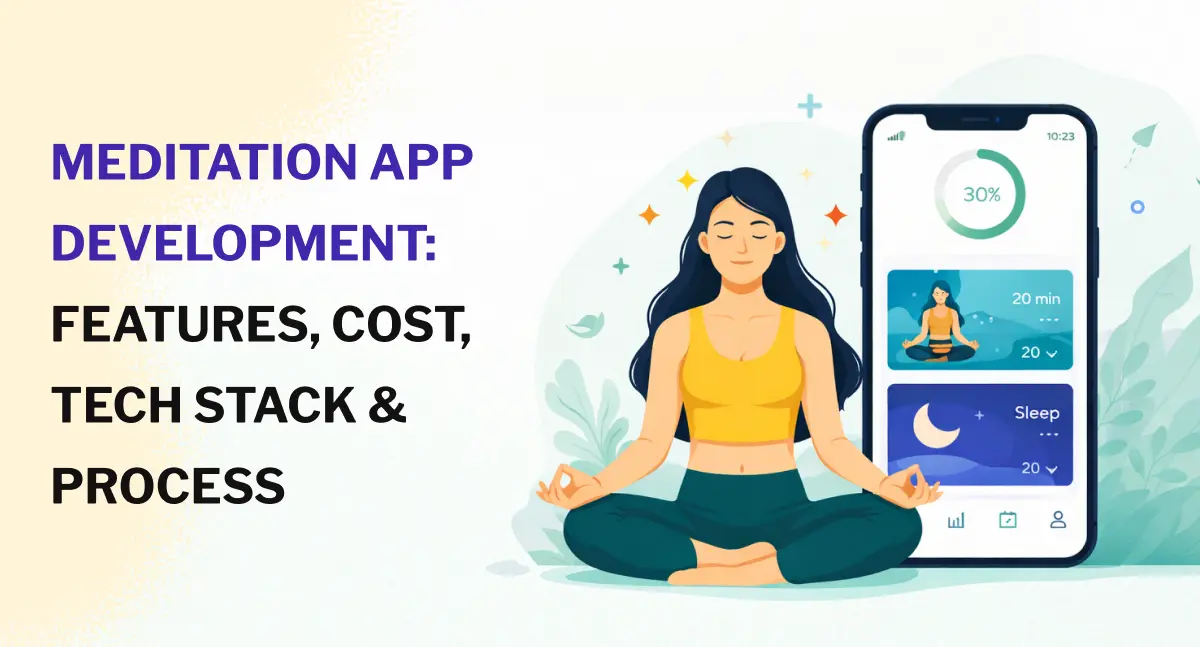
Building a meditation app usually costs somewhere between $6,000 and $45,000, depending on how many features you want, how much content you plan to produce, and whether you're building a simple guided-audio library or something with AI-driven personalization and wearable integration.
Listen to Audio Podcasts
That range is wide because meditation apps aren't one thing. A basic library of pre-recorded sessions is a different project than a corporate wellness platform with mood tracking and HR dashboards. Before any of the feature decisions or cost numbers make sense, you need to know which one you're actually building.
The category itself isn't small. The global meditation management apps market was valued at around $2.20 billion in 2025 and is projected to reach close to $6.99 billion by 2033, growing at roughly 14.67% a year, according to Grand View Research. North America alone accounts for more than 43% of that revenue.
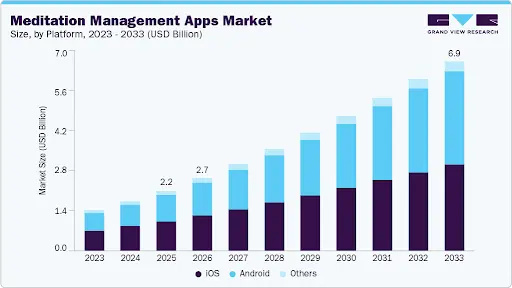
Growth numbers like that make the space look inviting. They also hide the real problem: this is one of the most saturated corners of the app store. Calm and Headspace aren't just popular, they're structurally dominant, and cloning what they do rarely works for a new entrant.
This article walks through the app types worth considering, the features that actually matter, where compliance lines sit, the tech stack, the real development process, and what it costs. By the end you should be able to scope a project instead of guessing at one.
Have a Meditation App Idea? Let's Bring It to Life
Whether you're building a guided meditation app, a sleep wellness platform, or an AI-powered mindfulness solution, the right development strategy can save time and reduce long-term costs. Our team can help you define the right features, technology stack, and roadmap for your project.
Talk to Our Expert
Why the Meditation App Market Looks Easy and Isn't
A meditation app can seem like a simple build on paper. Audio player, a content library, a subscription button. Plenty of agencies will pitch it that way.
The reality is that content quality and audience focus decide whether an app survives past month three, not the feature list. Two apps can have identical functionality and completely different outcomes because one picked a real audience gap and the other didn't.
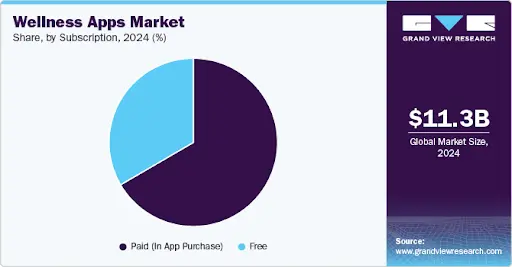
Freemium is the dominant business model in this space, with free-tier access making up roughly 60-65% of the market according to several 2026 industry reports. Users expect to try before they commit to a subscription. That shapes how you think about your first-session experience long before it shapes your pricing page.
Calm alone holds a large share of category downloads, and Headspace isn't far behind. So the real question for a new app isn't "how do we build a meditation app." It's "who is currently underserved by the two apps everyone already has installed."
Teams that do well here usually pick something specific. New parents adjusting to disrupted sleep. Night-shift healthcare workers. University students during exam periods. Veterans. Non-English speaking communities. A specific faith tradition's meditation practices. Small, well-defined audiences beat broad, generic ones almost every time in this category.
Types of Meditation Apps You Can Build
The type of app you choose decides your content budget, how much compliance exposure you carry, and who you're actually competing against. It's worth spending real time on this decision before touching a feature list.
Guided Meditation Library Apps
This is the most common structure: pre-recorded audio or video sessions, organized by category like stress, sleep, focus, or anxiety relief. Headspace built its early reputation on structured, multi-day courses rather than single standalone sessions.
Technically, this is the least complex option to build. The complexity shows up on the content side instead. You need enough sessions, in enough categories, recorded well, to make the library feel worth paying for.
Sleep and Soundscape Apps
Bedtime stories, ambient sound generation, white noise, and sleep-focused tracking. This is Calm's core differentiator, and it's not an accident that sleep content converts better than daytime meditation content for a lot of apps.
People are more willing to pay for something that solves a nightly frustration than for something that's merely nice to have during the day.
Mindfulness and Habit-Building Apps
These lean on daily streaks, short journaling prompts, breathing exercises, and mood check-ins. There's real overlap here with mental health apps, and it's worth being precise about where the line sits. Tracking mood for the sake of reflection is different from tracking symptoms for the sake of diagnosis. We get into that distinction in more detail in the compliance section below.
Community and Teacher Marketplace Apps
Insight Timer took a different route than Calm or Headspace: a large network of independent teachers, user-generated content, and ratings instead of a closed, produced library. It's a genuinely different technical and moderation problem. You're building a marketplace, not just a content player.
Corporate and Enterprise Wellness Meditation Apps
Distribution through employers rather than direct-to-consumer app store downloads. This model is growing fast. In the wellness app space more broadly, 74% of US employers offered meditation or mindfulness apps as a benefit in 2024, up from 52% in 2020.
Per-employee licensing is a cleaner, more predictable revenue model than consumer subscriptions, and it comes with its own requirements: usage dashboards for HR, single sign-on, and sometimes integration with existing benefits platforms.
Niche and Specialty Meditation Apps
Faith-based meditation, walking meditation, meditation for kids, meditation for chronic pain or tinnitus, meditation for grief. These smaller categories carry far less competition, and for a new entrant in 2026, this is often the more realistic starting point than trying to out-Calm Calm.
Core Features Every Meditation App Needs
These aren't differentiators. They're the baseline. Skipping one of these isn't a bold product decision, it's a gap your users will notice on day one.
Onboarding and personalization quiz. A short set of questions about goals, experience level, and available time, used to shape the very first recommendation. A common mistake here is making onboarding too long before the user hears any actual content. Wellness apps in particular need to get someone into their first session in under a minute, or you lose them before they've experienced any value at all.
A content library with real filtering. Categorized by duration, topic, narrator, and experience level, with working search. This matters more than people assume, because a lot of returning users are looking for a specific session they liked before, not a brand-new suggestion.
Offline playback and downloads. Easy to overlook, genuinely important. People use meditation apps on flights, in areas with weak signal, or specifically because they're trying to disconnect. An app that requires a live connection for every session is missing a big chunk of its actual use case.
Progress tracking and streaks. Session history, a calendar view, total minutes meditated. Apps with daily streak mechanics tend to retain meaningfully more users at the 30-day mark than apps without them, based on development data shared by teams who've built several of these products.
Reminders and smart notifications. Timing matters more than frequency. Notifications tied to a user's actual past session pattern outperform generic daily pings. And over-notifying is one of the fastest ways to get uninstalled in this specific category, because the entire pitch of the app is reducing stress, not adding another buzzing notification to the pile.
An audio player built for the job. Interval bells, background noise mixing, a sleep timer with a fade-out, background playback while the phone is locked. Small details, but they're the difference between an app that feels considered and one that feels like a wrapper around some MP3 files.
Multiple narrator voices and localization. Male and female voice options, and multi-language support if you're aiming beyond one market. Asia Pacific is flagged as the fastest-growing region in most 2026 market reports on this category, which makes localization worth planning for early rather than bolting on later.
Subscription and payment integration. In-app purchase flows, free trial logic, and often family or group plan options. Getting this wrong, or making it clunky, is a fast way to lose a user who was otherwise ready to convert.
Good onboarding and a calm, uncluttered visual design carry a lot of weight in this category specifically, since the whole point of the product is to reduce friction and mental noise. Our UI/UX design team spends real time on exactly this kind of interface work for wellness products, where the design itself is part of the therapeutic experience, not just decoration around it.
Need Help Prioritizing Features for Your Meditation App?
Choosing the right features is essential for delivering a seamless user experience while staying within budget. Our experts can help you identify the features that best match your business goals and target audience.
Book a Free Consultation
Advanced and Differentiating Features
This is the section that actually decides whether your app competes or gets buried on page four of a search result.
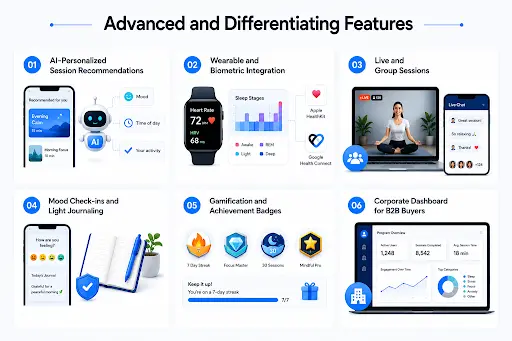
AI-personalized session recommendations. Instead of a static menu, the app adapts what it suggests based on mood check-ins, time of day, and what the user has actually finished versus abandoned. Multiple 2026 industry reports flag AI-guided mindfulness programs as one of the biggest trends shaping where this category is heading next.
Wearable and biometric integration. Apple Watch, Apple HealthKit, Google Health Connect. Heart rate variability and sleep stage data can feed directly into what the app suggests, which turns a static library into something that responds to how the user is actually doing physically.
Live and group sessions. Scheduled, streamed sessions with a real instructor. This adds a social and accountability layer that pre-recorded content simply can't replicate, and it's becoming a genuine retention lever rather than a gimmick.
Mood check-ins and light journaling. Useful and popular, but worth handling carefully. The moment an app starts making claims about treating anxiety or depression, rather than supporting general relaxation, it moves into mental-health-app territory with a different set of compliance obligations. We cover this boundary in detail in our mental health app development guide, and it's worth reading before you finalize this part of your feature set.
Gamification and achievement badges. Milestones and streak badges work well for a lot of users, but they should be optional and dismissible. Some users find gamification actively counterproductive in an app that's supposed to be about calm rather than competition.
A corporate dashboard for B2B buyers. Aggregate, anonymized usage analytics for HR teams. This is often the single feature that actually closes an enterprise wellness contract, more than any consumer-facing feature on the list.
If you're building the AI-personalization layer, that work sits squarely in our generative AI development practice, where we build recommendation and adaptive-content systems for products in this exact space.
Where HIPAA and Health Claims Actually Apply
Most articles on this topic either skip compliance entirely or get the boundary wrong. It's worth getting right, because the cost of retrofitting compliance after launch is a lot higher than designing for it from the start.
A meditation app that doesn't collect Protected Health Information and doesn't make treatment claims generally sits outside HIPAA. Plenty of successful meditation apps operate exactly this way: no PHI, no diagnostic language, just wellness content.
The line gets crossed when an app adds mood tracking tied to clinical terminology, symptom scoring, or any claim that it treats a diagnosable condition. At that point you're no longer building a wellness app. You're building something closer to a mental health app, with a very different compliance load.
There's a second, separate risk that's easy to miss: FTC scrutiny of health claims in advertising. An app claiming it "reduces anxiety" or "treats insomnia" needs evidence to back that up, or it risks running into deceptive-advertising problems. This is distinct from HIPAA and worth thinking about on its own.
App Store and Play Store review has also tightened for apps in the health and wellness categories that make efficacy claims. The specifics shift over time, so it's worth checking current guidelines rather than assuming last year's rules still apply.
The practical takeaway: decide during discovery whether you're building a wellness app or a mental health app. That single decision shapes your feature set, your legal review process, and your marketing copy from day one. It's the same fork in the road we raise early in our mental health app development guide, and it's worth answering before any design work starts.
Tech Stack for Meditation App Development
Mobile Frameworks
For most meditation apps, cross-platform development is the sensible starting point. It's faster to market and cheaper to maintain, and it's more than capable of delivering the polish this category needs. Our teams typically build these products on React Native or Flutter, depending on the specific animation and performance needs of the app.
Native development starts to make sense when deep HealthKit or Apple Watch integration is a core differentiator rather than a nice-to-have, since that level of platform-specific integration is harder to replicate well in a cross-platform framework.
Backend and Infrastructure
Node.js handles real-time needs well: live session streaming, streak syncing across devices, and notification delivery. Where AI personalization or a recommendation engine is involved, Python tends to be the better fit for the machine learning components.
Cloud audio delivery and CDN setup deserve more attention than most cost estimates give them. Streaming a large content library efficiently, especially with offline download support, is a real infrastructure cost that's easy to underestimate at the planning stage.
Content Management and Storage
You'll want an admin panel for uploading and organizing sessions, tagging content by category and duration, and scheduling new releases. This matters more than it sounds like it should, because content refresh cadence is one of the biggest drivers of long-term retention in this category.
AI and Personalization Layer
This covers the recommendation engine architecture and any sentiment-aware check-in features. Worth repeating: keep the language and framing in the wellness lane, not the clinical one, unless you've deliberately decided to build a mental health product with the compliance work that comes with it.
Payment and Subscription Infrastructure
App Store and Play Store in-app purchase requirements, third-party subscription management tools if you need more flexibility than the platform defaults offer, and family or group plan logic if that's part of your pricing model.
The Meditation App Development Process, Step by Step
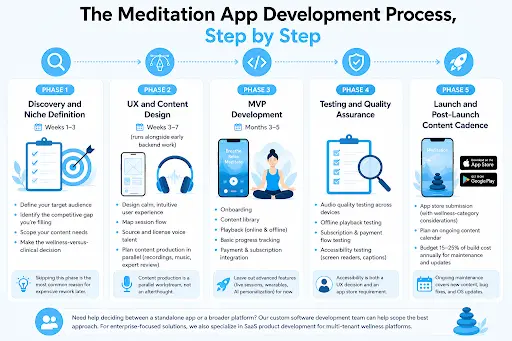
Phase 1: Discovery and Niche Definition (Weeks 1-3)
This is where you define your actual audience, identify the competitive gap you're filling, scope your content needs, and make the wellness-versus-clinical decision covered earlier. Skipping or rushing this phase is the single most common reason projects end up needing expensive rework later.
Phase 2: UX and Content Design (Weeks 3-7, running alongside early backend work)
Visual design for a meditation app has to feel calm, not just look clean. This is also when session flow gets mapped out and narrator or voice talent gets sourced and licensed.
One thing that catches teams off guard: content production, meaning recording sessions, licensing background music, and getting expert review if you're making any health-adjacent claims, is a parallel workstream, not something you handle after the app is built. Planning for it late is one of the most common reasons launches slip.
Phase 3: MVP Development (Months 3-5)
Core MVP scope usually includes onboarding, the content library, playback, basic progress tracking, and payment integration. Deliberately leave out live sessions, wearable integration, and advanced AI personalization for this stage. Add them once you have real usage data telling you they're worth the investment.
Phase 4: Testing and Quality Assurance
Audio quality testing across a range of devices, offline playback testing, full subscription and payment flow testing, and an accessibility check covering screen reader support and captions for any video content. Accessibility isn't optional polish here. It's both a UX decision and, increasingly, a policy expectation from the app stores themselves.
Phase 5: Launch and Post-Launch Content Cadence
App store submission for wellness-category apps has its own set of review considerations, particularly around any claims made in your listing copy. After launch, budget for an ongoing maintenance rate of roughly 15-25% of your build cost annually, covering new content, bug fixes, and OS updates. This is a similar figure to what we cite in our mental health app guide, and it holds up across most wellness app categories.
If you're weighing whether to build this as a standalone consumer app or as part of a broader platform, our custom software development team can help scope that decision during discovery, and if you're leaning toward a multi-tenant, B2B wellness platform for enterprise clients, that's more of a SaaS product development conversation.
How Much Does Meditation App Development Cost
Costs vary a lot by app type and depth of features. Here's a realistic breakdown:
| App Type | MVP Cost | Full Platform |
| Basic guided meditation library app | $6,000 - $12,000 | $18,000 - $25,000 |
| Sleep or soundscape app with offline mode | $8,000 - $10,000 | $20,000 - $30,000 |
| Mindfulness app with streaks and journaling | $7,000 - $9,000 | $22,000 - $32,000 |
| AI-personalized meditation app | $8,000 - $10,000 | $30,000 - $45,000+ |
| Enterprise or corporate wellness platform | $12,000 - $15,000 | $28,000 - $40,000 |
A few things push these numbers up or down: how many platforms you're targeting, how much AI personalization you want, whether you need wearable and HealthKit integration, and how detailed the visual design work is.
Content production is the cost that gets buried most often in other estimates, so it deserves a callout here. Professional narration, licensed background music, and translation for multi-language support aren't one-time expenses. They're an ongoing line item, because a stale content library is one of the fastest ways to lose subscribers.
Plan for annual maintenance at roughly 15-20% of your build cost, covering content updates, bug fixes, and keeping pace with OS changes.
For a fuller picture of what shapes mobile app budgets more broadly, our mobile app development page breaks down the underlying cost drivers in more depth.
Looking for an Accurate Meditation App Cost Estimate?
Every meditation app is different, and development costs depend on your feature requirements, integrations, and business objectives. Share your project idea with our team, and we'll provide a tailored estimate and development roadmap.
Request a Cost Estimate
Monetization Models That Actually Work
Freemium with a premium subscription tier is the dominant model, making up more than 60% of the market. Users expect a real trial period before they're asked to pay, not a locked app with a paywall on the first screen.
Corporate and B2B licensing is a growing second path, priced per employee and sold through benefits packages rather than app store downloads. It's a steadier revenue model than consumer subscriptions, since it doesn't depend on individual churn the same way.
One-time premium content packs exist too, but they tend to underperform subscriptions on long-term retention, since there's no ongoing reason for a user to keep coming back once they've bought the pack.
Pure ad-supported models generally underperform in this category specifically. Ads sit awkwardly against a product whose entire pitch is calm and reduced distraction, and users notice the contradiction.
Common Mistakes That Sink Meditation Apps
- Cloning Calm or Headspace feature for feature.
Matching their feature list without a distinct audience or content angle just means competing directly against two apps with years of content libraries and brand recognition already built up. - Underestimating content production as an ongoing cost.
Treating audio and video content like a one-time expense instead of a running content calendar is one of the most common budget mistakes we see. - Over-notifying users.
In a category where the entire promise is reducing stress, extra notifications work directly against your own value proposition. - Skipping the wellness-versus-clinical-claims decision early.
Adding a mood-tracking feature that implies treatment, without having made a deliberate decision to build a mental health product, means retrofitting compliance work later at a much higher cost. - Ignoring accessibility.
Captions, screen reader support, and plain-language onboarding aren't extras. They're both a UX consideration and, increasingly, a policy expectation from app store reviewers. - Launching without a content refresh plan.
A pattern shows up again and again in this category: strong initial downloads followed by a steep drop-off once the content starts to feel stale. Planning your content calendar before launch, not after, is the fix.
Choosing a Meditation App Development Company
Since this is a common search itself, it's worth answering directly. A few things actually matter when you're evaluating a development partner for this specific category.
Look for a portfolio that includes wellness or health-tech products, not just general mobile apps. Content licensing and production workflows are a real part of this project, so ask how a prospective team handles that, not just the coding side. Ask about their post-launch maintenance model, since ongoing content updates and OS compatibility are recurring needs, not a one-time deliverable. And ask whether they understand the compliance boundary between wellness and mental health apps covered earlier in this article, because that understanding should be shaping their feature recommendations from the first discovery call.
Building a Meditation App That Actually Lasts
The market is growing at a steady double-digit rate, but that growth doesn't guarantee any individual app's success. Two teams can build nearly identical apps and get completely different outcomes, and the difference almost always comes down to content quality and a clearly defined audience, not the length of the feature list.
Pick a real gap. Build the essentials well before reaching for advanced features. Plan for content as an ongoing commitment, not a launch-day checkbox. That's a more realistic path to a meditation app that keeps users past their first week than trying to out-build Calm on features alone.
At Nyusoft, we've worked through this exact set of decisions with wellness and health-tech clients, from picking the right niche during discovery to scoping the tech stack and content workflow that fits the budget. If you're weighing up what your own meditation app should actually include, our mobile app development and UI/UX design teams are a good place to start that conversation, and our case studies show how similar projects have come together end-to-end.
FAQs
1. How much does meditation app development cost?
The cost of meditation app development depends on the app's complexity, features, supported platforms, and third-party integrations. A basic meditation app typically starts around $6,000, while a feature-rich solution with AI personalization, wearable integration, and premium content can cost $40,000 or more.
2. How long does it take to develop a meditation app?
A simple meditation app can take 2–3 months to develop, while a more advanced application with custom features, AI capabilities, and enterprise functionality may require 4–6 months or longer. The timeline depends on the project scope and development approach.
3. What features should a meditation app include?
A successful meditation app should include user registration, guided meditation sessions, personalized recommendations, progress tracking, reminders, offline listening, subscription management, secure payments, and an intuitive admin panel. Additional features like AI recommendations and wearable integration can further improve the user experience.
4. Which technologies are best for meditation app development?
The right technology stack depends on your business goals. Many businesses choose Flutter or React Native for cross-platform development, while Node.js, Python, cloud services, and secure databases provide a scalable backend. AI tools and wearable integrations can also be added as needed.
5. Can AI be integrated into a meditation app?
Yes. AI can personalize meditation recommendations based on user preferences, daily habits, mood check-ins, and activity history. It can also power intelligent coaching, adaptive wellness plans, and conversational assistants to improve user engagement.
6. How do meditation apps make money?
Most meditation apps generate revenue through subscription plans, freemium models, in-app purchases, corporate wellness programs, premium content, and partnerships. Choosing the right monetization strategy depends on your target audience and business model.
7. Can a meditation app integrate with wearable devices?
Yes. Meditation apps can integrate with wearable devices and health platforms such as Apple Health, Google Health Connect, Fitbit, and Apple Watch. These integrations allow users to track wellness metrics, monitor progress, and receive more personalized recommendations.
8. Is it better to build a native or cross-platform meditation app?
The right approach depends on your business goals, budget, and timeline. Cross-platform frameworks like Flutter and React Native help reduce development time and cost while supporting both iOS and Android. Native development may be preferred for projects requiring advanced platform-specific features or deeper hardware integration.
9. What factors affect meditation app development costs?
Several factors influence development costs, including the number of features, UI/UX complexity, supported platforms, AI capabilities, third-party integrations, content management, testing requirements, and ongoing maintenance. Defining your project scope early helps estimate the budget more accurately.
10. Why should businesses invest in meditation app development?
The growing demand for digital wellness solutions has created new opportunities for startups, wellness brands, fitness businesses, and enterprises. A meditation app can increase customer engagement, generate recurring subscription revenue, strengthen brand loyalty, and support long-term business growth in the expanding wellness market.
Ready to Build Your Meditation App?
Whether you're launching a startup, expanding your wellness brand, or creating a corporate mindfulness solution, having the right development partner can make all the difference. At Nyusoft, we build scalable, feature-rich meditation apps tailored to your business goals. From strategy and UI/UX design to development, AI integration, testing, and post-launch support, our team helps turn your idea into a successful mobile application.
Get a Free Consultation