


 Front End Development
  Back End Development
  CMS / ECommerce Development
  Mobile Apps Development
  Cloud Services
  Fullstack Services
  Solution


How to Build an AI-Powered Fitness Tracking App: Features, Tech Stack & Cost
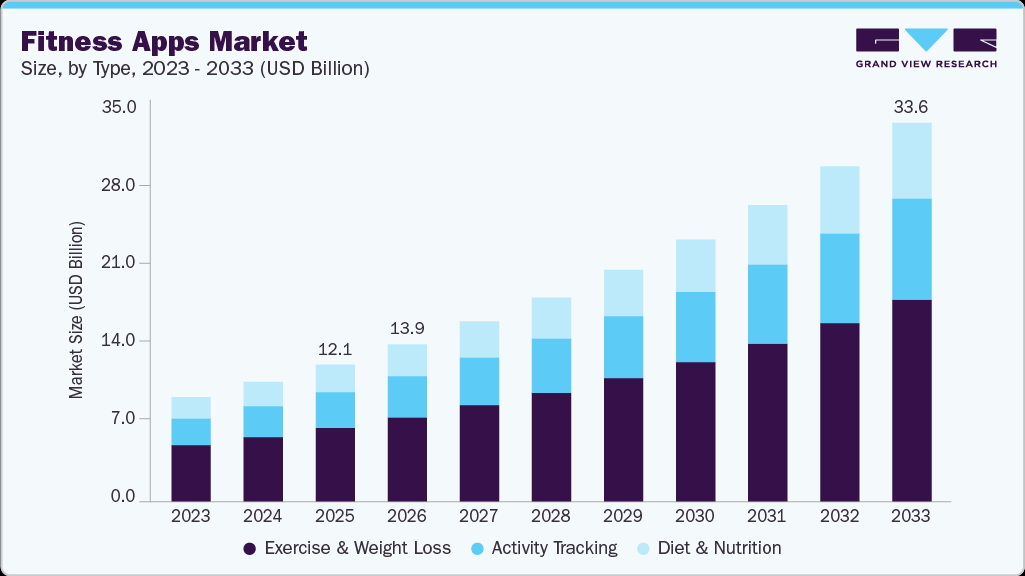
The global fitness app market is projected to surpass $33.6 billion by 2030, growing at a CAGR of over 13.40% (Grand View Research). But here is the number that matters more for founders and CTOs: apps with AI-driven personalisation report up to 35% higher daily active user retention compared to their static counterparts.
The difference between a fitness app that users open daily and one that gets deleted after two weeks comes down to one thing: intelligence. Users no longer want an app that simply logs their runs or counts their reps. They want an app that understands them, adapts to them, and anticipates what they need before they ask.
This guide covers everything involved in AI Powered Fitness App Development from defining the right feature set and selecting a tech stack to understanding real development costs and the engineering decisions that separate good AI fitness apps from great ones. Whether you are a startup founder scoping your MVP, a product manager planning the next major release, or a CTO evaluating build-vs-buy options, this is your complete reference.
In this guide:
- What is an AI-powered fitness tracking app?
- Why build one: market opportunity and business case
- Must-have features of an AI fitness tracking app
- How AI works inside a fitness tracking app
- Tech stack for AI fitness tracking app development
- Step-by-step development process
- How much does it cost to build an AI fitness tracking app?
- Common challenges and how to solve them
- Conclusion and next steps
What Is an AI-Powered Fitness Tracking App?
A traditional fitness tracking app is a digital logbook. It records what you tell it calories consumed, steps taken, workouts completed and presents that data back in charts and streaks. Useful, but passive.
An AI-powered fitness tracking app is fundamentally different. It does not wait for instructions. It observes patterns in your behaviour, biometric signals, and activity data, then uses machine learning to generate predictions, adapt recommendations, and personalise the experience without manual input from the user.
Consider the difference in practice:
A traditional app shows you that you burned 400 calories on Monday's run.
An AI fitness app notices that your heart rate variability is lower than your baseline on Tuesday, predicts elevated fatigue risk, and automatically recommends a recovery session instead of the scheduled HIIT workout before you even open the app.
Well-known examples already doing this at scale include Freeletics (adaptive workout plans driven by performance feedback loops), Whoop (HRV-based recovery scoring), and Fitbod (ML-powered strength training recommendations that adjust based on muscle fatigue models).
Building an AI fitness app means building a system that learns. That engineering challenge and the product opportunity it creates is what this guide addresses.
Why Build an AI Fitness App: Market Opportunity and Business Case
The market numbers
The fitness app market is no longer a niche. Over 1 in 3 smartphone users in developed markets has at least one health or fitness app installed (Statista). AI adoption within that space is accelerating sharply driven by wearable proliferation, consumer comfort with data sharing, and the dramatic drop in cost of deploying ML models at scale.
Key signals for founders and investors:
- The AI in healthcare and fitness segment is growing at a CAGR of 44.9% (MarketsandMarkets)
- Average revenue per user (ARPU) for AI-personalised fitness apps is 2-3x higher than generic fitness apps
- Subscription retention rates for personalised fitness apps are 40-60% higher at the 90-day mark than non-personalised equivalents
Three business models worth building for
B2C (Consumer app): Direct-to-consumer apps are monetized via subscription (most common), freemium, or in-app purchases. High user acquisition costs but large addressable market. Examples: Noom, Freeletics, Strava.
B2B (Enterprise / gym software): AI fitness platforms sold to gyms, corporate wellness programs, or health insurers. Lower volume, higher contract value, stickier retention. Often sold as white-label or custom-branded solutions. Nyusoft's healthcare solutions practice covers exactly this kind of white-label health platform built for enterprise buyers.
B2B2C (White-label platform): Build once and license to multiple gym chains or fitness brands. Each client deploys under their own brand. This model significantly improves unit economics for development agencies and technology partners.
Understanding your business model before you scope features is not optional; it shapes every architecture and AI investment decision that follows.
Must-Have Features of an AI Fitness Tracking App
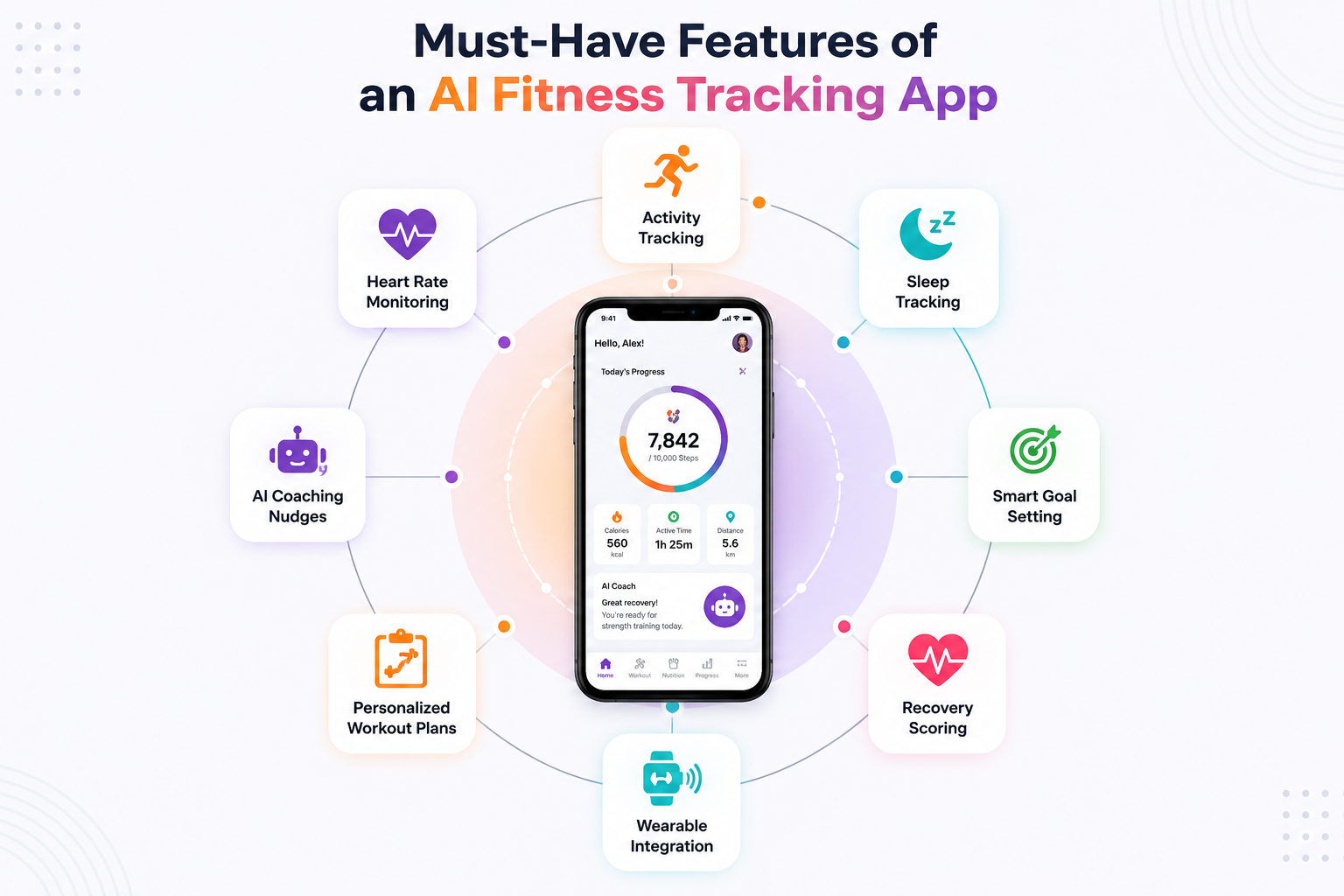
Feature scoping is where most fitness app projects go wrong. Teams either build too much (over-engineering an MVP) or too little (shipping a generic tracker with an "AI" label on it). The right approach is to separate core tracking features from AI-powered features and prioritize ruthlessly.
Core tracking features
These are table stakes, the baseline that any fitness tracking app, AI-powered or not, must deliver:
| Feature | Description |
| Activity tracking | Auto-detect workouts (run, cycle, swim, gym session) using accelerometer and GPS data |
| Step counter | Pedometer integration with daily goal tracking and streak mechanics |
| Calorie tracking | Food logging (manual and barcode scan) with nutritional breakdown |
| Heart rate monitoring | Real-time BPM via wearable or camera-based PPG |
| Sleep tracking | Sleep stage detection (light, deep, REM) via wearable sensors |
| GPS route mapping | Live route tracking for outdoor workouts, elevation data, pace splits |
| Workout logging | Manual and auto-detected exercise logging with sets, reps, weight, duration |
| Progress dashboard | Visual representation of trends across activity, body metrics, and nutrition |
For the calorie and nutrition tracking layer specifically, integrating a purpose-built AI-powered nutrition tracking capability rather than treating food logging as a secondary feature meaningfully increases both engagement depth and premium conversion rates.
AI and ML-powered features
This is where your app earns its differentiation. These features require ML models, data pipelines, and ongoing model training, but they are also the features users pay more for and churn less from:
Personalized workout plans: ML models analyze a user's fitness history, stated goals, available equipment, schedule, and recovery status to generate dynamic weekly programs. Plans adapt week-over-week based on performance signals, not just a static 12-week template.
AI coaching nudges: Contextual push notifications driven by behavioral ML. Not "Time to work out!" Instead, "Your recovery score is high, and you have a 90-minute window before your calendar blocks ideal conditions for today's strength session."
Smart goal setting: Rather than letting users set arbitrary goals, an AI model cross-references the user's baseline metrics, historical trend data, and behavioral patterns to suggest achievable, progressive goals with predicted milestone dates.
Form analysis and correction (computer vision): Using the device camera or wearable sensors, a computer vision model analyzes movement patterns during exercises and provides real-time corrective feedback. Critical for injury prevention in home workout contexts.
Predictive recovery scoring: Models built on heart rate variability (HRV), sleep quality, training load, and subjective wellness inputs generate a daily readiness score. The app then adjusts workout intensity recommendations accordingly. This is where real-time biometric intelligence connects directly to the kind of longitudinal health data that our AI-powered health monitoring platform is designed to capture and surface.
Adaptive difficulty: Workout plans that dynamically adjust intensity, volume, and rest periods based on real-time performance data within a session. If a user is completing sets faster than projected, the model increases load. If they are struggling, it scales back.
Injury risk flagging: Anomaly detection models identify patterns in movement data, training load, and recovery metrics that are statistically correlated with injury onset and surface warnings before the user feels symptoms.
AI personal trainer (conversational): NLP-powered chat interface that answers fitness questions, explains exercise mechanics, logs data via natural language ("I did 3 sets of 10 squats at 80 kg"), and provides motivational coaching, essentially a GPT-powered fitness coach embedded in the app.
Wearable and device integration features
An AI fitness app without wearable integration is leaving its most valuable data source on the table. Key integrations to scope:
| Platform | Data available | SDK |
| Apple Watch / HealthKit | HRV, ECG, SPO2, workout data, sleep | Apple HealthKit |
| Google Fit | Activity, heart rate, nutrition, sleep | Google Fit REST API |
| Fitbit | Steps, sleep stages, HRV, skin temp | Fitbit Web API |
| Garmin Connect | Advanced running metrics, VO2 max, training load | Garmin Health API |
| Oura Ring | Sleep, readiness, HRV, body temperature | Oura REST API |
| WHOOP | Strain, recovery, HRV | WHOOP API |
How AI Works Inside a Fitness Tracking App
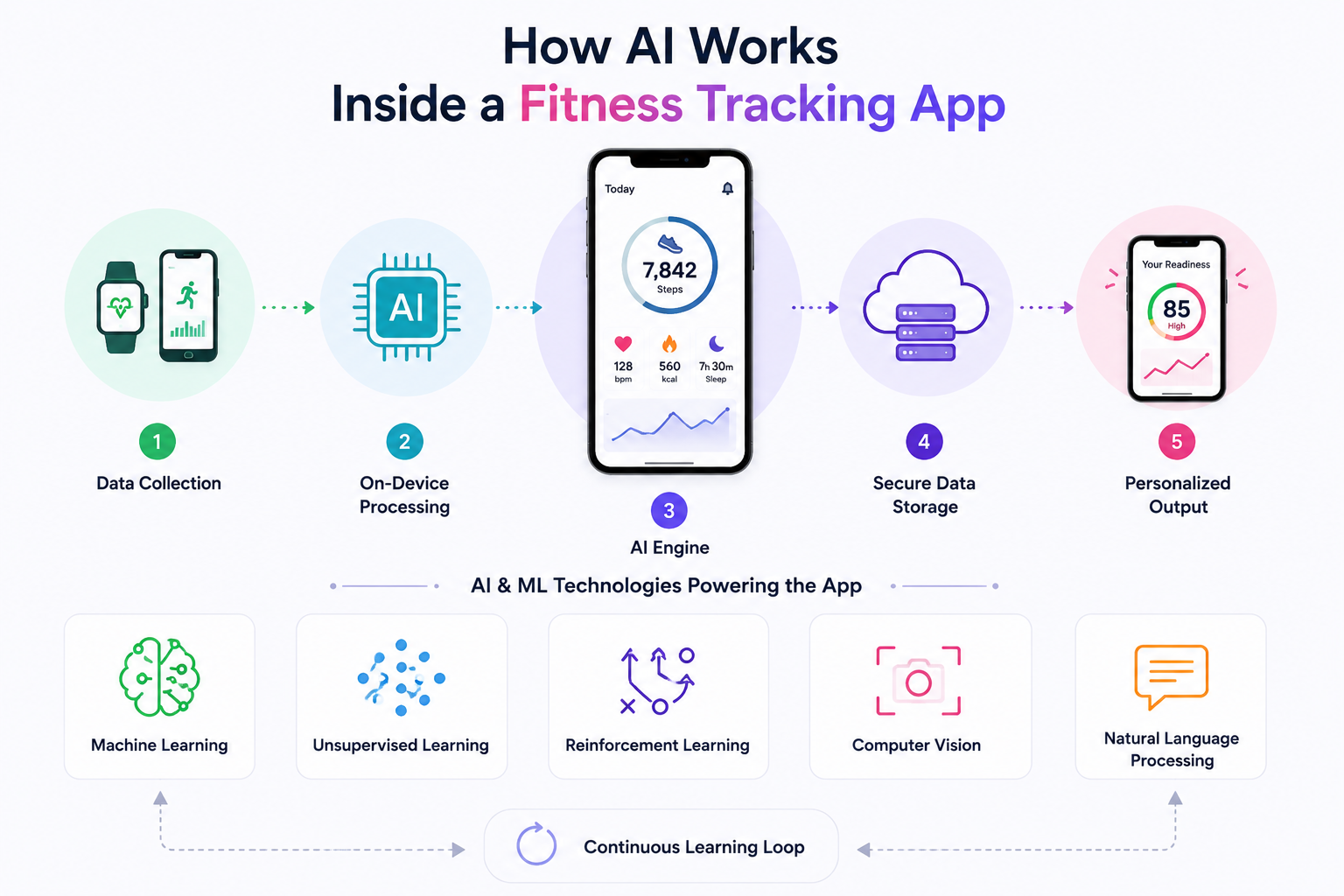
Understanding the engineering architecture behind AI fitness features is critical for product leaders scoping a build. Here is how the key components work in practice.
Machine learning models used in fitness apps
Different AI features inside a fitness tracking app rely on different categories of ML:
Supervised learning powers workout classification, calorie estimation from sensor data, and sleep stage detection. The model is trained on labeled datasets of known workout types with their corresponding sensor signatures and learns to classify new sensor inputs accordingly.
Unsupervised learning drives pattern recognition and anomaly detection. It identifies clusters in user behaviour data (e.g., users who work out in the morning have 23% higher 90-day retention) without being given explicit labels valuable for personalization and churn prediction.
Reinforcement learning is the engine behind truly adaptive workout plans. The model treats the workout program as a series of decisions (increase intensity? reduce volume? swap exercise?) and learns optimal adjustments over time by observing user performance outcomes, improving its recommendations with every session completed.
Computer vision powers form analysis. Models like MediaPipe Pose detect 33 body landmarks in real time, enabling the app to assess joint angles, movement symmetry, and rep quality from a standard phone camera.
Natural language processing (NLP) is the backbone of AI coaching features, parsing voice or text inputs for workout logging, generating contextually appropriate coaching messages, and powering conversational fitness assistants. Nyusoft's AI chatbots' and virtual assistants' capabilities cover exactly this kind of NLP layer for conversational health and coaching interfaces.
Real-time data processing pipeline
A production AI fitness app processes data across multiple layers:
- Sensor Layer → Wearable / phone sensors (accelerometer, GPS, HR sensor, camera)
- Edge Processing → On-device ML models run inference locally for latency-sensitive features (real-time activity tracking and form feedback)
- API Gateway → Encrypted data transmission to cloud backend
- Cloud ML Layer → Heavy model inference (personalisation engine, recovery scoring, predictive recommendations)
- Data Store → Time-series database for biometric history + user event logging
- Personalization → Output layer that generates the tailored UI content the user sees
- Engine → (workout plan, nudge, recovery score, goal update)
The critical architectural decision is edge vs. cloud ML. Features requiring sub-100ms latency (real-time form correction, live heart rate coaching) must run on-device using lightweight models. Features requiring more computational power (weekly plan generation, predictive injury risk) can run in the cloud with slightly higher latency tolerance.
Personalisation engine: how recommendations adapt over time
The personalization engine is the most technically complex component of an AI fitness app and the one most competitors leave undiscussed.
It operates as a continuous feedback loop:
Cold start: New user completes an onboarding questionnaire. Pre-trained population-level models generate initial recommendations based on goal, fitness level, and available equipment.
Data accumulation: Every workout logged, every push notification opened or dismissed, every session rated all of this is a behavioral signal fed back into the model.
Model updating: User-specific fine-tuning occurs on a rolling basis. After 2-3 weeks of data, recommendations shift from population-level averages to individually calibrated outputs.
Contextual adaptation: The engine layers in contextual signals time of day, calendar availability, weather, and recent sleep quality to generate recommendations that fit the user's life, not just their fitness profile.
Outcome optimisation: The model is ultimately optimised for the metric that matters for your business whether that is workout completion rate, goal achievement, or subscription renewal. Reinforcement learning continuously adjusts recommendation strategy to maximise that metric.
This loop is what separates a personalized app from a genuinely adaptive one. Building it properly requires not just ML engineering but careful data architecture and a defined behavioral data strategy from day one. Nyusoft's machine learning solutions practice is built around exactly this kind of custom model design and iterative retraining architecture.
Tech Stack for AI Fitness Tracking App Development
Choosing the right fitness app tech stack is one of the most consequential decisions in the build and one where generic app development advice often fails. AI fitness apps have specific requirements around real-time data processing, on-device ML, and health data compliance that shape every layer of the stack.
Frontend and mobile frameworks
| Framework | Best for | Trade-off |
| React Native | Cross-platform MVP builds; large talent pool | Some limitations with native health sensor APIs |
| Flutter | Cross-platform with near-native performance; strong for animation-heavy UIs | Smaller ecosystem for health integrations |
| Swift (iOS) | Native iOS with full HealthKit access; best performance for on-device ML | iOS only; higher cost |
| Kotlin (Android) | Native Android with full Google Fit and sensor access | Android only |
Recommendation for most fitness app builds: Start with React Native or Flutter for cross-platform reach, with native modules bridged for HealthKit and Google Fit where needed. If your core differentiator is on-device AI (real-time form analysis, sensor-heavy tracking), native is worth the additional investment.
Backend and cloud infrastructure
| Component | Options |
| API layer | Node.js, Python (FastAPI / Django REST) |
| Real-time data | WebSockets (Socket.io), Firebase Realtime Database |
| Time-series data storage | InfluxDB, TimescaleDB (for biometric history) |
| General database | PostgreSQL, MongoDB |
| Cloud provider | AWS (most mature health compliance tooling), GCP (strongest ML infrastructure), Firebase (fastest for MVP) |
| Authentication | Auth0, Firebase Auth, AWS Cognito |
| Push notifications | Firebase Cloud Messaging (FCM), APNs |
For teams choosing Node.js or Python on the backend, both of which are strong choices for fitness app API layers, the decision often comes down to where the heavier ML workloads sit. Python's ecosystem (FastAPI, TensorFlow, scikit-learn) makes it the natural choice when the backend is also handling model serving.
AI and ML frameworks and APIs
| Use case | Framework / Tool |
| Custom ML model training | TensorFlow, PyTorch |
| On-device inference (iOS) | Core ML, Create ML |
| On-device inference (Android) | TensorFlow Lite, ML Kit |
| Cloud ML serving | Google Vertex AI, AWS SageMaker |
| Pose detection / form analysis | MediaPipe (Google), PoseNet |
| NLP / AI coaching | OpenAI API (GPT-4o), Anthropic Claude API |
| Nutrition recognition (food photo) | Clarifai Food Model, LogMeal API |
| Predictive analytics | scikit-learn, XGBoost (for structured data models) |
For teams building conversational AI coaching features on top of LLMs, Nyusoft's LLM integrations capability covers the prompt engineering, context management, and API orchestration required to build reliable fitness coaching assistants on top of GPT-4o or Claude.
Third-party integrations
| Integration | Purpose |
| Apple HealthKit | iOS health data read/write |
| Google Fit API | Android health data read/write |
| Fitbit Web API | Fitbit device data sync |
| Garmin Health API | Advanced sports metrics |
| Oura / WHOOP API | Recovery and sleep data |
| Edamam / Nutritionix API | Nutritional database for food logging |
| Stripe | Subscription billing |
| Twilio / OneSignal | Push notification infrastructure |
| Amplitude / Mixpanel | Product analytics and retention tracking |
Read Also: Fitness App Monetization Models: Beyond the Subscription
Step-by-Step: How to Build an AI Fitness Tracking App
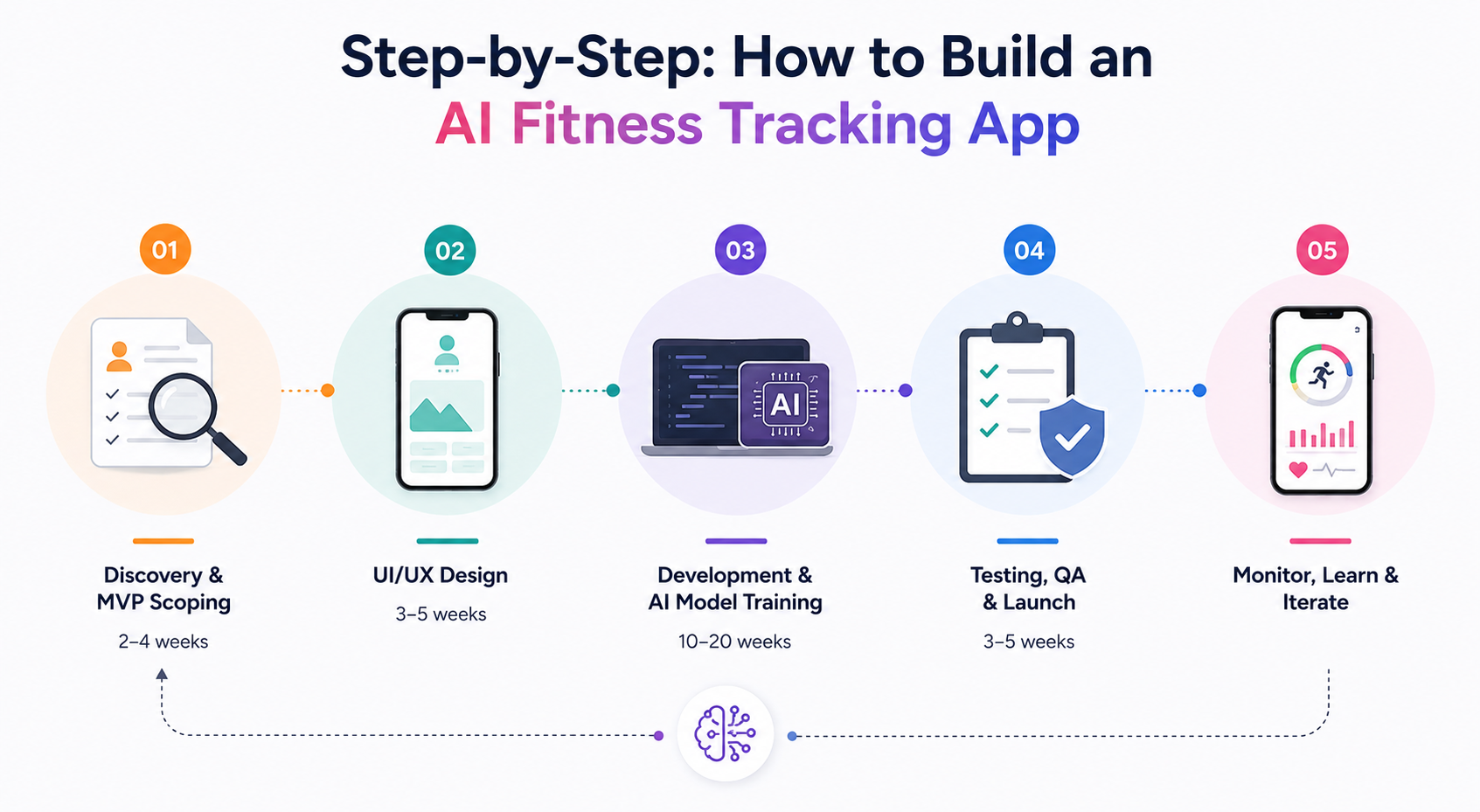
Step 1: Discovery and MVP scoping (2-4 weeks)
The most expensive mistake in fitness app development is building the wrong thing at full fidelity. Discovery exists to prevent this.
During discovery, the core team (product, engineering, and design) aligns on the following:
Target user persona: Who is the primary user? Are you a recreational runner, a gym-goer following a coach program, or a corporate wellness participant? The answer shapes every feature priority.
Core AI differentiator: What is the one AI capability that makes your app meaningfully better than existing options? This single capability should define the MVP.
MVP feature set: A ruthless prioritization exercise. For a fitness AI MVP, this typically means one core tracking feature plus one AI personalization feature, properly executed, rather than ten features built halfway.
KPIs: Define success before writing a line of code. Typical metrics: Day-30 retention, weekly active workout rate, NPS, subscription conversion rate.
Data strategy: What data does your AI need? How will you collect it? How will you handle consent, storage, and compliance? This cannot be retrofitted later.
Output: Product requirements document, user stories, MVP feature list, data architecture decision.
Step 2: UI/UX design for fitness apps (3-5 weeks)
Fitness app UX has its own conventions and its own failure modes. The two most common are:
Onboarding friction kills AI cold-start quality. Your AI needs data to personalize. The onboarding flow is where you collect the initial signal fitness level, goals, available equipment, schedule, and injury history. The design challenge: collect enough to make the AI useful immediately without making the user abandon it before they ever see the app's value. Best practice is a progressive onboarding flow of 5-8 screens that feels like a personal trainer intake, not a data entry form.
Dashboard design determines perceived intelligence. Users judge your AI by what they see on the home screen. If the dashboard shows generic stats (steps: 6,432), the app feels dumb. If it surfaces a contextualized insight ("Your recovery is strong today; here is a plan that takes advantage of it"), the AI feels real. Invest heavily in dashboard UX.
Other design considerations:
- Gamification patterns (streaks, badges, social challenges) have an outsized effect on retention for fitness apps; design these in from the start
- Accessibility: heart rate data and workout stats must be legible in outdoor lighting conditions and at small sizes
- Dark mode is a near-universal expectation for fitness apps used during gym sessions
Great fitness app UX requires deep domain knowledge of how users actually move through health and workout flows. Nyusoft's UI/UX design services team has applied this thinking across health, wellness, and on-demand platforms, and the patterns that work in fitness apps are meaningfully different from generic mobile UX.
Output: Figma prototype (all key flows), component library, design system, motion spec for key transitions.
Step 3: Development and AI model training (10-20 weeks, depending on scope)
Development runs in parallel streams for most AI fitness app builds:
Mobile development stream: Feature-by-feature sprint delivery against the approved design. Native modules for health sensor integrations are typically the most time-consuming components; budget 2-3 weeks for HealthKit and Google Fit integration and testing across device types.
Backend and API stream: REST API development, database schema, authentication, push notification infrastructure, third-party integration. Real-time WebSocket architecture for live workout features needs careful load testing.
AI/ML stream: This is where fitness apps diverge most from standard mobile builds:
Pre-trained model integration: Using existing models (Core ML, MediaPipe, OpenAI API) is significantly faster than custom training. For most MVPs, pre-trained models with fine-tuning get you 80% of the way.
Custom model training: If your core differentiator requires a custom model (e.g., a proprietary recovery scoring algorithm), you need a training dataset, data labeling, training infrastructure, and ongoing evaluation pipelines. Plan for 6-12 weeks for an initial custom model, plus ongoing retraining post-launch. Nyusoft's AI development services team manages this full ML lifecycle from dataset preparation through to production model deployment and monitoring.
Data labeling: Custom fitness models require labeled training data annotated with sensor readings, classified workout types, and scored recovery samples. This is often underestimated in project plans. Budget time and cost for it explicitly.
Output: A functional app with all MVP features, integrated AI models, backend APIs, and an admin dashboard.
Step 4: Testing, QA, and launch (3-5 weeks)
AI fitness apps have QA requirements beyond standard mobile testing:
AI model accuracy testing: Does the workout classifier correctly identify all target exercise types with acceptable precision/recall? Does the personalization engine generate sensible plans for edge-case users (complete beginners, users with stated injuries, users with atypical schedules)?
Wearable compatibility QA: Test against actual devices, not just simulators. Apple Watch Series 6, 7, 8, and 9 have different sensor capabilities. Fitbit Charge vs. Fitbit Sense have different API data availabilities.
Health data compliance check: Before submission, conduct a formal review against HIPAA (if handling health data for US users) and GDPR (for EU users). App Store and Play Store review for health apps is stricter than general apps. Apple in particular will reject apps that misrepresent health claims.
Performance testing: AI inference on lower-end devices must stay within acceptable latency bounds. On-device ML on an iPhone SE vs. an iPhone 15 Pro produces meaningfully different performance profiles.
Beta testing: A structured beta with 100-500 real users running real workouts produces failure modes that lab testing will never surface. Build beta testing time into the schedule explicitly.
Output: QA-certified build, App Store and Play Store listings, launch plan, support documentation.
How Much Does It Cost to Build an AI Fitness Tracking App?
Cost estimation for AI fitness app development varies significantly based on feature scope, AI complexity, team structure, and engagement model. The figures below are directional ranges based on market-rate development costs.
Cost by feature complexity (agency or dedicated team model)
| Build tier | What is included | Estimated cost range |
| MVP / Basic | Core tracking (steps, calories, workouts), basic activity charts, manual food log, user authentication, simple goal setting no custom AI | $15,000 - $25,000 |
| Mid-tier with AI | All MVP features and AI workout recommendations (pre-trained models), wearable integration (HealthKit and Google Fit), personalised dashboard, push notification engine, NLP-based workout logging | $20,000 - $40,000 |
| Full AI platform | All mid-tier features and custom ML models (recovery scoring, injury prediction), real-time form analysis (computer vision), adaptive personalisation engine, AI coaching chatbot, multi-wearable support, admin analytics dashboard | $80,000 - $120,000+ |
AI-specific cost line items often missed in project scoping
These costs appear in every serious AI fitness app build but are routinely absent from early estimates:
| Cost item | Typical range | Notes |
| ML model training (custom) | $15,000 - $50,000 | It depends on dataset size, model complexity, training infrastructure |
| Data labelling / annotation | $5,000 - $20,000 | Required for custom supervised learning models |
| Third-party AI API costs (ongoing) | $500 - $5,000/month | GPT API, computer vision APIs, nutrition recognition scales with MAU |
| Model retraining (post-launch) | $3,000 - $10,000/quarter | Models degrade without periodic retraining on new user data |
| Health data compliance audit | $5,000 - $15,000 | HIPAA and GDPR compliance review by specialist counsel or firm |
| Cloud ML infrastructure (ongoing) | $1,000 - $8,000/month | Scales with user base; GPU inference is expensive |
Cost by team and engagement model
| Model | Typical rate | Best for | Trade-off |
| In-house team | $120,000 - $200,000+/year per senior engineer | Long-term product companies with ongoing roadmap | Highest fixed cost, slowest to staff for AI specialisms |
| Freelancers | $50 - $150/hour | Supplementing existing team with specific skills | Coordination overhead: AI specialists are hard to find freelance |
| Development agency | $60,000 - $400,000 (project-based) | Startups and founders needing full-stack delivery | Best value for AI-heavy builds; agency brings ML expertise and fitness domain knowledge |
| Nearshore / offshore agency | $30,000 - $180,000 | Cost-conscious builds with longer timelines | Quality varies significantly; strong vetting required |
For most founders and product teams building an AI fitness tracking app for the first time, working with a specialist development partner who has built in this domain before significantly reduces both cost overruns and model quality risk. Fitness app AI is not generic ML; it requires domain expertise in biometric data, sensor signal processing, and health behaviour modelling. Nyusoft's SaaS product development practice includes recurring-revenue fitness platform builds structured exactly for this kind of phased investment model.
Common Challenges in AI Fitness App Development - and How to Solve Them
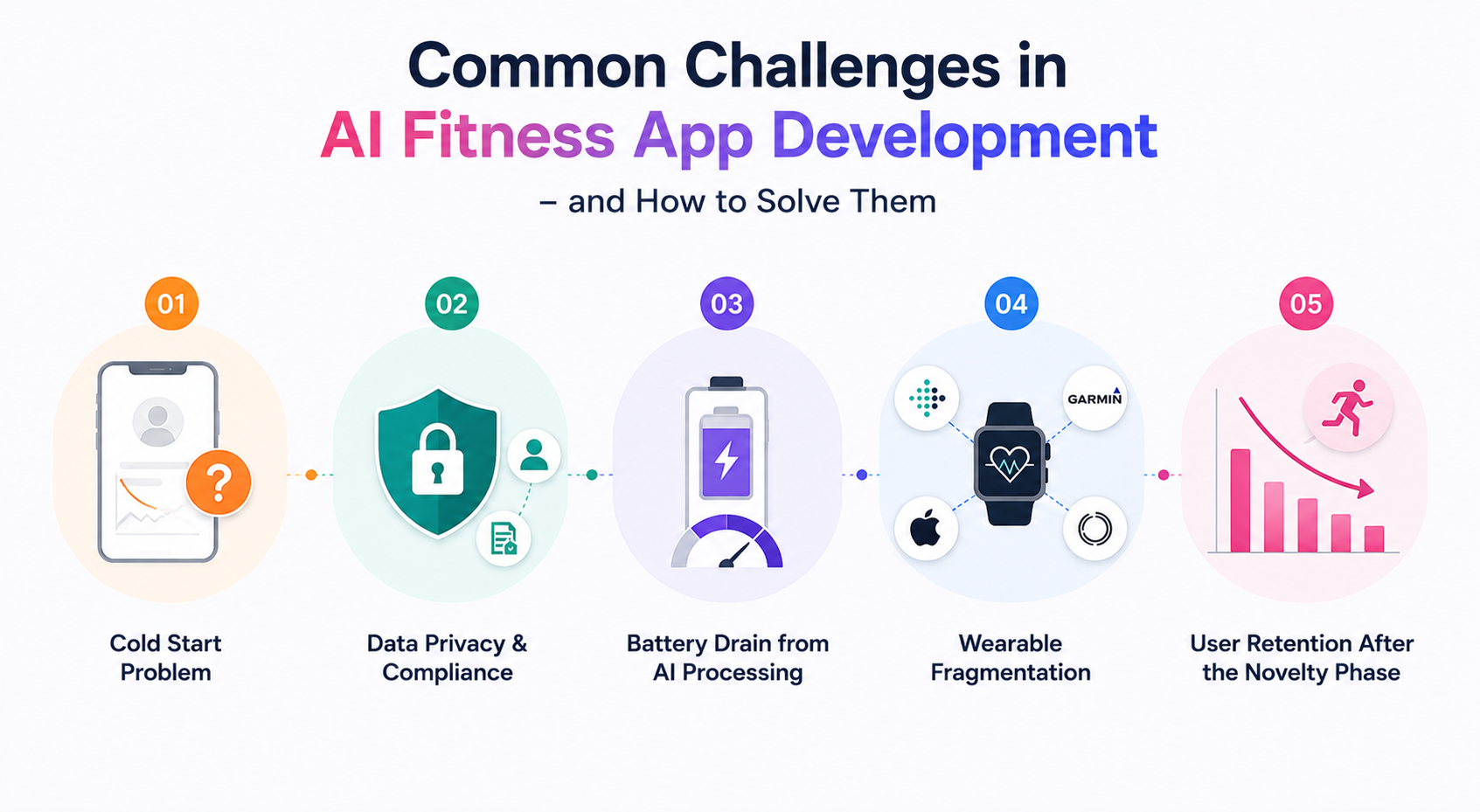
Challenge 1: The cold-start problem
The problem: Your AI needs data to personalize. New users have no history. The first session is, by definition, the least personalized, which is also the moment users are evaluating whether the app is worth keeping.
The solution: Design the onboarding flow to collect meaningful prior information (fitness level, goals, schedule, past workout frequency, equipment access). Use population-level models trained on cohorts similar to the new user's stated profile to generate an initial plan that feels personalized even before the user has completed a single workout. A well-designed onboarding questionnaire closes approximately 70% of the cold-start gap.
Challenge 2: Data privacy and health data compliance
The problem: Fitness apps collect some of the most sensitive personal data that exists: biometrics, sleep patterns, medical conditions, and location. HIPAA (US), GDPR (EU), and platform-level policies (Apple's HealthKit data use restrictions) create a complex compliance environment that cannot be handled as an afterthought.
The solution: Architect for privacy from day one. Use on-device ML wherever possible to keep sensitive data local. Anonymize and aggregate data before cloud transmission. Implement explicit, granular user consent flows for each data category. Appoint a data protection lead (or engage specialist counsel) before your first public beta. For teams building for a health or clinical-adjacent audience, Nyusoft's experience in healthcare technology development means compliance requirements are built into the architecture, not bolted on after the fact.
Challenge 3: Battery drain from real-time AI processing
The problem: Real-time sensor polling, GPS tracking, and on-device ML inferences are all battery-intensive. An app that drains 40% of battery during a 45-minute workout will be deleted.
The solution: Use edge ML inference with lightweight, quantized models optimized for mobile (TensorFlow Lite, Core ML). Implement adaptive polling rates: high-frequency sensor reads during active workout detection and low-frequency background polling otherwise. Batch non-real-time processing (weekly plan generation, trend analysis) to off-peak windows.
Challenge 4: Wearable fragmentation
The problem: There are dozens of wearable platforms with different SDKs, data schemas, update frequencies, and API rate limits. Integrating even three or four creates significant engineering complexity and an ongoing maintenance burden.
The solution: Build a unified health data abstraction layer, a normalization service that maps incoming data from all wearable sources into a single internal schema. Changes to the Fitbit API or Garmin SDK then require updates only to the abstraction layer, not to every component of your app that consumes biometric data. This is a one-time architectural investment that pays dividends across the entire product lifecycle. It is also closely related to the IoT device integration patterns. Nyusoft applies in IoT development projects where abstracting across hardware data sources is a core engineering discipline.
Challenge 5: User retention after the novelty phase
The problem: Fitness apps see high early engagement (the "January effect" motivated new users) followed by a sharp drop-off at weeks 3-6 when novelty fades and habit has not yet formed.
The solution: This is primarily a behavioral design challenge, not a technical one, but AI can address it. Personalized push notifications based on the user's individual behaviour patterns (not generic time-based reminders) increase re-engagement rates significantly. Streak mechanics, social accountability features, and milestone recognition systems built into the AI's output layer create habit loops that extend the engagement lifecycle. The AI personalization engine should be optimized explicitly for a retention metric (Day-30 or Day-90 retention), not just workout completion rate. This is also where investing in custom software development rather than off-the-shelf app builders pays off: retention-driving AI logic cannot be configured in a no-code tool; it has to be built.
Conclusion: What to Build Next
Building an AI-powered fitness tracking app is a meaningful engineering and product undertaking. The apps that win in this market are not the ones with the most features; they are the ones whose AI genuinely improves the user's fitness outcomes and whose product experience makes that intelligence visible and trustworthy.
The critical decisions are front-loaded: which AI capability is your core differentiator, what data strategy underpins it, and what tech architecture gives your model the inputs it needs to improve over time? Get those three right, and everything else features, stacks, and costs become a planning exercise rather than a guessing game.
If you are ready to move from outline to execution, the next step is a scoped discovery engagement with a development team that has built in this domain. The nuances of health sensor integration, on-device ML optimization, and behavioral data architecture are not learnable from a sprint zero; they come from having shipped AI fitness products before.
Nyusoft is a specialist team in AI-powered fitness tracking app development. If you have a fitness app concept or an existing product you want to make smarter, talk to our team about what a scoped build looks like for your specific goals.
FAQs
Q1. What is the difference between a traditional fitness app and an AI-powered fitness tracking app?
A traditional fitness app simply records what you manually enter steps, calories, workouts. An AI-powered app goes beyond that by learning your behaviour, analysing your biometric data, and automatically adapting recommendations without you lifting a finger.
Q2. What machine learning models are used inside an AI fitness tracking app?
Different features use different ML models. Supervised learning handles workout classification and sleep detection. Reinforcement learning powers adaptive workout plans. Computer vision enables real-time form analysis. NLP drives conversational AI coaching letting users log workouts through natural language.
Q3. How much does it cost to build an AI-powered fitness tracking app?
A basic MVP starts around $5,000–$10,000. A mid-tier build with AI recommendations and wearable integration runs $10,000–$25,000. A full AI platform with custom models and coaching chatbot can reach $25,000–$75,000+. Ongoing costs like cloud infrastructure and model retraining also add up post-launch.
Q4. How long does it take to build an AI fitness tracking app?
Typically 18–34 weeks end-to-end. Discovery takes 2–4 weeks, design 3–5 weeks, and core development 10–20 weeks. Testing and launch adds another 3–5 weeks. Custom ML model development can push the timeline further by 6–12 weeks.
Q5. What is the best tech stack for building an AI fitness tracking app?
React Native or Flutter works well for cross-platform mobile. Python or Node.js handles the backend. For AI, TensorFlow Lite and Core ML run models on-device, while AWS or GCP hosts heavier cloud ML workloads. InfluxDB is ideal for storing biometric time-series data.
Q6. How does the personalisation engine in an AI fitness app improve over time?
It starts with onboarding data of your goals, fitness level, and schedule. Every workout logged and notification acted on becomes a learning signal. Within 2–3 weeks, recommendations shift from generic population averages to individually tailored outputs that keep getting smarter with each session.
Q7. What business models work best for AI fitness apps?
Three models work well: B2C subscriptions for consumer apps, B2B licensing for gyms and corporate wellness programmes, and B2B2C white-label for selling to multiple fitness brands. Choosing the right model early shapes every feature and architecture decision that follows.
Q8. How do you solve the cold start problem in an AI fitness app?
Collect meaningful data during onboarding fitness level, goals, equipment, and schedule. Use population-level models trained on similar users to generate initial recommendations that feel personalised from day one, even before the user completes their first workout.
Q9. What compliance requirements apply to AI fitness apps that collect health data?
HIPAA applies for US health data, GDPR for EU users, and Apple enforces its own HealthKit data rules. Best practice is to use on-device ML to keep sensitive data local, anonymise data before cloud transmission, and build consent flows in from day one not after launch.
Q10. What hidden costs do founders miss when budgeting for an AI fitness app?
The most overlooked costs are data labelling ($5,000–$20,000), third-party AI API usage ($500–$5,000/month), quarterly model retraining ($3,000–$10,000), and health data compliance audits ($5,000–$15,000). Budgeting only for development without these ongoing AI costs leads to post-launch surprises.