


 Front End Development
  Back End Development
  CMS / ECommerce Development
  Mobile Apps Development
  Cloud Services
  Fullstack Services
  Solution


Fitness App Monetization Models: Beyond the Subscription
Most fitness apps launch with a single bet: the subscription. A monthly fee, a premium tier, maybe an annual discount. It feels safe. It feels proven. And for the first few months, the numbers look promising.
Then reality arrives. Studies consistently show that more than 80% of fitness app users churn within the first 90 days. When your only revenue lever is a recurring charge on users who've already stopped showing up, that churn doesn't just hurt retention metrics it collapses your entire business model.
The most successful fitness platforms Peloton, Future, MyFitnessPal, Strava don't rely on subscriptions alone. They layer multiple revenue streams, each targeting a different user behaviour, a different buyer, or a different stage of the product journey.
So what are fitness app monetization models, exactly? They are the structured strategies a fitness app uses to generate revenue from its users, partners, or data independently of or in combination with a subscription offering. The best-performing apps treat monetization as an architecture decision, not an afterthought.
This guide breaks down eight models in full: how each works, who it works for, and how to decide which combination fits your app's stage and audience. If you are a CTO or founder evaluating how to build a revenue-resilient fitness app, this is your decision framework and if you are still at the planning stage, our AI-Powered Fitness App Development solutions are built to support exactly these kinds of architecture decisions from day one.
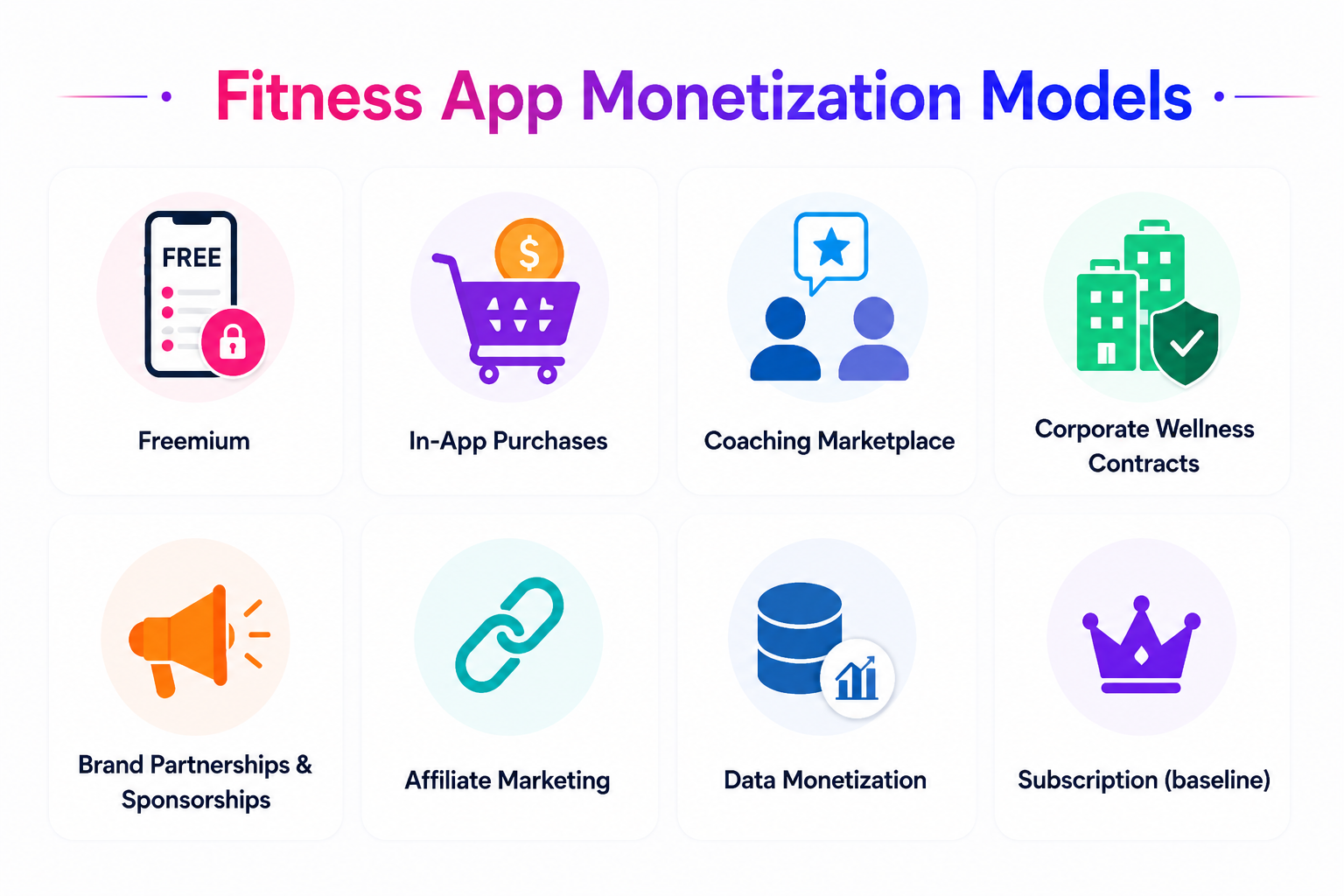
The 7 Fitness App Monetization Models
Before diving deep into each, here is an at-a-glance comparison to orient your thinking:
| Monetization Model | Best For | Revenue Potential | Complexity |
| Freemium | B2C apps with large user bases | Medium | Low |
| In-App Purchases | Content-rich apps | Medium–High | Medium |
| Coaching Marketplace | Platform-style apps | High | High |
| Corporate Wellness Contracts | B2B-ready apps | Very High | High |
| Brand Partnerships & Sponsorships | Apps with engaged communities | Medium–High | Medium |
| Affiliate Marketing | Content and recommendation apps | Low–Medium | Low |
| Data Monetization | Scale-stage apps | Medium | High |
| Subscription (baseline) | All app types | Medium | Low |
Each of the first seven models is an opportunity to build revenue that subscriptions alone cannot create. Here is how each one works.
1. Freemium Model - Convert Free Users Into Paying Customers
The freemium model is one of the most proven fitness app monetization models for consumer-facing products. The logic is straightforward: remove the barrier to entry by making core features free, then create enough value behind a paywall to convert a percentage of your user base into paying customers.
For fitness apps, a typical conversion rate from free to premium sits between 2% and 5%. That sounds low until you consider scale: at 500,000 users, even a 3% conversion rate at $9.99/month is $1.5 million in monthly recurring revenue.
What to offer free vs. premium - the feature gating strategy
The most common mistake in freemium design is gating the wrong features. Free should be genuinely useful enough to build a habit and demonstrate value. Premium should unlock the features users want after they are already engaged.
Effective free-tier features for fitness apps: basic workout tracking, step counting, a limited library of workouts (10–15), and community access. Effective premium features: advanced analytics and progress visualisation, custom training plans, nutrition tracking with macro targets, live coaching sessions, and integrations with wearables like Apple Watch or Garmin.
If you want nutrition tracking to be a meaningful premium differentiator, it is worth understanding what purpose-built AI-Powered Nutrition Tracking App Development looks like because bolted-on nutrition features rarely convert as well as native, AI-driven ones.
MyFitnessPal has executed this well for years. Its free tier is functional enough to build a genuine calorie-tracking habit. Its premium tier unlocks macro goals, meal analysis, guided plans, and ad removal features users genuinely want once they are invested in the platform.
Conversion rate benchmarks
Industry data suggests fitness apps that gate personalisation (not just content) see significantly higher conversion rates. Users are willing to pay for outcomes, not content alone. If your premium tier offers a smarter, more personalised experience than the free tier, your conversion rate will reflect it.
The freemium model works best as a foundation not a ceiling. Layer in-app purchases and other models on top to maximise lifetime value per user.
2. In-App Purchases - Selling Features, Content & Virtual Goods
In-app purchases (IAP) represent one of the most flexible fitness app revenue models available, particularly for apps with a strong content strategy. Unlike subscriptions, IAPs are transactional users who pay once for something specific, which lowers the psychological friction significantly.
In fitness apps, IAP takes several forms: one-time workout programme purchases, challenge packs, meal plan bundles, virtual coaching sessions, and digital equipment guides. Some apps also sell branded content, such as a celebrity trainer's 30-day plan, for example as a premium one-time purchase.
The pricing psychology that most apps miss
One of the most underexplored angles in fitness app monetisation is IAP pricing psychology, and it is a genuine content gap that few development resources address.
The counterintuitive reality: a $4.99 workout pack frequently outperforms a $9.99/month subscription for the same content. Why? Because the mental accounting is different. A one-time $4.99 purchase feels like a specific, bounded commitment. A $9.99/month subscription triggers loss aversion users immediately calculate the annual cost ($120) and hesitate.
This matters deeply for how you structure your IAP catalogue. Consider pricing your content in the $2.99–$7.99 range for individual items, and use bundles ($14.99 for a 12-week programme) to increase average transaction value without triggering the subscription hesitation.
The IAP + freemium hybrid stack
The most effective setup for early-to-mid stage fitness apps is a freemium baseline combined with an IAP catalogue. Free tier drives downloads and habit formation. IAPs generate immediate transactional revenue from engaged users. Subscription sits on top as an all-inclusive upgrade for power users. This stack maximizes lifetime value across the full spectrum of your user base, from casual browsers to committed athletes.
Getting the in-app payment architecture right from the outset is an engineering concern, not just a product one. It is one reason founders working on mobile app development benefit from partnering with a team experienced in transactional app design.
3. Coaching Marketplace Model - Turning Your App Into a Platform
This is the model that most competitors miss entirely, and it is one of the highest-ceiling fitness app monetization models available to custom-built platforms.
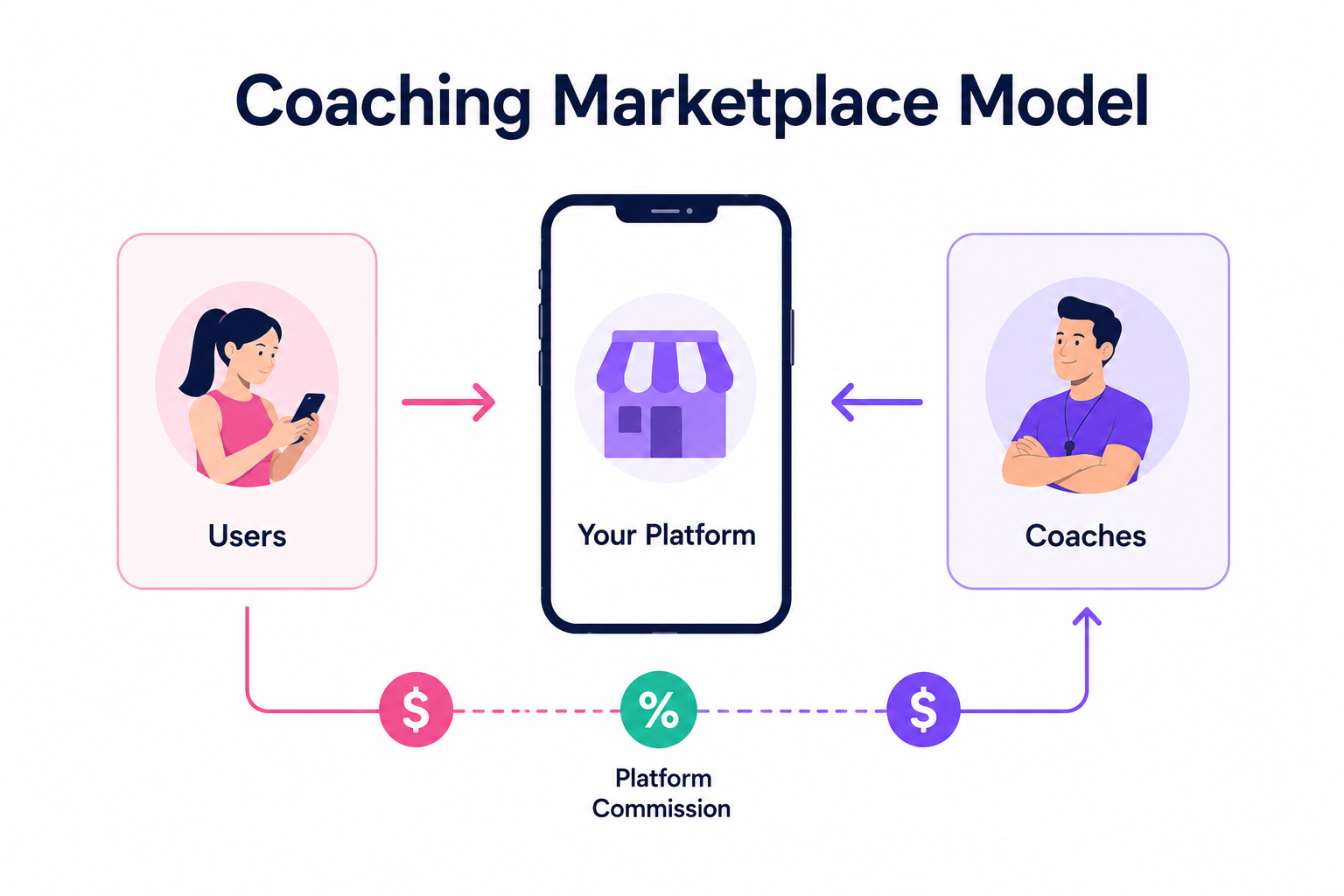
The coaching marketplace transforms your app from a product into a two-sided platform. On one side: users seeking personalised guidance. On the other: certified trainers, coaches, nutritionists, and physiotherapists offering their services through your platform. Your app earns a commission typically 15% to 30% on every booking or engagement.
How the commission structure works
The standard marketplace model operates on a revenue-share basis. A trainer charges $80 for a 60-minute virtual session. Your platform takes 20% ($16). The trainer receives $60. At scale, with 500 active coaches each completing 10 sessions per week, that is $80,000 in weekly gross transaction volume generating $16,000 in platform revenue weekly, without a single subscription.
Apps like Future (personalized coaching via text and video) and Trainiac (AI-matched trainer pairing) have built their entire business model around this structure. The model works because it aligns incentives: coaches want clients, users want accountability, and the platform earns from the match.
Building this kind of two-sided platform requires a very different technical architecture than a standard fitness app. Nyusoft's experience in marketplace development including vendor management, commission handling, and profile systems, is directly applicable to fitness coaching platforms.
The trust layer: vetting and onboarding coaches at scale
The coaching marketplace model lives or dies on trust. Users are sharing biometric data, fitness goals, and personal health histories with coaches on your platform. Your vetting architecture must reflect that responsibility.
At minimum, build: credential verification (certifications from NASM, ACE, ISSA, or equivalent), background check integration, profile completeness scoring, user review and rating systems, and a response-time SLA that coaches must meet to maintain active status. The platforms that succeed in this space treat coach quality as a product feature, not a compliance checkbox.
Marketplace vs. employed trainers - revenue and legal implications
A critical architecture decision: are coaches independent contractors (marketplace model) or employed staff? The marketplace model where coaches are independent is significantly more scalable and avoids employment tax liabilities. However, it also means you cannot control pricing, availability, or session structure as tightly. Legal structures vary by jurisdiction, so engage employment counsel early if you intend to operate across markets.
The coaching marketplace model is also a natural B2B expansion vector. Gym chains and corporate wellness programmes can deploy your platform to connect their members with remote coaches a white-label revenue layer on top of the marketplace itself.
4. Corporate Wellness Contracts - The High-Ticket B2B Model
The corporate wellness market is one of the most underexplored revenue opportunities in the fitness app space, and it represents a genuinely different buyer, sales cycle, and contract structure from consumer monetisation.
Corporate wellness app monetization works on a per-employee-per-month (PEPM) licensing model. Employers typically HR departments at mid-to-large companies, pay between $15 and $50 per employee per month to provide fitness app access as an employee benefit. For a company with 2,000 employees, that is $30,000 to $100,000 in monthly recurring revenue from a single contract. The sales cycle is longer (typically 3–6 months) but the contract lifetime is significantly longer than consumer subscriptions, and churn is near-zero once integrated into a company's benefits stack.
What corporate wellness buyers actually need
Consumer fitness app features are table stakes for corporate buyers. What enterprise HR departments actually evaluate during procurement includes: administrative dashboards with aggregate (not individual) engagement reporting, Single Sign-On (SSO) integration with their identity provider (Okta, Azure AD), HIPAA compliance for health data handling, ADA accessibility compliance, configurable challenge and incentive structures (step challenges, active minutes leaderboards), and dedicated account management.
If your app is not built with these enterprise requirements from the start, retrofitting them is expensive and time-consuming. This is an architectural decision that should be made at the product design stage not after you land your first enterprise prospect. Nyusoft's custom software development practice is specifically structured to accommodate compliance-first builds like this.
Pricing models for B2B fitness app contracts
Beyond PEPM, corporate contracts can include: flat annual licence fees (simpler to budget, preferred by some procurement teams), usage-based pricing (charges per active user per month, lower risk for employer), and tiered structures (basic access at $15 PEPM, premium with coaching at $35 PEPM). The most sustainable structure for you as an app developer is tiered PEPM; it creates natural upsell paths and aligns revenue with adoption.
This tiered B2B model has strong parallels with how SaaS product development is typically architected multi-tenant infrastructure, role-based access, admin dashboards which is why fitness apps pursuing corporate wellness often benefit from teams with SaaS delivery experience.
Positioning for enterprise wellness tenders
Corporate wellness tenders increasingly require vendors to demonstrate health outcomes, not just engagement metrics. If you can instrument your app to generate aggregate reporting "employees using the app averaged X more active minutes per week" you have a significant competitive advantage in procurement conversations. Outcome data is the difference between winning a pilot and winning a three-year contract.
5. Brand Partnerships & Sponsorships - Revenue Without Disruptive Ads
Banner advertising in fitness apps is a trust and UX killer. Users who are mid-workout do not want to see a car insurance ad. But brand partnerships done correctly feel like value-adds, not interruptions.
The fitness app brand partnership model works by integrating relevant brand experiences natively into the app. This takes several forms: branded workout challenges sponsored by an equipment or apparel company, co-developed content series (a Nike-sponsored running programme within your app), sponsored nutrition tracking features powered by a supplement brand, and exclusive member discount programmes from fitness gear brands.
Branded challenges and sponsored content series
A branded 30-day challenge, "The Garmin Step Challenge" or "The Whoop Recovery Series," gives a brand prominent, contextual exposure to a highly qualified fitness audience while offering users a genuinely useful feature. The brand pays a flat sponsorship fee (typically $10,000 to $150,000 depending on your user base and engagement metrics) for a defined campaign period.
The revenue here is not subscription-dependent. It is driven by your engagement metrics and audience quality. A fitness app with 200,000 highly active users is more valuable to a brand than an app with 2 million dormant ones.
For wearable integration, specifically a common component of branded challenges, our AI-Powered Fitness Tracking App Development work includes native support for Apple Watch, Garmin, and Whoop, which makes your app far more attractive to exactly these kinds of hardware brand partners.
Equipment and supplement brand partnerships—deal structure
Direct brand partnerships typically follow one of three commercial structures: flat sponsorship fees for placement and content integration, revenue share on purchases driven from within the app (tracked via affiliate or referral links), or co-development agreements where the brand funds a feature in exchange for exclusivity or branding rights.
Peloton's early growth was partly funded by brand partnerships that gave equipment and apparel companies access to its highly affluent, highly engaged subscriber base. As your community grows, the fitness app brand partnership revenue model scales with it without adding to your development or content cost base.
6. Affiliate Marketing - Earning Commission on What Users Already Buy
Fitness app users are buyers. They purchase supplements, equipment, apparel, meal kits, and health trackers often while actively using an app that influences their decisions. Health app affiliate marketing turns that purchasing behaviour into a direct revenue stream.
Affiliate revenue works via commission: your app recommends or features a product, a user clicks through and purchases, and you earn a percentage of the sale typically 5% to 15% depending on the category and partner. Equipment and apparel programmes tend toward the lower end; supplement and digital product programmes often go higher.
Best affiliate categories for fitness apps
The highest-converting affiliate categories for fitness platforms include: protein supplements and nutrition products (repeat purchase, high urgency), fitness equipment (high average order value), meal kit and food delivery services (subscription-based, so you earn recurring commissions), wearables and fitness trackers, and fitness apparel.
Major affiliate networks Impact, ShareASale, and PartnerStack all have fitness brand programmes. Many brands also run direct affiliate programs with better commission rates than network aggregators.
Integrating affiliate links without breaking trust
The cardinal rule of affiliate integration in fitness apps: only recommend what is genuinely relevant to the user's goal. A user tracking marathon training should not see affiliate links to weight-loss supplements. Contextual relevance is not just a UX principle; it directly drives conversion rates.
This is where a thoughtfully designed UI/UX design service makes a measurable difference. Contextual affiliate placements that feel native to the user's journey, not slapped onto a screen, are a design problem as much as a product strategy problem.
The most effective affiliate placements in fitness apps are post-workout gear recommendations based on workout type, nutrition product suggestions linked to macro goals in the nutrition tracker, and equipment recommendations tied to specific workout programs. These feel like helpful suggestions, not advertising, and they convert significantly better than generic placements.
7. Data Monetization - Ethical Revenue From Aggregate Insights
Data monetization is the fitness app revenue model that nobody talks about openly, but many scale-stage apps quietly use. Done responsibly, with full user consent and robust compliance architecture, it can become a meaningful revenue stream. Done carelessly, it destroys user trust and creates serious legal exposure.
The model works at scale: anonymized, aggregated fitness and health data from large user bases has genuine commercial value to research institutions, insurance actuaries, public health bodies, and health brands seeking behavioral insights. A fitness app with one million users tracking sleep, activity, nutrition, and heart rate is sitting on a dataset that academic researchers and insurance underwriters would pay to access, provided it is properly anonymized and users have consented to its use.
This model is closely adjacent to what health-focused platforms like our AI Powered Personal Health Monitoring App are designed to support: rich longitudinal data capture with a consent architecture that meets regulatory standards.
Who buys fitness app data and how the deal works
Primary buyers of aggregated fitness data include academic research institutions (typically via grant-funded research agreements), insurance companies seeking actuarial data on health behaviors (must be aggregate and non-identifying), pharmaceutical and health brand R&D teams, and public health agencies. Deals are typically structured as annual data licensing agreements, with pricing based on the size of the dataset, the granularity of the data, and the exclusivity of access.
Building a compliant consent and data architecture
This model is only viable with a rigorously designed consent framework. At minimum, your app must present explicit opt-in consent for data sharing (separate from the standard terms of service), allow users to opt out at any time and delete their data on request (GDPR Article 17), ensure all shared data is k-anonymized or differentially private before licensing, and document your data processing activities in a DPIA (Data Protection Impact Assessment).
HIPAA compliance is an additional requirement if your user base includes clinical or healthcare-adjacent contexts. Building this infrastructure correctly from the start requires deliberate architectural choices; it cannot be bolted on after launch. This is why data monetization is typically only viable for apps that have been intentionally designed for it. Teams with experience in healthcare solution development understand this compliance layer from the ground up.
How to Choose the Right Fitness App Monetization Model
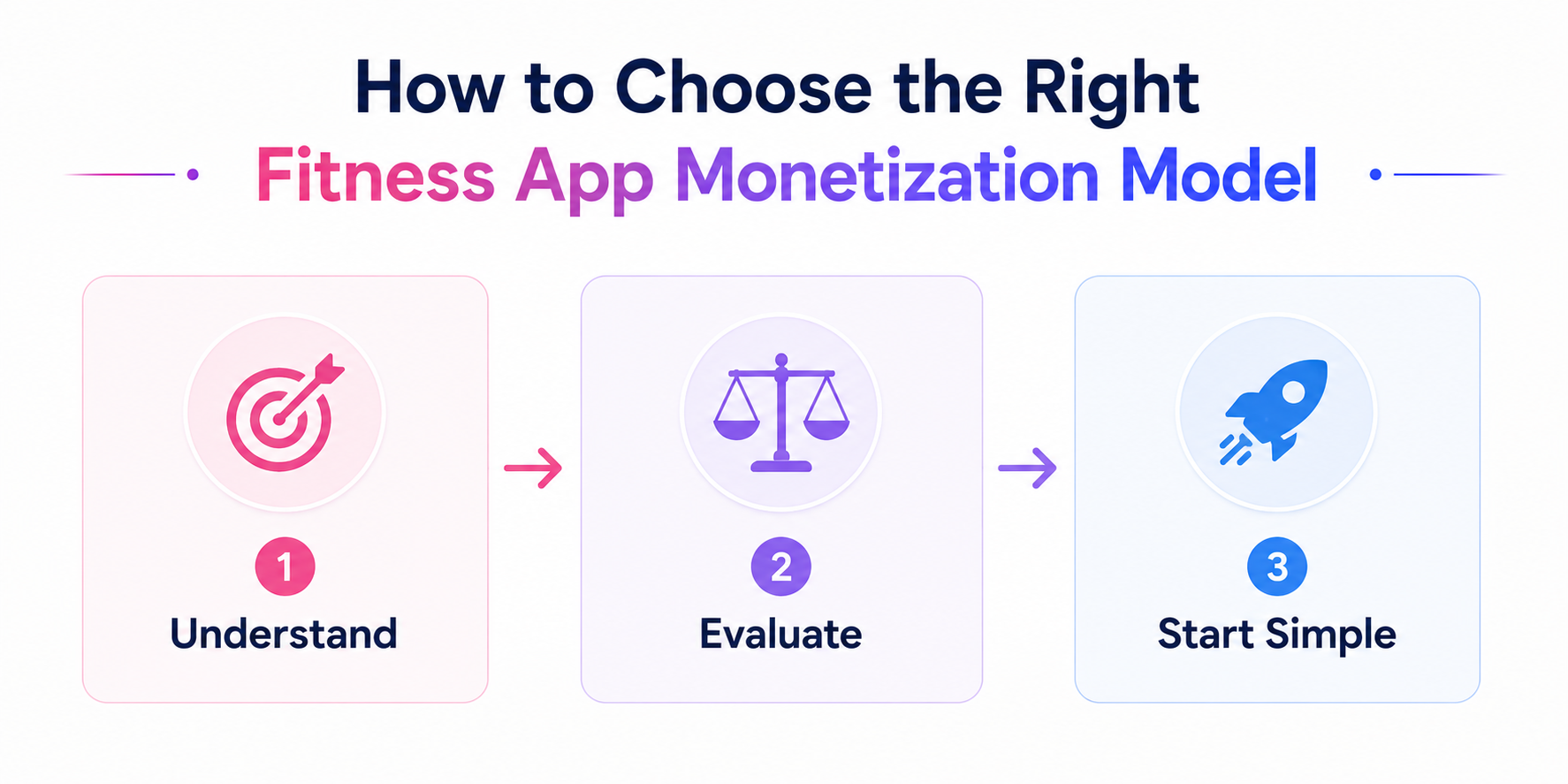
Understanding each model is one thing. Knowing which combination to build for your specific app is the decision that actually matters. Here is a practical framework for founders and CTOs.
Decision matrix - model fit by app type
| App Type | Recommended Primary | Recommended Secondary | Avoid Until Scale |
| Consumer B2C (general fitness) | Freemium | IAP, Affiliate | Corporate Wellness |
| Personal training / coaching app | Coaching Marketplace | Subscription | Data Monetization |
| Corporate / employee wellness | Corporate Contracts | Subscription | Freemium |
| Content-led (video workouts) | Subscription | IAP, Brand Partnerships | Marketplace |
| Community / social fitness | Freemium | Brand Partnerships, Affiliate | Corporate Contracts |
| Niche / condition-specific | Subscription | Corporate Contracts | Affiliate |
Early-stage apps: start simple, layer fast
If you are pre-launch or in your first 12 months, resist the temptation to build all eight models simultaneously. Start with freemium plus a small IAP catalog that gives you immediate revenue potential without the operational complexity of running a marketplace or pursuing enterprise sales.
Once you have validated retention (users returning for 60+ days), activate brand partnership outreach and affiliate integration. These require minimal engineering lift and can be layered onto an existing product without disruption.
For teams at this stage, Nyusoft's mobile app development engagement model, which supports both MVP-stage builds and post-launch iteration, is specifically designed for this kind of progressive feature layering.
Scaling apps: when to add the high-complexity models
The coaching marketplace and corporate wellness models both require significant operational infrastructure, coach vetting systems, enterprise compliance, and dedicated account management. These are worth building once you have proven product-market fit and have the team to support them.
A good rule of thumb: add the marketplace model when you have a sufficiently engaged user base to attract quality coaches (typically 50,000+ active users). Pursue corporate wellness contracts when you have the compliance infrastructure and a case study from at least one employer pilot program.
Data monetization should only be pursued once you have legal counsel experienced in health data regulation, a properly designed consent framework, and a dataset large enough to be commercially valuable (typically 250,000+ active users with 90+ days of behavioral data).
The fitness apps that build durable revenue do so by treating monetization as a layered system, not a single bet.
Conclusion - Build a Fitness App That Earns Beyond Day One
The subscription model is not dead. But for fitness apps competing in an increasingly crowded market, it is not enough to build a durable business on its own.
The eight fitness app monetization models covered here, freemium, in-app purchases, coaching marketplaces, corporate wellness contracts, brand partnerships, affiliate marketing, data licensing, and subscriptions, each unlock a different segment of revenue potential. The best-performing apps combine three to five of these, layering complexity as the product and team mature.
The strategic principle is simple: diversified monetization increases revenue per user, reduces dependence on any single churn event, and creates a more resilient business. Your fitness app revenue model is not just a feature; it is a core architectural decision that should be designed into the product from day one.
Planning to build a monetization-ready fitness app, one architected from the ground up to support multiple revenue streams, enterprise compliance, and scalable growth? Talk to our fitness app development team, and let's map the right revenue architecture for your product.
FAQs
Q1. Why isn't a subscription model enough for a fitness app business?
Over 80% of fitness app users churn within the first 90 days. When subscriptions are your only revenue stream, that churn collapses your entire business. Layering multiple monetization models means you earn revenue from different user behaviours not just from users who stay subscribed.
Q2. How does the freemium model work for fitness apps?
Free users get basic features like workout tracking and step counting. Premium unlocks advanced analytics, custom plans, nutrition tracking, and wearable integrations. Conversion rates typically sit between 2%–5%, but apps that gate personalisation, not just content, consistently see higher conversions because users pay for outcomes, not features.
Q3. What is the difference between in-app purchases and a subscription in a fitness app?
Subscriptions charge users on a recurring basis. In-app purchases are one-time transactions, a workout programme, a challenge pack, or a meal plan bundle. A $4.99 one-time purchase often converts better than a $9.99/month subscription because it feels like a smaller, bounded commitment with no ongoing obligation.
Q4. What is a coaching marketplace model in a fitness app?
It turns your app into a two-sided platform connecting users with certified trainers, nutritionists, and coaches. Your platform earns a commission typically 15%–30% on every session booked. It generates revenue without relying on subscriptions and creates a high-value experience users are willing to pay more for.
Q5. How do corporate wellness contracts work for fitness apps?
Companies pay a per-employee-per-month (PEPM) fee usually $15–$50 to offer your app as an employee benefit. A single contract with a 2,000-person company can generate $30,000–$100,000 in monthly recurring revenue. The sales cycle is longer but churn is near-zero once it's embedded in a company's benefits stack.
Q6. What do corporate wellness buyers look for in a fitness app?
Enterprise HR teams evaluate SSO integration, HIPAA compliance, ADA accessibility, admin dashboards with aggregate reporting, and configurable challenge structures. Consumer-facing features alone won't win enterprise deals; compliance and reporting capabilities are what close them.
Q7. How do brand partnerships work in fitness apps without disrupting the user experience?
Instead of banner ads, brands sponsor native experiences, a branded 30-day challenge, a co-developed content series, or exclusive member discounts. This feels like added value to users, not advertising. Sponsorship fees typically range from $10,000 to $150,000 depending on your user base size and engagement quality.
Q8. How can fitness apps earn revenue through affiliate marketing?
When a user clicks a product recommendation for supplements, equipment, apparel, or meal kits and makes a purchase, the app earns a commission of 5%–15%. The key is contextual relevance: recommend products aligned to the user's active goals, not generic placements, as this directly drives higher conversion rates.
Q9. Is data monetization ethical for fitness apps, and how does it work?
Yes, when done responsibly. Aggregated, anonymised fitness data sleep, activity, nutrition, heart rate has value to research institutions, insurers, and health brands. It requires explicit user opt-in consent, the ability to opt out and delete data at any time, and proper anonymisation before any data is shared or licensed.
Q10. How should a fitness app founder choose the right monetization model?
Start simple freemium plus a small in-app purchase catalogue for early-stage apps. Once retention is proven (60+ days), layer in affiliate and brand partnerships with minimal engineering effort. Add the coaching marketplace at 50,000+ active users. Pursue corporate wellness only once compliance infrastructure is in place. Build in layers, not all at once.