

 Front End Development
  Back End Development
  CMS / ECommerce Development
  Mobile Apps Development
  Cloud Services
  Fullstack Services
  Solution


How Claude Powers Mentor Matching in Learning Platforms
Your mentoring program is growing. What was initially a few mentor-mentee pairs to be handled in a spreadsheet has become a logistical nightmare. You have 200 employees seeking mentors, a dozen criteria to be matched, and an already stretched-thin HR department.
Does this sound familiar to you? Then you are not alone. Companies across industries, especially in the EdTech space, are running into a common challenge and are increasingly turning to AI to solve it. Anthropic has developed Claude AI, an increasingly popular tool for learning platforms looking to move beyond guesswork and build truly scalable mentor matching systems. In this article, we’ll break down how it works, why it matters for your business, and what to consider when choosing an AI-powered mentoring solution.
What Is Mentor Matching and Why Should Businesses Care?
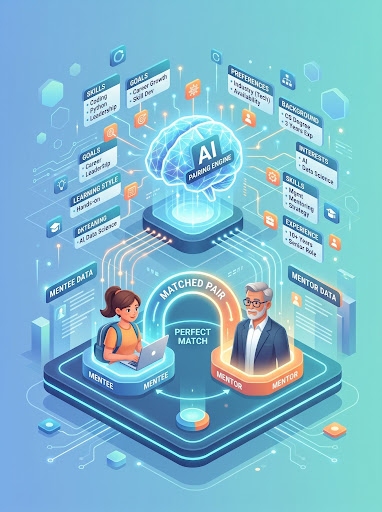
Mentor matching is the method of matching a mentor and a mentee on the basis of such factors as skills, career goals, level of experience, and communication preferences. This is the pillar in a corporate learning platform that can make or break your mentoring program; it will be the factor that will propel actual results or will be a box that is ticked.
This is the reason why it is important to your bottom line. Companies with successful mentoring programs always experience greater involvement of employees, accelerated leadership growth, and reduced turnover. However, the work there is effective. It is not only a waste of time when a bad match is present, but it also discourages participation and destroys confidence in the program.
Mentors provide guidance that is applicable to the real objectives of the mentees when there is a proper match-up. Mentors have a sense of their time being appreciated. And your L&D team has quantifiable results that they can report. Once it is poorly executed, either party loses interest in a few weeks.
Where Does Traditional Mentor Matching Fall Short?
The majority of the organizations begin with manual matching. An HR comes through profiles, possibly sends out a questionnaire, and matches individuals, depending on which department or on seniority or whoever happens to be a decent fit. There are considerable limitations to this approach.
- Limited data points. Manual matching is usually based on two or three variables, which include job title, location, and possibly an expressed interest. It does not pay attention to the more in-depth compatibility cues, such as communication style, learning preferences, or even particular skill deficiencies that really forecast an effective relationship.
- It does not scale. It is feasible to handle 10 pairs manually. Dealing with 100 or 500 pairs at various departments and geographies? Spreadsheets fall short at that point. One platform states that administrators were taking up to 15 hours a month to complete only manual matching processes.
- Human bias creeps in. Even good-intentional coordinates would match familiar faces, visible people, or people who are reminiscent of them. This compromises the objectives of diversity, equity, and inclusion and restricts the program scope.
Read Also: Building Personalized Learning Management Systems with Claude
How Claude AI Makes Mentor Matching Smarter
This is the place of interest. The introduction of natural language understanding to mentor matching by Claude AI alters the possibilities.
The classical matching algorithms take place on structured data. They make comparisons between dropdown selections and checkbox responses. Claude is capable of doing things that those algorithms cannot: it is able to read and comprehend open-text replies. When a mentee writes down the intent of wanting to improve at having difficult conversations with their direct reports, Claude can decode that purpose and pair it with a mentor who has outlined coaching and conflict resolution as a strength, even though the two individuals did not use the same keywords.
A realistic breakdown of what Claude does inside a learning platform is as follows:
- Profile analysis at depth. Claude considers the profiles of mentors and mentees as a whole. It examines abilities, objectives, career expectations, and textual responses to create compatibility insights not just on the surface.
- Smarter pairing recommendations. Rather than any strict formula such as matching by department, Claude is able to consider several factors at once, seniority gap, common interests, complementary skills, timezone overlap, and prioritize the possible matches based on how likely they are to be compatible.
- Conversation support. After a match, Claude will be able to create tailor-made session agendas, propose the discussion topics according to the goals of the mentee, and even write icebreaker prompts to make the relationship begin successfully.
- Early warning signals. With engagement trends and feedback on the sessions, Claude can prioritize the matches that are on the brink of becoming inactive, providing program administrators with an opportunity to take action before the relationship dies.
How Mentor Matching Differs Across the USA and UK Markets
Mentor matching has grown from a simple HR function to become a competitive software segment. Platforms such as Together, Chronus, MentorcliQ, Qooper, and PushFar are now using artificial intelligence-powered algorithms that go beyond job titles - taking into account goals, skills, as well as personality and personal preferences in communication to form connections that are actually lasting.
Features — What it Does
| AI-Driven Matching | Matches based on profiles, goals, skills, and preferences to automatically suggest the most compatible matches between mentor and mentee. |
| Open-Text Profile Analysis | Based on natural language processing in order to interpret written answers, rather than dropdown picks, to gain greater compatibility insights. |
| Engagement Monitoring | Monitors session frequency, feedback ratings, and activity levels to warn about at-risk matches before they go silent. |
| Personalized Session Agendas | Produces custom conversion scripts and discussion points depending on what the mentee has outlined as their objective and progress. |
| Program Analytics and ROI Reporting | Analytics provides dashboards displaying the quality of matches as well as the rate of completion, retention impacts, and overall program effectiveness. |
| Multi-Format Mentoring Support | It supports group, one-on-one reverse, and peer monitoring on one platform. |
| Scalability Across Teams | Allows for expansion from one department to the entire organization without adding administrative burdens. |
| HR and LMS Integration | Connects to existing tools such as HRIS platforms, learning management systems, Slack, and Microsoft Teams to ensure seamless adoption. |
What Should You Look for in an AI-Powered Mentoring Platform?
Suppose you’re considering evaluating a program for mentorship in your business. Here are the features that distinguish strong programs from the average ones.
1. Intelligent matching that learns.
Find platforms that employ machine learning, or AI, instead of static rules, to pair mentors with mentees. The most effective systems will improve their recommendations as they gather more information from your company.
2. Scalability across teams and regions.
The platform you choose should be able to handle the expansion without adding additional administrative burden if you are looking to expand from a single department to a whole organization. The tool will not need to revamp your processes.
3. Analytics that prove ROI.
Program managers require dashboards that display engagement rates and match quality scores, session completion, and other business impact metrics such as retention, as well as internal mobility. If you can’t determine it, then you won’t be able to justify the budget.
4. Integration with your existing tools.
The platform must be connected to your HR, LMS, calendar tools, and messaging platforms such as Slack and Microsoft Teams. Separate tools that reside outside your tech stack cause problems and can hinder the use of your platform.
5. Data security and compliance.
Particularly for enterprise deployments, make sure you have SOC2 certification and GDPR compliance. Mentoring data can include personal goals as well as performance-related information and must be protected in line with GDPR.
The Bottom Line!
AI-powered mentor matching is no longer a luxury; it is the way that modern learning platforms provide real-time business outcomes. If you’re planning to adopt AI-powered LMS solutions for better mentoring and scalability, Nyusoft Solutions can help with a 75% client retention rate and a plethora of projects that have been successfully completed. We are prepared to create it for you. Contact us now!