


 Front End Development
  Back End Development
  CMS / ECommerce Development
  Mobile Apps Development
  Cloud Services
  Fullstack Services
  Solution


Top Fitness App Ideas Startups Should Build
The fitness app market is full of trackers. What it's short on is apps that solve a specific problem for a specific type of person, and that's exactly where the opportunity sits for startups right now.
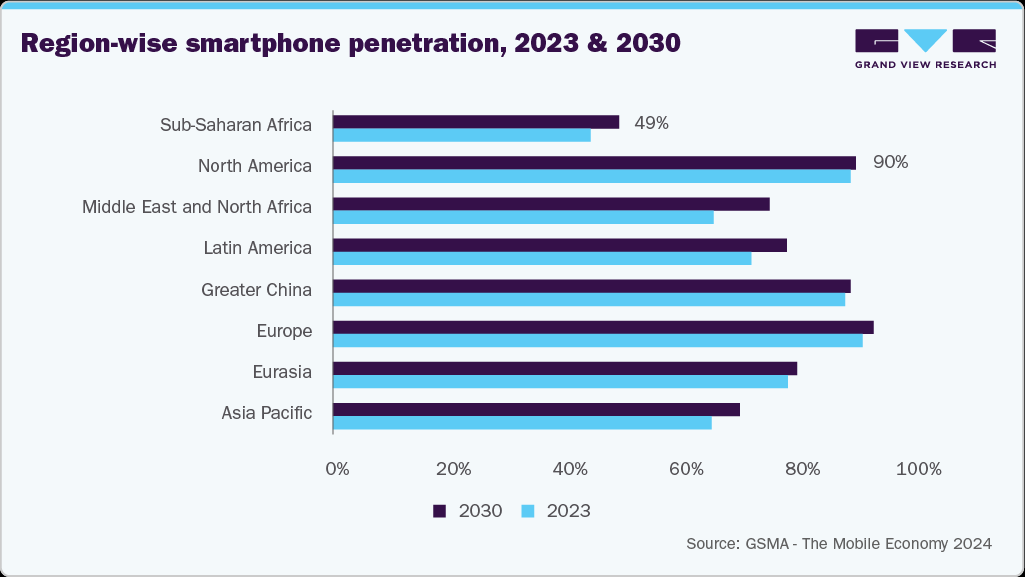
Generic fitness apps lose users fast. The winners in this space are narrow, intelligent, and built for audiences that mainstream platforms ignore. Smartphone adoption is a key driver behind this surge. Europe and North America already lead globally, with penetration rates of 89% and 91%, respectively, in 2023, and both regions are on track to grow further by 2030, according to GSMA data cited by Grand View Research.
This isn't a list of broad categories. Each idea below comes with the target user, the features it actually needs, how it makes money, and whether it's a lean MVP or a full build from day one.
Why Most Fitness Apps Don't Get Past Week Three
Before the ideas, the honest context.
Most fitness apps that fail don't fail because of poor execution. They fail because they're trying to out-feature Strava, MyFitnessPal, and Apple Fitness+. That's not a competition any startup can win with a standard development budget.
The apps gaining real ground right now go narrow. They serve an underserved group well, and they build something those users rely on, not just download once and forget.
Three things make a startup fitness app viable today:
- A clearly defined user who genuinely can't find what they need elsewhere
- A monetization model that works without millions of downloads
- Personalization that makes switching to a competitor feel like starting over
MyFitnessPal alone generated $16 million in revenue in a single month in early 2025. The gap between top-tier apps and the rest is wide, but inside niche categories like senior fitness, rehabilitation, corporate wellness, and women's hormonal health, the top spots are not yet locked. That's where startups should be looking.
If you're at the stage of evaluating fitness app development seriously, the ideas below are the ones worth your time.
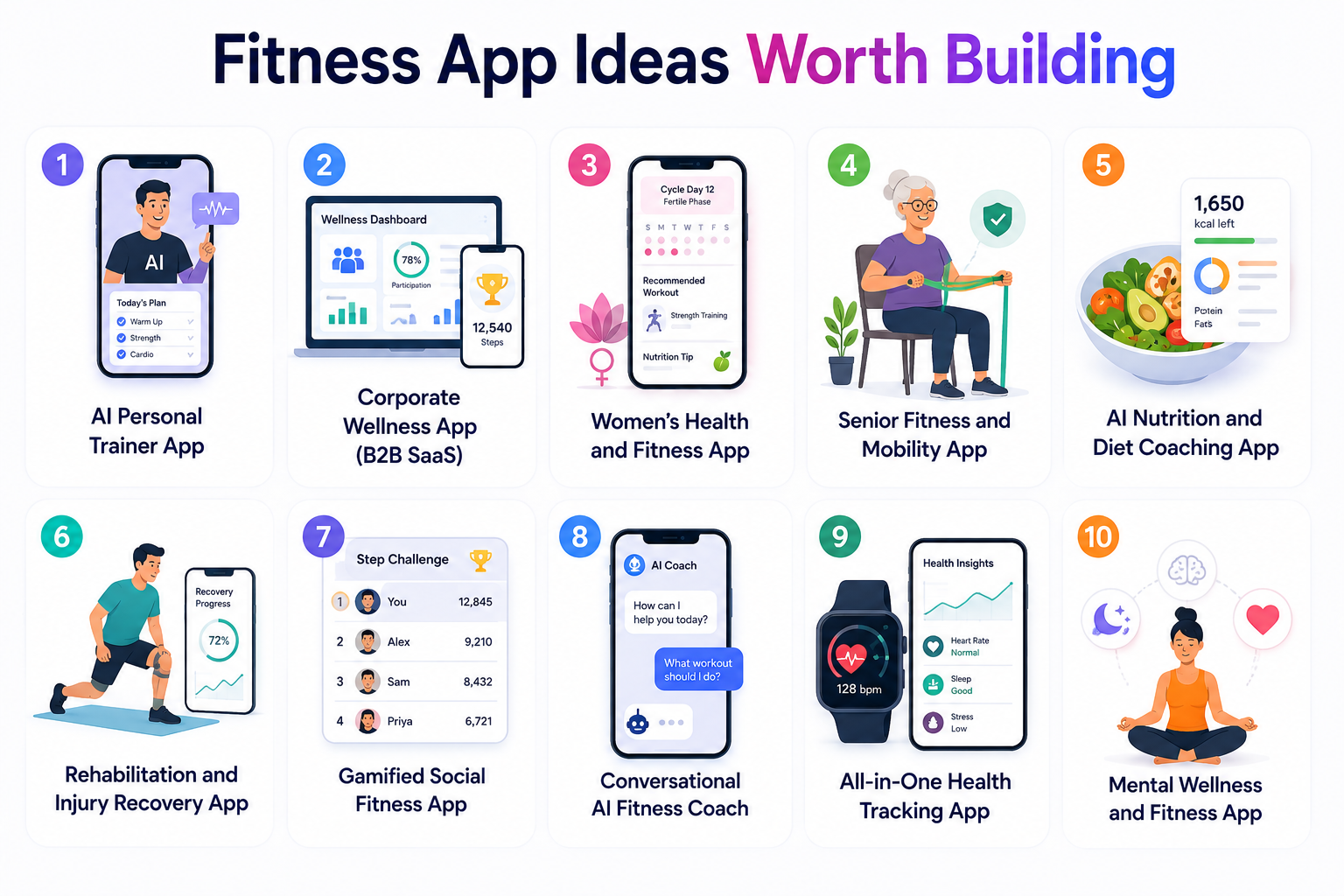
10 Fitness App Ideas Worth Building
These aren't concepts pulled from trend reports. They're grounded in real market gaps, user behavior that's already been validated, and business models that work at a smaller scale before they need to work at a large scale.
1. AI Personal Trainer App
Who it's for: Solo exercisers who want coaching-level guidance without a coaching-level price.
This is the most competitive category on the list, but it's also the most scalable. The hyper-personalized fitness segment is forecast to reach $31.1 billion by 2036, up from $5.5 billion, according to Future Market Insights. Most apps in this space still deliver plans that don't actually change based on what the user does. That gap is still wide open.
Features this app needs:
- Adaptive workout engine that adjusts intensity, volume, and exercise selection each week based on actual session data not just goal settings from onboarding
- Computer vision form analysis using the phone's camera during exercises
- Recovery readiness score built from wearable data or daily self-reported input
- Voice coaching during sessions hands-free guidance without needing to look at the screen
- Goal pace alerts that tell users when they're ahead or behind their target based on real trajectory, not a calendar countdown
- AI chatbot for on-demand coaching questions between sessions
Revenue model: Freemium with a premium AI coaching tier at $12–$20/month. One-time program purchases (8-week strength block, marathon prep) work well alongside the subscription.
Build priority: Full build. An MVP without the core adaptive AI features won't convert or retain users in this category. The personalization has to be real from day one.
You can see how Nyusoft approaches this kind of adaptive system through their AI-powered fitness tracking app development work.
2. Corporate Wellness App (B2B SaaS)
Who it's for: HR teams and benefits managers at mid-size to enterprise companies. Employees are the end users.
The business model here is fundamentally different from consumer fitness apps and that's the point. Companies pay per employee seat on annual contracts. Revenue is predictable. Churn is far lower than consumer subscriptions. One enterprise client can generate what 500 individual subscriptions would.
Employer-sponsored wellness programs are growing steadily in the US and Europe, driven by insurance cost incentives and a genuine cultural shift toward workforce health as a retention tool.
Features this app needs:
- Admin dashboard showing HR teams participation rates, team engagement trends, and aggregate health data (never individual employee data)
- Employee-facing app with step challenges, team competitions, and personal goal tracking
- Group challenge builder department vs. department, monthly step contests, wellness streaks
- Integration with major health insurance providers for incentive tracking
- Anonymous individual data employees see their own data, employers see only aggregates (HIPAA and GDPR compliance required)
- Push notification system tied to activity patterns, not a fixed schedule
Revenue model: B2B SaaS. Seat-based pricing at $5–$15 per employee per month on annual contracts. Upsells include advanced analytics dashboards and white-labeling for large clients.
Build priority: Strong MVP candidate. Start with team challenges and basic health tracking layer analytics and insurance integrations in version two after you've signed your first five clients.
This kind of platform architecture fits directly into SaaS product development scalable from the start, without rebuilding the foundation as you grow.
3. Women's Health and Fitness App
Who it's for: Women managing fitness alongside hormonal health cycle-specific training, prenatal fitness, postpartum recovery, or perimenopause support.
This is one of the most underdeveloped segments in the fitness app market. Most mainstream apps treat female users as a default gender toggle on a male-designed system. Flo has proven the engagement potential in women's health; the crossover into fitness is almost entirely untapped.
Features this app needs:
- Cycle-synced workout recommendations where intensity and exercise type adjust based on cycle phase, not just generic "light workout today"
- Trimester-specific prenatal exercise programs with safety gating
- Postpartum recovery tracking with progression milestones that account for physical readiness, not just weeks since delivery
- Nutrition guidance aligned with hormonal phases
- Community forums with moderated peer support and an anonymous posting option for sensitive topics
- Option to connect with a certified women's health coach for paid sessions
Revenue model: Subscription at $9–$15/month. Brand partnerships with women's health supplement and apparel companies as a secondary layer.
Build priority: A focused MVP on cycle-synced training alone can validate the concept before investing in prenatal and postpartum features, which require clinical input.
4. Senior Fitness and Mobility App
Who it's for: Adults aged 60+ focused on mobility, strength maintenance, fall prevention, and staying physically active without gym access.
The over-60 demographic is the fastest-growing smartphone user group and one of the highest-spending. Yet nearly every fitness app in the market is designed for someone half their age. Platforms running live small-group fitness classes specifically for older adults are gaining traction proving the model works without a complicated tech stack.
Features this app needs:
- Low-impact exercise library with clear, close-up video instruction chair exercises, balance drills, light resistance, seated yoga
- Large-text, high-contrast UI designed for reduced visual acuity accessibility is the design brief, not an afterthought
- Fall risk assessment and mobility tracking over time
- Family member access adult children can view participation and progress with the user's consent
- Weekly progress reports formatted to share with a GP or physiotherapist
- Medication and hydration reminders that connect with daily activity targets
- Social layer group class scheduling, buddy accountability, community chat
Revenue model: Consumer subscription at $8–$12/month. Family plan pricing (one subscription, multiple family members can monitor). B2B sales to senior care facilities and retirement communities at a higher per-facility rate.
Build priority: High priority for MVP. The UI simplicity requirement means you need fewer complex features, not more. Accessibility, trust, and reliability matter more than feature volume here.
5. AI Nutrition and Diet Coaching App
Who it's for: People who track food but want guidance not just calorie totals.
Camera-based food logging is mainstream. The next level is turning that log data into coaching that actually adjusts connecting what someone ate to how they trained, how they slept, and where they are relative to their goal.
Features this app needs:
- Camera-based food recognition and nutritional breakdown point the phone, get the macros
- Barcode scanning and restaurant menu integration
- AI nutrition coach that adjusts macro and calorie targets based on training load, sleep quality, and goal pace not a static number set at onboarding
- Meal planning engine that generates weekly menus based on dietary restrictions, preferences, and performance goals
- Grocery list generation from the weekly meal plan
- Progress reports connecting nutrition behavior to body composition changes over time
- Optional wearable integration for blood glucose or metabolic data
Revenue model: Freemium. Premium tier at $10–$18/month unlocks AI coaching and meal planning. White-label option for gyms and personal trainers who want to offer it to clients.
Build priority: Camera food logging and basic AI suggestions can ship first. Full meal planning with adaptive coaching comes in version two.
The foundation for this kind of system is exactly what Nyusoft builds with AI nutrition tracking app development connecting multiple data streams into one intelligent coaching layer.
6. Rehabilitation and Injury Recovery App
Who it's for: Patients recovering from orthopedic surgery, sports injuries, or chronic musculoskeletal conditions. Secondary buyers: physiotherapists who want to keep patients on track between clinic visits.
Telehealth normalization created genuine appetite for guided recovery outside clinical settings. Insurance reimbursement structures in the US are beginning to cover digital health programs that creates a B2B2C revenue path that very few startups have explored properly.
Features this app needs:
- Clinician-prescribed exercise protocols the physio sets the plan inside the platform, the patient follows it in the app
- Computer vision form check for rehabilitation exercises ensures the patient is performing movements correctly without a therapist watching every session
- Pain and symptom logging after each session creates a recovery data record for clinical review
- Progress sharing with the treating clinician via PDF reports and in-app messaging
- Milestone-based progression exercises unlock as the patient demonstrates readiness, preventing them from rushing ahead
- Telehealth scheduling integration for follow-up appointments
- Full HIPAA-compliant data storage throughout
Revenue model: Dual model. B2C subscription at $12–$20/month for self-directed recovery. B2B licensing to physiotherapy clinics at $50–$200/month per clinician seat.
Build priority: This is a full build. Clinical workflow requirements, compliance architecture, and the dual-user model (patient + clinician interface) mean you can't ship a meaningful MVP without the core infrastructure in place.
Nyusoft's work in health monitoring app development covers the biometric data handling and compliance infrastructure that makes this type of platform viable.
7. Gamified Social Fitness App
Who it's for: Adults aged 18–35 who need external motivation and social accountability to stay consistent.
Strava surpassed 100 million users largely on the strength of its social mechanics not its tracking features. The engagement model is proven. The opportunity is building gamification into the workout experience itself, not just adding a leaderboard on top of a standard tracking app.
Features this app needs:
- Live fitness challenges with real-time leaderboards during events
- Friend activity feed with workout-specific reactions and comments not a generic social feed
- Team-based streak challenges across friend groups
- XP system where users level up based on consistency, not just performance beginners stay engaged without feeling outclassed
- Achievement badges tied to real workout data, not arbitrary milestones
- In-app challenge marketplace branded fitness events with actual prizes
- Import from Strava and Apple Health for users who already track elsewhere
Revenue model: Freemium base. Premium at $7–$10/month removes ads and unlocks all challenges plus advanced analytics. Brand sponsorship of challenge events is where the scalable revenue ceiling gets interesting.
Build priority: Good MVP candidate. Social features and basic challenges can launch before the full gamification engine is complete early users help shape what the reward system should actually look like.
8. Mental Fitness and Physical Wellness App
Who it's for: Stressed professionals who want fitness, sleep, and mental wellness in one place not three separate subscriptions.
Health and fitness apps collectively generated $3.8 billion in in-app purchase revenue in a recent 12-month period, with holistic wellness among the fastest-growing categories. Headspace and Calm don't do physical training. Most workout apps ignore mental health entirely. That gap is real, and users are actively looking for something that bridges it.
Features this app needs:
- Daily check-in capturing energy level, mood, and stress this data feeds directly into what session the app recommends
- Workout library filtered by goal AND current mental state (e.g., "I'm overwhelmed show me something grounding and physical")
- Guided breathwork and mindfulness before and after sessions not just a separate meditation section
- Sleep quality tracking connected to next-day training intensity
- Journaling module linked to weekly goal review
- AI coach that adjusts the training plan when mood data and recovery scores suggest burnout is building
- Progress dashboard tracking both physical and mental health markers over time
Revenue model: Subscription at $12–$18/month. Annual plans with a meaningful discount drive long-term retention. B2B licensing to Employee Assistance Program (EAP) providers is a high-value secondary channel.
Build priority: MVP can focus on mood-adaptive workout recommendations and a basic mindfulness library. Sleep integration and the journaling module follow in version two.
9. Niche Sport Training App
Who it's for: Dedicated practitioners of one specific sport rock climbers, martial artists, swimmers, cyclists, trail runners who get nothing useful from general fitness apps.
Niche communities have high engagement and strong word-of-mouth velocity. No mainstream app serves them well which means acquisition costs within that community are low, and users who find the right tool become advocates quickly.
Features this app needs (using a climbing app as the example):
- Route grading system and climb progression tracking by grade and style
- Finger strength and grip endurance training programs built on sport-specific periodization
- Injury prevention protocols for the sport's most common injuries (for climbing: finger pulleys, elbow tendons)
- GPS route logging for outdoor sessions
- Video analysis of technique upload a clip, get structured feedback
- Community board where users share routes, conditions, and training tips
- Equipment logbook with gear lifecycle tracking and maintenance reminders
Revenue model: Freemium to be paid at $8–$15/month. One-time training program purchases work well (a 12-week strength cycle, an injury prevention course). Gear affiliate partnerships with specialist brands add a clean secondary revenue stream.
Build priority: The strongest MVP candidate on this list. Build for one sport and one community. Prove engagement, then decide whether to expand.
10. AI Virtual Fitness Coach with Conversational Interface
Who it's for: People who don't know where to start and want to be guided through conversation like texting a trainer rather than navigating menus and selecting from plan libraries.
This is no longer a speculative idea. Zing Coach, which uses AI to deliver hyper-personalized workouts, crossed 1 million users and raised a $10 million Series A. The conversational fitness coach is being validated in real numbers right now.
Features this app needs:
- Natural language onboarding the AI builds a user profile through conversation instead of a form. Users answer the way they'd talk to a trainer.
- Real-time chat interface for workout questions, form guidance, and motivation when a session gets hard
- AI generates workouts on request based on available equipment, time, energy level, and the user's history not a preset library
- Voice interface for hands-free coaching during the session
- Conversational progress summaries - "Here's what you've built over the last four weeks and why it's working" delivered as a message, not a stats screen
- Escalation path to a real human coach for users on the premium tier
Revenue model: Freemium with an AI conversation cap per month. Premium at $15–$25/month removes the cap. An optional human coaching add-on at a higher price point adds a second revenue ceiling.
Build priority: This needs a full build. A conversational fitness coach that feels robotic or repetitive will lose users in the first session. The experience has to feel natural from the start.
Nyusoft's AI chatbot and virtual assistant development work covers the conversational AI architecture that makes this kind of interface work reliably at scale.
Read Also: How to Build an AI-Powered Fitness Tracking App: Features, Tech Stack & Cost
Features Every Fitness App Needs - Regardless of Type
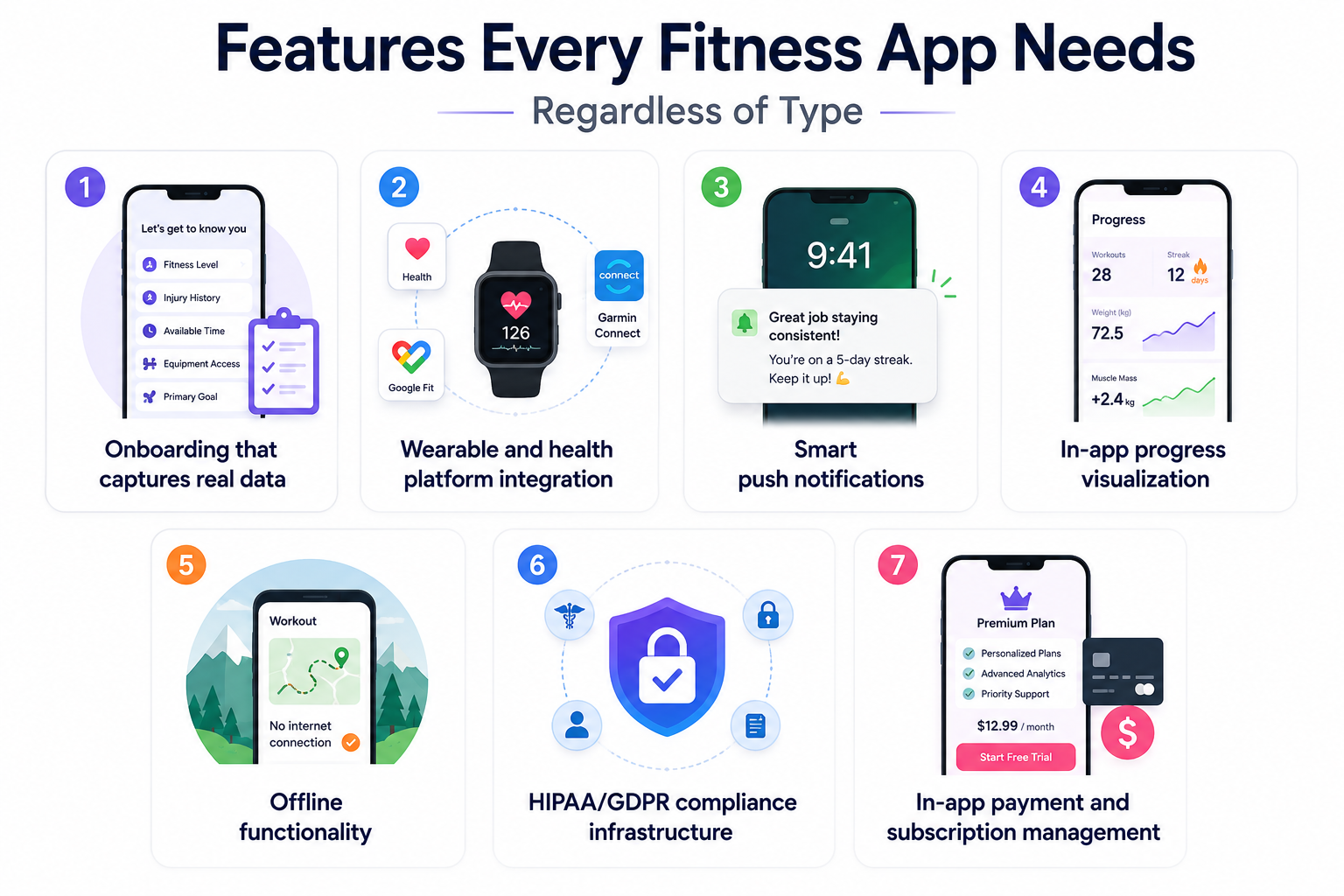
The ideas above each have specific requirements. But there's a baseline every fitness app needs to clear before anything else matters.
- Onboarding that captures real data. Fitness level, injury history, available time, equipment access, primary goal. The more accurate the input, the better the output from day one and first-session quality determines whether users come back.
- Wearable and health platform integration. Apple HealthKit, Google Fit, and Garmin Connect at minimum. Users expect their existing data to sync automatically. Manual entry is a hard ceiling on long-term engagement.
- Smart push notifications. Not reminders at a fixed time nudges triggered by behavior. A user who misses their usual session time on Tuesday needs a different message than one who has been consistent for six weeks.
- In-app progress visualization. Streaks, charts, and body composition comparisons are the highest-engagement features in fitness apps. They give users a reason to open the app on days they're not working out.
- Offline functionality. Gyms, parks, and hiking trails don't always have signals. Core session features must work without a live connection and sync when connectivity returns.
- HIPAA/GDPR compliance infrastructure. If your app collects health data and every app on this list does you need compliant storage, role-based access control, and a clear data use policy before you launch, not after.
- In-app payment and subscription management. Smooth upgrade flows, trial period handling, and cancellation paths that don't frustrate users. A poor billing experience kills referrals.
How These Apps Make Money
A great idea without a revenue model is a side project. Here's how the main monetization structures map across these app types.
Freemium to paid subscription works for AI personal trainers, nutrition, mental wellness, and gamified apps. The core experience is free advanced personalization and features are behind a paywall. Conversion happens when users see real results and want more.
B2B SaaS seat licensing works for corporate wellness and rehabilitation apps sold to clinics. Revenue is predictable, contracts are long, and customer lifetime value is significantly higher than consumer subscriptions.
One-time program purchases work as a layer across all app types. A 12-week training plan, an injury prevention course, a postpartum recovery guide these appeal to users who resist subscriptions and generate high-margin revenue without adding recurring infrastructure costs.
Community and brand sponsorship works as a secondary layer for gamified and niche sport apps. Challenge campaigns sponsored by fitness brands, gear affiliate commissions, and community marketplace features can generate meaningful revenue without touching the subscription model.
How to Pick the Right Idea to Build First
Ten ideas is too many to build. Here are three filters that narrow it down quickly.
Can you reach the user? A senior fitness app sounds simple to build, but reaching adults over 65 who don't spend time on Instagram or TikTok requires an entirely different distribution approach partnerships with physiotherapy networks, retirement communities, and senior care organizations. If you can't reach the target user cost-effectively, the best product in the world won't help you grow.
Do you have domain credibility? Rehabilitation apps and clinical health tools require trust from the first conversation. If your founding team has no background in physiotherapy or healthcare, you'll need a clinical advisor or partnership before you can credibly approach physio clinics or hospital systems. The idea is sound the distribution requirement is real.
Can you build a real MVP? The AI personal trainer, nutrition app, and niche sport app all have clear, lean MVP paths. The rehabilitation app and conversational AI coach need more complete builds to work at all. Be honest about where you are in your funding stage before committing to a build scope.
Where to Start
The fitness app market rewards the most specific apps, not the broadest ones. Every idea above is built around a real user with a real unmet need and a monetization model that doesn't require 10 million downloads to sustain the business.
The common thread across all of them: users stay when the app makes them feel like it was built specifically for them. That comes from deliberate product decisions made early on who the user is, what problem is being solved, and how the app behaves when the user's situation changes.
If you're mapping out a fitness app and want to get the product architecture, AI layer, and build scope right before committing to development, Nyusoft has built across all of these categories from AI-powered fitness app development and AI nutrition tracking platforms to health monitoring apps and SaaS wellness platforms. Their team works with founders at every stage, from early scoping through to a shipped product.
Schedule a free consultation with Nyusoft
FAQs
Q1. Why do most startup fitness apps fail within the first few weeks?
Most fail because they try to compete with Strava, MyFitnessPal, and Apple Fitness+ on features a competition no startup can win on a standard budget. Apps that survive go narrow, serve a specific underserved user extremely well, and build something that the group genuinely relies on rather than downloads once and forgets.
Q2. What makes a niche fitness app more viable for startups than a general one?
Three things: a clearly defined user who can't find what they need elsewhere, a monetization model that works without millions of downloads, and personalisation that makes switching feel like starting over. Niche categories like senior fitness, rehabilitation, and women's hormonal health still have no dominant player; that's where the real opportunity sits.
Q3. What is the most underdeveloped segment in the fitness app market right now?
Women's health and fitness is one of the most underdeveloped segments. Most mainstream apps treat female users as a gender toggle on a male-designed system. Cycle-synced training, prenatal fitness, postpartum recovery, and perimenopause support are almost entirely untapped despite Flo already proving massive engagement potential in women's health.
Q4. What makes a senior fitness app different from a regular fitness app?
Senior fitness apps need large-text high-contrast UI, low-impact exercise libraries with close-up video instruction, fall risk assessment, and family member access so adult children can monitor progress. Accessibility is the core design brief not an afterthought. Trust and reliability matter far more than feature volume for this audience.
Q5. What features does a rehabilitation and injury recovery app need to work properly?
It needs clinician-prescribed exercise protocols, computer vision form checking during rehab exercises, pain and symptom logging after each session, and milestone-based progression that prevents patients from rushing ahead. A dual interface one for patients, one for physiotherapists and full HIPAA-compliant data storage are non-negotiable from day one.
Q6. What is a gamified social fitness app and how does it keep users engaged?
It wraps workout tracking inside social mechanics live challenges with real-time leaderboards, team-based streak competitions, and an XP system where users level up based on consistency rather than performance. This keeps beginners engaged without feeling outclassed, which is the biggest retention problem standard fitness apps fail to solve for casual users.
Q7. How does a conversational AI fitness coach app work?
Instead of forms and menus, the AI builds a user profile through natural conversation the way a real trainer would in an intake session. It then generates workouts on request based on available equipment, time, energy level, and history, and delivers progress summaries as messages rather than stats screens. The experience has to feel natural from session one or users won't return.
Q8. What baseline features does every fitness app need regardless of its niche?
Every fitness app needs accurate onboarding data collection, wearable integration with at least HealthKit and Google Fit, behaviour-triggered push notifications, in-app progress visualisation, offline functionality for gym and outdoor use, and HIPAA/GDPR-compliant data storage. These aren't optional extras; they're the floor every app must clear before niche features matter.
Q9. Which fitness app ideas are good for an MVP and which need a full build from day one?
Niche sport apps, corporate wellness, and senior fitness are strong MVP candidates; they need fewer complex features and can validate early with a focused scope. AI personal trainer apps, rehabilitation platforms, and conversational AI coaches need full builds from the start because a half-built version of these won't convert or retain users at all.
Q10. How should a startup decide which fitness app idea to build first?
Apply three filters: Can you reach the target user cost-effectively through your existing channels? Does your team have domain credibility in that space especially for clinical or health-adjacent ideas? And can you build a real MVP within your current funding stage? The best idea that fails all three filters is still the wrong one to start with.