


 Front End Development
  Back End Development
  CMS / ECommerce Development
  Mobile Apps Development
  Cloud Services
  Fullstack Services
  Solution


Top Challenges Nutritionists Face and How Mobile Apps Solve Them
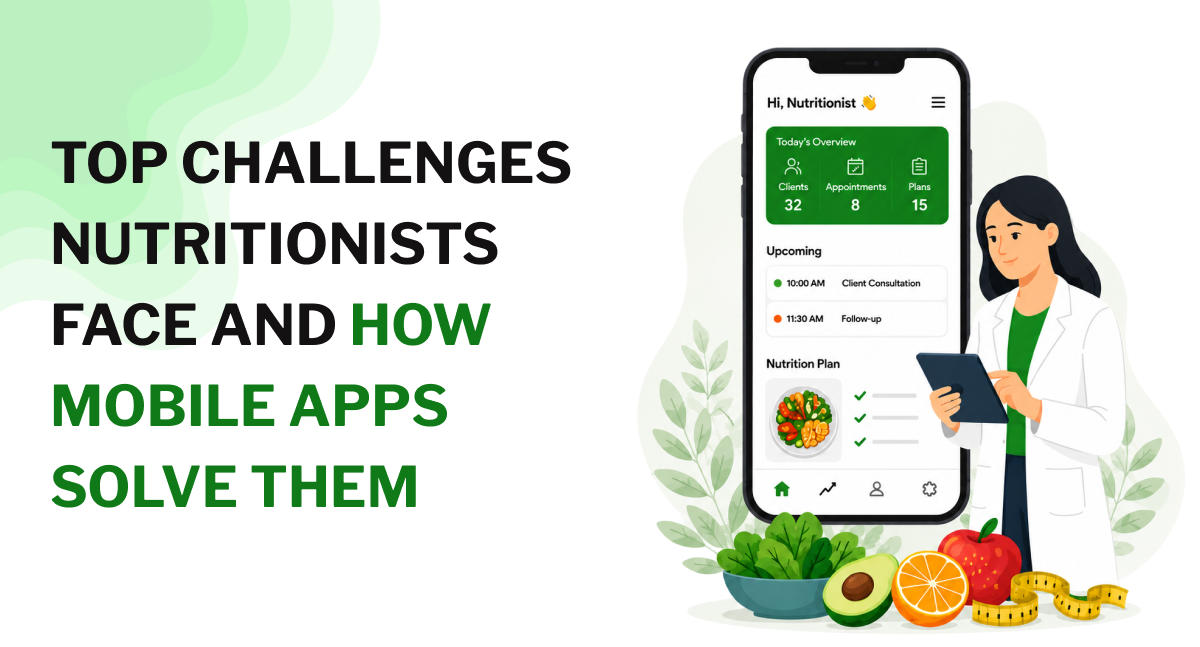
Nutritionists and dietitians deal with a predictable set of daily problems that have nothing to do with their clinical knowledge. Client compliance breaks down between sessions. Administrative work eats into time that should go toward patient care. Food logs come back inaccurate. Growing a practice beyond a fixed session model feels impossible. And keeping up with the misinformation clients bring in from social media is its own full-time job.
Mobile apps built specifically for nutrition practice address each of these problems in practical, measurable ways. Not by replacing the practitioner but by giving them better data, removing manual work, and keeping clients engaged between appointments.
This article covers the seven most significant challenges nutritionists face, what each one actually costs a practice day to day, and what the right technology solution looks like for each.
The State of Nutrition Practice - Why Technology Has Become Necessary
These challenges are not unique to any individual practitioner. They are systemic, and the data backs that up.
A 2024 meta-analysis published in BMC Psychology found the prevalence of burnout among dietitians and nutritionists is as high as 40.4% comparable to burnout rates seen across other medical professions. A separate survey of dietitians internationally found that 62% already use mHealth apps in their practice but primarily as an information resource, not as an integrated part of their clinical workflow. Almost half of 570 surveyed dietitians used mobile apps as educational resources for patients, while structured integration into daily practice remains limited.
The gap between "uses apps occasionally" and "runs the practice on a digital platform" is exactly where most nutritionists sit right now. The ones who have bridged that gap are serving more clients, spending less time on administration, and building practices that are not capped by the number of hours they can physically work in a week.
The shift to hybrid and fully remote consultations has accelerated the need for proper digital infrastructure. A practitioner who ran an in-person clinic in 2019 and now does 40% of sessions over video needs more than a calendar app and email. They need a system that makes remote practice feel as organized and professional as a physical clinic.
Challenge 1 - Client Compliance Breaks Down Between Sessions
This is the challenge every nutritionist names first, and it is the one that most directly affects client outcomes.
A client commits during the appointment. They leave motivated, plan written, goals clear. Two days later, old habits start pulling. By day five, they have skipped logging twice. By the next session, two weeks of progress data is missing and the conversation starts from a position of incomplete information.
The problem is not that clients are not motivated. It is that motivation without structure and visibility fades quickly. A nutritionist sees a client once a week or once a fortnight. The other 13 days are effectively invisible.
Verbal recall at the next session makes this worse, not better. Research has consistently shown that dietary recall is unreliable. Clients sometimes forget what they ate, misremember portion sizes, or simply leave off items they feel uncomfortable reporting. The result is that recommendations get built on incomplete data, which produces incomplete results, which erodes client trust.
A purpose-built mobile app addresses this at the structural level.
Daily food logging with push notification reminders keeps the habit visible between sessions without the nutritionist having to chase every client. Automated daily or weekly check-ins simple prompts asking about energy, mood, hunger levels, or sleep give the practitioner a week's worth of context before the next appointment.
Progress dashboards the client can view themselves create a layer of self-accountability that does not depend on the practitioner being available. Streak tracking and small reinforcement mechanics, something as simple as a visual log showing 6 out of 7 days logged this week improve consistency without adding anything to the nutritionist's workload.
When the next session arrives, the practitioner opens a dashboard that shows the full two weeks. The conversation is grounded in real data rather than imperfect recall. That changes the quality of every session.
Challenge 2 - Manual Administrative Work Consumes Clinical Time
The burnout numbers cited above are not caused by client care. Most nutritionists went into the profession specifically because they find client work meaningful. The burnout is caused by everything that surrounds it.
Session notes written in generic tools not built for nutrition workflows. Meal plans assembled from scratch in Word documents or spreadsheets for each new client. Appointment scheduling is managed through a patchwork of email, personal calendar, and text messages. Payment collection handled separately from everything else. Consent forms and progress summaries emailed back and forth without a central record.
A nutritionist running a 20-client private practice can easily spend three hours a day on tasks like these. That is three hours not spent on client care, professional development, or growing the practice. Over a week, it adds up to a full working day lost to administration every single week.
This is the part that is rarely framed correctly. The administrative burden is not just an efficiency problem it is a capacity ceiling. There is a direct limit on how many clients a practitioner can serve when every new client adds a proportional increase in manual work.
A practice management app built for nutrition removes this ceiling, piece by piece.
Structured session note templates designed for nutrition workflows reduce note-taking time significantly. A meal plan builder with reusable templates means creating a plan for a new client takes 20 minutes rather than two hours because the base logic is already built and the practitioner is adjusting, not starting from scratch. Integrated appointment scheduling with automated reminders reduces no-shows without a single follow-up phone call.
In-app document management keeps consent forms, progress summaries, and follow-up plans organized in one place rather than scattered across an email inbox. Payment collection connected to the same platform means one less system to manage. The practitioner who spends three hours a day on administration with the right tools can reduce that to under an hour and use the rest of that time on the work they actually trained for.
Challenge 3 - Food Logging Accuracy Is Chronically Unreliable
This challenge is directly connected to the first one, but it deserves its own section because the downstream impact is clinical not just operational.
A nutritionist's recommendations are only as good as the data they are built on. If the food log shows a client is eating 1,800 calories a day but the actual intake is closer to 2,400, every calculation, every macro target, and every "why is this not working" conversation is starting from the wrong place.
Traditional paper food diaries have recall bias built into them by design. People log at the end of the day or at the end of the week before their appointment, not at the time of eating. Portion estimation without a reference point produces wildly inconsistent numbers. Home-cooked meals are nearly impossible to log accurately without a recipe breakdown tool. Restaurant meals have no standard nutritional reference in most paper-based logging methods.
There is also the social desirability factor. Clients who know their nutritionist will read the log sometimes edit it consciously or not before handing it over. Nobody wants to report the second glass of wine or the late-night snack.
A well-built mobile app addresses food logging accuracy at the input stage before the data reaches the practitioner.
Real-time logging at the moment of eating eliminates recall bias. A quick log entry right after a meal is significantly more accurate than reconstructing the day from memory that evening. Barcode scanning for packaged products removes manual entry errors entirely. Photo-based food recognition lets users point a camera at a plate and have the app estimate the meal content, removing the need to identify portion sizes manually, which most people cannot do accurately anyway.
Restaurant and chain food databases cover branded items that would otherwise require guesswork. When the practitioner receives a log built from real-time entries, barcode scans, and photo recognition rather than end-of-week memory, the data quality is categorically better. And better data produces better recommendations which produces better client outcomes.
Challenge 4 - Scaling a Practice Beyond a Fixed Session Model Is Hard
This is a business challenge as much as a clinical one, and it is where technology creates the most significant financial impact for nutrition professionals.
A practitioner's revenue in a traditional session-based model is directly capped by time. A nutritionist who can see eight clients a day is maxed out at eight clients a day no matter how skilled they are, no matter how much demand exists for their services. The only ways to grow are to raise prices, work more hours, or hire other practitioners. All three have limits.
Group programs and online courses are a natural extension, but running them without purpose-built tools means coordinating everything manually which adds more administrative work rather than reducing it. Most generic platforms are not built for the specific flow of group nutrition coaching: assigning meal plans to multiple clients, monitoring individual progress within a group, messaging at scale, and handling dietary variations across a cohort.
The right app infrastructure removes the ceiling on client capacity without removing the quality of care.
Group coaching programs delivered through the app serve multiple clients simultaneously from a single set of content and interactions. Automated meal plans and educational content delivered on a schedule reach clients without requiring live intervention at every step. Self-service onboarding reduces the setup time for each new client intake forms, health questionnaires, and goal-setting prompts all happen before the first session, not during it.
Progress monitoring dashboards that flag clients who need attention rather than requiring a manual review of every client's log every day are what make a 50-client practice manageable. The practitioner focuses on the clients whose data shows they need a conversation, rather than doing a daily sweep across everyone.
For practices ready to build that kind of digital infrastructure properly, understanding what goes into a professional nutrition app development platform is a practical starting point.
Challenge 5 - No Visibility Into What Clients Do Between Appointments
This is a distinct challenge from compliance and the difference matters.
Compliance is about client behavior. Visibility is about the practitioner's information gap. A client can be doing everything right, logging consistently, following the meal plan, drinking enough water and the nutritionist still walks into the next session without a clear picture of how the week actually went.
A client reports feeling tired and not progressing. The nutritionist has no data from the 12 days since the last appointment to work from. Was it sleep? Stress? A hidden calorie surplus? A change in activity level? Without between-session data, the consultation becomes investigative rather than progressive. Time is spent reconstructing the week rather than moving forward.
Wearable data exists for most clients steps, sleep, heart rate, calorie burn. But it lives in a separate app the nutritionist cannot access. The client might mention it briefly in session. The practitioner never sees it in any structured way.
A mobile app built for nutrition practice closes this gap systematically.
Daily symptom and energy check-ins take a client 30 seconds to complete but give the practitioner a full week of context before the next session. Water intake tracking adds another passive data point between appointments. Wearable integration pulling sleep data, step counts, and activity levels from Apple Health or Google Fit into the same view as nutrition logs gives the practitioner the full picture rather than a fragment of it. This is where purpose-built health monitoring app infrastructure connects directly to nutrition practice workflows.
Automated pre-session summaries, generated from logged data before each appointment, mean the practitioner arrives prepared. Alerts triggered when a client's intake drops significantly below their target enable proactive outreach: a quick message before the problem compounds, rather than a conversation about why things went wrong after the fact.
Challenge 6 - Managing Misinformation Clients Bring Into Sessions
This is a challenge unique to nutrition practice that almost no technology article addresses yet every nutritionist knows exactly what it feels like.
A client arrives convinced that a particular detox protocol will reset their metabolism. Another one is certain that a specific food combining rule is why they cannot lose weight. A third has been following advice from a social media influencer whose credentials are a large following and an aesthetic lifestyle.
Nutritionists must regularly counter popular but scientifically unfounded dietary advice from social media influencers and celebrities a challenge that has intensified as diet content has become one of the most-shared categories on every major platform. The problem is not just that the information is wrong. The problem is what it costs in session time.
A 45-minute consultation that spends 20 minutes untangling a misinformation belief and rebuilding trust in evidence-based practice is a consultation that covers half the ground it should. Multiply that across a full client load and the cumulative cost is significant both in clinical productivity and in practitioner energy.
A mobile app built around the practitioner-client relationship addresses this by changing where clients get their nutritional information day to day.
An in-app educational content library, curated and controlled by the practitioner, gives clients reliable, evidence-based information within the same environment they use to log meals and track progress. When a client has a question about intermittent fasting at 9pm on a Tuesday, they can open the app and find the practitioner's explanation rather than falling down a social media rabbit hole.
Practitioners can push targeted articles, explainers, and recipe content to specific clients based on the beliefs or misconceptions they have raised in sessions. A client who has been reading about extreme calorie restriction gets the article on metabolic adaptation sent directly to their app. The educational relationship continues between appointments, not just during them.
When clients are consistently getting nutritional information from within the practitioner's platform, the competition from social media misinformation does not disappear but it has a credible counterweight. Trust in the practitioner as a source is reinforced every time they engage with content that is useful and accurate.
Challenge 7 - Delivering Remote Nutrition Services Professionally
Remote practice is now a permanent part of how nutrition services are delivered not a temporary arrangement. But the tools most practitioners use to deliver remote consultations were not designed for nutrition work.
A video call on a generic platform works for communication. It does not integrate with meal plans, food logs, or progress data. The practitioner is looking at their client on one screen and a spreadsheet or PDF on another. The client is on a laptop with a printed meal plan next to them. It gets the job done, but it does not feel like a professional clinical service.
Consent forms and intake questionnaires sent by email before the first session arrive in an inbox alongside promotional emails and newsletters. Documents pile up in shared folders with naming conventions that eventually stop making sense. Payment is handled on a third platform with its own login and workflow.
For clients, the experience of a remote consultation stitched together from four different tools is noticeably less polished than an in-person appointment. That perception affects their confidence in the service and their commitment to the program.
A purpose-built app brings the entire remote practice experience into a single environment.
Video consultation within the same platform as food logs, meal plans, and progress data means the practitioner can pull up a client's logged week during the call without switching tabs. Digital intake forms and health questionnaires complete before the first session flow directly into the client record, no manual transfer, no lost data.
Secure in-app messaging for between-session communication removes the need to use personal phone numbers or standard email for clinical conversations. Clients send photos of meals, ask questions about food choices, or flag a concern and the practitioner responds within a structured, recorded, professional channel.
For nutrition practices working with clinical populations, diabetes management programs, post-surgical nutrition, condition-specific dietary support, HIPAA-compliant data handling is not optional. Building that compliance into a purpose-built platform from the start is far more reliable than applying it retroactively to a generic tool that was never designed for health data.
What to Look for in a Mobile App Built for Nutrition Practice
If you are evaluating existing tools or planning a custom build, here is the framework that matters not a list of app names, but the criteria that separate useful platforms from ones that add more work than they remove.
The client-facing app has to be simple enough that clients actually use it daily. If logging a meal requires too many steps or the interface is confusing, compliance drops and the data problem returns. Simplicity on the client side is not a nice-to-have; it is what makes everything else work.
The practitioner dashboard needs to surface the right information without requiring manual review of every client. A dashboard that shows all 40 clients the same way regardless of their activity level forces the practitioner to sort through noise. Flagging clients who need attention based on logging gaps, significant intake drops, or upcoming sessions is what makes scale manageable.
The meal plan builder should save time relative to current methods. If building a meal plan in the app takes longer than building one in a spreadsheet, the tool is adding friction rather than removing it. Reusable templates, dietary restriction filters, and one-click client assignment are the features that make the builder genuinely useful.
Food logging with barcode scanning and photo recognition produces meaningfully better data than manual text entry. Both should be standard, not premium add-ons.
Appointment scheduling and session note tools built for nutrition workflows matter more than generic calendar integrations. Notes that include nutritional summary fields, progress markers, and plan adjustment logs are more useful than a blank text field.
Secure communication, compliance-ready data handling, and wearable integration are the infrastructure features that separate a professional clinical platform from a consumer wellness app repurposed for practice use.
When a Generic App Is Not Enough
Off-the-shelf nutrition apps solve the individual practitioner's problem reasonably well. They are affordable, quick to set up, and cover the core features most practitioners need.
But a nutrition clinic, a corporate wellness provider, a healthcare network, or a specialist dietary practice has requirements that existing consumer or SMB tools cannot meet. They need their own branded environment. They need data ownership not data held in a third-party vendor's database on terms that can change with a policy update. They need feature sets configured for their specific clinical workflow, not a generic configuration built for the average user.
A white-label or custom-built platform changes the calculus entirely. The business owns the product experience. Clients interact with a branded, professional platform rather than a third-party app. The feature set is built around the actual clinical workflows not adapted from a consumer product that approximates them.
Condition-specific clinical platforms: diabetes nutrition management, cardiac dietary support, post-surgical recovery programs need data models, dietary logic, and compliance infrastructure that consumer apps simply do not provide. Multi-practitioner networks need role-based access, shared client dashboards, and aggregate reporting that go beyond what individual-practitioner tools are designed to handle.
For businesses at that stage, understanding what a custom-built nutrition platform actually involves from feature architecture to compliance and tech stack is the first practical step. Our full guide on diet and nutrition app development covers what building at that level looks like, including what makes a nutrition platform production-ready for clinical and enterprise use.
For practices where meal planning is the core clinical tool, the architecture decisions around recipe databases, dietary filtering, and household planning are covered in detail in our meal planning app development guide.
The Real Cost of Not Solving These Problems
Every challenge covered in this article has a cost that compounds over time.
A compliance problem that goes unaddressed means clients plateau, lose motivation, and churn. An administrative burden that never gets fixed means the practitioner's growth ceiling stays exactly where it is today. Inaccurate food logs mean recommendations built on bad data which means results that do not arrive on schedule, which damages the practitioner's reputation however good their clinical thinking is.
Mobile technology built specifically for nutrition practice does not replace what nutritionists do. It removes the friction around what they do, giving them better data, reducing the administrative load, extending the reach of their practice between sessions, and creating a professional service experience that matches the quality of the clinical work.
For individual practitioners, that means more time with clients and less time on paperwork. For growing practices and nutrition businesses, it means building a platform that can scale without the wheels coming off.
At Nyusoft, we build health and nutrition platforms for clinics, wellness businesses, and healthcare providers from initial product scoping through post-launch development. Our teams work across fitness app development, health monitoring, and clinical nutrition software, with an understanding of the compliance requirements and workflow needs specific to health practice.
If you are evaluating what a custom nutrition platform would look like for your practice or business, we are happy to talk through what you need.
FAQs
Q1. Can a mobile app genuinely improve client compliance or does it just shift the problem?
It depends entirely on how the app is designed. An app that only sends reminders to log meals shifts the compliance problem slightly but does not solve it. Clients who are not logging will also ignore notifications. The apps that genuinely improve compliance do three things together: they reduce the friction of daily logging to the point where it takes less than 60 seconds, they give clients a visible progress picture they can check themselves without waiting for the next appointment, and they create small daily habits around check-ins that eventually become automatic. Compliance improves when the app makes consistent behavior easier than inconsistent behavior, not when it adds another notification to an already noisy phone. The practitioner's side matters equally. When a nutritionist can see a client's week before the session rather than reconstructing it from memory during the session, the quality of the conversation changes in ways clients feel directly.
Q2. How do nutritionists protect client health data when using a mobile app?
Health data collected through a nutrition app falls under different regulatory frameworks depending on the geography and the nature of the data. In the United States, apps that handle data linked to an individual's health condition, medical history, or treatment in a clinical context fall under HIPAA requirements meaning data must be encrypted at rest and in transit, access must be role-controlled, and audit logs must be maintained. In the European Union, GDPR applies to any personal data including dietary preferences and health goals, regardless of where the practitioner is based. Beyond regulatory requirements, practitioners should specifically look for apps that use end-to-end encryption for client communications, do not share or sell client data to third-party advertisers, and offer data export or deletion on client request. A practical first step before adopting any app for clinical use is to review the vendor's data processing agreement and confirm it aligns with the compliance requirements of your specific practice setting.
Q3. What is the difference between a nutrition app built for practitioners and one built for consumers?
A consumer nutrition app is designed for an individual managing their own diet independently. The experience is self-contained; the user sets their own goals, logs their own meals, and interprets their own progress. A practitioner-facing platform is built around a professional relationship. It needs two distinct interfaces: a client-facing app for daily logging and plan access, and a practitioner dashboard for managing multiple clients, reviewing progress data across a caseload, assigning and adjusting meal plans, writing session notes, and scheduling appointments. The data architecture is also different: a consumer app stores one user's data; a practitioner platform manages hundreds of client records with role-based access controlling who can see what. Most consumer apps repurposed for clinical use create friction because they were never designed for the multi-client, multi-role workflow that a nutrition practice actually runs on.
Q4. How many clients can a nutritionist realistically manage using a digital platform compared to traditional methods?
The answer varies significantly based on how the platform is used, but the difference is meaningful. A nutritionist managing clients through traditional methods, paper notes, email communication, manually built meal plans, phone-based scheduling can typically handle 15 to 25 active clients before the administrative workload becomes unsustainable. With a purpose-built digital platform, the same practitioner can realistically manage 40 to 60 or more active clients, because the tasks that scale poorly: meal plan creation, progress review, appointment reminders, document management are either automated or templated. Group coaching programs delivered through an app extend this further, as the practitioner delivers to many clients simultaneously rather than one at a time. The ceiling is not the practitioner's clinical capacity, it is always the administrative infrastructure around it.
Q5. Do clients actually use nutrition apps consistently, or do most people abandon them quickly?
Most people abandon general health apps within the first two weeks; this is well-documented in app usage data across the category. But the abandonment pattern in practitioner-assigned apps is significantly different from consumer-downloaded apps. When a client downloads an app on their own, they have no external accountability and no structured reason to return. When a nutritionist assigns an app as part of the program where session conversations reference the logged data, where the practitioner can see whether the client has logged or not, and where the app connects directly to the plan they are paying to follow, retention is substantially higher. The accountability loop between practitioner and client is what sustains engagement. Apps used in isolation from a professional relationship behave like consumer apps. Apps embedded in a clinical or coaching relationship behave quite differently.
Q6. Can a mobile app help nutritionists who work with clients managing specific health conditions like diabetes or PCOS?
Yes, and condition-specific functionality is one of the clearest cases where a purpose-built platform outperforms a generic nutrition app. Managing a client with type 2 diabetes requires tracking not just calories and macros but glycaemic index values, carbohydrate distribution across meals, and ideally blood glucose readings alongside dietary logs. A PCOS nutrition protocol involves specific macro ratios, anti-inflammatory food prioritisation, and cycle-aware dietary adjustments that a generic macro tracker does not support. Purpose-built clinical platforms can enforce condition-specific dietary rules at the database level filtering recipe suggestions, flagging non-compliant foods, and surfacing nutritional breakdowns relevant to the condition rather than just standard macro splits. When these platforms also integrate with continuous glucose monitors or wearable health devices, the practitioner gets a clinical picture that is genuinely useful rather than approximated from self-reported data alone.
Q7. How does a nutrition app help with client sessions specifically, not just between sessions?
The impact on the session itself is one of the most underappreciated benefits. When both the practitioner and client arrive at an appointment with access to the same two weeks of logged data, the session changes character entirely. Instead of the first 15 minutes being spent reconstructing what happened, what did you eat, how did you feel, did you follow the plan, the practitioner opens the dashboard and the week is already visible. The session can start from analysis and problem-solving rather than information gathering. Progress charts, nutritional averages, adherence patterns, and flagged days where intake deviated significantly from the plan are all visible before a word is spoken. Practitioners who have made this shift consistently report that session quality improves noticeably not because the app does the clinical thinking, but because it removes the information gap that was consuming the first third of every appointment.
Q8. What should a nutritionist look for when evaluating whether an app will actually reduce their workload?
The single most important question is whether the app's workflow matches how the practice already operates or whether adopting it requires the practitioner to change how they work to fit the tool. An app that requires significant behavior change from the practitioner to use correctly will be partially adopted at best and abandoned at worst. Beyond workflow fit, look for a meal plan builder with reusable templates rather than a blank-canvas builder that requires starting from scratch for every client. Look for session note tools that have nutrition-relevant fields rather than a generic text editor. Confirm that client onboarding intake forms, health questionnaires, dietary history can happen before the first session rather than during it. And test the client-facing logging experience yourself before assigning it to clients. If you find it confusing or slow, clients will too and a logging experience clients avoid produces no data at all.
Q9. Is it worth building a custom app for a nutrition practice, or is an existing platform always sufficient?
For an individual practitioner or a small private practice, an existing platform is almost always the right starting point. The cost and time investment of custom development does not make sense at that scale when several capable off-the-shelf tools already exist. The calculus changes when the practice grows into a business with specific requirements that existing tools cannot meet. A nutrition clinic running multiple practitioners with shared client management, a corporate wellness program delivering to hundreds of employees across an organisation, a telehealth network connecting clients to dietitians at scale, or a condition-specific clinical platform working within a hospital system all of these have feature, compliance, and branding requirements that consumer or SMB tools were not built for. At that point, a custom or white-label platform built to the specific workflow gives the business something an off-the-shelf product cannot: full ownership of the experience, the data, and the ability to build features that match exactly how the practice works rather than adapting the practice to fit what the tool allows.
Q10. How long does it typically take before a nutrition practice sees real results from adopting a digital platform?
The honest answer is that it depends on how completely the platform is adopted and how consistently the practitioner integrates it into their client workflow. Practices that adopt a new platform halfway using it for some clients but not others, or using the scheduling feature but still building meal plans manually see limited results because the efficiency gains require consistent use to compound. Practices that fully commit, onboard all active clients to the platform, and use it as the primary workflow for logging, meal planning, session notes, and communication typically start seeing measurable time savings within four to six weeks as templates are built out and the daily rhythm becomes familiar. Client compliance improvements are often visible within the first two to three weeks, simply because the accountability structure changes immediately when logging is tracked rather than reported verbally. The administrative time savings take slightly longer to fully materialise because they accumulate gradually as more templates are built and more processes are moved into the platform.