

 Front End Development
  Back End Development
  CMS / ECommerce Development
  Mobile Apps Development
  Cloud Services
  Fullstack Services
  Solution


The Future of EdTech Product Development with Claude Integrations
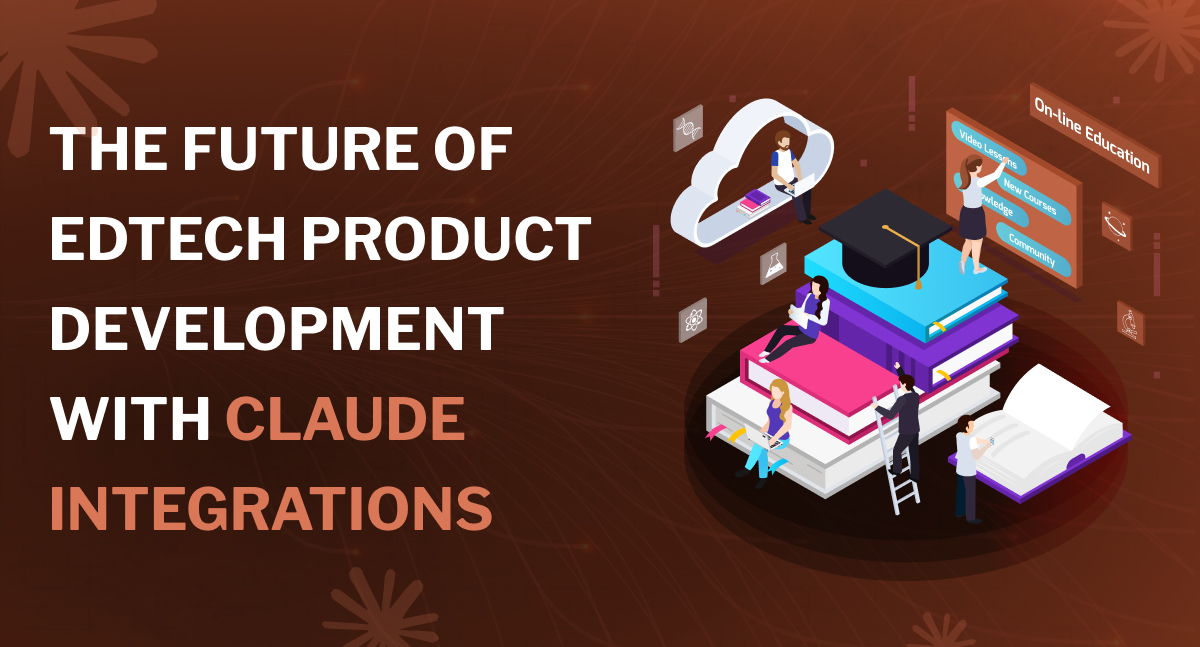
If your EdTech product still treats AI as a nice-to-have feature, you’re already behind. The market has moved. Institutions, teachers, and learners now expect AI to be woven into the tools they use every day, not bolted on as an afterthought.
This post dissects the future of EdTech product development, why Claude is worth paying attention to, and how your team can use Claude integrations to create better products in less time. Whether you are a founder, product manager, or CTO of an EdTech company working in the US or UK, this blog will guide you on how you can integrate Claude into your existing LMS.
EdTech Market Trends That Matter for Product Teams in 2026
The statistics speak for themselves. Grand View Research estimates the global AI in education market size to be $5.88 billion in 2024 and projects it to increase as high as $32.27 billion by 2030 with a CAGR of 31.2%. That is 36% of the market held by no less than North America alone.

What does this mean for product teams? Three things:
- AI has become an expectation, rather than a competitive edge. Without it on your platform, the buyers will inquire.
- Compliance is non-negotiable. The US has FERPA, the UK has GDPR, and a transparent AI decision-making policy everywhere. Your purchases, school districts, and corporate L&D teams will question your data practices prior to examining your features.
- Interoperability wins. Institutions do not desire another stand-alone tool. They desire AI that is integrated within the systems that they already possess: their LMS, their assessment engine, and their analytics dashboard.
Why Claude? What Makes It Different for EdTech
There exist numerous AI models. Why, then, as an EdTech product team, should Claude be of interest to us?
It begins with the design of the Claude. Anthropic developed Claude as a safety-first system with long-context processing (i.e., it can process the entire textbook, policy document, or course catalog in a single conversation) and structured outputs that can be worked with in practice by product teams in a programmable way.
Learning mode is, however, the true distinguishing factor of education. Learning mode does not provide a student with the answer when they ask Claude a question. It poses follow-up questions, directs their thought process, and assists them in solving the problem. This is not a wrapper your team has to build to do Socratic tutoring but rather is part of the model.
Next is the integration layer. Anthropic links Claude to Canvas LMS, Google Workspace, GitHub, Panopto, and Wiley via the Model Context Protocol (MCP). That is to say that Claude is capable of drawing on several platforms in one conversation, and that is what institutions require.
Compliance on the compliance front, Claude for Education is FERPA compliant and has certifications of SOC2 Type I and II, ISO 27001, and ISO 42001. By default, student conversations are not included in model training. This is not a promise of the future-universities such as Northeastern (50,000 users at 13 campuses), the London School of Economics, and Champion College are already deploying on a campus-wide scale. Partnership Teach For All has over 100,000 teachers in 63 countries partnering with Anthropic.
4 Ways to Use Claude Integrations in Your EdTech Product
It is here that it becomes practical. The following 4 use cases are some of the ways Claude integrations may add real value to your product without having to rebuild everything from scratch.
| Use Cases | What it Does | Who Benefits | Integration Approach |
| Adaptive Content Generation | Auto-generate differentiated learning materials (multiple reading levels, language variants, scaffolded versions) from a single content source. | Content teams, instructional designers, and teachers. | Claude API with your content management system. Feed it source material, and get back multiple versions formatted for your platform. |
| Intelligent Tutoring | Provides Socratic-style guidance that walks learners through problems instead of giving answers. | Students, corporate learners, tutoring platforms. | Claude’s Learning Mode via API. Reduces the need to build your own tutoring engine from scratch. |
| Assessment and Feedback at Scale | Generates rubric-aligned feedback, quiz questions, and formative checks from uploaded student work or course materials. | Teachers, L&D managers, assessment platforms. | Claude API connected to your LMS or assessment engine. It handles long documents well and returns structured feedback that your system can display. |
| Internal Product Team Workflows | Speeds up user-story generation, spec writing, UX research summaries, and rapid prototyping for your own dev team. | Product managers, UX researchers, and engineering leads. | Claude API or Claude.ai for internal use. Your team ships faster, which means your users get updates faster. |
Read Also: Building Personalized Learning Management Systems with Claude
Getting Started Without Over-Engineering It
You do not have to redesign your entire product to begin to use Claude. The following is a realistic course:
- Pick one use case. Large-scale content generation and feedback are most likely to be the fastest wins since they address a pain point that is directly apparent (time) with a quantifiable result (volume and quality of output).
- Connect to your stack on board. The API and MCP connectors by Claude are set up to be compatible with the tools your team and your users are already using. You are not replacing your architecture, but adding a capability.
- Budget for reality. The prices of AI-driven EdTech MVPs range from $50,000 to $200,000 based on the scope and level of production-readiness you require. The validation of a focused pilot takes 4-6 weeks and involves real users and quantifiable metrics.
- Measure what matters. Not only did users use the AI feature, but did it save time, increase completion rates, or decrease the cost of content production? Your customers - particularly in the US and UK - desire effective information, not demonstrations.
So, What’s Stopping You?
This is what most EdTech companies do not understand: they wait. They are waiting for the ideal AI strategy. They ship only after the competitors. They will wait until a customer requests them. Why does your platform not do this yet? At that stage, you are not being innovative. You’re catching up.
The next three years of EdTech companies that will be owned are not the ones with the largest budgets. It is they who identify a use case that runs on Claude today, test it against live users next month, and scale it next quarter. That is what takes you through the process of going through it, to our platform, which runs on it.
However, AI is not the hard part, as no one tells you here. It’s the integration. It’s making Claude talk to your LMS, your assessment engine, your analytics stack - without breaking what already works. It manages FERPA and GDPR and does not slow down your team. It is having an idea of the use case that will actually create a difference for your particular product and your particular market.
This is exactly what we at Nyusoft Solutions help you with. We have developed adaptive learning environments, tutoring marketplaces with AI, virtual classrooms, and bespoke LMSs with EdTech companies in the US, UK, and other countries. Our team will make Claude, GPT, Gemini, and other AI models part of production products not as an experiment but as a fundamental feature that customers use daily.
Are you wondering how Claude would perform in your product? We will give you the straight of it — what to build on, what not to, and how quickly we can get you there. Reach out to us today to know more!