

 Front End Development
  Back End Development
  CMS / ECommerce Development
  Mobile Apps Development
  Cloud Services
  Fullstack Services
  Solution


How AI is Driving the Growth of Mental Wellness Platforms And How You Can Build One
AI mental wellness platforms use natural language processing, machine learning, and behavioral pattern recognition to deliver accessible, personalized mental health support at scale. Building one means getting three things right: the right features, a solid compliance framework, and a clear picture of who you are building for. The market is expanding fast, the need is real, and the window for building something people genuinely rely on is open right now. Here is everything you need to know before you start.
Why the Mental Wellness Platform Market Is Growing So Fast
There are not enough therapists. That is the single clearest driver behind the growth of digital mental health tools.
Wait times for a first appointment with a licensed therapist can stretch weeks or even months in most countries. Meanwhile, rates of anxiety, depression, and burnout have not slowed down. People are looking for support between sessions, outside business hours, and without the friction of scheduling.
That gap is exactly what AI mental wellness platforms fill.
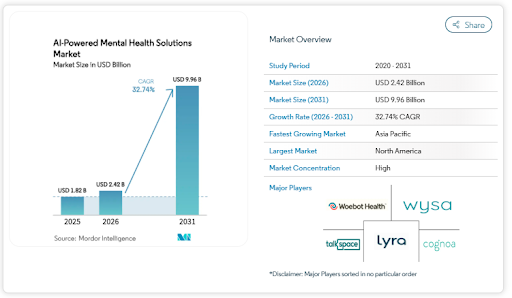
According to Mordor Intelligence, the AI-powered mental health solutions market is projected to grow from $1.82 billion in 2025 to $9.96 billion by 2031, at a compound annual growth rate of 32.74%. That is not a niche market finding its footing. That is a category moving toward the mainstream.
On the enterprise side, corporate absenteeism linked to stress costs businesses an estimated $300 billion annually. Employers are now actively funding AI-based wellness tools as part of their benefits packages, which means B2B revenue channels are opening up alongside direct-to-consumer ones.
This is not just a technology story. It is a healthcare access story. And the platforms being built right now will define how the next generation accesses mental health support.
What an AI Mental Wellness Platform Actually Does
Before getting into how to build one, it helps to be clear about what these platforms actually do, because "AI mental health app" covers a lot of ground.
A real platform is not just a chatbot with some mood tracking bolted on. The most useful ones do three jobs well.
First, early detection. They pick up on signals and patterns in how users write, what time they engage, and how their sentiment shifts over days or weeks before a crisis point is reached.
Second, continuous support. They are available at 2 AM on a Tuesday. They do not cancel appointments or run late. They meet users where they are, which is often not in a therapist's office.
Third, guided care pathways. They move users toward appropriate levels of care. When someone needs more than an app can offer, a well-built platform recognizes that and routes them toward a human professional.
The Core AI Capabilities That Power These Platforms
Natural language processing (NLP) is the engine behind most AI mental wellness interactions. It allows the app to understand what a user is actually saying, not just keyword matching, and respond in a way that feels human and grounded.
Behavioral pattern recognition tracks how a user's behavior changes over time. Less engagement, more negative language, and disrupted sleep patterns—these are signals the AI learns to read.
Sentiment analysis works on journal entries, check-ins, and chat logs to understand emotional tone and flag shifts that might need attention.
Crisis detection logic is one of the most critical parts of any mental health platform. When a user's language suggests they may be at risk, the system needs a clear, tested protocol for escalating to a human or emergency resource.
Personalized content recommendations use past behavior to surface the exercises, meditations, or tools most likely to help a specific user at a specific moment.
The Different Types of Mental Wellness Platforms You Can Build
Not every mental wellness platform looks the same. The type you build should match the audience you are serving and the problem you are solving.
CBT and Therapy-Guided Apps
These are structured programs based on cognitive behavioral therapy or dialectical behavior therapy protocols. They walk users through exercises, thought reframing techniques, and behavioral experiments. They work well for anxiety, depression, and stress management. Woebot and Wysa are examples of platforms that have taken this approach and built clinical credibility behind it.
AI Chatbot Companion Apps
These are lower-barrier, higher-volume platforms. Users talk to an AI companion that responds with empathy, asks follow-up questions, and helps users process what they are feeling. The entry cost for users is low, which makes these apps good for reaching people who would never book a therapy session.
Teletherapy Platforms with AI Triage
These combine human therapists with an AI intake and triage layer. The AI handles intake questions, symptom screening, and session preparation. The human therapist handles the actual therapy. This hybrid model is where clinical credibility and scale intersect. If you are building for a healthcare provider or an insurance company, this is often the model they want.
Corporate Wellness Platforms
These are employer-facing tools that integrate with HR systems, track workforce wellbeing trends, and give organizations an early warning system for team burnout. They are growing fast because employers are now paying for them directly as part of benefits packages.
Adaptive Meditation and Mindfulness Apps
These go beyond static guided meditations. The AI personalizes session recommendations based on the user's stress levels, sleep data, and engagement history. Headspace added an NLP-driven journaling module in 2025 that analyzed user entries and delivered personalized CBT prompts, resulting in a 20% increase in daily engagement.
| Platform Type | Best For | Revenue Model |
| CBT / Therapy App | Individuals, clinical partners | Subscription |
| AI Chatbot Companion | B2C, high-volume users | Freemium |
| Teletherapy + AI Triage | Healthcare providers | Per session + SaaS |
| Corporate Wellness | Employers, HR teams | Enterprise license |
| Adaptive Meditation | Wellness-focused consumers | Subscription |
Must-Have Features in an AI Mental Wellness Platform
Feature decisions are where most platforms get into trouble. Build too little and users do not see value. Build too much in one go, and you delay the launch while burning through the budget.
Here is how to think about it.
User-Facing Features
AI chat or virtual companions are the front door of most platforms. Users need to feel heard from the first message. The quality of the NLP model here matters more than most other decisions you will make.
The mood and emotion tracking dashboard gives users a mirror. Seeing a two-week mood chart is more motivating than any push notification. Make it visual, simple, and tied to real patterns.
Guided CBT or DBT exercises add clinical weight to the experience. These are structured, evidence-based activities that users can complete between therapy sessions or on their own.
Journaling with sentiment feedback lets users write freely while the AI surfaces patterns or themes they might not have noticed themselves.
Sleep and stress monitoring is valuable if you integrate with wearables or allow manual input. Sleep is one of the most reliable early indicators of mental health shifts.
In-app video or audio sessions with therapists are necessary if your platform includes human professionals. The video layer needs to be reliable, private, and easy to use on mobile.
Crisis escalation flow is non-negotiable. Every platform, no matter how wellness-focused, needs a tested pathway for users who are at risk. This means clear language, a link to a crisis helpline, and if possible, a real human response protocol.
Admin and Therapist-Side Features
Therapists using your platform need patient progress tracking, session notes, appointment management, and engagement analytics. If this side of the product is clunky, therapists will not recommend the platform to their patients. The admin layer deserves as much attention as the user-facing product.
Technical and Compliance Features
End-to-end encryption, role-based access controls, audit logs, and HIPAA or GDPR compliance are not optional add-ons. They are the foundation. Mental health data is among the most sensitive data categories that exist. Users will not trust a platform that cuts corners here, and regulators will not let one operate for long.
Step-by-Step: How to Build an AI Mental Wellness Platform
Step 1: Define Your Audience and Care Model
Start with a specific question: Who is this for, and what does their care journey look like?
A B2C app for stressed millennials looks completely different from a clinical platform for a hospital system or an enterprise tool for a Fortune 500 HR team. Get this wrong and everything else—your features, pricing, compliance requirements, and marketing—will be off target.
Step 2: Scope Your MVP
The platforms that launch and grow are almost always the ones that started narrow.
Pick one user group, one core problem, and one primary interaction model. Get that right before expanding. A focused MVP reduces development cost, speeds up learning, and makes it easier to iterate based on real feedback.
Step 3: Map Your Compliance Requirements
This is where many builders underestimate the work involved.
If you are targeting US users, you need to understand HIPAA requirements for storing and transmitting protected health information. For European users, GDPR applies. For India, the DISHA framework governs health data. Each has specific requirements for data storage, user consent, breach notification, and data access.
Bring a compliance consultant in early. The cost of retrofitting compliance into a finished product is significantly higher than building it in from the start.
Step 4: Select Your Tech Stack
For cross-platform mobile apps, React Native or Flutter both work well. React Native has a larger ecosystem; Flutter tends to produce more consistent UI across platforms.
For the backend, Node.js and Python with FastAPI are both strong choices. Python is particularly well-suited if your team is building custom ML models, since the tooling ecosystem for AI development in Python is mature and well-supported.
For the AI layer, most teams start with OpenAI's API or Google Vertex AI for natural language processing. As your platform matures and you accumulate your own data, training a fine-tuned model on mental health-specific datasets becomes worth exploring.
For data storage, PostgreSQL with encrypted fields handles most use cases well. Use AWS HealthLake or Azure Health APIs for compliant cloud hosting if you are building for a US clinical audience.
A strong custom software development partner can help you finalize the right stack for your specific use case, compliance requirements, and scale targets before you write a line of code.
Step 5: Build and Integrate the AI Layer
The AI layer is the hardest part to get right and the part that determines whether your platform feels genuinely helpful or just technically functional.
Start with a proven NLP model for conversation. Train it on mental health-appropriate language, which means careful dataset curation to avoid harmful outputs. Build your crisis detection logic as a separate, tested module with a clear human escalation path. Add sentiment analysis to journal and chat inputs. Then layer in recommendation logic that improves over time as you accumulate user data.
Teams exploring Generative AI development for health applications should allocate significant time to safety testing. This is not a standard software QA process. It requires clinical review.
Step 6: Design for Trust
Mental wellness apps live or die on trust. Users are sharing things they might not tell their closest friends.
The UX should feel calm, clean, and unhurried. Avoid aggressive notifications. Use plain, non-clinical language. Make the privacy settings easy to find and easy to understand. Make onboarding feel like a conversation, not a form.
The UI/UX design decisions here are not cosmetic. They directly affect whether users open the app again on day two.
Step 7: Test with Clinical Advisors Before Launch
Before any public release, have licensed mental health professionals review your care pathways, crisis protocols, and AI response quality.
Clinical advisors will catch things developers miss. A response that seems helpful from a product perspective can be clinically problematic. Getting this review done pre-launch is far less expensive than dealing with the consequences post-launch.
Step 8: Launch, Monitor, and Iterate
Your post-launch metrics should go beyond downloads and daily active users.
Track session length, return rate after the first week, crisis event response times, and whether users who start a CBT program actually complete it. These numbers tell you whether the platform is genuinely helping, not just being opened.
How Much Does It Cost to Build an AI Mental Wellness Platform?
Cost depends on four main variables: feature scope, AI complexity, compliance requirements, and your development team's location and experience.
According to Talentelgia's 2025 development report, the average cost of building an AI mental wellness app ranges from $4,000 to $20,000+, depending on scale and technology stack.
Here is a more practical breakdown:
| Build Tier | What It Includes | Estimated Cost |
| MVP / Basic Chatbot App | Core AI chat, mood tracking, basic compliance | $4K – $8K |
| Mid-Tier Platform | AI + teletherapy, CBT exercises, admin dashboard | $8K – $15K |
| Enterprise-Grade Platform | Full feature set, EHR integration, custom AI models | $20K+ |
What most people underestimate:
The obvious costs are developer hours and infrastructure. The less obvious ones include compliance audits, clinical content licensing if you are using established CBT or DBT frameworks, ongoing AI model training as your dataset grows, and the cost of clinical advisors during development and testing.
A proper budget plan accounts for all of these, not just the initial build.
The Challenges Nobody Talks About Openly
Most articles about building mental health platforms focus on what to build. Fewer talk honestly about what makes this category genuinely harder than other app categories.
Clinical safety and liability sit at the top of that list. If your AI gives guidance that contributes to a user's harm, you are not just dealing with a PR problem. You are dealing with a legal and ethical one. Every response pathway needs to be stress-tested against edge cases.
User trust and early retention is a harder problem than most builders expect. The majority of mental health app users drop off within the first three days. Onboarding has to do real work, not just collect a name and a goal. It has to establish why this platform is worth coming back to.
Regulatory oversight is tightening. The FDA's Digital Health Advisory Committee is actively reviewing generative AI in mental health applications. Platforms launching now need to be building with regulatory scrutiny in mind, not as an afterthought.
The AI-as-therapist framing is a liability. Apps that position their AI as a replacement for a licensed therapist face both regulatory risk and user trust issues. The platforms gaining clinical legitimacy right now are the ones that position AI as a support layer alongside, not instead of, professional care. The agentic AI solutions that work best in healthcare are the ones designed with clear human handoff protocols built in.
What Makes Users Actually Stick to a Mental Wellness App
Building the platform is one challenge. Getting users to come back the next day, and the day after that, is a different one entirely.
Personalization depth matters more than surface-level customization. Knowing a user's name is not personalization. Remembering that they tend to feel worse on Sunday evenings and surfacing the right content at that moment is personalization.
Progress visibility keeps users engaged. People want to see that what they are doing is working. A clear, simple mood trend chart or streak counter gives users evidence that the platform is delivering value.
Warm escalation paths, not cold walls. When a user needs more support than the app can offer, the handoff to a human therapist or crisis resource should feel like a natural next step, not an abrupt rejection. Platforms that handle this well build lasting loyalty.
Privacy transparency is a competitive advantage. In a category where users are sharing their most sensitive experiences, being genuinely clear about how data is used and protected is not just ethical practice. It is a product differentiator.
A Dartmouth randomized controlled trial published in 2025 found that users of a generative AI therapy chatbot sent an average of 260 messages over eight weeks, which is roughly equivalent to eight traditional therapy sessions worth of engagement. The improvements seen were comparable to those from traditional outpatient therapy. That is the standard the category is moving toward.
Platforms built on mobile app development foundations that prioritize performance, stability, and smooth cross-device experience will always have a retention advantage over apps that feel slow or unreliable.
How Nyusoft Can Help You Build Your Mental Wellness Platform
Building an AI mental wellness platform requires more than a development team. It requires a team that understands the intersection of AI, healthcare compliance, and product design and has shipped real products in all three areas.
Nyusoft has worked across healthcare technology solutions, fintech, and AI-powered product development. That breadth matters when you are building something that needs to hold up technically, comply with healthcare regulations, and earn the trust of users sharing their most personal experiences.
The engagement process is straightforward. It starts with a discovery phase where the team works through your target audience, care model, compliance requirements, and build scope before writing a line of code. From there, the process moves through architecture planning, development sprints, clinical QA, and launch support.
If you are a startup with a product idea, a healthcare provider looking to add digital capabilities, a clinic operator who wants to scale access to care, or an enterprise team building a workforce wellness product, the right conversation to have is about what you are trying to accomplish, not just what you want to build.
Schedule a meeting with the Nyusoft team and walk through your platform concept with people who have shipped products in this space before.
FAQs
1. What is an AI mental wellness platform?
An AI mental wellness platform is a digital product that uses machine learning, natural language processing, and behavioral data to deliver personalized mental health support. It can include AI chat companions, mood tracking, guided therapy exercises, crisis detection, and connections to licensed therapists, all within a single app or web platform.
2. How is AI used in mental health apps?
AI is used to power conversational therapy chatbots, analyze journal entries for emotional patterns, track mood shifts over time, detect early signs of crisis, and recommend personalized content like CBT exercises or meditation sessions. NLP models handle language understanding, while machine learning improves responses based on user behavior over time.
3. How much does it cost to build an AI mental health platform?
The development cost typically ranges from $4,000 for a basic MVP to $20,000 or more for an enterprise-grade platform with full AI capabilities, teletherapy integration, and compliance architecture. The biggest cost variables are AI complexity, the compliance layer (HIPAA/GDPR), and whether you are integrating with external healthcare systems.
4. How long does it take to build a mental wellness app?
A focused MVP typically takes 4 to 6 months from discovery to launch. A mid-tier platform with AI chat, therapy sessions, and an admin dashboard usually takes 8 to 12 months. Enterprise builds with custom AI models and EHR integrations can run 12 to 18 months depending on scope and compliance requirements.
5. What compliance standards apply to mental health app development?
In the United States, HIPAA governs the storage and transmission of health data. In Europe, GDPR applies. In India, the Digital Information Security in Healthcare Act (DISHA) sets the framework. If your platform works with licensed therapists or stores clinical data, you will need to meet the requirements of the relevant jurisdiction from day one of development.
6. Can AI replace a licensed therapist in a mental wellness app?
No. AI can provide structured support, guided exercises, and 24/7 availability for mild-to-moderate conditions. It cannot diagnose, prescribe, or handle complex clinical cases. The most effective platforms use a hybrid model where AI handles daily support and triage, and licensed therapists manage clinical care and crisis intervention. Positioning AI as a therapist replacement creates both regulatory and ethical risk.
7. What features should a mental wellness platform include?
Core features include an AI chat or companion, mood and emotion tracking, guided CBT or DBT exercises, journaling with sentiment analysis, crisis escalation pathways, and in-app therapist sessions. On the admin side, therapist dashboards, session notes, appointment management, and engagement analytics are essential. HIPAA-compliant data encryption and role-based access should be part of the technical foundation.
8. What tech stack is used to build an AI mental health app?
Most teams use React Native or Flutter for cross-platform mobile development. Python with FastAPI or Node.js handles the backend. For AI, OpenAI's API or Google Vertex AI are common starting points for NLP. PostgreSQL with encrypted storage works well for data, and AWS HealthLake or Azure Health APIs support HIPAA-compliant cloud hosting.
9. Which type of mental wellness platform is most profitable?
Corporate wellness platforms currently offer the strongest B2B revenue potential because employers fund them directly as part of benefits packages. Teletherapy platforms with AI triage are gaining traction with insurance companies and healthcare providers. B2C subscription apps are viable at scale but require strong retention rates to remain profitable given acquisition costs.
10. How do I make users stick to a mental wellness app?
Retention in mental health apps comes down to three things: genuine personalization that goes beyond a user's name, clear progress visibility so users see that the platform is working, and warm escalation paths when users need more support than an app can offer. Apps that feel calm, trustworthy, and private consistently outperform those that feel clinical or pushy. Most users drop off within three days, so onboarding carries more weight here than in almost any other app category.