

 Front End Development
  Back End Development
  CMS / ECommerce Development
  Mobile Apps Development
  Cloud Services
  Fullstack Services
  Solution


AI Chatbots in Healthcare: Use Cases, Features & Development
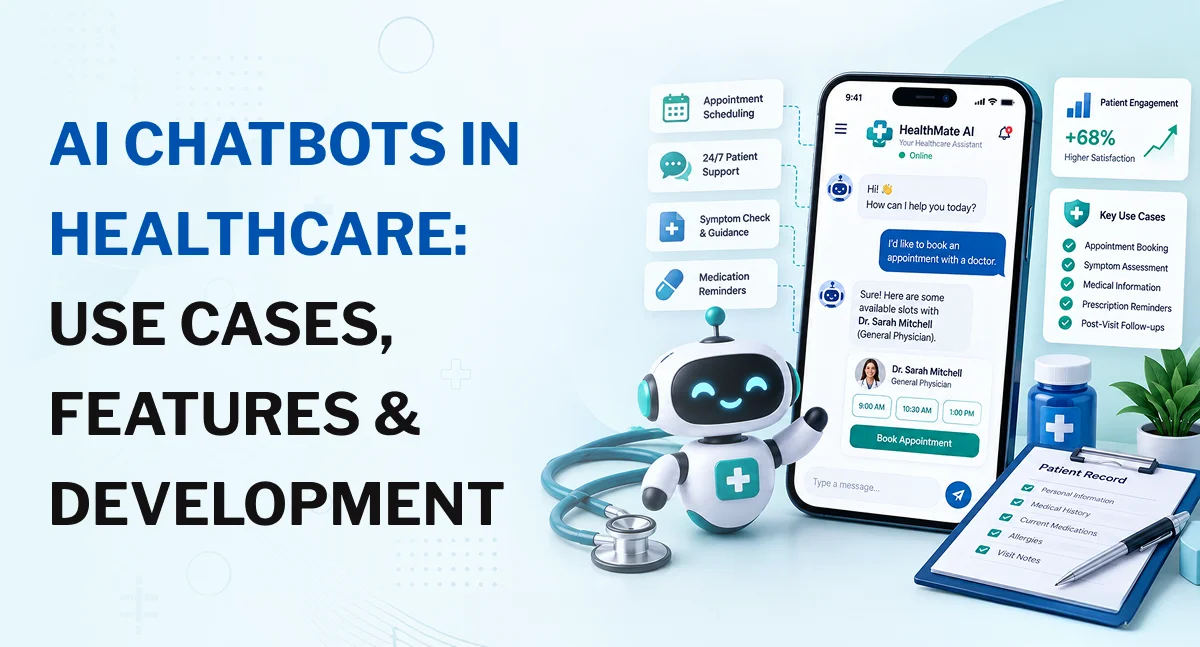
AI chatbots in healthcare are being used for patient support, appointment scheduling, health information, reminders, intake, care coordination, and selected administrative workflows. The global healthcare chatbot market was valued at approximately US$1.48 billion in 2025 and is projected by Grand View Research to reach about US$6.64 billion by 2033, representing a 20.2% CAGR. North America accounted for the largest share of the market in 2025.
The technology ranges from simple FAQ assistants to AI systems that connect with healthcare platforms, retrieve information from approved knowledge sources, process documents, and hand conversations to staff. The right approach depends on the chatbot's purpose, the healthcare data involved, and how much authority the system should have.
For healthcare organizations, the important question is not simply which AI model to use. It is what the chatbot should do, which systems it needs to access, what information it can provide, and where a healthcare professional needs to take over.
What Can an AI Chatbot Do in Healthcare?
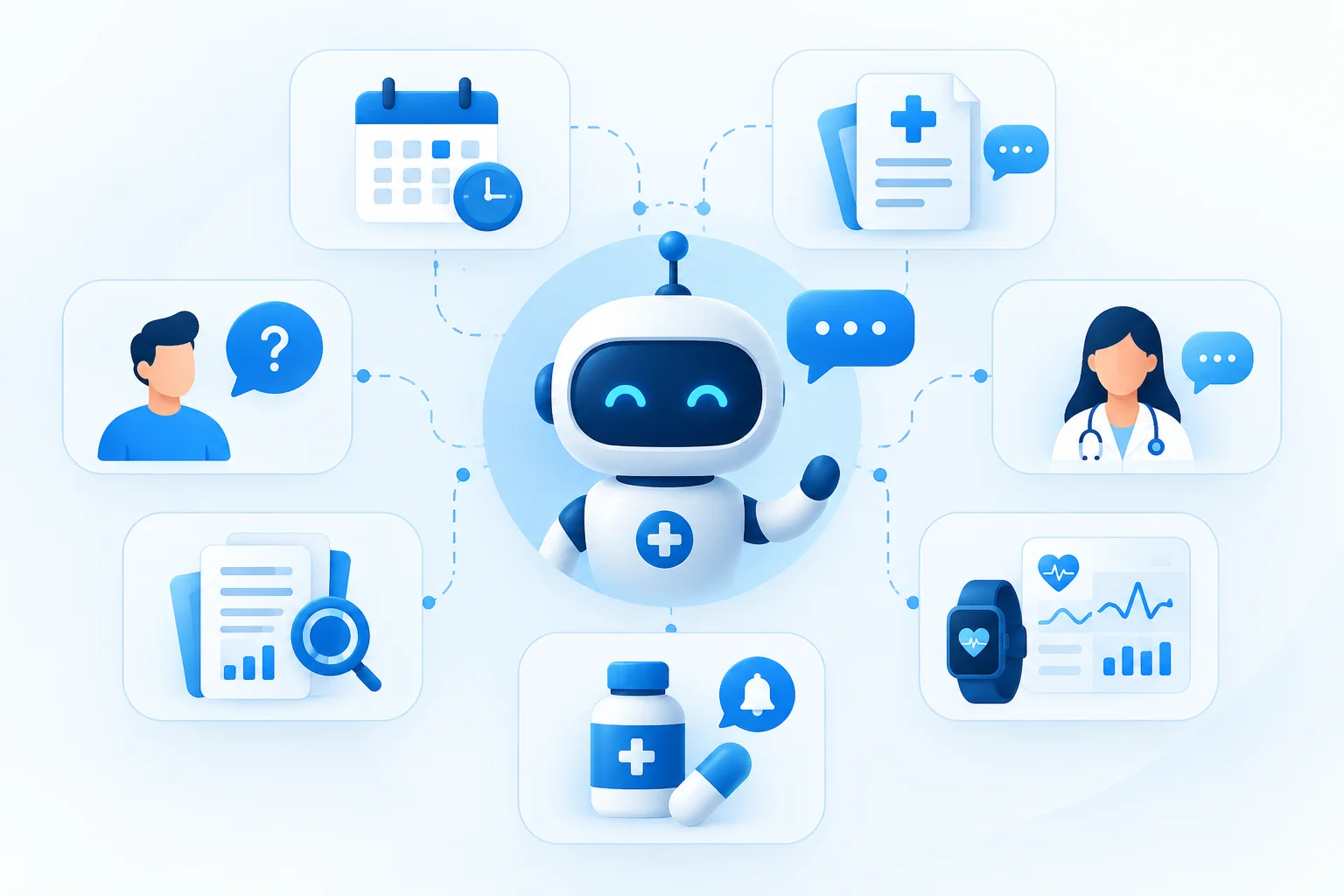
A healthcare chatbot can be a relatively simple patient information tool or part of a larger healthcare platform.
A basic chatbot might answer questions about clinic hours, services, appointments, or preparation instructions. A more advanced system can connect with scheduling platforms, patient portals, healthcare databases, and approved knowledge bases.
Common applications include:
- Patient-facing chatbots for questions, appointments, reminders, and education
- Healthcare staff assistants for information retrieval, documentation, and administrative work
- Administrative chatbots for registration, scheduling, billing, and support
- Health information assistants for explaining approved medical information
- Clinical workflow assistants that collect information and route it to healthcare professionals
- Voice healthcare assistants for hands-free interaction
The chatbot's role should be established before selecting the technology. An assistant that books appointments does not require the same architecture as one that processes patient records or supports clinical workflows.
AI Chatbot Use Cases in Healthcare
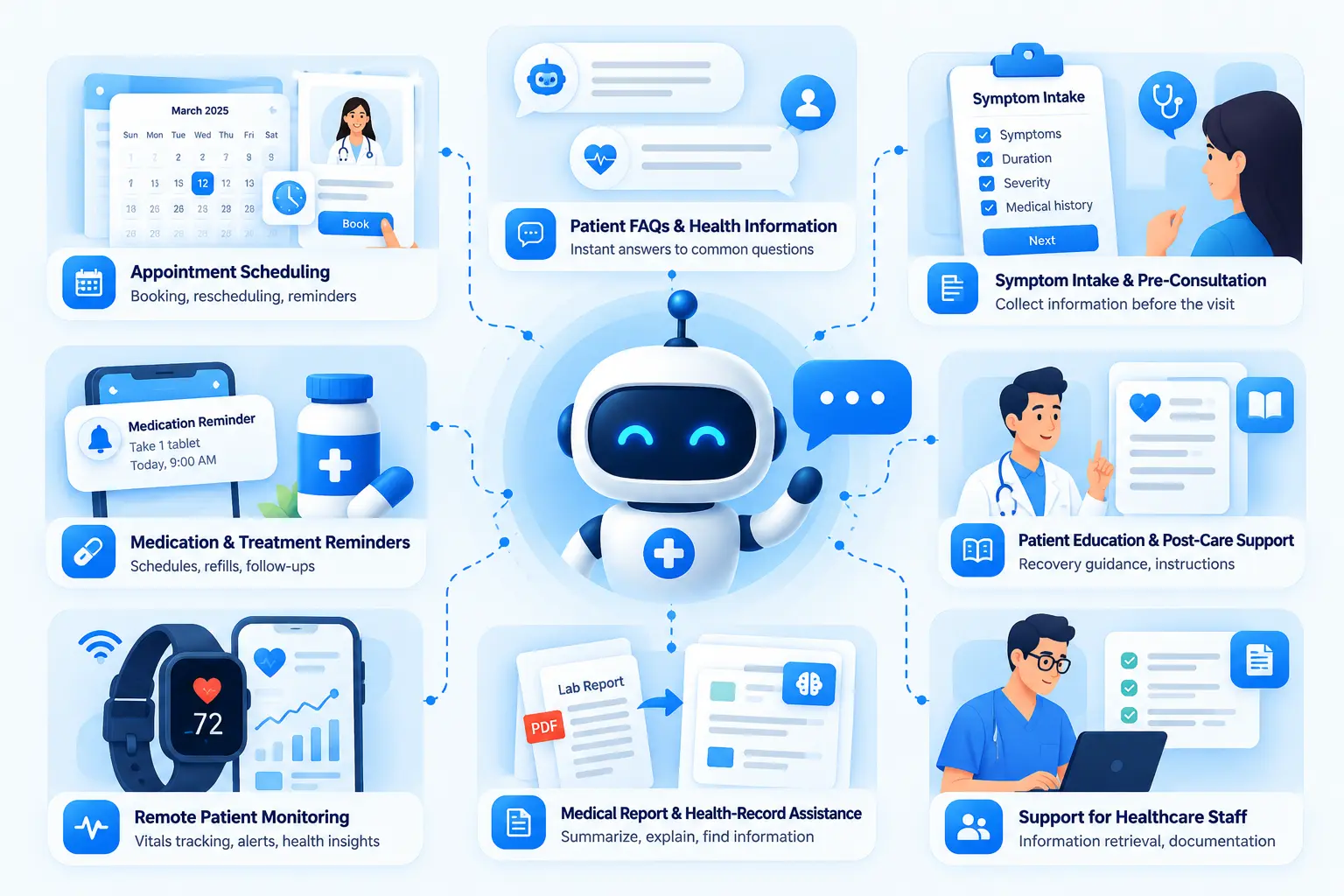
Healthcare organizations can apply conversational AI across patient communication, administrative work, and selected healthcare workflows.
Appointment Scheduling and Patient Registration
Appointment management is one of the clearest applications because the workflow is structured and easy to measure.
A chatbot can help patients:
- Find available appointment times
- Select a provider or department
- Book appointments
- Reschedule appointments
- Cancel appointments
- Receive appointment reminders
- Complete basic registration
- Understand appointment preparation requirements
It can also connect the conversation directly to provider availability instead of simply collecting a request for staff to process later.
A broader healthcare platform can combine appointment management with patient profiles, medical records, telemedicine, and secure communication. This becomes particularly useful when planning a healthcare software platform rather than a standalone chatbot.
For products where appointment scheduling is the main function, the chatbot can also become part of a larger doctor appointment app that handles provider search, availability, booking, reminders, payments, and virtual consultations.
Patient FAQs and Health Information
Patients often need straightforward information before or after a healthcare interaction.
A chatbot can answer approved questions about:
- Clinic services
- Appointment preparation
- Prescription procedures
- Follow-up instructions
- Operating hours
- Insurance processes
- General health information
- Provider availability
- Medical terminology
The distinction between providing health information and making a clinical decision needs to remain clear.
For example, a chatbot may explain what a medical term means in plain language. That does not mean it should diagnose a condition or recommend treatment without an appropriate clinical framework.
Symptom Intake and Pre-Consultation Support
Conversational AI can collect information before a patient speaks with a clinician.
The chatbot may ask structured questions about:
- Symptoms
- Duration
- Severity
- Existing conditions
- Current medications
- Relevant history
- Other information required for the consultation
The collected information can then be routed to the appropriate healthcare professional.
This can make the consultation process more organized, but the chatbot should not be presented as an autonomous diagnostic authority.
It should also have escalation rules. If a conversation suggests a potentially urgent situation, the system needs a defined pathway for directing the person to appropriate care.
Medication and Treatment Reminders
A healthcare chatbot can support routine reminders for:
- Medication schedules
- Prescription refills
- Follow-up appointments
- Laboratory tests
- Treatment milestones
- Care-plan activities
The conversational interface can make reminders more useful because the patient may be able to confirm completion, ask where to find instructions, or request help from the care team.
Medication changes require a different level of control. A chatbot should not independently modify treatment instructions simply because the underlying technology can perform an action.
Patient Education and Post-Care Support
Patients often have questions after a consultation or procedure.
A chatbot can provide access to approved information about:
- Preparation instructions
- Recovery guidance
- Follow-up procedures
- Lifestyle information
- Frequently asked questions
- Educational resources
- When to contact a care team
The information should come from controlled sources that can be reviewed and updated by authorized personnel.
Remote Patient Monitoring Support
Conversational AI can also become the interaction layer for remote patient monitoring.
For example, a patient may use connected devices to record health information while the chatbot provides reminders, answers questions, or explains information available through the monitoring platform.
A broader health monitoring app can combine vital tracking, medical records, health alerts, AI insights, medical report analysis, and conversational health support.
The chatbot should not be confused with the monitoring system itself. It is one part of the wider product that helps users interact with health information and related workflows.
Health monitoring platforms can also use OCR and NLP to process medical reports, generate plain-language explanations, and create longitudinal health summaries. That creates an opportunity for the conversational interface to sit on top of information already collected by the wider healthcare application.
Medical Report and Health-Record Assistance
AI chatbots can help users work with information contained in medical documents.
Possible functions include:
- Explaining medical terminology
- Summarizing reports
- Finding specific information
- Extracting structured information
- Processing uploaded documents
- Preparing questions for a healthcare professional
- Presenting information in simpler language
OCR and NLP can be useful when documents need to be converted into structured information before the conversational layer can work with them.
A good example of this type of architecture can be seen in an AI fertility intelligence platform, where laboratory information, health indicators, predictive models, and a conversational assistant are combined within one healthcare product.
There is an important distinction between extracting or explaining information and making a clinical interpretation. The system should make that boundary clear.
Support for Healthcare Staff
Conversational AI is not limited to patient-facing applications.
Healthcare staff can use AI assistants for:
- Internal knowledge search
- Document summarization
- Patient communication drafts
- Administrative questions
- Workflow guidance
- Information retrieval
- Task routing
- Documentation support
A provider-facing assistant can reduce the need to search across multiple systems, provided that access permissions are properly enforced.
Build an AI Chatbot Around Your Healthcare Workflow
From patient support and appointment scheduling to health information and staff assistance, your chatbot should be built around the workflows it needs to handle. Define the right features, integrations, and AI approach for your healthcare product.
Let’s Plan Your AI Chatbot
Features to Include in a Healthcare AI Chatbot
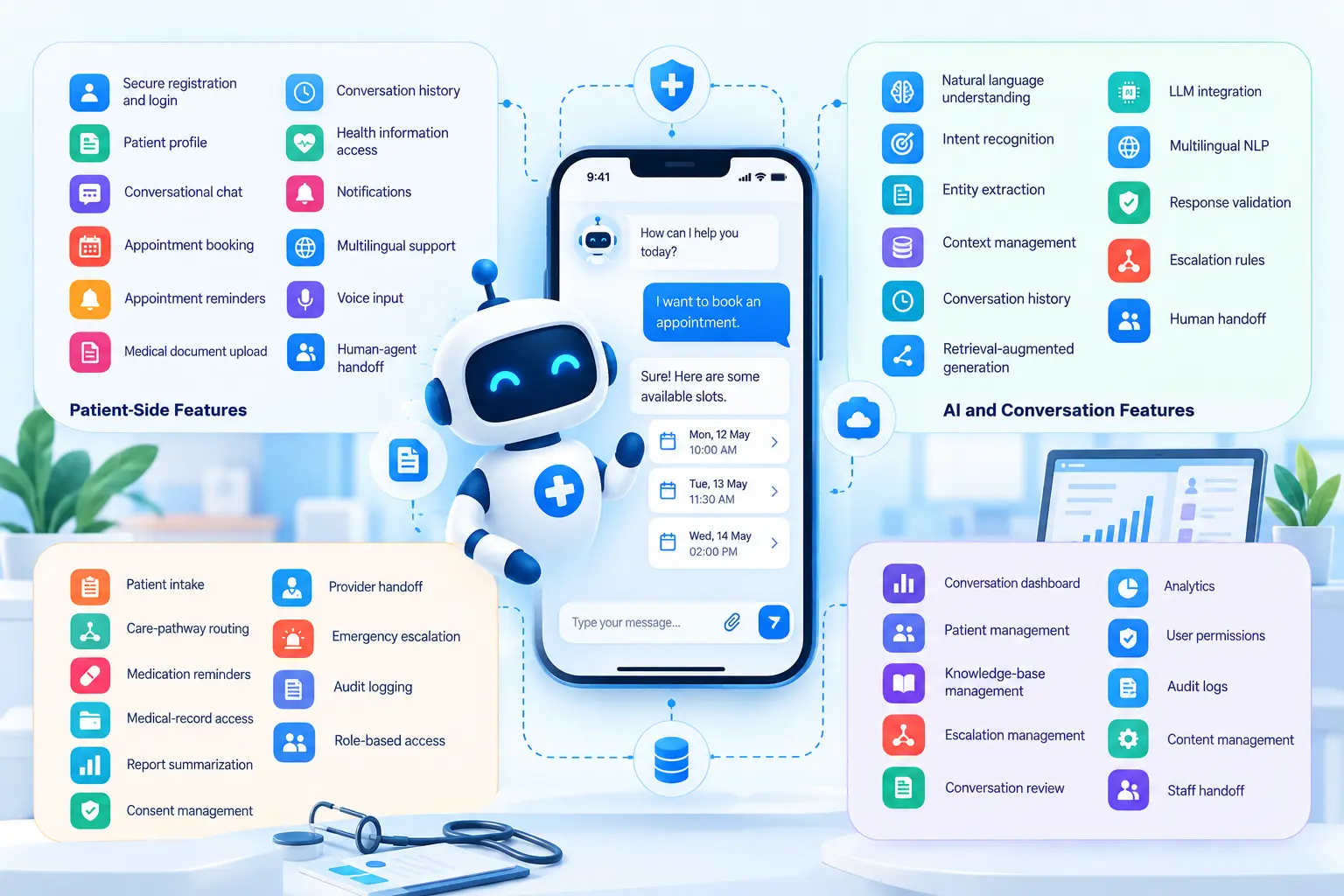
A healthcare chatbot needs more than a conversational interface connected to an AI model.
Patient-Side Features
Depending on the use case, the patient application may include:
- Secure registration and login
- Patient profile
- Conversational chat
- Appointment booking
- Appointment reminders
- Medical document upload
- Conversation history
- Health information access
- Notifications
- Multilingual support
- Voice input
- Human-agent handoff
Not every project needs every feature. A chatbot designed only for appointment scheduling may need a much smaller feature set than a patient health assistant.
AI and Conversation Features
The AI layer may include:
- Natural language understanding
- Intent recognition
- Entity extraction
- Context management
- Conversation history
- Retrieval-augmented generation
- LLM integration
- Multilingual NLP
- Response validation
- Escalation rules
- Human handoff
Natural language processing is useful because patients do not consistently phrase requests using the same terminology.
For example:
"Can I move my appointment?"
and:
"I can't make it on Thursday. Can I change my visit?"
may represent the same underlying intent.
A properly designed NLP layer can identify that intent and route the request to the correct workflow. This is where NLP development becomes relevant, particularly for intent recognition, entity extraction, dialogue management, multilingual interaction, and document processing.
Healthcare-Specific Features
Depending on the product, healthcare-specific functionality may include:
- Patient intake
- Care-pathway routing
- Medication reminders
- Medical-record access
- Report summarization
- Consent management
- Provider handoff
- Emergency escalation
- Audit logging
- Role-based access
These features should be selected according to the actual workflow. Adding clinical functionality simply because the technology supports it can create unnecessary risk.
Provider and Admin Features
The administrative side may include:
- Conversation dashboard
- Patient management
- Knowledge-base management
- Escalation management
- Conversation review
- Analytics
- User permissions
- Audit logs
- Content management
- Staff handoff
An effective admin interface should also show authorized staff why a conversation was escalated and what information the patient has already provided.
Turn Healthcare Chatbot Features Into a Working Product
Choose the features that fit your users, healthcare workflows, and data requirements. From NLP and RAG to patient authentication, human handoff, and healthcare integrations, the right architecture starts with a clear product scope.
Discuss Your Chatbot Requirements
How Healthcare AI Chatbots Work
A healthcare chatbot is usually made up of several connected layers.
User Message and Intent Detection
The process begins when a user sends a message.
The system can identify:
- Intent
- Entities
- Context
- Urgency
- User permissions
- Required workflow
For an appointment request, entities could include the provider, date, and appointment type.
For a health-related question, the system may identify symptoms, requested information, or the relevant health topic.
Knowledge Retrieval and AI Response
A general-purpose language model should not automatically be treated as the source of truth for healthcare information.
A more controlled architecture can connect the model to approved knowledge sources.
This is where retrieval-augmented generation, commonly called RAG, can be useful. The application retrieves relevant information from a controlled knowledge base and gives that information to the language model when generating a response.
For example, a healthcare organization could use RAG to retrieve approved preparation instructions for a procedure rather than asking a general-purpose model to generate those instructions from its own knowledge.
This also makes content maintenance easier because the underlying information can be updated without retraining the language model.
Integration With Healthcare Systems
A production healthcare chatbot may need connections to:
- EHR and EMR systems
- Patient portals
- Appointment systems
- Telemedicine platforms
- Payment systems
- Prescription systems
- Medical-record platforms
- Wearable devices
- Notification systems
Interoperability should be considered early if the chatbot needs to exchange healthcare information with other systems.
FHIR can be relevant for applications that need to exchange structured healthcare information between compatible systems.
A healthcare development project may therefore need a broader healthcare app development process covering product planning, clinical workflows, compliance, integrations, and technical architecture rather than treating the chatbot as an isolated feature.
Human Escalation
A healthcare chatbot should have a defined route to human support.
Depending on the use case, that could mean:
- Doctor
- Nurse
- Care coordinator
- Support representative
- Scheduling staff
- Emergency information
The patient should not have to repeat the entire conversation after escalation. Passing the relevant context to an authorized staff member can make the handoff much more useful.
Technology Stack for Healthcare Chatbot Development
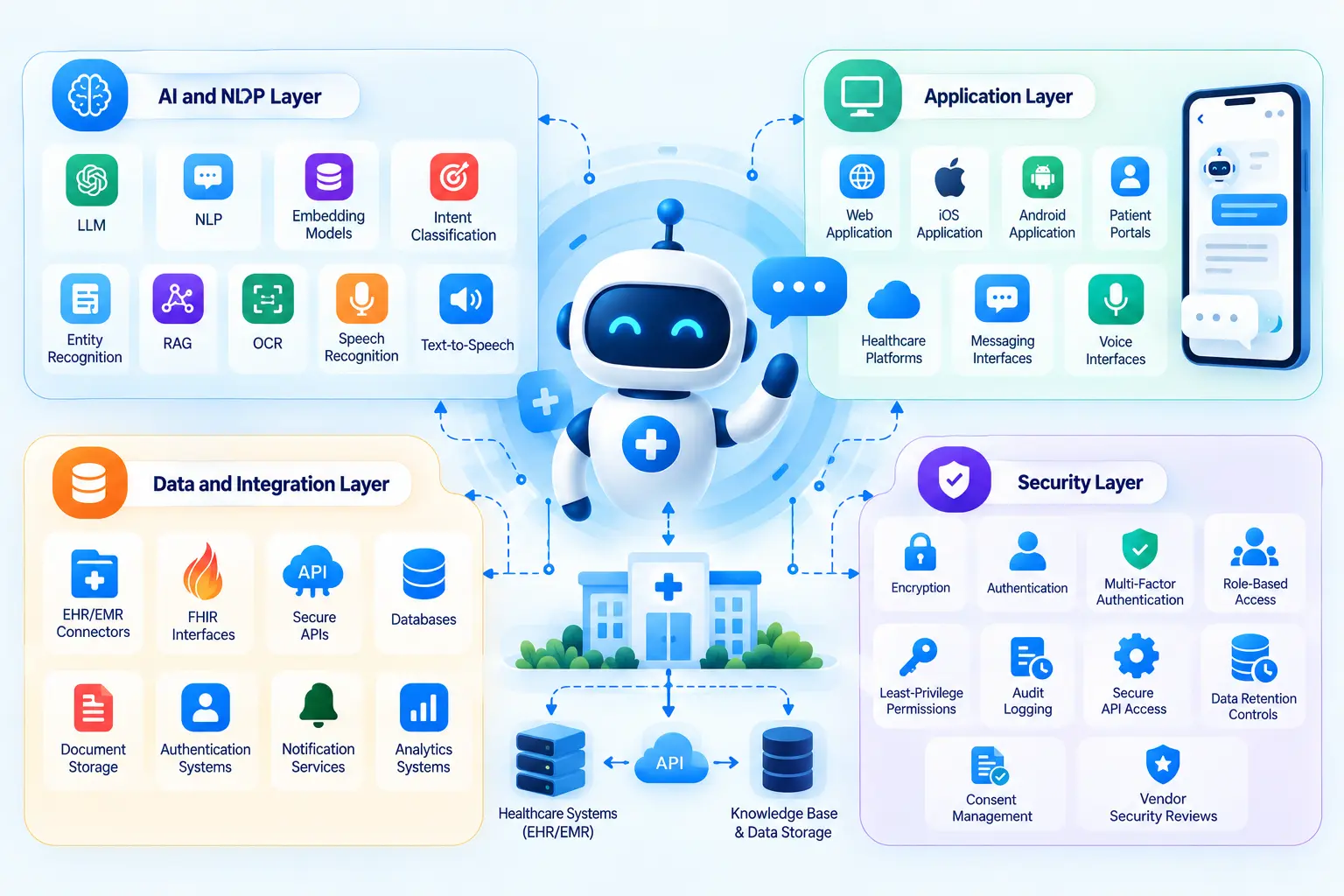
The technology stack depends on the chatbot's purpose, data requirements, and integrations.
AI and NLP Layer
Common components include:
- Large language models
- Natural language processing
- Embedding models
- Intent classification
- Entity recognition
- RAG
- OCR
- Speech recognition
- Text-to-speech
A generative AI development architecture can provide the foundation for conversational applications, while healthcare-specific knowledge, access controls, and workflow rules sit around the model.
Machine learning can also support classification, prediction, anomaly detection, and other healthcare workflows. These models are separate from the conversational interface but can provide information that the chatbot explains to the user.
Application Layer
The chatbot may be delivered through:
- Web applications
- iOS applications
- Android applications
- Patient portals
- Healthcare platforms
- Messaging interfaces
- Voice interfaces
The interface should match the way the target users already interact with the healthcare organization.
Data and Integration Layer
This layer may include:
- Secure APIs
- EHR/EMR connectors
- FHIR interfaces
- Databases
- Document storage
- Authentication systems
- Notification services
- Analytics systems
Security Layer
Security should be part of the architecture from the beginning.
Common controls include:
- Encryption
- Authentication
- Multi-factor authentication
- Role-based access
- Least-privilege permissions
- Audit logging
- Secure API access
- Data retention controls
- Consent management
- Vendor security reviews
Choose the Right Technology Stack for Your Healthcare Chatbot
Your chatbot may need AI and NLP, RAG, EHR/EMR connectivity, FHIR interfaces, secure APIs, authentication, and data controls. Define the technology stack around the chatbot's actual healthcare use case.
Discuss Your Technology Stack
Security, Privacy and Compliance Requirements
Healthcare chatbots can process highly sensitive information, so their security requirements differ from those of ordinary customer-service chatbots.
Protecting Patient Information
For US healthcare organizations covered by HIPAA, electronic protected health information is subject to administrative, physical, and technical safeguards under the HIPAA Security Rule.
A chatbot that handles protected health information may therefore require controls around:
- Data encryption
- Identity verification
- Access permissions
- Audit logs
- Secure storage
- Data transmission
- Vendor relationships
- Incident response
- Data retention
The exact obligations depend on the organization, its role under applicable law, and how the chatbot is used.
HIPAA and International Requirements
HIPAA is particularly relevant to many US healthcare organizations, but a global healthcare product may need to address additional privacy and healthcare requirements in the countries where it operates.
The scope depends on factors such as:
- Where users are located
- Where data is stored
- Who controls the data
- What information is collected
- Whether the system supports clinical functions
- Which third-party providers process the information
Compliance should therefore be considered during architecture planning rather than immediately before launch.
AI Safety and Governance
Healthcare AI introduces risks beyond conventional software security.
A chatbot can produce:
- Incorrect information
- Incomplete information
- Misleading explanations
- Biased responses
- Outdated information
- Overconfident answers
The World Health Organization's guidance on AI in healthcare identifies risks including false, inaccurate, biased, or incomplete outputs, automation bias, and cybersecurity vulnerabilities. It also recommends appropriate oversight and stakeholder involvement when AI systems are developed and deployed.
For a healthcare chatbot, this means testing should cover both conventional software behavior and AI-specific failure modes.
AI Chatbot Development Process for Healthcare
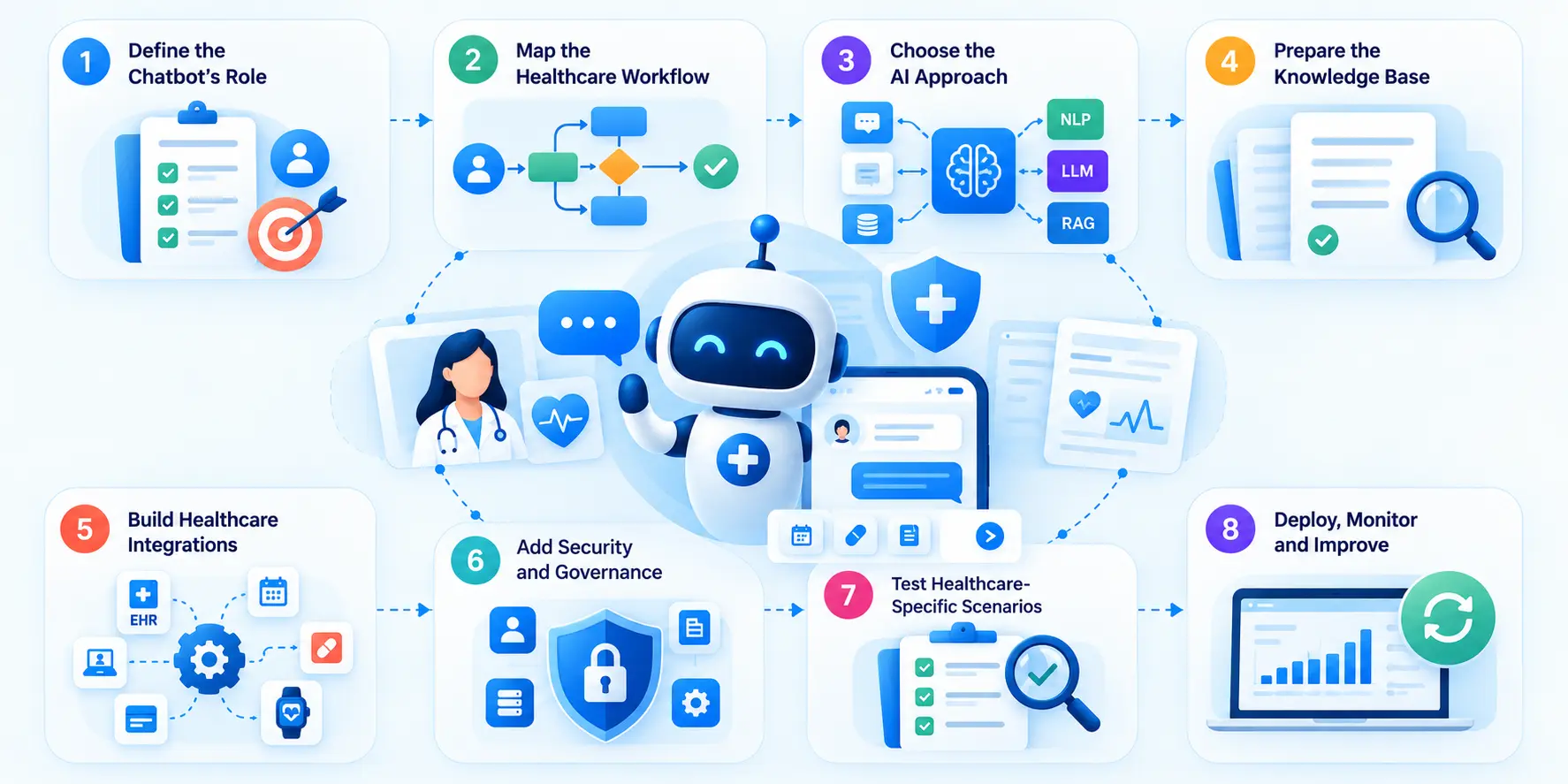
1. Define the Chatbot's Role
Start by deciding exactly what the chatbot should do.
Document:
- Target users
- Primary use case
- Supported tasks
- Restricted tasks
- Data it can access
- Actions it can perform
- Escalation conditions
An appointment assistant can have a tightly controlled workflow. A patient-facing health assistant needs a different level of testing and governance.
2. Map the Healthcare Workflow
Map what happens before, during, and after a conversation.
For example:
Patient question → intent detection → information retrieval → response → action or escalation
For appointment scheduling:
Patient request → authentication → provider availability → appointment selection → booking → confirmation
This process exposes missing integrations and approval points before development gets too far.
3. Choose the AI Approach
Several approaches can be considered.
Rule-based chatbot: Useful for fixed conversations and predictable workflows.
NLP chatbot: Useful when the system needs to understand varied user language and identify intents.
LLM chatbot: Useful for natural-language interaction, summarization, and flexible responses.
RAG chatbot: Useful when answers need to be grounded in approved documents or knowledge sources.
Hybrid chatbot: Combines fixed workflows with AI-based conversation.
For many healthcare applications, a hybrid architecture can be practical because some actions need predictable rules while other interactions benefit from natural-language understanding.
4. Prepare the Knowledge Base
The knowledge source should be treated as part of the product.
It may contain:
- Healthcare organization policies
- Patient instructions
- FAQs
- Approved educational material
- Service information
- Provider information
- Workflow documentation
Each source should have an owner and a process for review and updates.
5. Build Healthcare Integrations
Connect the chatbot to the systems it actually needs.
Potential integrations include:
- EHR
- EMR
- Appointment scheduling
- Patient portal
- Telehealth
- Prescription systems
- Payment systems
- Wearables
Integration requirements can significantly affect project scope, so they should be identified before development estimates are finalized.
6. Add Security and Governance
Build security controls, permissions, logging, consent, and data-handling processes into the architecture.
For AI systems, establish:
- Model evaluation criteria
- Approved response boundaries
- Escalation rules
- Monitoring
- Human review
- Testing datasets
- Failure handling
7. Test Healthcare-Specific Scenarios
Testing should go beyond checking whether the chatbot produces a response.
Test scenarios should include:
- Normal patient questions
- Ambiguous questions
- Unsupported questions
- Emergency-related language
- Incorrect assumptions
- Requests for private information
- Attempts to bypass access controls
- Medical misinformation
- Hallucinated information
- Failed integrations
- Human escalation
The system should also be tested with different ways people naturally describe the same problem.
8. Deploy, Monitor and Improve
After launch, monitor meaningful metrics such as:
- Task completion rate
- Escalation rate
- Unanswered question rate
- Response accuracy
- Appointment completion
- Human handoff rate
- User drop-off
- Response latency
- Error frequency
Conversation volume alone does not tell you whether the chatbot is useful.
How Much Does Healthcare AI Chatbot Development Cost?
Healthcare AI chatbot development can cost anywhere from $3,000 to $20,000+, depending on the chatbot's complexity, integrations, AI capabilities, security requirements, and intended use.
A basic healthcare FAQ chatbot may only need a conversational interface and approved content. A more advanced system may need patient authentication, appointment scheduling, RAG, medical document processing, EHR/EMR integration, and human-agent escalation.
| AI chatbot type | Approximate development cost | Typical features |
| Basic Healthcare AI Chatbot | $3,000–5,000+ | Website chat, healthcare FAQs, general health information, basic AI responses, simple appointment assistance |
| Patient Support Chatbot | $5,000–10,000+ | Appointment booking, patient authentication, reminders, FAQs, basic patient workflows, selected integrations |
| Advanced Healthcare AI Chatbot | $10,000–15,000+ | Multiple integrations, RAG, medical document processing, multilingual support, voice, patient intake, human handoff, advanced workflows |
| Enterprise Healthcare AI Chatbot | $15,000+ | EHR/EMR integrations, complex patient workflows, advanced security, role-based access, analytics, audit logs, custom AI workflows, enterprise administration |
These are approximate development ranges, not fixed project quotes. The final cost depends on factors such as:
- AI model and API usage
- Number and complexity of chatbot workflows
- Web or mobile application development
- UI/UX requirements
- NLP capabilities
- RAG and knowledge-base architecture
- Medical document processing
- EHR/EMR integrations
- FHIR-based interoperability
- Security and access controls
- Healthcare compliance requirements
- Voice capabilities
- Multilingual support
- Analytics and reporting
- Testing and quality assurance
- Ongoing monitoring and maintenance
A basic FAQ chatbot can often be developed with a relatively small feature set, while an enterprise healthcare assistant may require multiple integrations, stricter access controls, extensive testing, and ongoing AI monitoring.
Choosing the lowest initial development cost can also create additional expenses later if the architecture was not designed for future integrations or higher data-security requirements. Defining the required workflows, integrations, user roles, and data requirements before development makes it easier to estimate the actual project scope.
Common Mistakes When Building Healthcare AI Chatbots
Treating an LLM as a Medical Expert
A language model can produce a fluent answer without guaranteeing that the information is medically correct.
Healthcare applications need controlled information sources, testing, and clear boundaries around what the chatbot can provide.
Giving the Chatbot Too Much Autonomy
A chatbot should not receive unrestricted authority simply because an API can perform an action.
Functions involving diagnosis, treatment, medication, patient records, or sensitive information require appropriate controls and oversight.
Building the Chatbot Before Defining the Workflow
A chatbot can be technically impressive and still fail to solve the user's actual problem.
Start with the workflow and identify where conversation genuinely improves it.
Ignoring the Source of Truth
If the chatbot relies on outdated or unverified information, a more capable language model will not solve the underlying problem.
The knowledge source needs ownership, review, and version control.
Skipping Human Escalation
Some conversations will always require a human.
The escalation path should be clear, and relevant conversation context should be passed to the authorized staff member.
Treating Compliance as a Checkbox
Healthcare compliance affects architecture, data storage, authentication, access control, vendors, logging, and workflows.
It should be considered throughout development.
Measuring Conversations Instead of Outcomes
A large number of conversations does not necessarily mean the chatbot is working well.
More useful measures include:
- Appointment completion
- Task completion
- Escalation accuracy
- Unanswered question rate
- Response accuracy
- Resolution rate
- User satisfaction
AI Healthcare Chatbot vs Traditional Healthcare Chatbot
| Area | Traditional chatbot | AI-powered chatbot |
| Responses | Predefined | Generated or retrieved |
| User input | Usually structured | Natural-language input |
| Context | Limited | Can maintain conversational context |
| Personalization | Basic | More flexible |
| Knowledge retrieval | Fixed content | Can connect to knowledge sources |
| Complex requests | Limited | Can support multi-step interactions |
| Workflow control | High | Requires careful design |
| AI risk | Lower | Requires additional evaluation and governance |
| Development complexity | Generally lower | Generally higher |
More AI does not automatically mean a better healthcare product.
If the task is simply to provide clinic hours or guide a patient through a fixed booking process, a controlled workflow may be more appropriate than an open-ended AI conversation.
The architecture should follow the task.
What Makes a Healthcare AI Chatbot Ready for Real-World Use?
A healthcare chatbot is closer to production-ready when five areas have been addressed.
1. A Clearly Defined Purpose
The team knows exactly what the chatbot should and should not do.
2. Reliable Information Sources
The chatbot retrieves information from approved and maintained sources.
3. Safe Escalation
Users can reach an appropriate person or care pathway when the chatbot cannot safely handle the request.
4. Secure Data Handling
Authentication, permissions, encryption, logging, and data retention match the information being processed.
5. Measurable Outcomes
The organization can determine whether the chatbot improves the workflow.
These checks are more useful than simply asking whether the chatbot uses the newest language model.
Building an AI Healthcare Chatbot
For organizations planning an AI healthcare chatbot, development can involve several connected areas, including conversational AI, healthcare software, NLP, generative AI, machine learning, secure integrations, and health-data workflows.
Nyusoft's existing healthcare technology work covers healthcare platforms, health monitoring applications, and an AI fertility intelligence platform that combines AI-driven fertility assessment, laboratory report processing, health tracking, and conversational assistance.
The development approach should start with the healthcare workflow rather than the chatbot interface. Define the users, information sources, integrations, permissions, and escalation rules first. The AI model and conversational architecture can then be selected around those requirements.
For a product that needs more than a basic chatbot, the development scope may include conversational interfaces, RAG, healthcare system integrations, security controls, analytics, human handoff, and ongoing model evaluation.
The right budget depends on what the chatbot needs to accomplish, how many people will use it, which systems it must connect to, and how much control it needs over healthcare data and workflows. A clear technical scope is the best starting point for an accurate development estimate.
FAQs
1. What is an AI chatbot in healthcare?
An AI chatbot in healthcare is a conversational software system that uses technologies such as NLP and large language models to communicate with patients, healthcare staff, or providers. Depending on its design, it can handle tasks such as appointment scheduling, patient FAQs, intake, reminders, health information, and workflow support.
2. What are the main use cases of AI chatbots in healthcare?
Common use cases include appointment scheduling, patient registration, symptom intake, medication reminders, patient education, post-care support, remote patient monitoring assistance, medical report assistance, and internal support for healthcare staff.
3. Can an AI healthcare chatbot diagnose patients?
A chatbot can collect symptoms and organize information for a healthcare professional, but it should not automatically be treated as an autonomous diagnostic authority. Diagnostic functionality requires appropriate clinical validation, safety controls, defined boundaries, and human oversight.
4. How much does it cost to develop an AI chatbot for healthcare?
Healthcare AI chatbot development can start around $3,000 - $5,000+ for a basic solution. More advanced systems with RAG, patient authentication, healthcare integrations, medical document processing, and enterprise security can cost $10,000 - $15,000+, while complex enterprise solutions can exceed $15,000.
5. What features should a healthcare AI chatbot include?
Depending on the use case, features can include secure login, patient profiles, conversational chat, appointment booking, reminders, medical document uploads, multilingual support, voice interaction, NLP, RAG, human handoff, audit logging, role-based access, and healthcare system integrations.
6. Can an AI chatbot integrate with EHR and EMR systems?
Yes. A healthcare chatbot can be connected to compatible EHR and EMR systems through APIs, FHIR interfaces, or other integration methods. The required approach depends on the healthcare systems involved and the information the chatbot needs to access.
7. How is patient data secured in an AI healthcare chatbot?
Security measures can include encryption, authentication, multi-factor authentication, role-based access, least-privilege permissions, audit logging, secure APIs, data retention controls, and consent management. The required controls depend on the type of data and the healthcare organization using the system.
8. What AI technologies are used to build healthcare chatbots?
A healthcare chatbot may use large language models, NLP, embedding models, intent classification, entity recognition, RAG, OCR, speech recognition, text-to-speech, and machine learning. A hybrid architecture can combine AI capabilities with predefined workflows and business rules.
9. How long does it take to develop a healthcare AI chatbot?
Development time depends on the chatbot's scope. A basic FAQ or appointment chatbot can have a much shorter development cycle than a healthcare assistant requiring EHR/EMR integrations, RAG, authentication, medical document processing, voice capabilities, security controls, and extensive testing.
10. Why is human handoff important in healthcare chatbots?
Human handoff gives patients a clear path to appropriate staff when the chatbot cannot safely or accurately handle a request. The system can pass relevant conversation history and collected information to an authorized staff member, reducing the need for the patient to repeat everything.
Ready to Plan Your AI Healthcare Chatbot?
Start with the use case, then define the workflows, integrations, AI capabilities, security requirements, and development scope. A clear technical plan can help you estimate the right development approach and budget.
Book A Free Consultation Now