

 Front End Development
  Back End Development
  CMS / ECommerce Development
  Mobile Apps Development
  Cloud Services
  Fullstack Services
  Solution


Mortgage Software Development: Features, Integrations & Technology Considerations
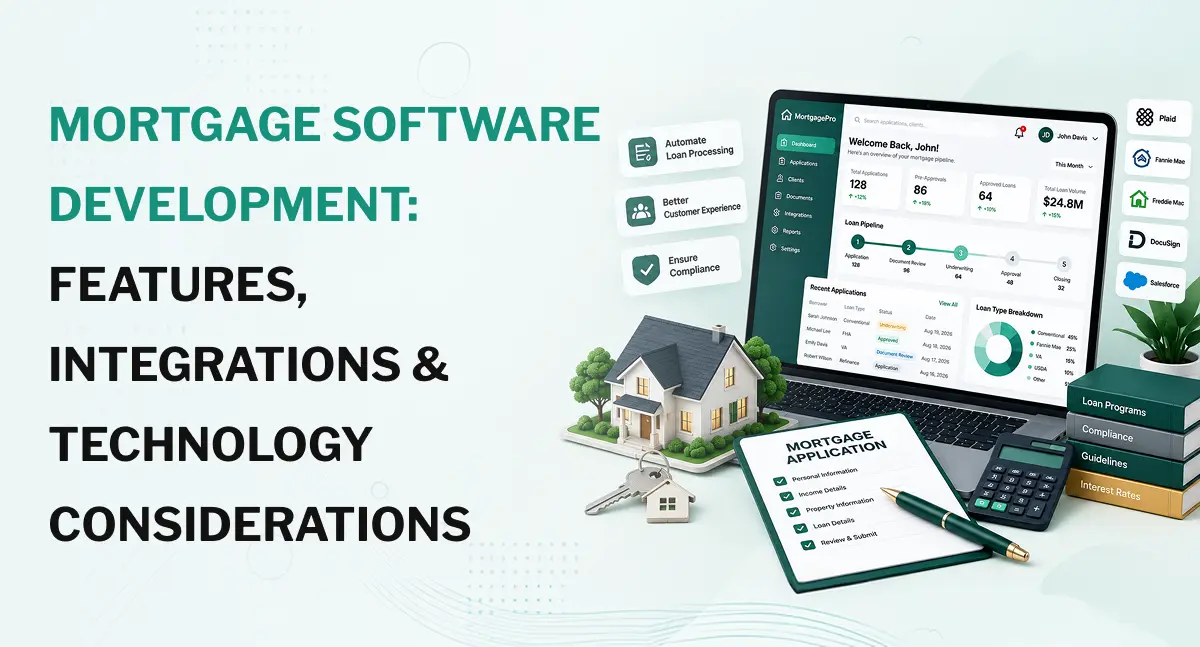
Mortgage software development involves building digital systems that support mortgage operations from borrower application and document collection through underwriting, approval, closing, and, where required, servicing.
The scope can be relatively focused, such as a borrower application portal or loan origination system, or much broader, covering underwriting, property data, document management, integrations, servicing, reporting and administration.
A mortgage platform also has requirements that are different from many other lending products. A loan record may need to connect borrowers, co-borrowers, properties, valuations, credit information, income verification, disclosures, documents, underwriting conditions and payment records. It may also need to exchange data with several external systems during a single mortgage application.
What Is Mortgage Software Development?

Mortgage software development is the process of designing and building software that manages one or more stages of the mortgage lifecycle.
Depending on the organisation, a mortgage platform can support:
- Borrower onboarding
- Mortgage applications
- Loan origination
- Credit and income verification
- Property and valuation information
- Underwriting
- Document management
- Approval workflows
- Closing
- Electronic signatures
- Mortgage servicing
- Payment management
- Reporting and analytics
- Administration
The term can cover several types of products.
Mortgage loan origination software
A loan origination system, or LOS, manages the mortgage from application through processing, underwriting and closing. It can act as the central operational system for the loan.
Mortgage borrower portal
A borrower-facing application allows customers to submit information, upload documents, receive updates and complete required steps online.
Mortgage underwriting software
An underwriting platform helps reviewers assess borrower, property and loan information, manage conditions and record decisions.
Mortgage servicing software
A servicing platform manages the post-closing relationship, including payments, account information, communications and servicing workflows.
End-to-end mortgage platform
Larger organisations may require several of these capabilities within one connected system.
The right model depends on what the business already has. A lender with an established servicing system may only need a new origination and borrower experience layer. Another organisation may want to build a complete mortgage platform from the ground up.
Have a Mortgage Software Idea?
Turn your mortgage software idea into a clear development plan with the right features, technology and integrations. Discuss your requirements with our team and understand the best approach for your project.
How Mortgage Software Supports the Mortgage Lifecycle
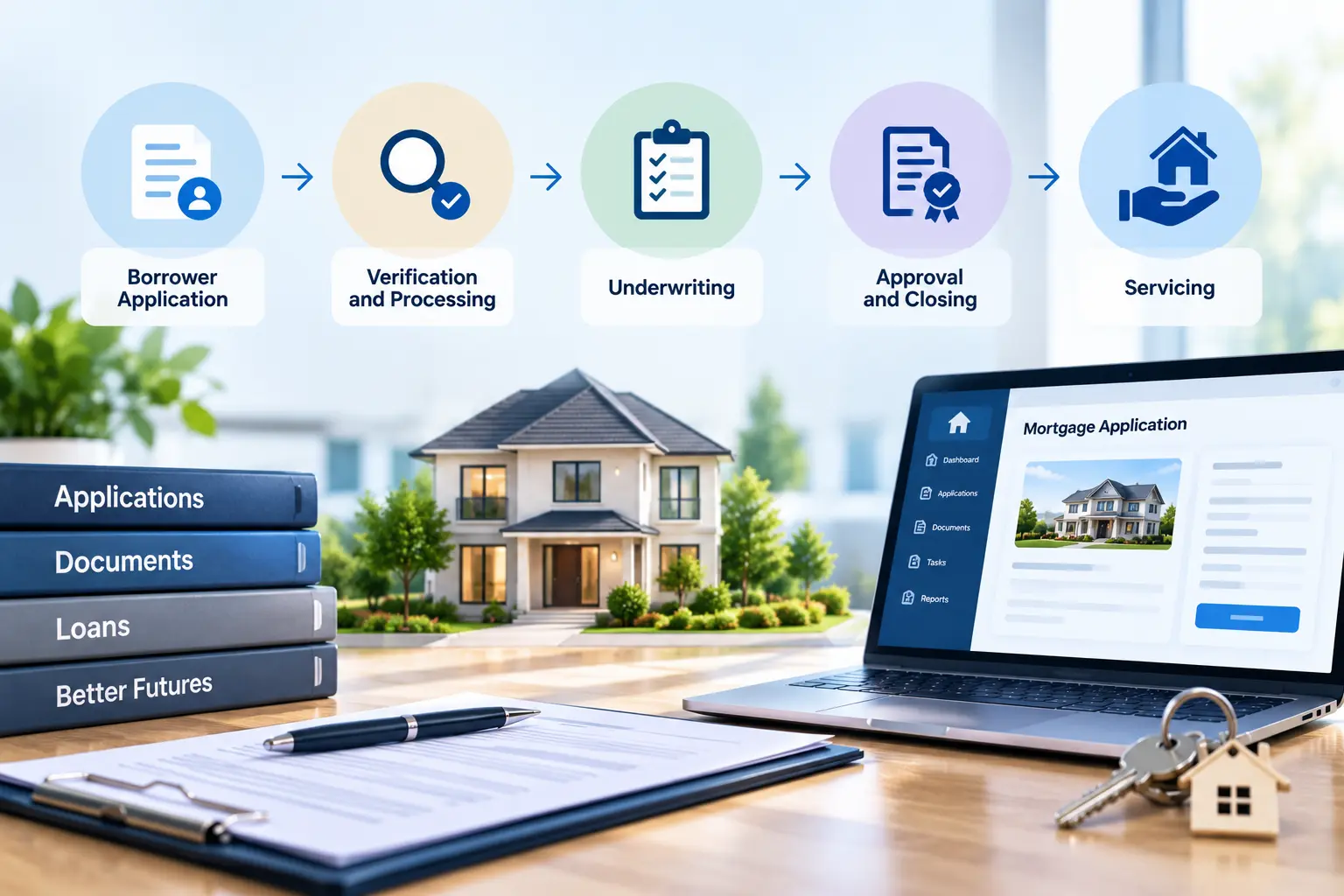
Before selecting features or technologies, it helps to map the actual mortgage workflow.
1. Borrower application
The process usually begins with an application containing borrower, employment, income, property and loan information.
A digital application can support:
- Borrower and co-borrower data
- Loan purpose
- Property details
- Income information
- Employment information
- Requested loan amount
- Loan product selection
- Consent and authorisation
- Document submission
The application should also save progress and clearly identify incomplete information.
2. Verification and processing
Once the application is submitted, the platform may connect with external services for identity, credit, income, employment, asset and property verification.
The software should record the result of each request and associate it with the correct loan file.
This is where integration design becomes particularly important. A mortgage platform may need information from several providers before an application can move to underwriting.
3. Underwriting
The underwriting stage brings together information from the borrower, property and external verification services.
The system can help underwriters:
- Review borrower information
- Review credit data
- Check income and employment information
- Assess property information
- Review required documents
- Manage loan conditions
- Request additional information
- Record decisions
- Escalate exceptions
- Maintain an audit trail
Automation can handle defined rules and repetitive checks while keeping human review for cases that require judgement.
4. Approval and closing
Once the loan satisfies the applicable requirements, the workflow moves toward approval and closing.
The platform can manage:
- Approval conditions
- Closing checklists
- Document preparation
- Disclosure workflows
- Electronic signatures
- Final document collection
- Closing status
- Post-closing document storage
Mortgage documentation is highly jurisdiction-specific. In the United States, for example, the CFPB provides requirements and official resources around mortgage disclosures such as the Loan Estimate and Closing Disclosure.
CFPB mortgage disclosure requirements
5. Servicing
If servicing is included in the product scope, the system can continue supporting the loan after closing.
Functions can include:
- Payment schedules
- Payment history
- Account balances
- Escrow information
- Customer communications
- Statements
- Delinquency workflows
- Servicing tasks
- Loan modifications
- Refinance-related processes
Servicing can substantially increase the project scope, so it should be treated as a separate product area during planning.
Key Features of Mortgage Software
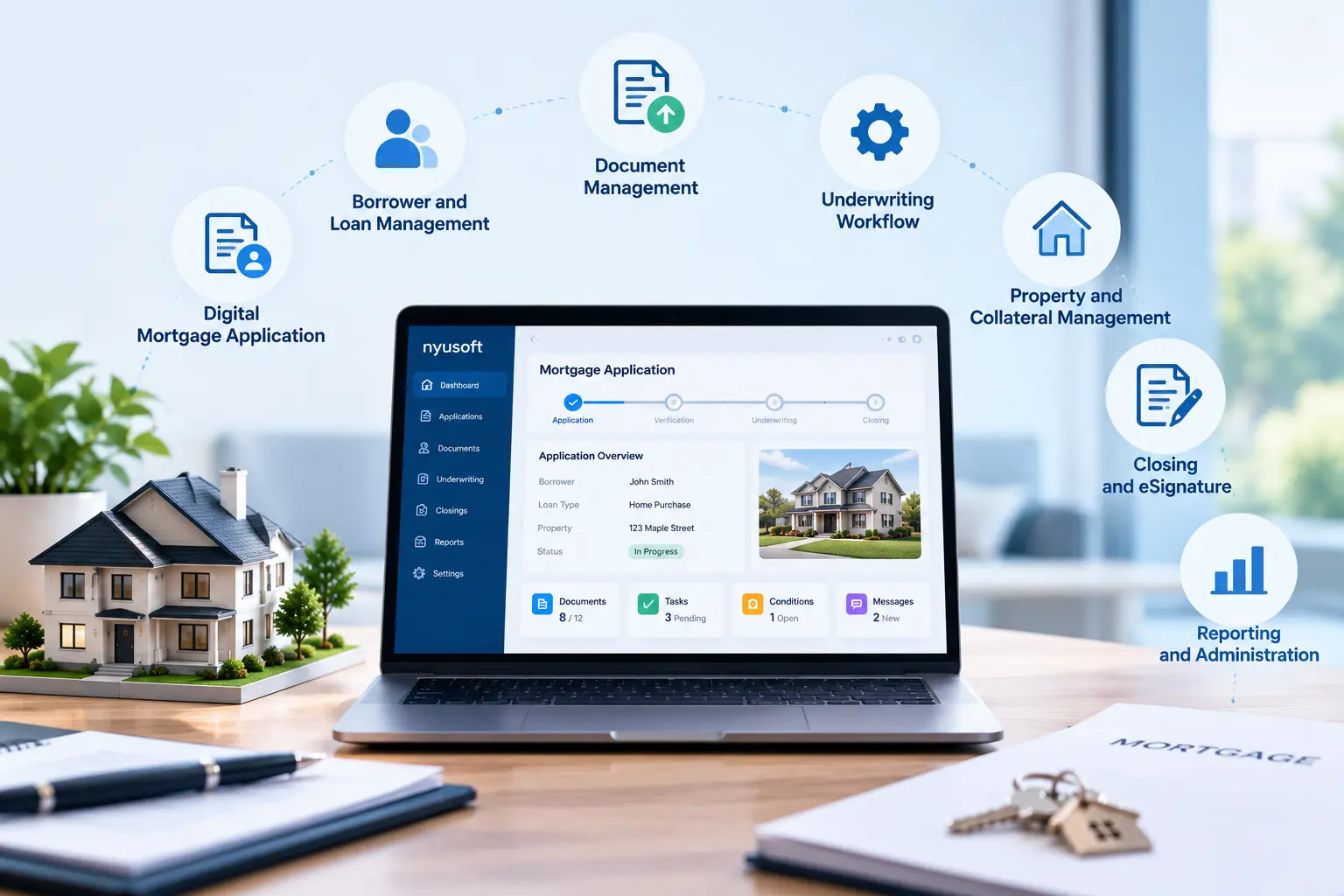
The most useful mortgage platforms are built around actual mortgage workflows rather than a generic collection of financial-app features.
Digital Mortgage Application
A borrower should be able to complete an application without unnecessary back-and-forth.
A digital mortgage application can include:
- Online application forms
- Borrower and co-borrower profiles
- Save-and-resume
- Application status
- Required-information tracking
- Secure document upload
- Consent management
- Notifications
- Secure communication
- Application history
The internal side should give loan officers and processors a clear view of incomplete applications and outstanding tasks.
Borrower and Loan Management
The platform should maintain a structured relationship between the borrower, application, property and loan.
Depending on the business, the record can contain:
- Borrower details
- Co-borrower information
- Loan information
- Application history
- Property details
- Communication history
- Assigned staff
- Important dates
- Documents
- Underwriting conditions
- Decision history
Changes to important information should be traceable through an audit history.
Document Management
Mortgage applications can involve a substantial number of financial, identity, property and legal documents.
A document-management module can provide:
- Secure upload
- Document classification
- Verification status
- Missing-document tracking
- Version control
- Expiration tracking
- Access permissions
- Document review
- Audit history
- Secure storage
A document should not exist as an isolated file. The platform should know which borrower, loan, application or workflow stage it belongs to.
Underwriting Workflow
Underwriting functionality can help organise complex loan reviews.
Useful capabilities include:
- Underwriter work queues
- Rule-based checks
- Loan condition management
- Exception handling
- Review notes
- Approval workflows
- Escalation
- Decision history
- Audit trails
Where automated decisioning is used, the business should also define how exceptions are handled and how users can review the information behind a decision.
Property and Collateral Management
Property information is central to mortgage lending.
A mortgage system may need to manage:
- Property address
- Property type
- Occupancy
- Estimated value
- Appraisal information
- Loan-to-value data
- Property documents
- Title-related information
- Collateral records
Property information should remain connected to the relevant loan throughout the workflow.
Closing and eSignature
Closing involves more than collecting signatures.
A platform can manage:
- Closing checklists
- Document preparation
- Document delivery
- Signature requests
- Signature status
- Closing tasks
- Final document storage
- Completion status
The workflow should show what has been completed, what is pending and which party is responsible for the next step.
Reporting and Administration
Management teams need visibility across the mortgage pipeline.
Reporting functionality can cover:
- Application volume
- Pipeline status
- Processing time
- Approval rates
- Outstanding conditions
- Loan officer performance
- Document status
- Closing status
- Servicing metrics
- User activity
- Audit records
Administrators also need tools for user management, roles, permissions, configuration and workflow rules.
Need Custom Mortgage Software?
Build mortgage software around your workflows, user roles and existing systems. Share your requirements with our team to plan the features, integrations and architecture your platform needs.
Mortgage Software Integrations
Integrations are one of the most important parts of mortgage software development.
A platform may need to communicate with credit providers, automated underwriting systems, property-data services, appraisal providers, income-verification services, eSignature platforms, banking systems, CRM platforms and existing loan origination or servicing systems.
The exact combination varies by country, mortgage product and business model.
Credit Bureau Integrations
Credit data can be used during eligibility assessment and underwriting.
The integration should address:
- Secure authentication
- Consumer authorisation
- Credit report requests
- Response processing
- Data validation
- Record matching
- Error handling
- Audit logging
For international products, the relevant credit providers differ by market, so the architecture should allow providers to be changed or added without rewriting the mortgage application.
Income, Employment and Asset Verification
Verification services can reduce manual collection and review of financial information.
Depending on the market, integrations may provide:
- Income verification
- Employment verification
- Bank-account information
- Asset verification
- Payroll information
- Financial transaction data
The system should record the verification source, timestamp, status and result.
Property and Valuation Integrations
Property data can come from different sources depending on the country and mortgage product.
The platform may need to connect with:
- Property databases
- Automated valuation models
- Appraisal management systems
- Property tax information
- Title services
- Land or property registries
- Real-estate data providers
These integrations can support underwriting, valuation and property-risk workflows.
Automated Underwriting Systems
In the U.S. mortgage market, lenders may need connectivity with automated underwriting systems such as Fannie Mae's Desktop Underwriter and Freddie Mac's Loan Product Advisor.
This is an example of why mortgage integration architecture needs to be designed around the actual target market rather than assuming that one global integration model will work everywhere.
Mortgage Industry APIs
Mortgage technology providers increasingly expose APIs for exchanging loan, borrower and servicing information.
For example, Fannie Mae provides APIs for approved business partners covering areas including eligibility, loan pricing, appraisals and servicing.
The development team should confirm API availability, licensing, credentials, data permissions and certification requirements before treating an integration as part of the final scope.
eSignature and Document Services
Mortgage software can integrate with electronic signature and document platforms to support:
- Signature requests
- Document delivery
- Signing status
- Completed documents
- Document storage
- Audit records
The integration should feed document status back into the mortgage workflow.
CRM and Enterprise Systems
Many lenders already have CRM, accounting, reporting, servicing or customer-support systems.
The architecture should define which application owns each type of data.
For example:
CRM: customer relationship information
Mortgage platform: application and loan workflow
Servicing platform: post-closing servicing records
Accounting system: financial records
This prevents conflicting information from being created across different applications.
Technology Stack for Mortgage Software Development
No single technology stack works for every mortgage platform. The right choice depends on the software's features, number of users, integrations, security requirements, target markets and transaction volume.
Frontend Technology
Common frontend technologies include:
- React for web applications and dashboards
- Next.js for web platforms requiring server-side rendering
- React Native for cross-platform mobile applications
- Flutter for cross-platform mobile development
- HTML, CSS and JavaScript for standard web interfaces
These technologies can be used to build borrower portals, loan officer dashboards, processor screens and admin panels.
Backend Technology
The backend handles the core mortgage operations, including:
- Mortgage business rules
- Loan application workflows
- User roles and permissions
- API connections
- Document processing
- Notifications
- Reporting
- Audit logs
Common backend technologies include:
The best option depends on the existing systems, required integrations, and development requirements.
Database Technology
Mortgage platforms need to store and manage structured information such as:
- Borrower and co-borrower details
- Loan applications
- Property information
- Documents
- Verification records
- Underwriting information
- Payment records
- Servicing data
Common technologies include:
- PostgreSQL
- MySQL
- Microsoft SQL Server
- MongoDB
- Redis for caching where required
For most mortgage systems, a relational database can be useful for managing connected financial and loan records.
API and Integration Technology
Mortgage software usually needs to connect with external services such as credit bureaus, property data providers, e-signature platforms, banking systems and other mortgage technology providers.
The API layer should support:
- REST APIs
- GraphQL, where appropriate
- Webhooks
- API authentication
- Data validation
- Error handling
- API logging
- Retry mechanisms
- API versioning
A well-structured integration layer also makes it easier to add or replace third-party services as the platform grows.
Cloud Technology
Cloud infrastructure can be used for:
- AWS
- Microsoft Azure
- Google Cloud
- Docker
- Kubernetes, for larger or more complex deployments
- Cloud databases
- Cloud document storage
- Monitoring and logging
- Automated backups
- Disaster recovery
The production environment should be separated from development and testing environments, with appropriate access controls for each.
For businesses that need custom mortgage software development services, the technology stack should be selected around the mortgage workflows and integrations first, rather than simply choosing the most popular technologies.
Mortgage Data Standards and Interoperability
Mortgage software often operates as part of a larger technology ecosystem.
The same loan information may move between the lender's application, credit providers, underwriting systems, appraisal services, closing platforms, investors and servicing systems.
This makes data interoperability an architectural requirement.
MISMO develops standards for exchanging mortgage information across areas including residential mortgage and eMortgage processes. Using recognised mortgage data standards can help development teams establish consistent structures for information exchanged between systems.
The practical considerations include:
- Data definitions
- Field mapping
- Validation
- API versions
- Data transformation
- Error handling
- Record matching
- Auditability
The objective is to prevent the same borrower or loan information from being manually entered into multiple systems whenever an automated exchange is possible.
Mortgage Software Security and Compliance
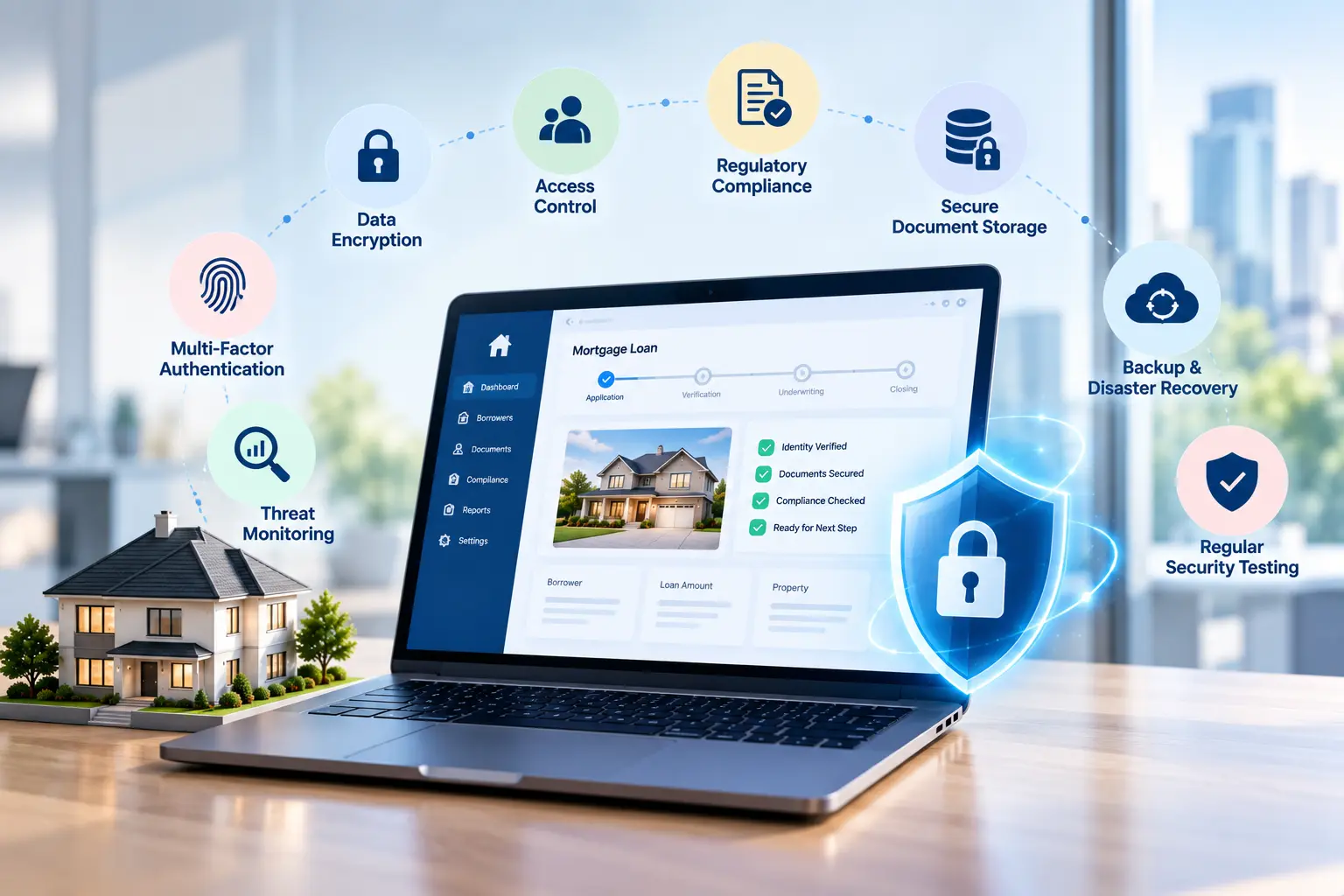
Security and compliance should be considered from the beginning of mortgage software development. The exact requirements depend on the country, mortgage product, organisation and type of data being handled.
Key Security Requirements
A mortgage platform should include:
- Data encryption for information in transit and at rest
- Multi-factor authentication (MFA) for sensitive accounts
- Role-based access control (RBAC) for different users
- Audit logs for important system and data activities
- API security for third-party integrations
- Secure document storage for borrower and loan documents
- Regular security testing, including vulnerability scans and penetration testing
- Backup and disaster recovery to protect critical mortgage data
Major Compliance Areas
The main compliance requirements can vary by market.
United States
- GLBA and FTC Safeguards Rule
- TILA / Regulation Z
- RESPA / Regulation X
- ECOA / Regulation B
- FCRA
- HMDA
- SAFE Act and applicable state requirements
United Kingdom
- UK GDPR
- Data Protection Act 2018
- FCA requirements
- MCOB
- Consumer Duty
Canada
- PIPEDA
- Applicable provincial privacy laws
- Provincial mortgage and consumer-protection requirements
Australia
- Privacy Act 1988
- Australian Privacy Principles (APPs)
- Applicable financial-services requirements
- APRA requirements, where applicable
UAE and other markets
- Applicable financial regulator requirements
- Local data protection and privacy laws
- Mortgage and consumer-protection regulations
PCI DSS, ISO 27001 and SOC 2
PCI DSS is relevant when the platform handles payment-card data.
ISO 27001 and SOC 2 are security and assurance frameworks rather than mortgage-specific laws. They may be relevant for enterprise platforms and organisations with specific security requirements.
For a global mortgage platform, compliance should be mapped separately for each target market rather than using one checklist for every country.
Planning a Secure Mortgage Platform?
Protect sensitive borrower and financial data with the right security architecture, access controls and compliance considerations. Talk to our team about your mortgage software security requirements.
How to Develop Mortgage Software
A successful mortgage project starts with business workflows rather than technology selection.
Step 1: Define the Mortgage Business Model
Identify:
- Lender or broker
- Mortgage products
- Residential or commercial lending
- Origination or servicing
- Target countries
- User groups
- Existing systems
A U.S. residential lender and an Australian mortgage broker will not have identical requirements.
Step 2: Map the Mortgage Workflow
Document the process from application to the final stage the platform will support.
Identify:
- Manual tasks
- Approval points
- Documents
- External services
- User roles
- Business rules
- Exceptions
- Reporting requirements
This becomes the functional foundation for the software.
Step 3: Define the MVP
The first release should solve a clearly defined problem.
For example, an MVP might include:
- Borrower onboarding
- Mortgage application
- Document collection
- Verification
- Application tracking
- Basic underwriting workflow
- Internal dashboard
- Notifications
Advanced servicing, analytics and automation can be added later if they are not required for the initial launch.
Step 4: Design UX and Architecture
Create user flows and prototypes before development.
At the same time, define:
- Database architecture
- API architecture
- Security model
- Integration strategy
- Cloud infrastructure
- Data ownership
- Compliance requirements
Step 5: Build Core Modules
Development can then proceed across:
- Frontend
- Backend
- Database
- Authentication
- Mortgage workflows
- Document management
- Administration
Step 6: Integrate External Systems
Integrations should be tested in sandbox environments before production.
This includes:
- Credit providers
- Verification services
- Property providers
- Underwriting systems
- eSignature
- Banking services
- Existing LOS or servicing systems
Step 7: Test Mortgage Logic
Testing needs to cover more than UI functionality.
Test:
- Loan calculations
- Eligibility rules
- Application states
- Document conditions
- Permissions
- API failures
- Duplicate records
- Underwriting scenarios
- Payment calculations
- Reporting accuracy
- Audit trails
Step 8: Security and Compliance Testing
Before production, conduct appropriate security testing and validate the platform against the requirements identified during discovery.
Step 9: Launch in Stages
A controlled rollout can reduce operational risk.
The first release can be introduced to a limited group of users, followed by broader deployment once workflows and integrations have been validated.
How Much Does Mortgage Software Development Cost?
Mortgage software can cost anywhere from a few tens of thousands of dollars for a focused MVP to several hundred thousand dollars for an enterprise platform.
A practical planning range looks like this:
| Project scope | Approximate cost |
| Focused mortgage MVP | $4,000-$6,000+ |
| Mid-level mortgage platform | $6,000-$12,000+ |
| Advanced platform with multiple integrations | $10,000-$15,000+ |
| Enterprise mortgage ecosystem | $15,000-$25,000+ |
These are planning ranges rather than fixed market prices. Actual pricing depends heavily on scope, development location, team composition and integration requirements.
What drives mortgage software cost?
Number of integrations: Credit, property, verification, underwriting, banking and eSignature integrations can add significant development work.
Underwriting complexity: Simple workflow rules cost less than a configurable decision engine.
Document processing: Basic uploads are relatively straightforward. Automated classification, extraction and verification require additional development.
Servicing: Adding post-closing servicing introduces substantial payment, account and workflow logic.
Mobile applications: Supporting web, iOS and Android increases the project scope.
Compliance: Multi-country products require additional analysis, configuration and testing.
Data migration: Moving data from an existing LOS or legacy platform can require data cleansing, mapping and migration testing.
Enterprise requirements: High availability, disaster recovery, advanced audit trails, analytics and complex permissions can increase the overall investment.
How Long Does It Take to Build Mortgage Software?
A focused mortgage MVP can take approximately 4 to 6 months, while a larger platform with extensive integrations and servicing capabilities can take 8 to 15 months or more.
A typical project may look like this:
| Stage | Typical timeframe |
| Discovery and requirements | 2-4 weeks |
| UX/UI design | 3-6 weeks |
| Architecture | 2-4 weeks |
| Core development | 3-6 months |
| Third-party integrations | 1-3 months |
| Testing and security | 4-8 weeks |
| Deployment | 1-3 weeks |
These phases often overlap.
For example, backend development can begin while later UX screens are being completed. Integration work can also begin before the entire application is finished.
What can extend the timeline?
- Multiple countries
- Multiple mortgage products
- Complex underwriting
- Legacy-system integration
- Large-scale data migration
- Several third-party APIs
- Mobile applications
- Advanced AI automation
- Servicing functionality
- Extensive compliance requirements
Third-party access can also affect delivery. API credentials, certification, sandbox approval and production access are sometimes controlled by the external provider rather than the development team.
Custom Mortgage Software vs Off-the-Shelf Software
Off-the-shelf mortgage software can make sense when its workflows and integrations already match the business.
Custom mortgage software becomes more attractive when the organisation needs:
- Proprietary mortgage workflows
- Custom underwriting rules
- Specific integrations
- A unique borrower experience
- Integration with existing enterprise systems
- Custom reporting
- Multi-country support
- A proprietary SaaS product
- Control over the product roadmap
The decision should not be based only on the initial purchase price.
A cheaper product can become expensive if employees need workarounds, duplicate data entry or manual processes because the software does not match the business.
For a mortgage technology company planning to offer its platform to multiple organisations, SaaS product development can be relevant because multi-tenant architecture, account isolation, administration and subscription management become part of the product design.
Building Custom Mortgage Software With Nyusoft
Mortgage software development requires more than building forms and dashboards. The platform needs to represent mortgage workflows accurately, protect sensitive borrower information, connect with external financial and property systems, and support the compliance requirements of the markets in which it operates.
Nyusoft works across financial software development, lending platforms, API integrations, web and mobile applications, and related financial technology requirements. Existing lending work can also provide a useful technical foundation for projects involving automated loan workflows, reporting, role-based access, and financial integrations. Contact our team now.
FAQs
1. What is mortgage software development?
Mortgage software development involves building software to manage mortgage processes such as loan applications, borrower information, document collection, underwriting workflows, property data, closing, payments and servicing.
2. How much does mortgage software development cost?
The cost of mortgage software development depends on the platform's features, integrations, security requirements and overall complexity. A focused mortgage MVP may cost around $4,000 to $6,000+, while a mid-level platform can range from $6,000 to $12,000+. Advanced platforms with multiple integrations may cost $10,000 to $15,000+, while enterprise mortgage ecosystems can start from $10,000 and reach $25,000+.
3. How long does it take to develop mortgage software?
A focused mortgage MVP can take around 4 to 6 months. A mid-level platform may require 6 to 9 months, while software with extensive integrations, automation and compliance requirements can take 9 to 18 months or more.
4. What features should mortgage software include?
Common features include digital loan applications, borrower management, document management, underwriting workflows, property and collateral management, loan status tracking, e-signatures, notifications, reporting and administration.
5. Which integrations are required for mortgage software?
Depending on the mortgage workflow, integrations may include credit bureaus, income and employment verification, property and appraisal services, title services, banking systems, e-signature providers, payment gateways, CRM systems, loan origination systems and mortgage APIs.
6. What technology is used to build mortgage software?
Mortgage platforms can be developed using technologies such as React, Next.js, Node.js, Python, .NET, Java, PostgreSQL, MongoDB, AWS, Microsoft Azure and Google Cloud. The final stack depends on the application's requirements and integrations.
7. How is mortgage software secured?
Mortgage software should use encryption, multi-factor authentication, role-based access control, audit logs, secure APIs, protected document storage, vulnerability testing, penetration testing, backups and disaster recovery controls.
8. What compliance requirements apply to mortgage software?
Requirements depend on the target market. In the US, common areas include GLBA, TILA/Regulation Z, RESPA/Regulation X, ECOA/Regulation B, FCRA and HMDA. Other markets may require UK GDPR, PIPEDA, Australia's Privacy Act or UAE data-protection and financial regulations.
9. Should I build custom mortgage software or use an existing platform?
Custom mortgage software development can be a better fit when a business needs specific workflows, proprietary business rules, multiple integrations or support for several markets. An existing platform may be more suitable when standard mortgage processes are sufficient and faster deployment is the priority.
10. Can mortgage software support multiple countries and regulations?
Yes. A mortgage platform can be designed with configurable workflows, permissions, document requirements, business rules and compliance settings for different jurisdictions. This allows the same core platform to support different markets without hard-coding every country's requirements into the application.
Ready to Build Your Mortgage Software?
From a focused MVP to an enterprise mortgage platform, get a development plan based on your features, integrations, target market and business requirements. Start a conversation with our mortgage software team.