


 Front End Development
  Back End Development
  CMS / ECommerce Development
  Mobile Apps Development
  Cloud Services
  Fullstack Services
  Solution


What Is The Importance Of HIPAA Compliance In Healthcare
Healthcare organizations exist to protect people. That includes protecting their bodies, their mental wellbeing, and the deeply personal information they share when they walk through a clinic door or open a patient portal. HIPAA compliance is the legal and ethical framework that makes the last part possible. At its core, HIPAA compliance means a healthcare organization or any business that handles patient data has the policies, safeguards, and practices in place to keep protected health information (PHI) private, secure, and accessible only to those with a legitimate reason to see it.
That's the direct answer. But stopping there misses what's actually happening in healthcare right now, and why the stakes around compliance have never been higher. Since 2011, healthcare has held the unfortunate distinction of being the most expensive industry for data breaches, according to IBM's annual Cost of a Data Breach Report. The average cost of a healthcare data breach reached $9.77 million in 2024. And through January 2026, cumulative breaches have affected more than 935 million individuals, essentially touching every American at least once. These aren't abstract numbers. Behind each incident are patients whose medical histories, insurance details, and Social Security numbers ended up somewhere they shouldn't have.
HIPAA compliance doesn't eliminate all risk. But organizations that treat it seriously, not as a checkbox exercise but as an operating standard, are measurably better positioned when attacks happen, face lower penalties when violations occur, and recover faster when things go wrong.
What HIPAA Actually Is (Without the Legalese)
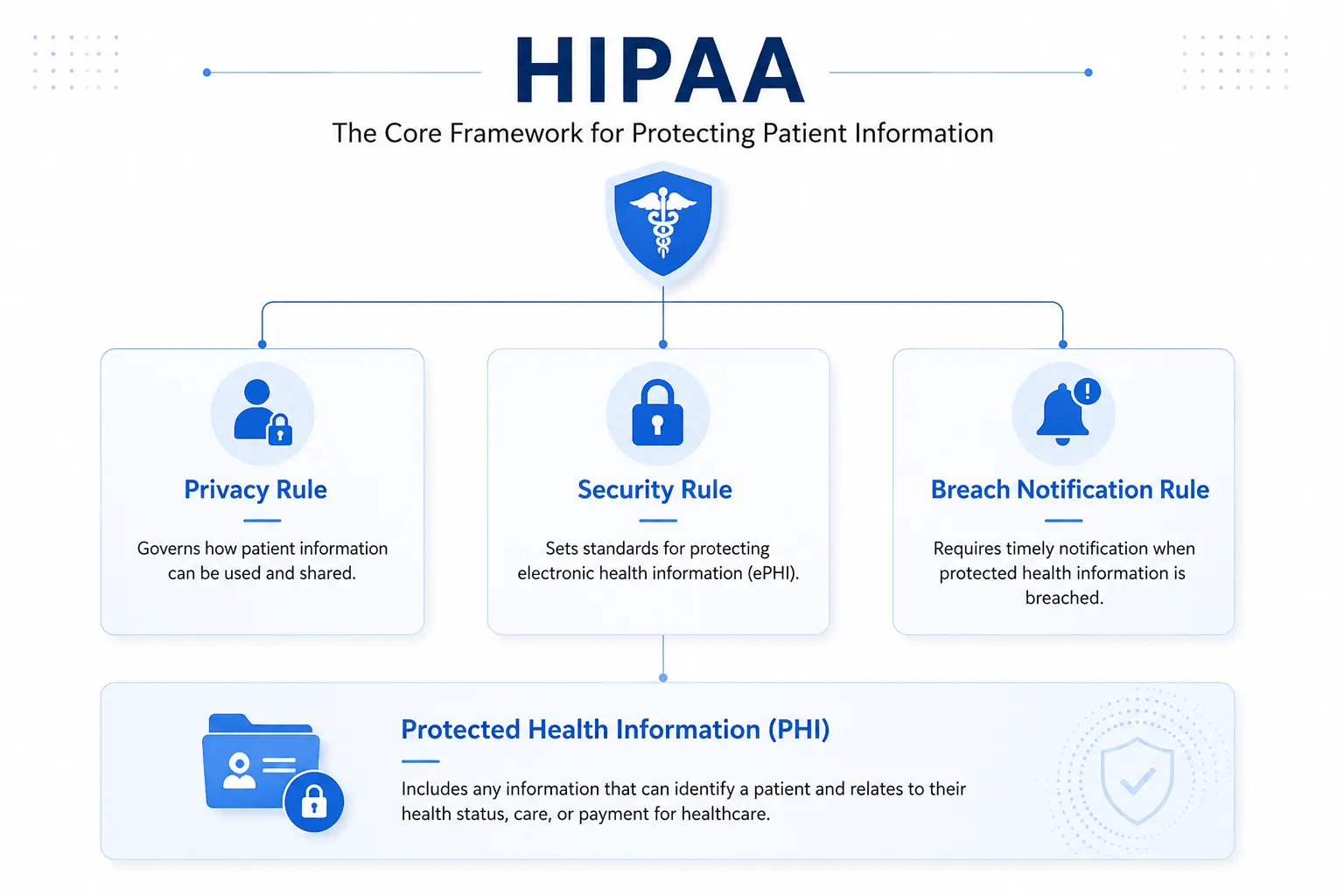
The Core Framework — Privacy Rule, Security Rule, and Breach Notification
The Health Insurance Portability and Accountability Act was signed into law in 1996. It established national standards for protecting patient health information and created enforceable rules around how that information can be used, shared, and secured. Three rules form the practical backbone of HIPAA.
The Privacy Rule governs who can access PHI and under what circumstances. It establishes patients' rights to view their own records, request corrections, and know how their information is being used. The Security Rule applies specifically to electronic PHI (ePHI) and outlines the administrative, physical, and technical safeguards organizations must maintain. The Breach Notification Rule dictates what happens when something goes wrong, covered entities must notify affected individuals, HHS, and in some cases the media when PHI is impermissibly disclosed.
PHI is broader than most people assume. It's not just a diagnosis. It includes names, dates of birth, contact information, Social Security numbers, health insurance IDs, payment information, and any data that can be used to identify a patient in connection with their health. A billing statement. A scanned prescription. An appointment record. An email between a doctor and a patient. All PHI. All subject to HIPAA.
Who Does HIPAA Actually Apply To?
Covered entities, such as hospitals, physician practices, health plans, and healthcare clearinghouses, are the obvious ones. But HIPAA's reach extends to business associates: any outside vendor or contractor that creates, receives, maintains, or transmits PHI on behalf of a covered entity.
This is where many organizations, especially technology companies, get caught off guard. Cloud storage providers, billing platforms, EHR vendors, and telehealth software companies are all business associates under HIPAA. If your platform touches patient data in any way, you're in scope. The contractual mechanism that governs this relationship is the Business Associate Agreement (BAA), a binding document that assigns compliance responsibilities and requires vendors to maintain appropriate safeguards.
The "we're just a tech company" defense has been tested repeatedly in federal enforcement cases. It doesn't hold up. Any healthcare software platform, whether it handles scheduling, prescription management, or patient monitoring, must be architected with HIPAA compliance from the ground up, not retrofitted later.
The Real Financial Stakes of Non-Compliance
What HIPAA Fines Actually Look Like
HIPAA penalties are tiered based on culpability, ranging from violations the organization genuinely didn't know about to willful neglect left uncorrected. The fines at the lower end can run into tens of thousands of dollars. At the top tier, uncorrected willful neglect carries penalties starting at $68,928 per violation, with annual maximums that can reach $2 million or more for a single category of violation.
OCR, the HHS Office for Civil Rights, which enforces HIPAA, collected more than $9.9 million in settlements and civil monetary penalties in 2024 alone, including a $4.75 million settlement with Montefiore Medical Center. In 2025, OCR reached 21 settlements, the second-highest annual total on record. Enforcement has picked up tempo significantly, and the agency has made clear it's not just focused on large health systems.
In 2022, 55% of OCR settlements were imposed on small practices. A solo physician's office. A regional clinic. A specialty group with a handful of providers. The scale of your organization doesn't change your legal obligations. What matters is whether PHI was mishandled and whether your safeguards were adequate.
Criminal penalties also exist. Individuals who knowingly access or misuse PHI for personal gain face up to ten years in prison. This provision is used less often than civil enforcement, but it's very real and has been applied to employees and contractors who improperly accessed patient records.
The Broader Cost Nobody Talks About
Fines get attention, but they're often not the biggest financial consequence of a HIPAA failure. The real damage tends to accumulate over the years.
IBM's research found that 75% of the increase in breach-related costs stems not from technical fixes, but from lost business, delayed operations, and reputational damage. That pattern tracks with what happened to UnitedHealth Group after the Change Healthcare ransomware attack in early 2024 it halted pharmacy operations, delayed medical billing, and cost the company $872 million in the first quarter alone, excluding direct breach response costs.
The aftermath of a breach doesn't resolve quickly. Organizations typically spend three to four years dealing with regulatory monitoring, legal settlements, public relations efforts, and mandatory corrective action plan requirements imposed by HHS. Only 12% of organizations that experience a major breach report full recovery.
Post-breach obligations include conducting a revised risk analysis, developing a formal risk management plan, rewriting policies, establishing new staff training programs, and submitting regular compliance reports to OCR. The administrative weight alone is substantial. Add to that the expanded audit requirements, higher cyber insurance premiums, and patient attrition, and the financial case for proactive compliance becomes straightforward.
Non-compliance with HIPAA adds an average of $219,000 to the cost of a breach, according to IBM's research. That's the tax on not having your compliance program in order before something goes wrong.
Why Patient Data Is So Valuable to Attackers
Medical records contain more usable personal information than almost any other data type. A stolen credit card becomes worthless in hours once it's cancelled. A stolen medical record contains a person's full name, date of birth, Social Security number, insurance information, home address, and detailed health history. That combination can support identity fraud, insurance fraud, and financial crimes for years.
Healthcare data reportedly fetches hundreds of dollars per record on dark web markets, far more than financial records. Attackers know this. They also know that healthcare organizations often run legacy infrastructure, fragmented IT systems across multiple facilities, and frequently prioritize clinical uptime over security tooling.
Hacking and IT incidents now account for 81% of all reported HIPAA breaches. Ransomware is responsible for 69% of all breached patient records. Those numbers have grown dramatically. Reported PHI breaches rose from 216 in 2010 to 566 in 2024, more than doubling in fourteen years, according to a JAMA Network Open study.
The operational disruption of ransomware in healthcare goes beyond data theft. Attacks lock out electronic health records, freeze billing systems, and shut down prescription management. Nearby hospitals can experience elevated emergency department traffic for weeks while attacked facilities are partially offline. People waiting for surgery, chemotherapy scheduling, or diagnostic results sit in that gap.
Malicious insiders are also a serious risk. In IBM's analysis, breaches caused by malicious insiders averaged $4.99 million per incident among the costliest breach types. Staff with access to far more patient data than their role requires, combined with inadequate access monitoring, creates predictable vulnerabilities.
Healthcare currently produces roughly 30% of the world's data, and that share is growing as EHRs, remote monitoring devices, and digital health tools proliferate. More data, more attack surface, more exposure without deliberate compliance infrastructure.
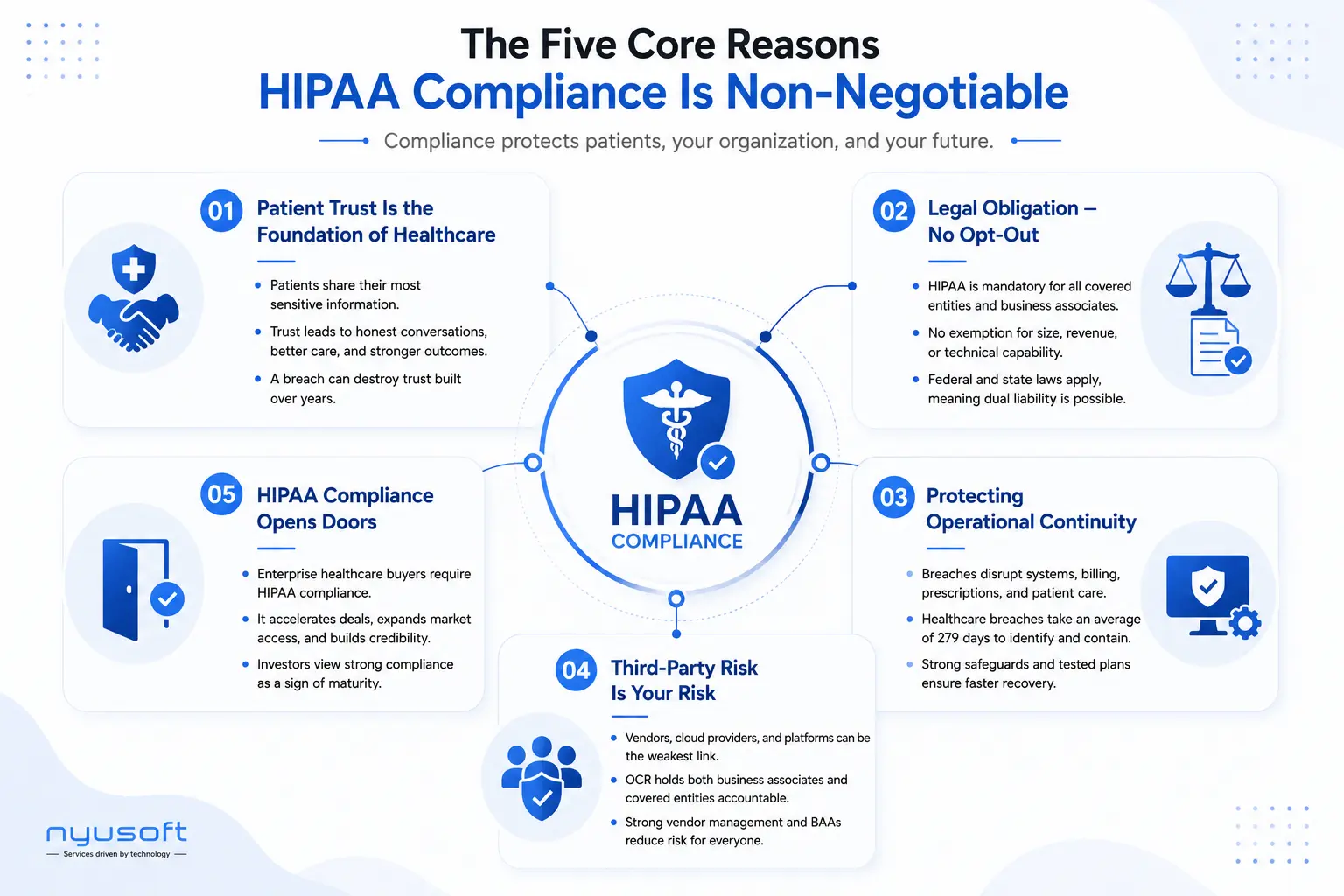
The Five Core Reasons HIPAA Compliance Is Non-Negotiable
1. Patient Trust Is the Foundation of Healthcare
The therapeutic relationship depends on honesty. Patients disclose things to their care team that they tell no one else, such as mental health struggles, substance use, sexual history, financial stress, and chronic conditions they haven't told their family about. That honesty only happens when patients trust that the information will be protected.
When a breach occurs, that trust fractures. Research consistently shows that patients who don't trust how their data is handled will withhold information from their providers, skip appointments, or avoid seeking care at all. That's not a hypothetical risk; it's a documented public health consequence of healthcare data breaches. Providers who experience significant breaches report measurable drops in patient volume that persist for months.
Trust is also an asset that takes years to build and can be destroyed in a single news cycle. A healthcare organization that handles a breach without adequate safeguards or clear communication will spend far longer rebuilding credibility than it would have spent maintaining proper compliance practices.
2. Legal Obligation — No Opt-Out
This isn't a voluntary framework. Every covered entity and business associate operating in the United States must comply with HIPAA, regardless of size, revenue, or technical sophistication. There is no exemption for small organizations and no scaling of requirements based on patient volume.
The Right of Access Initiative, launched by OCR in 2019, resulted in a 450% increase in enforcement actions between 2019 and 2022. It now accounts for over 50 enforcement actions targeting covered entities that delayed or denied patients' requests for their own medical records. Getting basic patient rights right isn't optional.
State-level obligations are layered on top. California, New York, and Texas have healthcare privacy regulations that go beyond HIPAA's baseline in various ways. Multi-state healthcare organizations can face dual liability federal enforcement from OCR and state enforcement simultaneously.
3. Protecting Operational Continuity
A ransomware attack doesn't just create a legal problem. It creates an operational crisis. Billing stops. Patient check-ins fail. Lab results don't move. Prescription systems go dark. And the restoration process is slow. Healthcare data breaches took an average of 279 days to fully identify and contain, according to IBM's 2025 data. That's longer than any other industry.
In 2024, 70% of breached organizations reported significant or very significant disruption to their operations. Many couldn't access critical systems for weeks. Some reduced services or diverted patients during the recovery period.
HIPAA-mandated safeguards, documented risk assessments, tested incident response plans, data backups that have been verified are what make it possible to respond coherently when an attack occurs. Organizations that have done this preparation recover faster, contain costs more effectively, and restore operations with less chaos. The ones that haven't are often building the plan for the first time in the middle of an active incident.
4. Third-Party Risk Is Your Risk
The most significant shift in HIPAA enforcement over the past several years has been toward vendor accountability. OCR is now holding both business associates and the covered entities that failed to vet them accountable for breaches that originate in vendor systems.
This matters because the biggest breach vectors today are often third-party cloud EHR providers with misconfigured servers, billing companies hit by ransomware, and telehealth platforms with inadequate encryption. The covered entity may have done nothing technically wrong on its own systems and still face regulatory scrutiny for failing to manage its vendor relationships properly.
Proposed updates to the HIPAA Security Rule, expected to take effect in mid-2026, would require business associates to provide annual written proof of compliance and submit breach notifications within 24 hours. That's a significant operational shift from the current framework and signals where enforcement priorities are heading.
Business Associate Agreements must be current, specific, and actually reviewed not signed once and filed in a drawer. High-risk vendors (anyone accessing ePHI regularly) should be assessed periodically, not just at onboarding. For organizations building custom healthcare software that others will use to manage patient data, compliance isn't just about your own organization it's about the obligations your clients take on when they sign a BAA with you.
5. HIPAA Compliance Opens Doors — Non-Compliance Closes Them
Hospital systems, large health plans, and enterprise healthcare buyers will not contract with vendors who cannot demonstrate HIPAA compliance. It's a deal-breaker, not a negotiating point. A signed BAA requires the vendor to formally represent that they maintain appropriate safeguards. Without that infrastructure, the conversation ends before it starts.
For health-tech startups and software vendors building healthcare products, compliance is a market access requirement. Organizations that build compliance into their architecture from day one close deals faster, move through procurement with fewer delays, and access enterprise healthcare contracts that are simply unavailable to non-compliant competitors.
Demonstrating HIPAA compliance also signals maturity to investors. A health-tech company that can articulate its privacy and security posture clearly with documented policies, a current risk analysis, and proper vendor agreements is a less risky investment than one whose compliance posture is vague or aspirational.
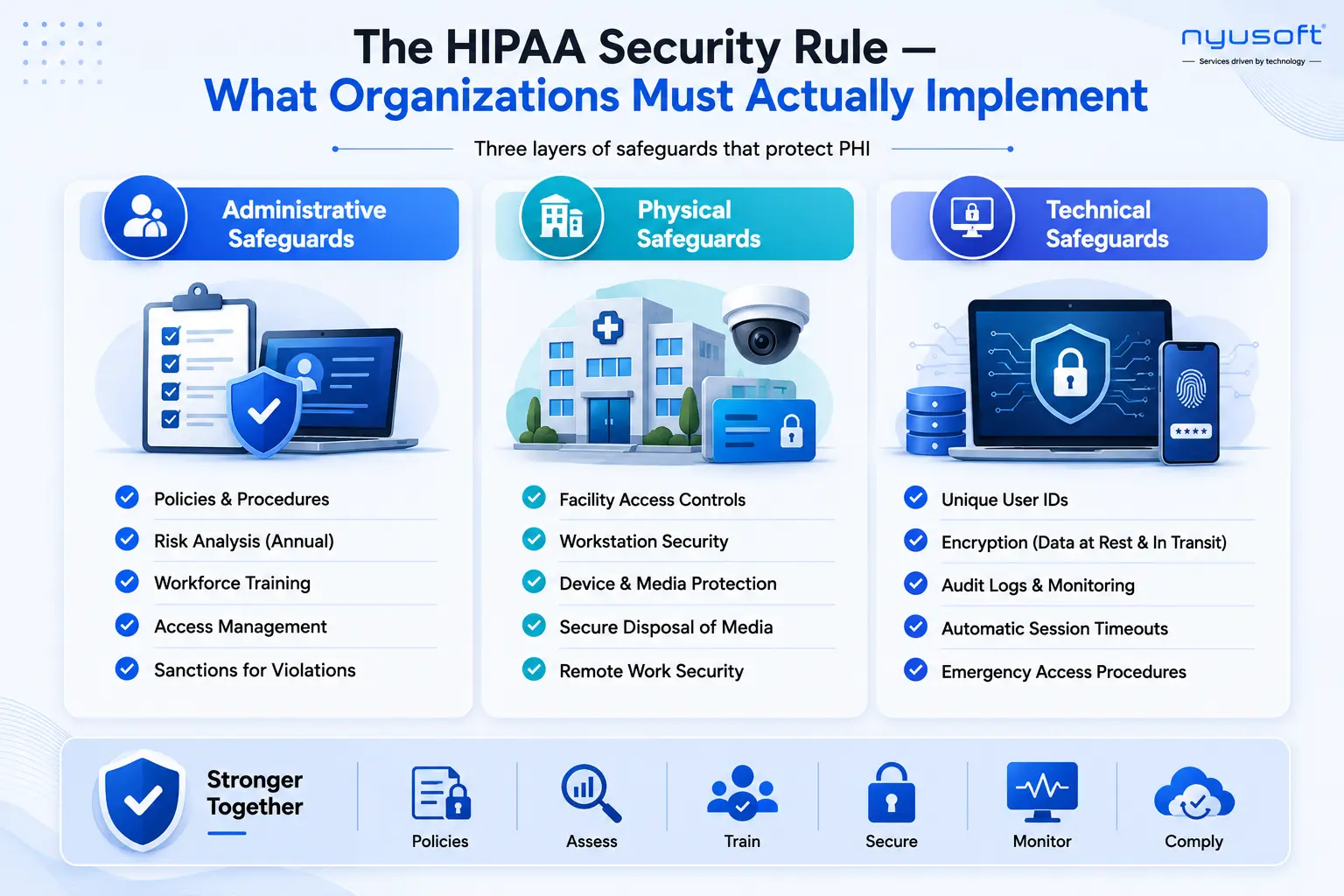
The HIPAA Security Rule — What Organizations Must Actually Implement
Administrative Safeguards
Administrative safeguards are the policies and procedures that govern how PHI is managed and who is responsible for it. They include designating a Privacy Officer and a Security Officer, conducting and documenting an annual risk analysis, managing workforce access and training, and establishing a formal sanctions policy for violations.
The annual risk analysis is the most commonly cited gap in OCR investigations. It's not enough to conduct one when the organization first launches and never revisit it. Systems change, vendors change, staff changes, and the risk analysis must reflect the current reality. When OCR investigated Solara Medical Supplies following a 2019 phishing attack that exposed PHI for more than 114,000 individuals, the agency imposed a $3 million settlement and cited failure to conduct a thorough risk analysis as a primary cause.
Workforce training is the other consistent failure point. Training has to be documented, current, and role-appropriate. A receptionist and a radiologist have different PHI access patterns and need different training content. A 20-minute video completed at onboarding and never revisited does not constitute an adequate training program.
Physical Safeguards
Physical safeguards govern access to the spaces and devices where ePHI is stored or accessed. Workstation security policies, facility access controls, device encryption, and media disposal procedures all fall here.
Improper disposal of physical media, hard drives, backup tapes, and old workstations is a recurring violation in OCR enforcement actions. Devices must be sanitized before disposal, not just deleted. Remote work environments introduce complications around personal devices and home networks that require explicit policies and technical controls.
Technical Safeguards
Technical safeguards are the controls built into systems and software. Unique user IDs, automatic session timeouts, emergency access procedures, audit logs tracking who accessed what and when, encryption for data at rest and in transit, these are the technical infrastructure of HIPAA compliance.
The proposed 2025 Security Rule updates would make several of these mandatory rather than addressable. Mandatory multi-factor authentication, mandatory encryption, comprehensive asset inventory and network mapping, and annual compliance audits are among the proposed requirements, with most provisions requiring implementation within 180 days of the rule becoming effective. For organizations still treating encryption as optional, that window is closing.
Common HIPAA Compliance Mistakes Healthcare Organizations Make
The same errors appear repeatedly across OCR investigations and breach post-mortems. Most of them are not sophisticated failures; they're basic gaps that accumulated over time because compliance wasn't treated as an ongoing program.
Skipping or neglecting the annual risk analysis is the most common. The risk analysis isn't a formality; it's supposed to identify where PHI lives, how it flows, what the vulnerabilities are, and how they're being mitigated. Organizations that conduct a real one are often surprised by what they find.
Outdated or missing Business Associate Agreements leave organizations exposed. Vendors are added without BAAs being executed, or existing agreements aren't updated when the vendor's scope of work changes.
Treating workforce training as a one-time event rather than an ongoing program means staff knowledge decays, new employees aren't adequately prepared, and phishing attacks succeed against people who haven't received current awareness training.
Assuming cloud vendors are automatically compliant is a category error. A cloud provider operating under HIPAA must execute a BAA with the covered entity and maintain appropriate safeguards. "We use AWS" is not a compliance statement.
Not testing the incident response plan is surprisingly common. Organizations draft a plan, file it, and assume it works. When an actual incident occurs, the gaps become apparent, and they're expensive gaps. Tabletop exercises and simulation drills are part of a real compliance program.
Storing PHI in personal email accounts or consumer-grade file sharing tools, such as Google Drive without a BAA, personal Gmail, or standard Dropbox accounts, remains a routine violation, particularly in smaller practices.
Over-provisioning access violates the minimum necessary standard, which requires that staff access only the PHI their role requires. Giving all employees administrator-level access to the patient database is not a compliance program.
How the HIPAA Landscape Is Changing Right Now
The Proposed 2025 Security Rule Overhaul
In December 2024, HHS proposed the first major update to the HIPAA Security Rule since 2013. The proposal responds directly to the surge in healthcare cyberattacks and the inadequacy of the existing framework against modern threats.
Key proposed requirements include annual compliance audits, mandatory MFA across all systems accessing ePHI, mandatory encryption replacing the current addressable designation, comprehensive asset inventory and network mapping, enhanced risk management protocols, and 24-hour breach notification requirements for business associates.
The rule is expected to become effective in mid-2026, with most provisions requiring implementation within 180 days. For organizations still treating certain safeguards as optional under the current addressable standards, these changes will require significant infrastructure work. Planning is considerably cheaper than scrambling once the rule is final.
State-Level Enforcement Is Accelerating
State Attorneys General are increasingly taking independent enforcement action against healthcare organizations that fail to meet minimum cybersecurity standards. In 2024, New York fined four healthcare organizations for cybersecurity failures, including one multi-state enforcement action conducted jointly with Connecticut and New Jersey. California and Indiana also imposed penalties in 2024.
The significance of this trend is that healthcare organizations now face the potential of simultaneous federal and state enforcement. A single breach can trigger OCR investigation, state AG investigation, and civil litigation from affected patients, all running in parallel.
Several states have healthcare-specific privacy laws that impose requirements beyond HIPAA's baseline. California's CMIA, for example, extends certain protections to health data held by entities that aren't covered entities under HIPAA including health apps and consumer wellness platforms.
AI and the New Compliance Challenges It Creates
AI tools are being deployed throughout healthcare clinical documentation, diagnostic support, revenue cycle management, and patient communication. Every AI system that processes PHI creates compliance obligations. The model provider, the infrastructure it runs on, and the data it's trained on are all subject to BAA requirements if PHI is involved.
Threat actors are also using AI. IBM's 2025 breach data shows 16% of breaches involved AI-powered attacks, with phishing (37%) and deepfakes (35%) being the primary methods. The sophistication of phishing attacks has increased dramatically, with AI-generated content that a staff member who could spot an obvious phishing email might not catch a sophisticated AI-crafted message impersonating their EHR vendor.
Organizations that deployed AI and automation in their security operations saw average breach cost reductions of $2.2 million in IBM's research. The same technology creating new attack vectors is also creating new defenses. But those defenses require deliberate implementation, not passive adoption.
What Good HIPAA Compliance Actually Looks Like in Practice
Good compliance programs have a few characteristics in common. They're built on a real risk analysis that reflects actual systems and workflows, not a generic template. They assign clear ownership, with named individuals responsible for privacy and security, not just a policy document that says "the organization will."
Policies describe what actually happens, not what should ideally happen. Training is current, documented, and role-specific. Vendor relationships are managed actively, BAAs are executed before data flows, and high-risk vendors are assessed periodically.
Incident response plans have been tested. Not necessarily through a full-scale simulation every year, but through tabletop exercises that walk the team through realistic scenarios. Who calls whom? Who decides whether an event crosses the breach notification threshold? Who is the media contact? These decisions made under stress during an actual incident go badly when they've never been made before.
For software products that handle PHI, health monitoring apps, telemedicine platforms, and EHR integrations, compliance is an architectural characteristic. Encryption at rest and in transit, role-based access controls, immutable audit logs, session management, secure API design, these are built in, not added on. Retrofitting compliance into an existing system is always more expensive and more disruptive than building it correctly the first time.
The organizations that handle compliance well tend to treat it the same way they treat quality assurance: not as a barrier to moving fast, but as a standard that makes what they build worth trusting.
Building HIPAA-Compliant Healthcare Software: What It Actually Requires
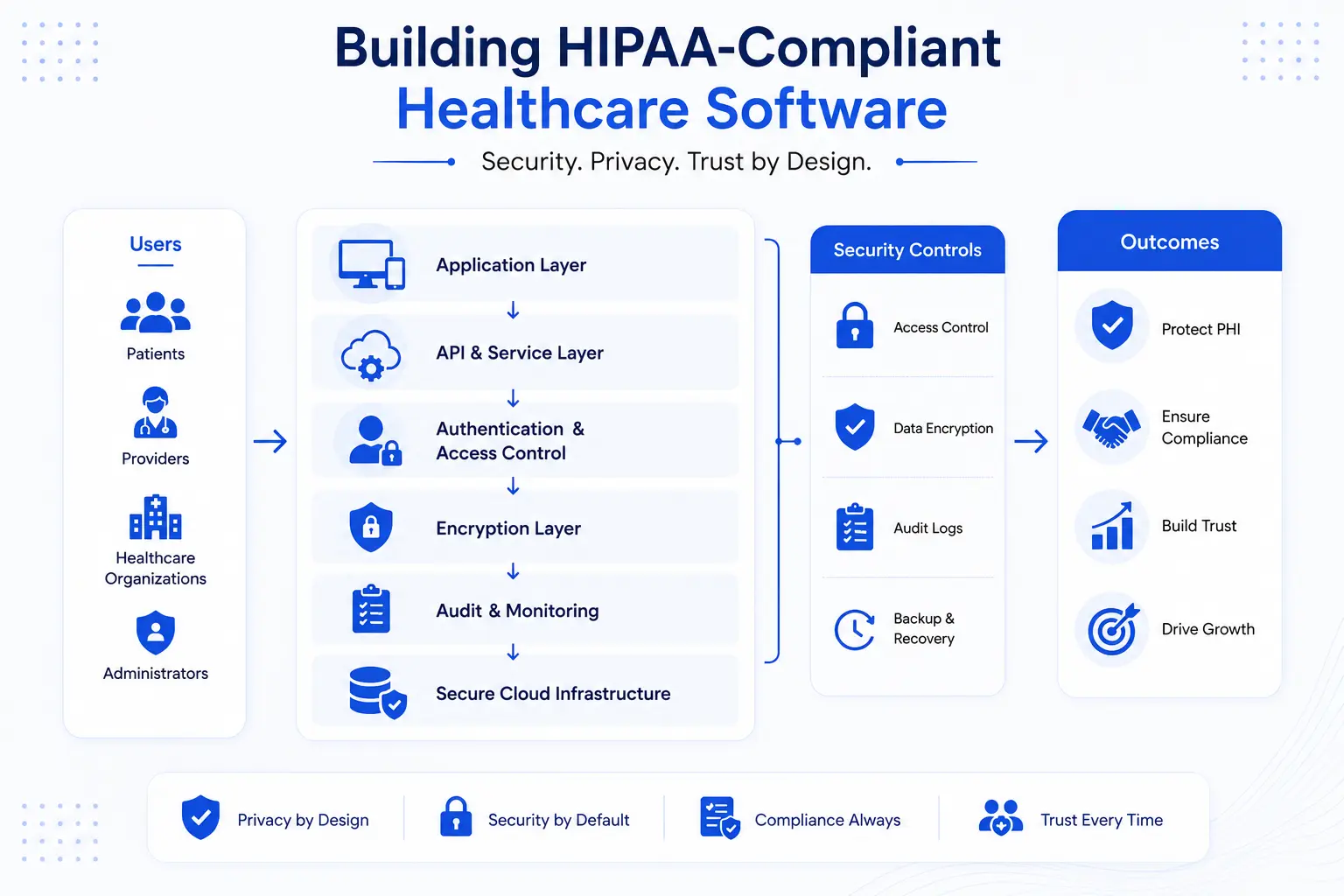
For any development team or software vendor working in healthcare, HIPAA compliance is a product specification, not an afterthought. The requirements are specific, and they have to be built into the architecture, not layered on top after launch.
At the application level, that means: unique user authentication with MFA, role-based access controls that enforce the minimum necessary standard, encrypted data storage and transmission, comprehensive audit logging that captures every PHI access event, secure session management, and properly configured API security. The system must also support data integrity, the ability to verify that PHI hasn't been altered or destroyed in an unauthorized manner.
At the infrastructure level: PHI must be hosted in environments where the vendor can and will execute a BAA. This includes major cloud providers (AWS, Azure, GCP all offer BAA-eligible service tiers), but requires deliberate configuration. "Running on AWS" doesn't automatically mean HIPAA compliant; it means you're using infrastructure that can be configured for HIPAA compliance. The configuration has to be correct.
Incident response capability must be built in. Systems need to support breach investigation log retention, access history, and event correlation. When OCR or legal counsel needs to reconstruct what happened and who accessed what, the audit trail has to exist and be readable.
For vendors operating as business associates, compliance documentation matters as much as technical architecture. A BAA that you can't actually fulfill because your security posture doesn't match its representations isn't protection, it's liability.
The 2025 Security Rule updates, when finalized, will require annual written proof of compliance from business associates and tighten timelines for breach notification significantly. Software vendors who want to maintain healthcare client relationships need to be building toward those requirements now, not after they take effect.
Why This Matters for Healthcare Technology Partners
Healthcare compliance isn't something a clinical organization can simply purchase and install. It requires capable technology partners who understand what's actually required, not just at the surface level of "HIPAA compliant" marketing language, but in the specifics of access controls, encryption standards, audit architecture, and incident response capability.
When evaluating a healthcare technology partner, the questions worth asking are concrete: Can they execute a BAA? What does their encryption approach look like for data at rest and in transit? How are audit logs structured and retained? What is their incident response process? Have they undergone independent security assessments?
Nyusoft builds HIPAA-aligned healthcare platforms with these requirements built into the architecture from the start: encrypted storage, role-based access, audit logging, and secure cloud configuration. The AI-powered health monitoring platform follows the same approach, with access controls and secure cloud deployment designed around the specific data privacy requirements of health information. For healthcare organizations and health-tech companies that need a technology partner with genuine compliance depth, that architecture foundation is what separates a platform you can operate confidently from one that creates liability.
HIPAA compliance isn't a destination. It's an operating standard that requires ongoing attention, regular review, and genuine organizational commitment. The organizations that understand this and the technology partners they choose are the ones positioned to earn and keep the trust that healthcare ultimately depends on.
FAQs
1. Why is HIPAA compliance important in healthcare?
HIPAA compliance protects patients' protected health information (PHI) by establishing standards for privacy, security, and data sharing. It helps healthcare organizations prevent data breaches, comply with federal regulations, maintain patient trust, and reduce the risk of financial penalties, legal action, and operational disruption.
2. Who is required to comply with HIPAA?
HIPAA applies to covered entities such as hospitals, clinics, physicians, health insurance providers, and healthcare clearinghouses. It also applies to business associates, including software vendors, cloud service providers, billing companies, telemedicine platforms, and any third party that creates, stores, processes, or transmits protected health information on behalf of a covered entity.
3. What information is protected under HIPAA?
HIPAA protects any information that can identify a patient in connection with their health or medical care. This includes names, addresses, phone numbers, dates of birth, medical records, prescriptions, insurance details, billing information, laboratory results, appointment records, and electronic protected health information (ePHI).
4. What are the main HIPAA rules healthcare organizations should understand?
The three primary HIPAA rules are the Privacy Rule, which governs the use and disclosure of protected health information; the Security Rule, which establishes safeguards for electronic protected health information (ePHI); and the Breach Notification Rule, which outlines how organizations must respond to and report data breaches involving patient information.
5. What are the most common HIPAA compliance mistakes?
Common compliance mistakes include failing to perform regular risk assessments, providing employees with unnecessary access to patient records, using unsecured email or cloud storage, neglecting employee training, failing to sign Business Associate Agreements (BAAs), and delaying software updates or security patches that protect sensitive healthcare data.
6. How can healthcare organizations maintain ongoing HIPAA compliance?
Maintaining HIPAA compliance requires continuous effort. Organizations should conduct annual risk assessments, provide regular employee training, implement role-based access controls, encrypt patient data, enable multi-factor authentication, monitor system activity with audit logs, review vendor agreements, and regularly update security policies to address emerging cyber threats.
7. What happens if a healthcare organization fails to comply with HIPAA?
Failure to comply with HIPAA can result in significant financial penalties, government investigations, corrective action plans, reputational damage, legal liabilities, operational disruptions, and loss of patient trust. In serious cases involving willful neglect or misuse of protected health information, criminal penalties may also apply.
8. Does HIPAA apply to cloud-based healthcare software and mobile applications?
Yes. Cloud-based healthcare software, patient portals, telemedicine platforms, mobile healthcare applications, and Software-as-a-Service (SaaS) products that handle protected health information must implement HIPAA-compliant security measures. Organizations should also ensure that their cloud providers and technology vendors are willing to sign Business Associate Agreements (BAAs) where required.
9. How does HIPAA compliance support healthcare cybersecurity?
HIPAA strengthens healthcare cybersecurity by requiring organizations to implement administrative, physical, and technical safeguards that protect patient information. These safeguards include encryption, access controls, audit logging, secure authentication, incident response planning, workforce training, and continuous risk management to reduce the likelihood and impact of cyberattacks.
10. What are the best practices for achieving HIPAA compliance?
Organizations should approach HIPAA compliance as an ongoing process rather than a one-time task. Best practices include conducting regular risk assessments, encrypting sensitive data, implementing role-based access controls, enabling multi-factor authentication, training employees on data privacy, maintaining Business Associate Agreements (BAAs), monitoring system activity through audit logs, and regularly reviewing security policies to address evolving cybersecurity threats and regulatory updates.
Need to Build HIPAA-Compliant Healthcare Software?
Whether you're developing a patient portal, telemedicine platform, healthcare mobile app, or custom medical software, building with security and compliance from the start is essential. Nyusoft helps healthcare organizations and health-tech companies develop secure, scalable, and HIPAA-ready digital solutions with privacy-first architecture, robust security controls, and modern healthcare integrations.