


 Front End Development
  Back End Development
  CMS / ECommerce Development
  Mobile Apps Development
  Cloud Services
  Fullstack Services
  Solution


How to Develop a Healthcare App: A Step-by-Step Guide
Building a healthcare app means working across four parallel tracks at once product strategy, technical architecture, regulatory compliance, and clinical workflow design. Most teams only think about one or two of these until the others force themselves into the picture, usually at the worst possible time.
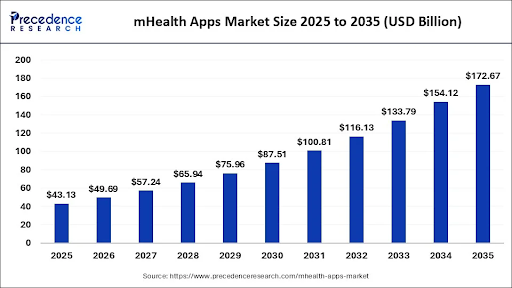
The short answer to how to develop a healthcare app: start with your user category, lock down your compliance requirements before writing a line of code, build a focused MVP, and plan your integrations early. The global mHealth apps market stood at $43.13 billion in 2025 and is projected to exceed $172.67 billion by 2035 (Source: Precedence Research). Demand is real. But most healthcare apps still fail, not because of bad engineering, but because teams misjudge how long compliance takes, underestimate EHR integration complexity, or build for the wrong user entirely.
This guide walks through the entire process in practical terms from choosing your app type to going live and keeping it running.
First, Decide What Type of Healthcare App You're Building
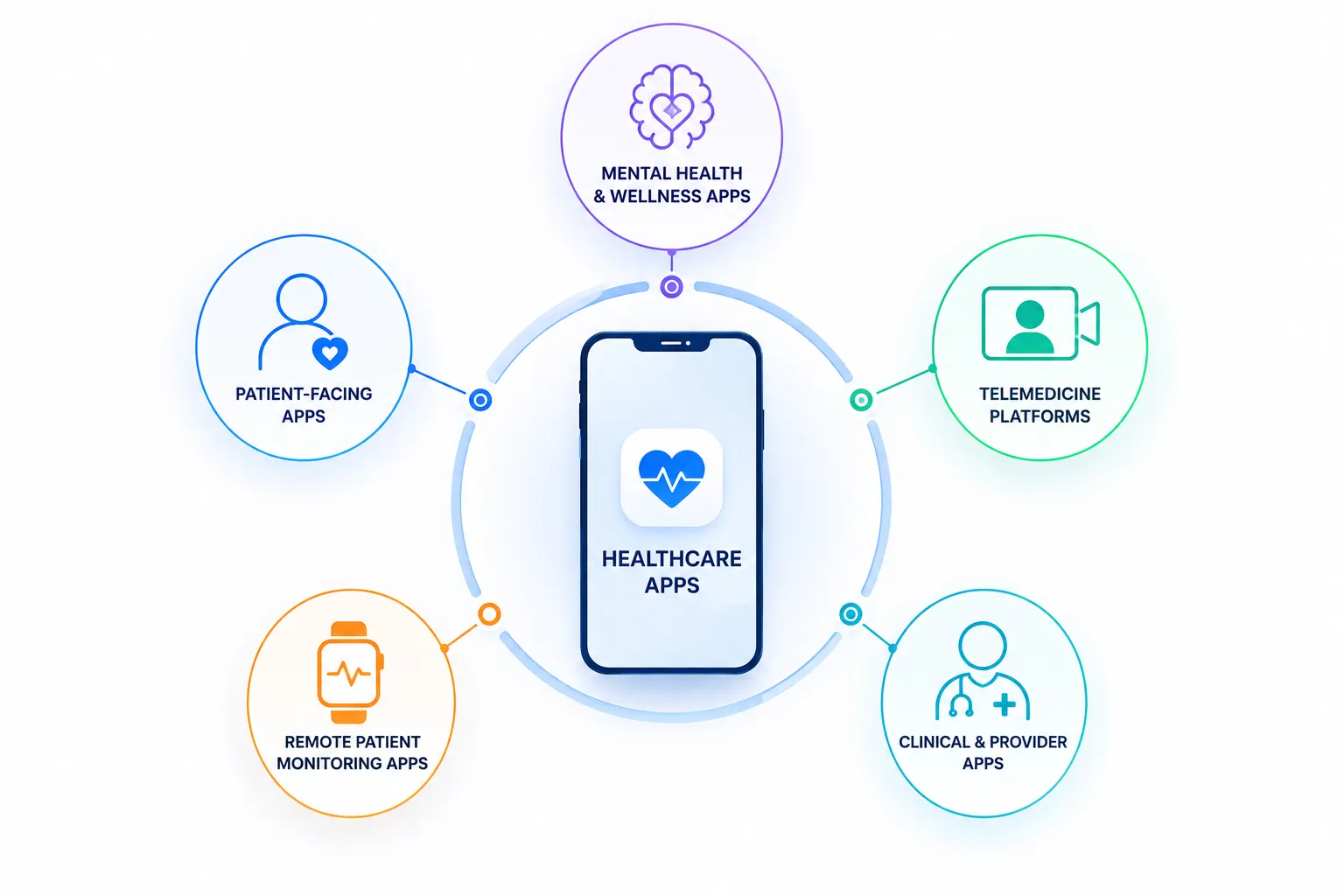
This is not a minor decision you can revisit later. Your app category determines your compliance obligations, your backend architecture, your integration requirements, and your timeline. Teams that skip this step often end up halfway through development when they realise the product they're building doesn't match the regulatory framework they planned for.
Patient-Facing Apps
These are the apps most people picture when they think of health tech appointment booking, symptom checkers, medication reminders, personal health dashboards, and chronic disease tracking. They're the most consumer-facing category, which means the UI/UX bar is genuinely high.
One thing that surprises many founders: the user base here spans a massive age and ability range. The interface that works for a 28-year-old with anxiety about their diet needs to be equally usable for a 70-year-old managing diabetes. That's a real design challenge that most MVPs underestimate.
Clinical and Provider-Facing Apps
These tools are built for physicians, nurses, care coordinators, and clinical staff. The entire design logic is different. Speed and accuracy matter more than visual polish. Clinicians don't browse apps; they use them in short, high-stakes bursts between patient interactions.
Market data makes this concrete: clinicians will bypass any system that takes more than 60 seconds for a standard task. If your interface doesn't fit inside how clinical work actually flows, it simply won't get used, regardless of how well it's built.
Telemedicine Platforms
Telemedicine has matured well beyond basic video calls. In 2026, more than 70% of healthcare providers globally offer virtual consultations as a standard service. A proper telemedicine platform needs to handle scheduling, consultation, prescription generation, and post-visit follow-up in one connected flow. Building just the video layer and calling it a telemedicine app is a common mistake.
For teams exploring this space, Nyusoft's work in AI-powered health monitoring app development gives a useful picture of what a properly integrated digital health solution looks like in practice.
Remote Patient Monitoring (RPM) Apps
RPM apps connect wearable devices and IoT sensors to cloud platforms, allowing providers to track vitals and symptoms outside of clinical settings. Hospitals invest heavily here because the numbers justify it monitoring apps reduce hospital readmissions by nearly 38% and improve medication adherence by over 30%.
This category requires close attention to device compatibility, real-time data pipelines, and alert logic. The IoT development capabilities required for RPM apps are meaningfully different from standard mobile app builds.
Mental Health and Wellness Apps
This is the fastest-growing consumer segment. Therapy scheduling, mood tracking, CBT modules, journaling tools, and crisis resources all fall here. General wellness apps that don't touch Protected Health Information (PHI) are faster and cheaper to build. But apps making clinical claims, storing mental health diagnoses, or connecting to providers cross into a different compliance tier quickly.
Core Features That Actually Drive Retention
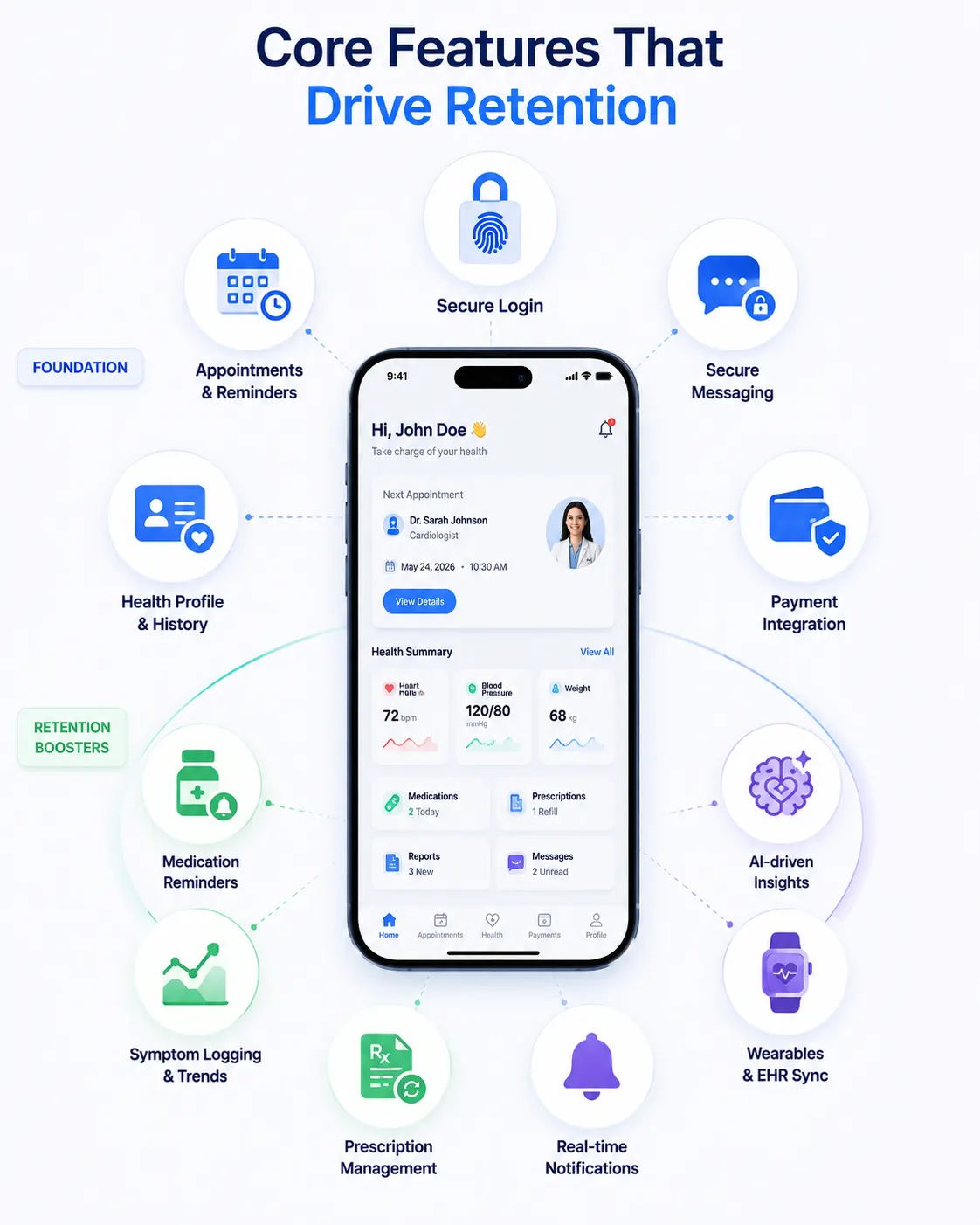
A lot of healthcare app feature lists read like wish lists. In practice, the features that keep users engaged are rarely the flashiest ones.
The non-negotiable foundation every healthcare app needs:
- Secure login with biometric authentication and proper session management
- Appointment booking, reminders, rescheduling, and visit preparation flows
- Secure in-app messaging between patients and providers
- A basic health profile and history dashboard
- Payment integration that works with insurance-friendly billing
These aren't exciting to pitch, but they're what users actually open the app for. Get these right first.
Beyond the foundation, the features that genuinely improve retention are the ones that reduce friction around things users do repeatedly:
- Medication reminders tied to real adherence tracking (not just push notifications)
- Symptom logging with trend visualisation over time
- Prescription management and refill requests without phone calls
- Real-time notifications connected to meaningful care milestones
Advanced features AI-driven symptom analysis, EHR integration, wearable sync, voice-enabled interactions are worth planning for from the start, even if they're not in the MVP. Over 40% of users prefer voice interactions for routine healthcare tasks. That number keeps rising. Design your architecture to support it later even if you don't build it now.
A practical tip: build the appointment-to-consultation flow first. If a patient can book, attend, and follow up with zero friction, everything else becomes easier to justify and easier to add.
Compliance Is Architecture, Not a Legal Review
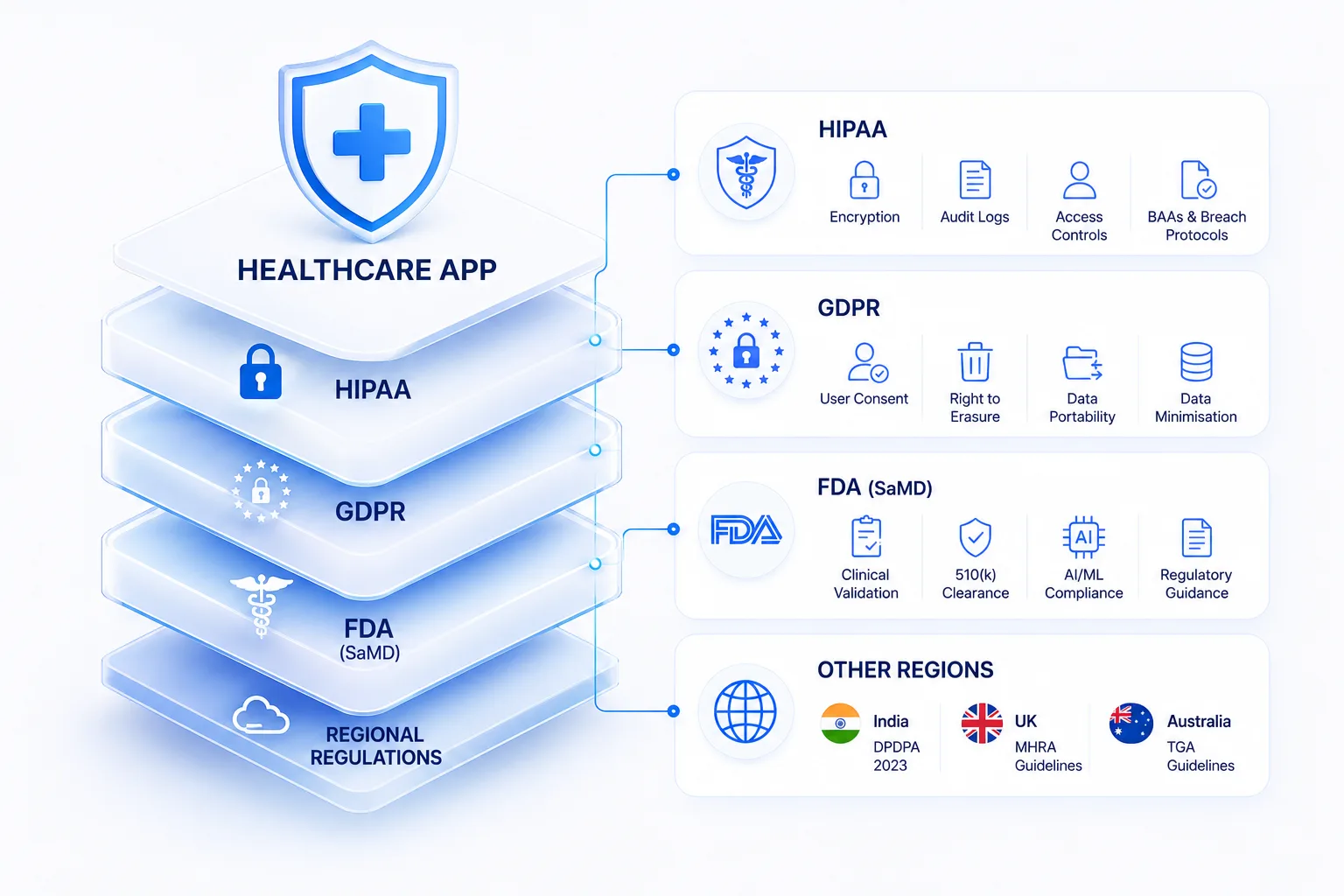
This is the section most development guides bury in the middle or treat as a checklist item. It should be the second thing you read after choosing your app type.
Healthcare compliance isn't a phase that happens before launch. It's a constraint that shapes every architectural decision from day one. Teams that treat it as a legal formality typically face expensive rebuilds six months in.
HIPAA for the US Market
Any app that stores, transmits, or processes Protected Health Information (PHI) falls under HIPAA. This isn't just about putting a privacy policy on your website. It means:
- AES-256 encryption at rest and in transit
- Comprehensive audit logs for all data access
- Strict access controls and role-based permissions
- Breach notification protocols and Business Associate Agreements (BAAs) with every third-party vendor
HIPAA non-compliance penalties range from $100 to $50,000 per violation. Building compliance from the start adds roughly 20–30% to your total project cost. Retrofitting it later costs far more, in both money and delay.
GDPR for European Users
GDPR applies to any app serving EU users, regardless of where the development company is based. A 2021 BMJ study found that 53% of healthcare apps failed to meet basic privacy standards, with non-compliance exposing companies to fines of up to 4% of global annual revenue. The key requirements are:
- Explicit, granular user consent for data processing
- The right to erasure and data portability
- Breach notification within 72 hours
- Data minimisation by design
FDA Regulations for Clinical Apps
If your app makes diagnostic or treatment recommendations, you may be building a Software as a Medical Device (SaMD). The FDA's digital health guidance framework determines whether you need 510(k) clearance. AI-powered diagnostic features attract the highest regulatory scrutiny.
Don't find this out after you've built the product. The question of whether your app qualifies as a medical device should be answered in week one.
Other Regions Worth Knowing
- India: Digital Personal Data Protection Act (DPDPA) 2023
- UK: MHRA post-Brexit digital health software guidance
- Australia: TGA guidelines for medical software
Choosing the Right Tech Stack
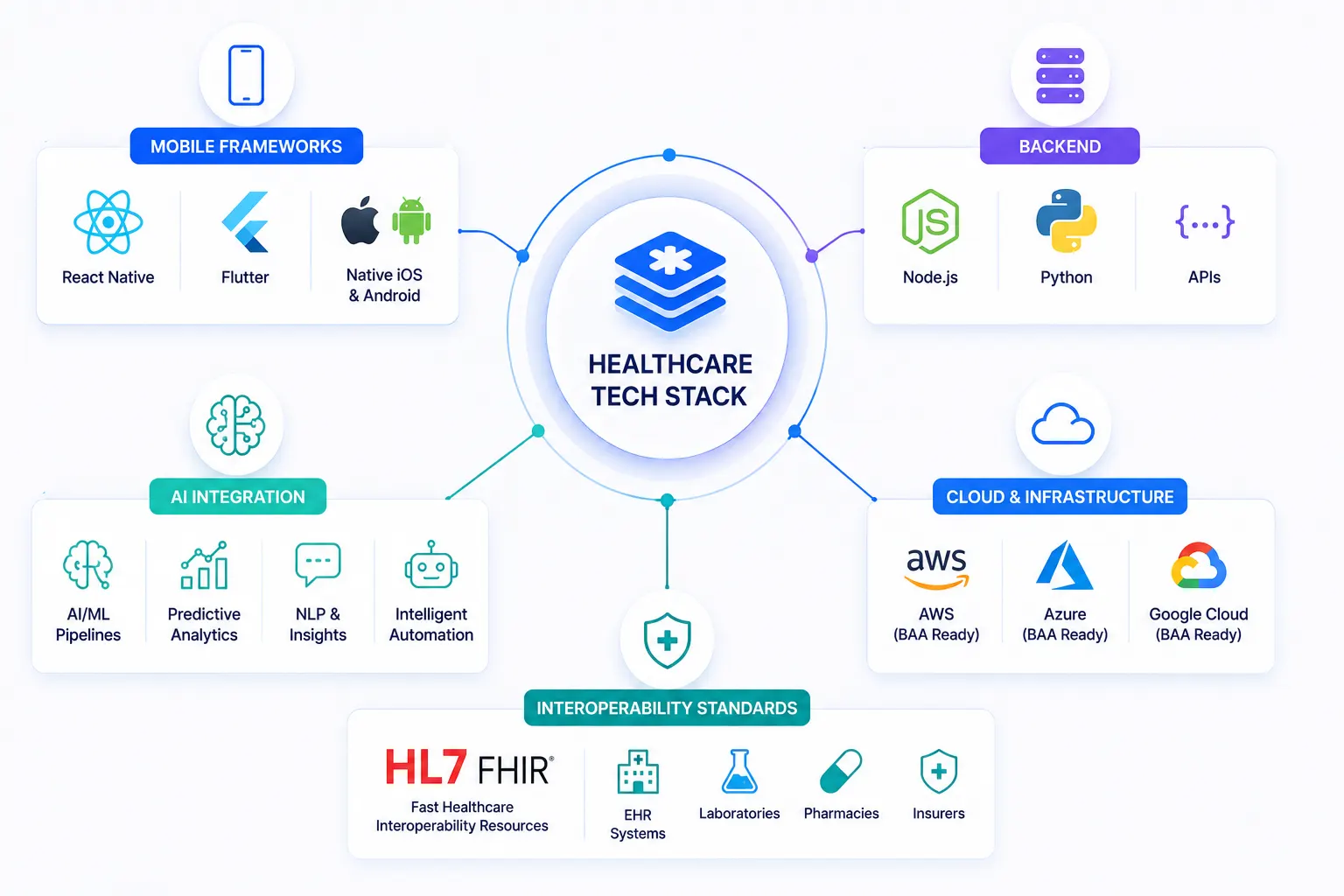
The healthcare tech stack decision isn't just a developer preference call. Security requirements, real-time performance needs, HL7 FHIR interoperability standards, and long-term maintainability all shape what makes sense.
Mobile Frameworks
React Native app development and Flutter app development are the two dominant cross-platform choices. Both let you build for iOS and Android from a single codebase, which meaningfully reduces time to market and development costs.
Native iOS or Android development makes more sense when you need deep device-level health data access direct integration with Apple HealthKit or Google Health Connect, for example. For most healthcare MVPs, cross-platform is the right starting point.
Backend
Node.js development is well-suited for real-time features: live consultation feeds, concurrent user monitoring dashboards, instant messaging. It handles concurrent connections efficiently, which matters for telemedicine at scale.
Python development is the better choice when your backend includes AI/ML pipelines predictive health analytics, symptom classification, or clinical decision support. Python's ecosystem for medical AI is significantly more mature.
For cloud infrastructure, HIPAA-compliant hosting requires a signed Business Associate Agreement with your cloud provider. AWS GovCloud, Azure Government, and Google Cloud all offer HIPAA BAA options.
Interoperability Standards
This is the part teams skip and pay for later. HL7 FHIR (Fast Healthcare Interoperability Resources) is now a mandatory standard for EHR connectivity in many markets. If your app will ever need to exchange data with hospitals, labs, pharmacies, or insurers, your data model needs to be designed with FHIR in mind from the start.
The lack of interoperability costs healthcare systems billions annually because of duplicate tests, delayed care, and manual data entry. Planning for it early is not just a technical decision it's a competitive one.
AI Integration
AI is no longer a differentiator in healthcare app development. It's becoming a baseline expectation. Symptom checkers, predictive alerts, personalised care recommendations, and ambient documentation are features that healthcare buyers are starting to expect rather than admire.
Nyusoft's generative AI development services and agentic AI solutions are specifically relevant here, particularly for teams building AI-powered diagnostic assistance or automated care coordination flows.
One important note: AI pipelines that process PHI carry their own compliance obligations around model governance and data lineage. Plan these before building.
The Development Process, Step by Step
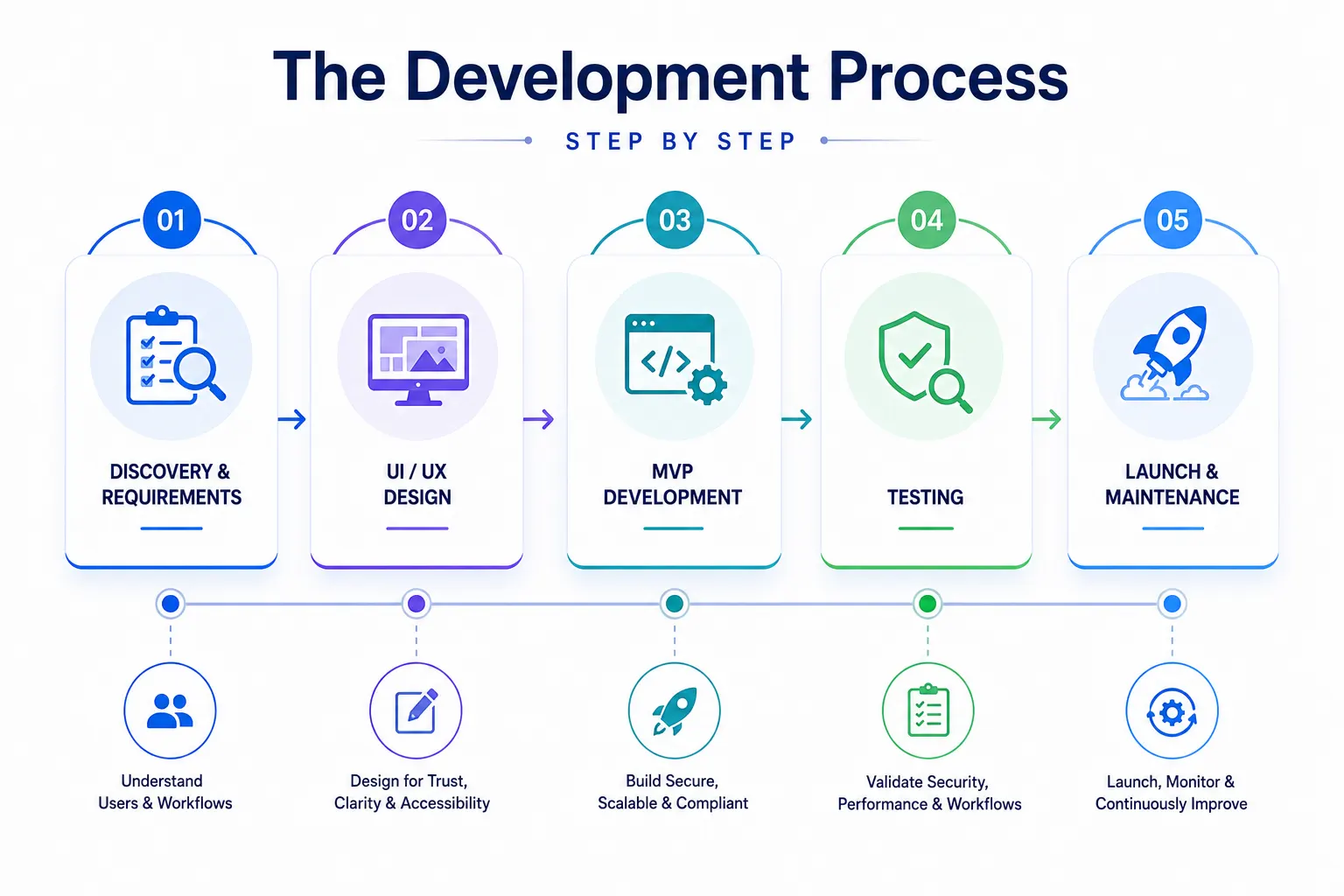
Phase 1: Discovery and Requirements (Weeks 1–3)
Map clinical workflows before touching wireframes. Talk to patients and providers separately; their mental models are genuinely different, and conflating their feedback leads to products that serve neither group well.
Define your compliance scope based on the data you're handling, not just the features you're planning. A lot of apps underestimate this because they focus on the happy path and miss the edge cases where PHI gets created.
This is also when you decide on your custom software development approach whether you're building everything bespoke, integrating existing platforms, or taking a hybrid route.
Phase 2: UI/UX Design
Healthcare UX has to account for users who are stressed, distracted, and sometimes in physical discomfort. The design can't assume a calm, seated user with full cognitive attention.
Personalised healthcare apps improve engagement by over 45% compared to generic solutions. That number reflects a real pattern: apps that adapt to a user's specific condition, medication schedule, or care history outperform one-size-fits-all designs by a significant margin.
Accessibility is not optional here. WCAG 2.1 AA compliance matters when you're serving elderly patients, users with visual impairments, or people managing conditions that affect fine motor control.
Nyusoft's UI/UX design services are particularly relevant for healthcare products where the design directly affects clinical outcomes and user trust.
Phase 3: MVP Development (3–6 Months Typically)
An MVP for a healthcare app typically costs between $50,000 and $100,000. This covers user registration, appointment management, basic health monitoring, and secure messaging. Full-featured, compliance-heavy platforms scale from $250,000 to $500,000 or more depending on EHR integrations and AI components.
The right approach: build compliance architecture first, then layer features on top. Not the other way around.
Consider a SaaS product development model if your healthcare app will serve multiple providers or institutions. The multi-tenant architecture requirements are meaningfully different from single-deployment products.
Phase 4: Testing
Healthcare testing is different from standard QA in a few important ways:
- HIPAA penetration testing — mandatory, not optional; covers data access, session handling, and encryption
- Clinical workflow testing — with actual practitioners, not just QA engineers simulating clinical tasks
- Load testing — telemedicine platforms see dramatic concurrent user spikes; test for real peak scenarios
- UAT with real patients — before public launch, ideally in a controlled healthcare environment
Phase 5: Launch and Post-Launch Maintenance
Apple and Google both have stricter review processes for medical and healthcare apps than for general consumer apps. Budget extra time for app store submission.
Post-launch isn't a wind-down phase. Annual maintenance runs 15–25% of the initial build cost. This covers security patches, HIPAA audit cycles, API version updates for EHR connections, and regulatory changes that affect your data handling.
Mistakes That Actually Kill Healthcare Apps
These aren't theoretical. They're patterns that come up repeatedly in real projects.
Treating compliance as a phase, not a foundation. Teams that plan to "add HIPAA later" typically face architecture rebuilds. Compliance requirements touch your database design, your API structure, your logging system, and your vendor contracts. You can't bolt these on after the fact.
Building for the wrong user. Building a provider tool based on patient feedback produces something neither group wants. Conduct user research with each group separately and never conflate their priorities.
Over-scoping the MVP. The first healthcare app usually fails in one of two ways: teams either overbuild and get buried in integrations before launch, or they ship too fast and discover the architecture can't handle compliance requirements or production traffic. Start with one workflow, build it well, and prove it before expanding.
Underestimating EHR integration complexity. Integrating with Epic, Cerner, or Athenahealth takes a minimum of three to six months per integration. It requires dedicated engineering effort, testing time, and ongoing maintenance. If your roadmap assumes a two-week EHR integration, revise it now.
Skipping security architecture planning. Over 275 million patient records were exposed in 2024. Cybersecurity threats targeting healthcare apps increased by over 45% year over year in 2026. Security architecture is not a feature, it's a structural property of the product. Teams that treat it as a feature add it last and regret it first.
What Does Healthcare App Development Actually Cost?
Concrete numbers, not ranges so wide they're meaningless.
| App Type | MVP Cost | Full-Featured Platform |
| Patient-facing wellness app | $4K – $7K | $10K – $20K |
| Telemedicine platform | $8K – $12K | $25K – $40K |
| EHR-integrated clinical tool | $10K – $15K | $50K – $80K+ |
| RPM with IoT integration | $15K – $30K | $40K – $80K |
Add 20–30% to any estimate for full HIPAA compliance architecture. Budget 15–25% of your build cost annually for maintenance.
These numbers assume a properly scoped project with an experienced team. The $1000 healthcare MVP that shows up on freelancer platforms doesn't include compliance architecture, security testing, or integration work. It's a prototype, not a product.
Nyusoft's mobile app development services cover the full build cycle for healthcare apps, from discovery through to post-launch support.
The Market Opportunity Is Real - But Execution Is Everything
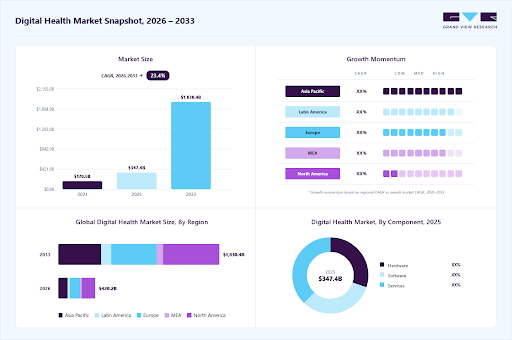
The global digital health market was estimated at $347.4 billion in 2025 and is projected to reach $1.83 trillion by 2033 (Source: Grand View Research). The Apple App Store currently features over 35,000 medical and healthcare apps. Google Play hosts more than 36,000.
That sounds saturated. It isn't, at the product layer.
The saturation is in the generic layer, the apps that do a bit of everything for no one in particular. Focused, compliant, workflow-aware apps built for specific clinical use cases still have real space to grow. 87.4 million Americans are now actively using health apps, up 39% from two years prior. The behavior is there. The question is whether the product is good enough to earn a place in it.
For founders and product teams looking for a development partner with genuine experience in healthcare software development, the difference between a vendor who understands clinical workflows and one who doesn't becomes visible quickly usually during the compliance phase or the first EHR integration attempt.
The teams that succeed in this space aren't the ones with the biggest feature roadmaps. They're the ones who picked one workflow, built it safely and correctly, proved it in the field, and expanded from there.
That's the whole strategy.
Final Thoughts
Healthcare app development is genuinely hard. Not because the technology is mysterious, but because you're building at the intersection of human health, regulatory law, clinical behavior, and consumer product design. Each of those disciplines has its own logic, and the product has to respect all of them at once.
Start with your app type. Lock down compliance before architecture. Build a focused MVP. Test with real users in real clinical contexts. Maintain the product properly after launch.
If you're evaluating platforms that already handle some of this complexity like an AI-powered personal health monitoring app, an AI-powered fitness app, or a nutrition tracking solution, those can serve as the foundation for a faster, lower-risk build.
The opportunity is large. The execution requirements are specific. Get both right and you have a product that actually matters to the people using it.
FAQs
1. What are the different types of healthcare apps?
Healthcare apps include telemedicine platforms, patient portals, remote patient monitoring apps, mental health apps, fitness and wellness apps, e-prescription solutions, and hospital management systems. The right type depends on your business goals and target users.
2. What is the first step in healthcare app development?
The first step is identifying your target audience and validating the problem your app will solve. This helps define the required features, compliance requirements, and overall development roadmap.
3. What regulations should healthcare apps comply with?
Healthcare apps may need to comply with HIPAA, GDPR, HL7 FHIR, FDA guidelines, or other regional healthcare regulations depending on where the app will be used and the type of patient data it handles.
4. Should I build a healthcare app MVP first?
Yes. Developing a Minimum Viable Product (MVP) allows you to validate your idea, collect user feedback, reduce development costs, and launch faster before investing in advanced features.
5. How can AI improve healthcare apps?
AI can power symptom checkers, predictive analytics, virtual assistants, medical image analysis, patient monitoring, workflow automation, and personalized healthcare recommendations.
6. Can healthcare apps integrate with wearable devices?
Yes. Healthcare apps can connect with Apple Health, Google Health Connect, Fitbit, smartwatches, glucose monitors, ECG devices, and other IoT wearables for real-time health tracking.
7. What factors affect healthcare app development costs?
The cost depends on app complexity, compliance requirements, AI functionality, third-party integrations, supported platforms, UI/UX design, and post-launch maintenance.
8. How do healthcare apps protect sensitive patient data?
Healthcare apps use encryption, secure cloud hosting, role-based access controls, multi-factor authentication, audit logs, and regular security testing to protect patient information.
9. What are the biggest challenges in healthcare app development?
Common challenges include regulatory compliance, interoperability with healthcare systems, data privacy, user adoption, scalability, and integrating emerging technologies like AI.
10. Why choose Nyusoft for healthcare app development?
Nyusoft develops secure, scalable, and compliance-ready healthcare applications tailored to your business goals. From strategy and UI/UX to AI integration, HIPAA-compliant architecture, cloud deployment, and ongoing support, our team delivers end-to-end healthcare software solutions.
Ready to Turn Your Healthcare App Idea into Reality?
Building a healthcare app requires the right balance of innovation, security, compliance, and scalability. Whether you're creating a telemedicine platform, patient portal, remote monitoring solution, or AI-powered healthcare application, our experienced development team can help you build a secure, compliant, and future-ready digital health solution from concept to launch.