


 Front End Development
  Back End Development
  CMS / ECommerce Development
  Mobile Apps Development
  Cloud Services
  Fullstack Services
  Solution


Yoga App Development: Features, Cost, and Development Guide For Businesses
Yoga app development typically costs between $4,000 and $25,000+, depending on whether you need a basic video library, a live-streaming and booking system, or full AI-powered pose detection. The features that matter most are a clean video player with offline access, instructor and class scheduling, flexible payment options, and, for apps competing at the top end, computer vision that corrects a user's form in real time.
A yoga app itself is simply a mobile or web platform that lets people follow guided sessions, book live classes with an instructor, or get posture feedback through their phone camera instead of a studio mirror.
The hard part isn't deciding to build one. It's picking the right tier for your budget, audience, and how fast you actually need to launch. A yoga studio testing demand for an online product needs a very different build than a wellness brand trying to compete with an established AI yoga app. This guide walks through both, along with the features, costs, and monetization choices that come with each.
Why Yoga Apps Are Becoming a Real Business Category, Not a Side Feature
Yoga used to live almost entirely inside a studio. A teacher, a room, a fixed class schedule. That model still works, but it caps how many people a single instructor can reach in a day.
Apps removed that cap. One instructor can now teach a sequence to thousands of people without renting a bigger room or adding more class slots to the calendar.
The market reflects that shift. According to Grand View Research, the global yoga market was valued at $127.0 billion in 2025 and is projected to reach $269.1 billion by 2033, growing at a compound annual rate of 9.9% (Grand View Research, Yoga Market Report).
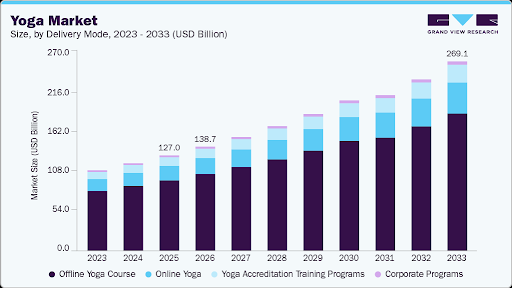
What's worth noticing is where most of that money still sits. Offline yoga classes accounted for nearly 74% of the market share in 2025, according to the same report. Most of the category has not gone digital yet. That gap is exactly what a well-built app is meant to close.
This also explains why investors and studio owners are treating yoga apps as a real product line rather than a marketing extra bolted onto an existing brand. A studio with loyal local members already has the content, the instructors, and the trust. What it usually doesn't have is a way to sell that experience to someone who lives three states away or simply prefers practicing before sunrise without driving anywhere.
Types of Yoga Apps You Can Build
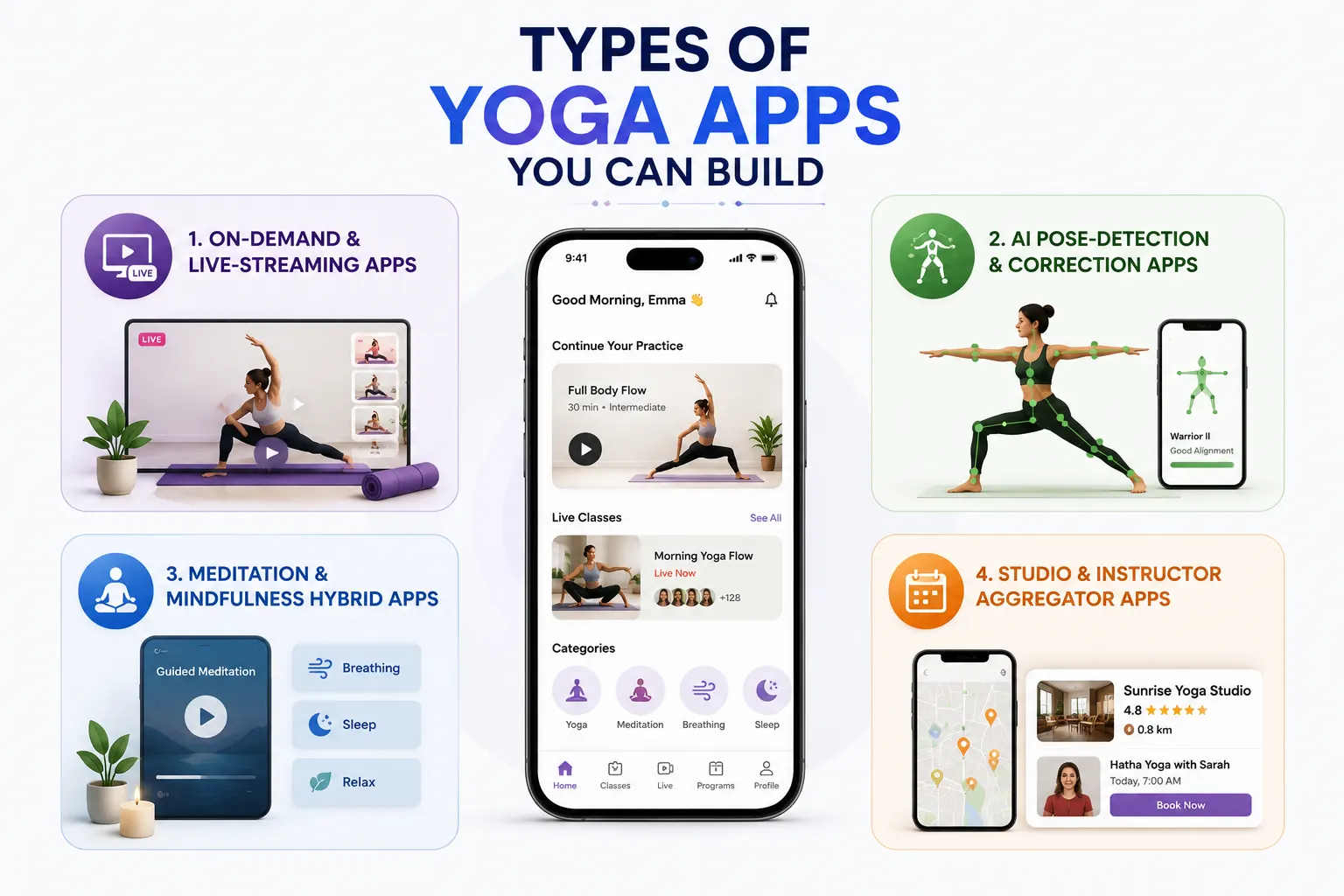
Not every yoga app does the same job. Before you scope features or set a budget, it helps to know which category you're actually building.
On-Demand and Live-Streaming Apps
This is the most common model. Users browse a video library, follow recorded sessions, and join scheduled live classes with a real instructor.
Glo and Alo Moves built their entire business on this format. The appeal is simple. Users get studio-quality instruction without leaving their living room, and the studio gets a way to monetize past recordings instead of letting them sit unused after a single class.
AI Pose-Detection and Correction Apps
These apps use the phone camera to track body position during a pose and flag misalignment in real time.
Yoga Go popularized this model. It works well for beginners who need form correction but don't have a teacher standing in the room watching them. The tradeoff is engineering cost. Accurate pose tracking needs real testing across body types and lighting, which is why this tier costs noticeably more than a video library.
Meditation and Mindfulness Hybrid Apps
Some apps lean less on physical poses and more on breathing exercises, guided meditation, and sleep content.
Headspace and Calm sit in this category, though many yoga-first apps now add a meditation section instead of building a separate product around it. This hybrid approach often performs well because it keeps users opening the app on days they don't feel like a full physical practice.
Studio and Instructor Aggregator Apps
Instead of producing content, these apps connect users with nearby studios or independent instructors for booking and class discovery.
This model works closer to a marketplace. The app earns money on booking fees rather than subscriptions, which changes the entire monetization plan later in this guide. It also shifts the technical priority away from video infrastructure and toward scheduling, calendars, and payment splitting between the platform and each instructor.
Core Features Every Yoga App Needs
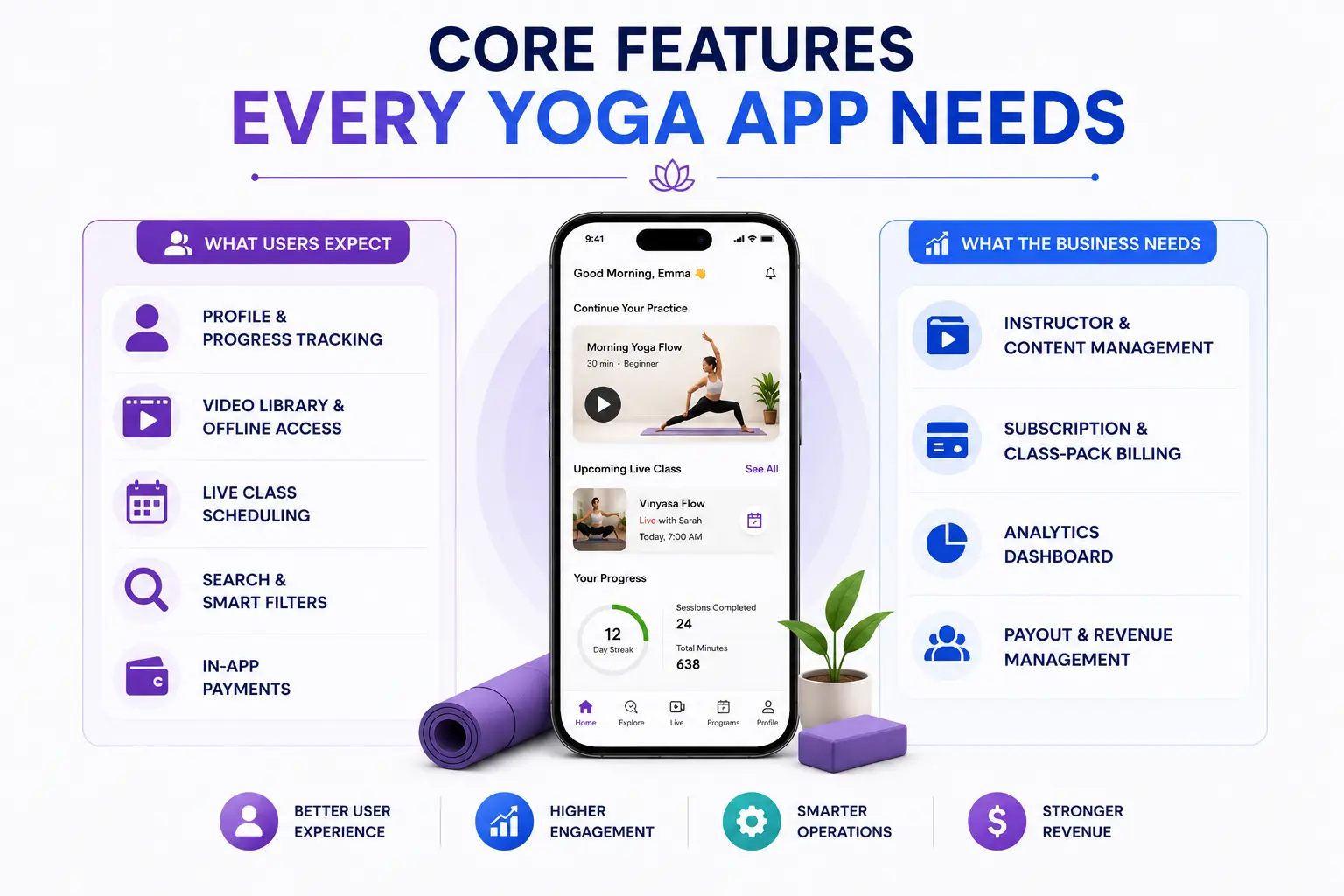
Once you know the type of app you're building, the feature list gets easier to define. Most successful yoga apps share a core set of user-facing features and a separate set built for the business running it.
What users expect:
- A profile that tracks streaks, session history, and progress over time, since most users stay longer when they can see consistency building up
- A video library with offline playback for sessions practiced at home with unreliable wifi, which matters more in yoga than most fitness categories because early morning and late night are the two most common practice windows
- Live class scheduling with calendar sync and reminders, so a booked session doesn't quietly get forgotten
- Search and filters by style, duration, and instructor, letting a beginner avoid an advanced vinyasa class by accident
- In-app payments that support both subscriptions and single-class purchases, since not every user is ready to commit to a monthly plan on day one
What the business needs to run it:
- Instructor and content management tools to upload, organize, and tag sessions without needing a developer involved every time new content goes live
- Subscription and class-pack billing that supports more than one pricing model at once, since locking into a single pricing structure early often means rebuilding it later
- An analytics dashboard showing retention, drop-off points, and revenue by plan, which is usually the first thing a founder wishes they had built in from day one instead of bolting on later
- Payout handling if multiple instructors earn a revenue share from bookings or content, which becomes a real operational headache fast if it's still being managed manually in a spreadsheet
AI Features That Separate a Generic Yoga App from a Competitive One
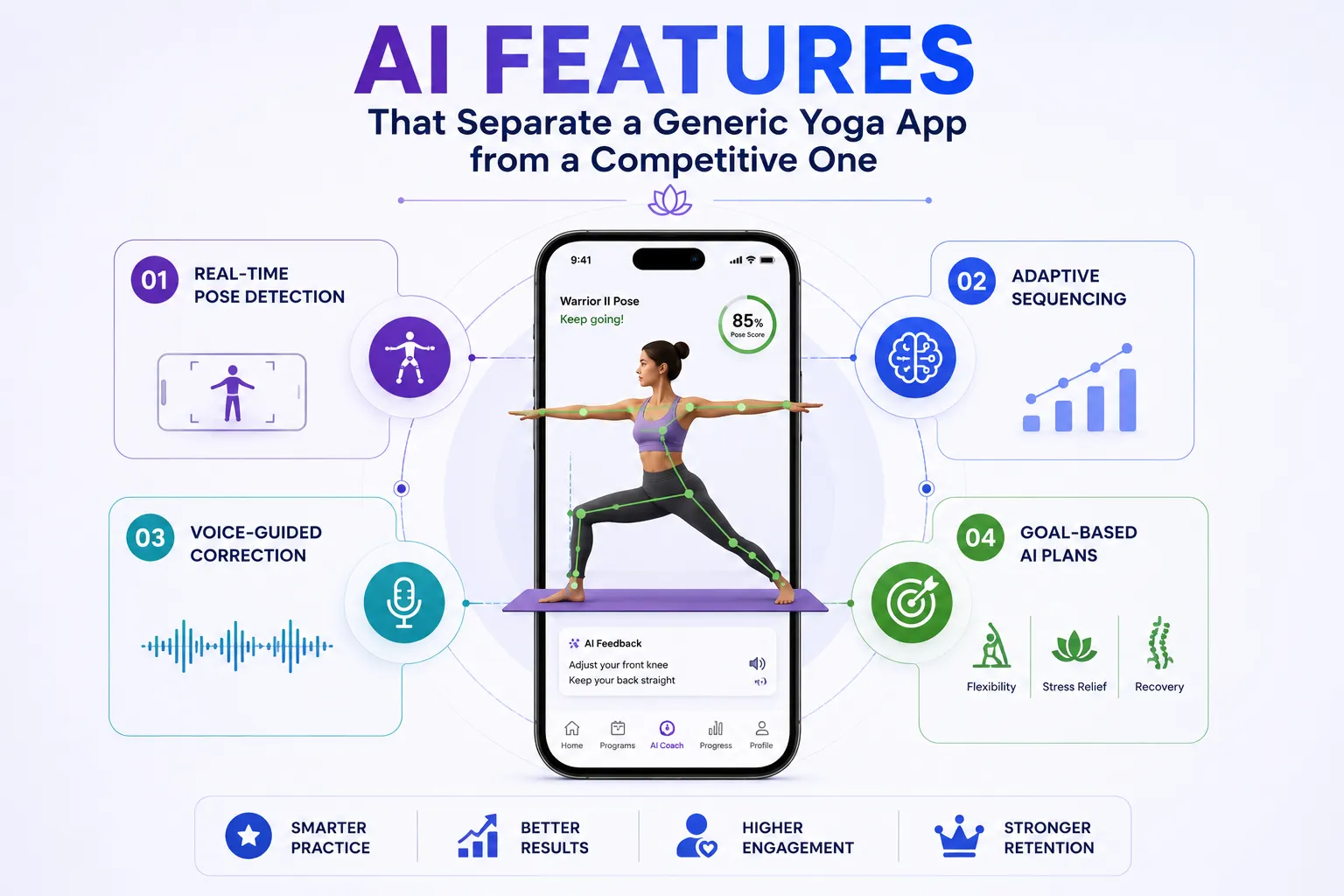
A basic video library can get an app to launch. It rarely gets it to stand out once two or three competitors copy the same format.
Real-time pose detection. Computer vision models such as MediaPipe or TensorFlow Pose track joint angles through the phone camera and flag misalignment before it turns into an injury. This is the single feature most often associated with premium yoga apps, and it's also the one users mention most in reviews once it works well.
Adaptive sequencing. The app adjusts difficulty based on how consistently and accurately a user has held previous poses, rather than running everyone through the same fixed program regardless of where they actually are in their practice.
Voice-guided correction. Spoken cues during a live camera session let users fix their form mid-pose instead of breaking position to glance at the screen, which keeps the experience closer to having an actual instructor in the room.
Goal-based AI plans. Sequences generated around a stated goal, such as flexibility, stress relief, or post-injury recovery, instead of a static plan built for an average user who doesn't exist. Over time, this is also what tends to drive the subscription renewals, since a plan that visibly adapts feels worth paying for again next month.
This is largely the same engineering foundation behind AI-powered fitness tracking apps, just applied to posture and breath instead of reps and pace.
How Long It Takes and What the Development Process Looks Like
The timeline depends almost entirely on whether AI features are in scope.
- Discovery and scope. Defining the app type, target audience, and feature list before any design work starts, which prevents the most common cause of budget overruns: deciding what the app actually is halfway through building it.
- UI/UX design. Wireframes followed by a clickable prototype so the flow gets tested before code is written, which is far cheaper to fix at this stage than after development is underway.
- Core development. Building login, video playback, scheduling, and payments, which forms the base of almost every yoga app regardless of tier.
- AI and computer vision integration. If pose detection is part of the build, this phase alone often adds four to six weeks on its own, mostly spent training and refining model accuracy rather than writing new screens.
- Testing. Camera-based features need real-world testing across lighting conditions, camera angles, and body types, not just a quick run on one developer's phone in a well-lit office.
- Launch and post-launch support. App store submission, followed by the first round of fixes once real users start hitting edge cases nobody planned for during development.
A basic app usually takes eight to ten weeks. An AI-powered version with pose detection generally takes three to five months once you account for the extra testing cycle.
Technology Stack for Yoga App Development
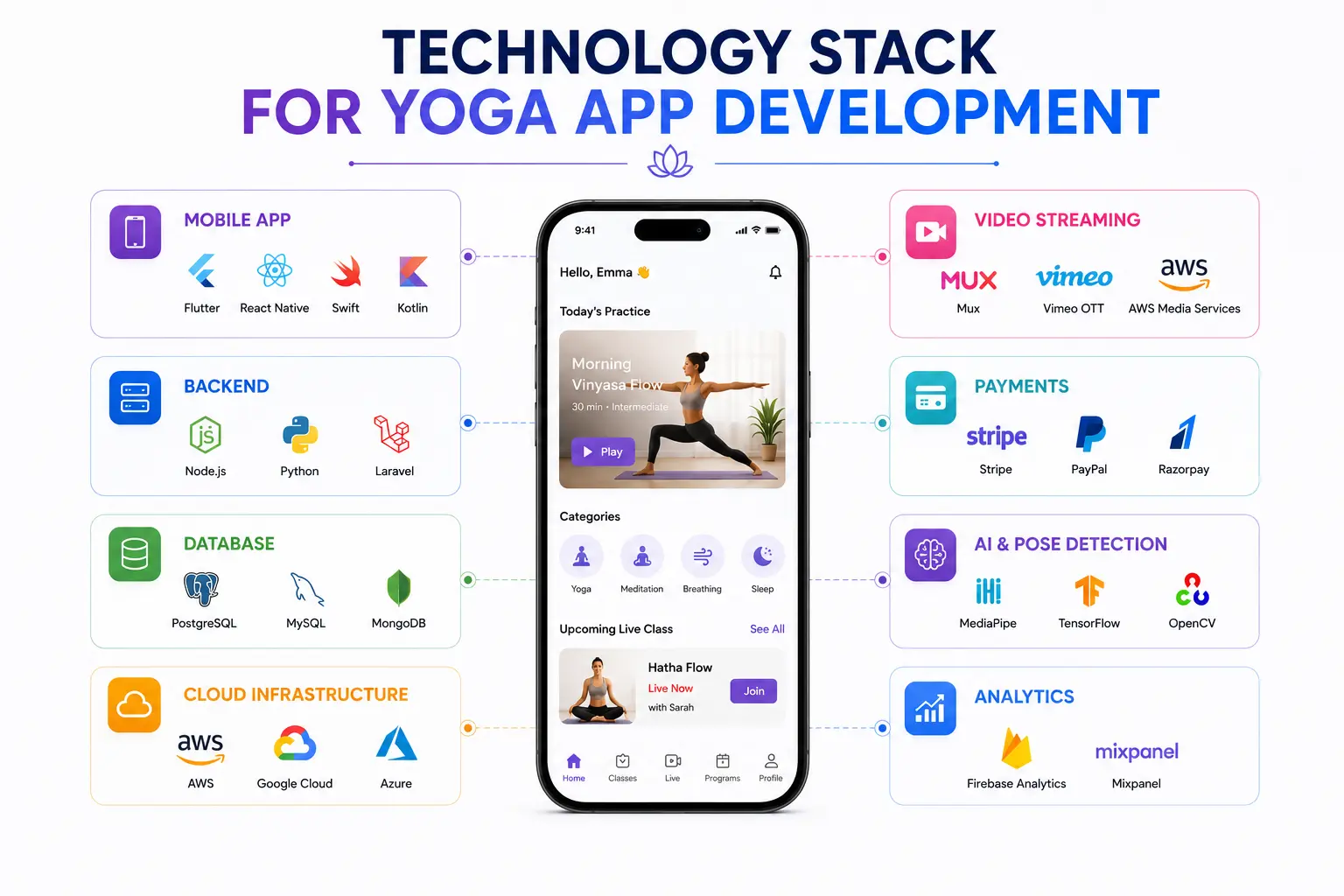
The technology stack you choose affects everything from app performance and scalability to development cost and future maintenance. Most modern yoga apps use a combination of mobile development frameworks, cloud infrastructure, video streaming tools, and AI technologies.
For cross-platform development, frameworks like Flutter and React Native are popular because they allow businesses to launch on both iOS and Android from a single codebase, reducing development time and cost. For native applications that require advanced performance or deeper hardware integrations, developers may use Swift for iOS and Kotlin for Android.
The backend typically relies on technologies such as Node.js, Python, or Laravel to manage user accounts, subscriptions, content libraries, and scheduling features. Cloud platforms like AWS, Google Cloud, and Microsoft Azure provide secure storage, scalability, and reliable performance for growing user bases.
Video delivery is a critical part of most yoga apps. Services such as AWS Media Services, Vimeo OTT, and Mux help stream high-quality content while supporting adaptive playback across different devices and internet speeds.
For AI-powered yoga apps, computer vision technologies play an important role. Tools such as MediaPipe, TensorFlow, and OpenCV enable pose detection, posture analysis, and personalized feedback through a smartphone camera. These technologies help create a more interactive experience by guiding users during practice and improving alignment awareness.
A typical modern yoga app technology stack may include:
| Component | Technologies |
| Mobile App | Flutter, React Native, Swift, Kotlin |
| Backend | Node.js, Python, Laravel |
| Database | PostgreSQL, MySQL, MongoDB |
| Cloud Infrastructure | AWS, Google Cloud, Azure |
| Video Streaming | Mux, Vimeo OTT, AWS Media Services |
| Payments | Stripe, PayPal, Razorpay |
| AI & Pose Detection | MediaPipe, TensorFlow, OpenCV |
| Analytics | Firebase Analytics, Mixpanel |
The ideal technology stack depends on your business goals, feature requirements, launch timeline, and long-term growth plans. A simple video-based yoga app may only need a lightweight architecture, while an AI-powered platform with pose detection and personalized recommendations requires a more advanced setup.
Yoga App Development Cost Breakdown
If you've already looked into fitness app development services for a related project, the numbers below will look familiar with one exception. Pose detection adds a real engineering cost that a standard workout tracker never has to carry.
Basic yoga app: $4,000 to $10,000 Video library, user profiles, basic progress tracking, built cross-platform on a single codebase. This tier is usually right for a studio testing whether an online product is worth pursuing before investing further.
Mid-tier app: $10,000 to $20,000 Live class scheduling, booking, in-app payments, and social or community features layered on top of the basic tier. Most independent instructors and small studio chains land here.
AI-powered yoga app: $20,000 and up Pose detection, personalized sequencing, and often wearable integration for heart rate or recovery data. This is where a brand is competing directly with established players rather than just digitizing an existing class schedule.
The AI tier costs more, but it's also where the market is moving fastest. Grand View Research projects the global fitness app market will grow from $12.12 billion in 2025 to $33.58 billion by 2033 at a 13.4% compound annual rate, and names AI-personalized apps as the fastest-growing segment inside that number (Grand View Research, Fitness App Market Report).
These ranges are general estimates. Final cost still depends on how much instructor content you need produced, how many platforms you're launching on, and where your development team is based. Developer rates vary significantly by region, and that often swings the final number more than the feature list itself.
Monetization Models for Yoga Apps
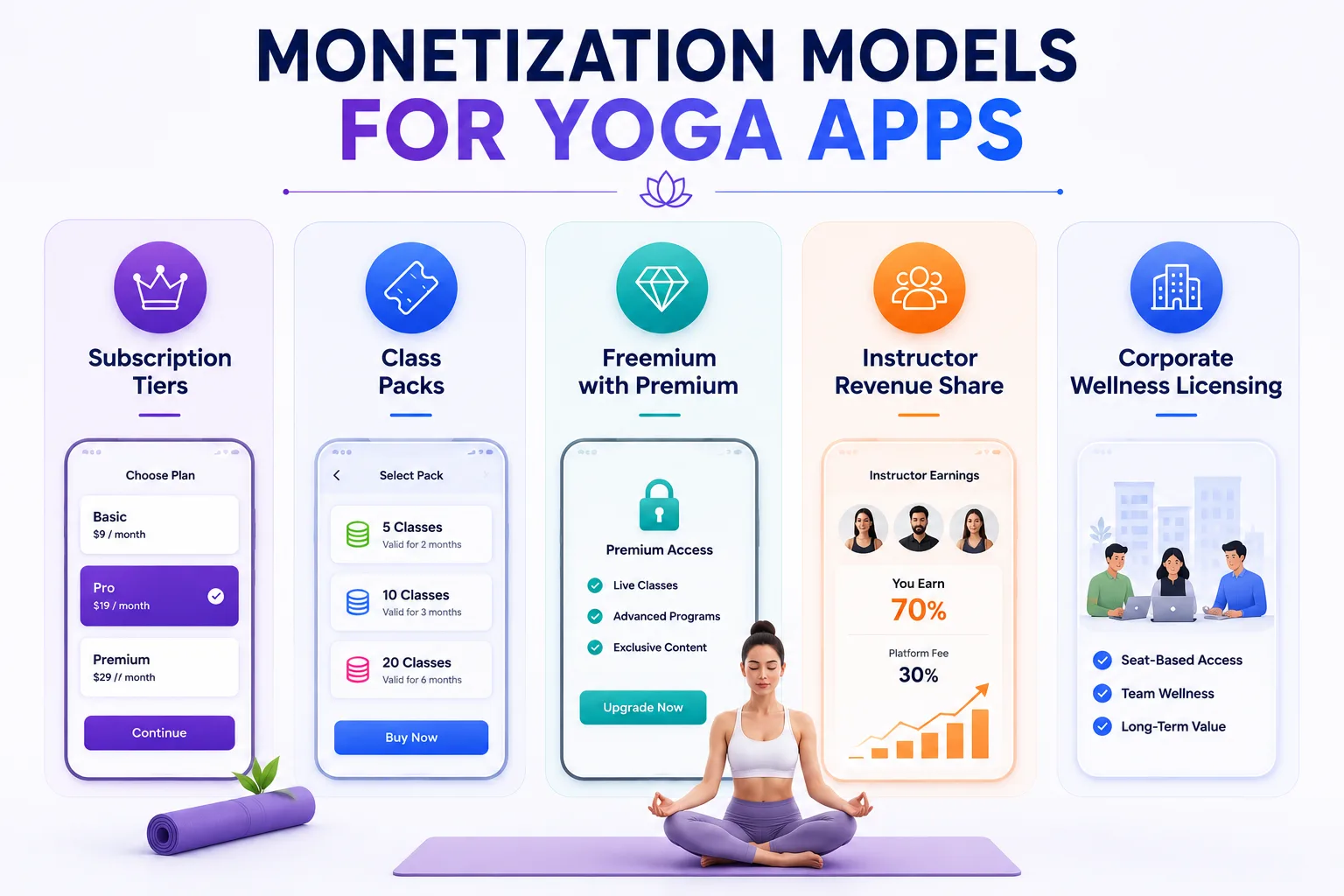
The app type you chose earlier usually decides which of these makes sense first.
Subscription tiers give users unlimited access for a monthly or annual fee. This is the default for on-demand and AI-powered apps, and it works best once you already have enough content that a single purchase wouldn't feel like a fair trade.
Class packs let users pay for a set number of sessions, which works well for studios moving their existing pricing structure online instead of redesigning it from scratch. It also tends to convert better with users who are hesitant to commit to a recurring charge.
Freemium with a premium lock keeps a basic library free and charges for live classes or advanced content, which is useful for building an audience before asking anyone to pay. The risk is giving away too much for free and never creating a strong enough reason to upgrade.
Instructor revenue share fits the aggregator model, where the app takes a booking or platform fee instead of charging users a flat subscription. This shifts most of the financial risk onto the platform rather than the instructor, which can make recruiting instructors easier in the early stages.
Corporate wellness licensing sells seat-based access to companies running employee wellness programs, which is a slower sale but often a much larger one once a contract is signed.
Common Mistakes Businesses Make When Building a Yoga App
Copying gym app feature sets. Workout trackers reward speed and reps. Yoga rewards form and breath. Bolting aggressive streak pressure and gamified badges onto a yoga app often works against the calmer experience the audience actually came for, and it shows up fast in reviews once users notice the mismatch.
Skipping content licensing clarity upfront. Who owns a recorded session, what happens if the instructor leaves the platform, and what they get paid if a class goes viral all need answers before filming starts, not after a dispute forces the conversation.
Underestimating computer vision testing. Pose detection accuracy shifts with lighting, camera angle, skin tone, and body type. Skipping a real-world testing phase here is the most common reason AI yoga features ship buggy at launch, and it's also the hardest mistake to fix after users have already formed an opinion of the app.
Ignoring offline access. A large share of yoga sessions happen at home on patchy wifi, often early in the morning before a household's internet is even fully active. Without offline video caching, that's exactly where users start to churn, usually within the first week.
Choosing a Development Partner
Look past the portfolio screenshots and ask what the team has actually shipped in wellness specifically, not fitness apps in general dressed up as yoga experience. A team that's only built calorie counters and step trackers will treat a yoga app the same way, and it will show in how the final product feels to use.
If pose detection or any computer vision feature is part of your plan, ask direct questions about model accuracy testing and how they've handled it on past projects. This is where most yoga app development companies either show real depth or start talking in generalities instead of specifics.
Ask for a cost breakdown by feature instead of accepting a single flat number. It's the only way to know what you're actually paying for if you need to cut scope later to hit a budget, and it also tells you a lot about how organized the team is before you've signed anything.
Budget is also where the build-versus-buy question comes in. It's worth comparing a custom build against a white-label fitness solution before committing to either path, since the right answer depends more on timeline and control than on price alone.
Post-launch support terms matter just as much as the build itself. Pose detection models in particular need ongoing tuning once real users start generating data the testing phase never accounted for, so ask what support actually looks like after launch, not just how much it costs to get there.
Design decisions should follow the audience that's actually paying, not an imagined average user. Grand View Research found women accounted for 71.84% of the global yoga market in 2025, and the 30 to 50 age group made up the largest share at 43.46% (Grand View Research, Yoga Market Report). That doesn't mean excluding anyone else. It means onboarding, instructor selection, and default content should be tested against that core audience first.
FAQs
What makes a yoga app different from a regular fitness app?
A fitness app tracks reps, calories, and workout intensity. A yoga app prioritizes pose accuracy, breath, and pacing instead. Most yoga apps also include meditation and slower-paced content that a typical workout tracker never needs to account for.
How accurate is AI pose detection in yoga apps right now?
Models like MediaPipe track joint angles well in good lighting with a clear camera view. Accuracy drops with poor lighting, loose clothing, or awkward camera angles. Most apps treat it as guidance rather than a clinical-grade correction tool.
Can a yoga app work without AI pose detection?
Yes. Plenty of successful yoga apps run entirely on recorded and live video without any computer vision feature. AI pose detection adds a competitive edge, but it isn't required to launch a working product.
Does a yoga app need offline video access?
It helps a lot, since many sessions happen early morning or late at night when wifi can be unreliable. Apps without offline playback tend to see higher drop-off in the first week. It's also one of the cheaper features to add relative to the retention it protects.
How should a yoga app handle instructor content ownership?
This needs a written agreement before filming starts, covering who owns each recording and what happens if an instructor leaves the platform. Skipping this conversation early is one of the most common sources of disputes later on.
Can multiple instructors use the same yoga app, or should it stay single-brand?
Both models work, but the choice changes the app's architecture. A single-brand app is simpler to build, while a multi-instructor marketplace needs scheduling and payout splitting built in from the start.
Is a white-label yoga app a good fit for a small studio?
It can be, especially for a studio testing demand before committing to a custom build. White-label options launch faster and cost less upfront, but offer less control over branding and future feature changes.
What data privacy concerns apply to camera-based yoga apps?
Apps using the camera for pose detection should process video on the device whenever possible instead of uploading footage to a server. Users should also be told clearly what's being captured and why before they grant camera access.
Should a yoga app include meditation and breathing content, or stay purely physical?
Most users respond well to having both in one app, since not every day calls for a full physical practice. Apps offering only poses tend to lose engagement on days users want something gentler.
What actually keeps users on a yoga app past the first month?
Personalization and content that evolves with the user's skill level matter more than adding constant new features. Apps that adjust difficulty or suggest a next step based on past sessions tend to retain users longer than a static library.
Final Thoughts
The real question isn't whether to build a yoga app. The market data already answers that on its own. The question is which version to build first: a focused video library that proves people will pay, or a fuller AI-powered platform that costs more upfront but competes at the level of Glo or Yoga Go from day one.
Either path works as long as the feature set matches the budget and the audience it's built for. Starting smaller and adding AI features once you have real usage data is rarely a wrong move, even if it feels slower at first.
Nyusoft has spent years building AI-powered fitness apps, and yoga and meditation centers are one of the recurring use cases we keep building for. If you're trying to figure out which tier actually fits your timeline and budget, talk to our team and we'll map it out before you commit to a number.