


 Front End Development
  Back End Development
  CMS / ECommerce Development
  Mobile Apps Development
  Cloud Services
  Fullstack Services
  Solution


How AI Agents Can Power Personalized Fitness Apps
AI agents help personalized fitness apps do what a good human trainer does: read your behavior, adjust your plan, flag problems early, and keep you showing up. They don't just log data. They act on it. That single shift is what separates the fitness app users who delete in two weeks from the ones that become part of their daily routine.
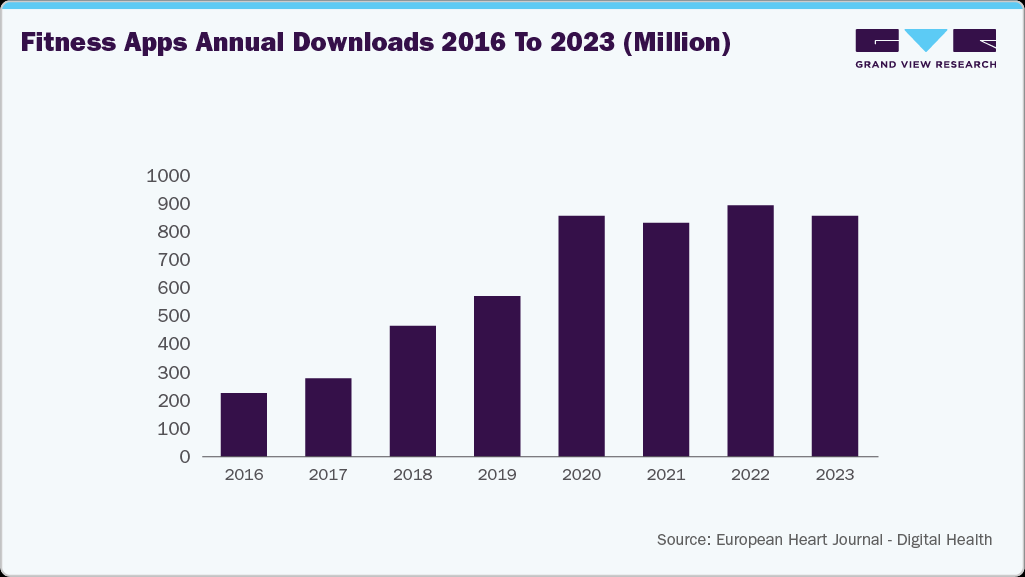
According to Grand View Research, fitness app downloads have surged from 230 million in 2016 to over 860 million in 2023, with the sharpest jump occurring in 2020 when downloads nearly doubled year-over-year. That trajectory hasn't slowed down since. The growth isn't coming from more apps; it's coming from apps people actually keep using and AI-driven personalization is the reason why.
This article breaks down exactly how AI agents work inside fitness apps, what they make possible for users, and what it means for anyone thinking about building one.
What Makes a Fitness App "Personalized" in the First Place?
Most fitness apps call themselves personalized. Most aren't.
They ask a few questions during onboarding, such as your age, your goal, how often you work out, and generate a plan based on that. That plan doesn't change unless you manually update your profile. It doesn't know you had poor sleep last night. It doesn't notice that you've skipped leg day three times in a row. It doesn't catch that you're burning out before you even feel it.
That's not personalization. That's a static template with your name on it.
Three things consistently fail in traditional fitness apps:
- Workout plans that ignore real-time physical state and treat every user session the same
- No meaningful connection between sleep quality, nutrition intake, and training intensity
- Zero awareness of when a user is drifting toward churning so nothing happens until they're already gone
AI agents solve all three. An AI agent is a system that perceives its environment in this case, user behavior and biometric data, makes decisions based on what it observes, and takes action without needing someone to manually trigger it each time.
When that kind of agent runs inside a fitness app, the app stops being passive and starts behaving like something that actually watches out for the user.
If you're exploring what this looks like in practice, Nyusoft's AI-powered fitness tracking app development work covers this exact architecture from behavior monitoring to real-time adaptive plans.
The 6 Ways AI Agents Work Inside a Fitness App
A well-built AI agent isn't a single feature. It's a system of decisions running quietly in the background, acting on data the user doesn't even have to think about.
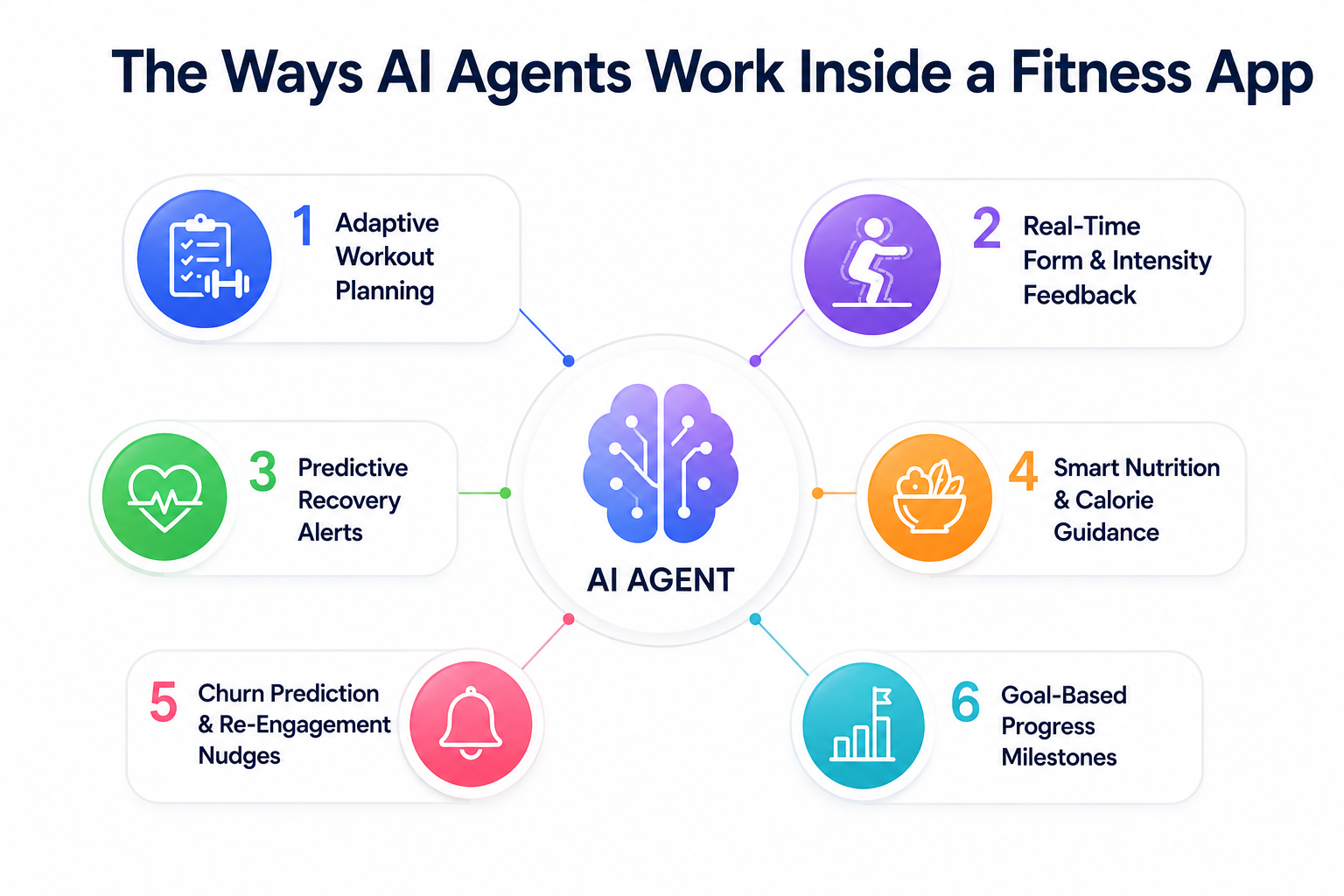
1. Adaptive Workout Planning
The most visible job an AI agent does is updating the workout plan based on what's actually happening, not what the user intended when they signed up.
If someone completes 90% of their sessions at high intensity for three straight weeks, the agent increases the challenge. If they've had two consecutive weeks of missed sessions and lower performance scores, it backs off, resets expectations, and rebuilds from a lower baseline.
This isn't a timer or a rule. It's a model that reads trends and makes a judgment call the same way a good personal trainer would after watching someone train for a month.
2. Real-Time Form and Intensity Feedback
Using the phone's camera or wearable sensor data, AI agents can assess movement quality and flag problems mid-session.
This matters for two reasons. First, poor form leads to injury, and injury is the fastest way to lose a user permanently. Second, real-time feedback creates a coaching experience inside the app that users genuinely value. It's one of the reasons they'd pay for a premium tier.
InsightAce Analytics values the AI in Fitness and Wellness market at $10.68 billion in 2025, forecasting it will reach $57.80 billion by 2035 at a 19.3% CAGR. Demand for real-time coaching tools, not static content, is the force behind that growth number.
3. Predictive Recovery Alerts
HRV (heart rate variability), resting heart rate, and sleep duration tell an AI agent a lot about whether a user is ready to train hard or needs to pull back.
Platforms like WHOOP and Oura have made recovery scores mainstream because users respond to them. When an app tells you "your body isn't ready for a hard session today" and backs it with actual biometric data, you trust it. More importantly, you keep using it.
Building predictive recovery into a fitness app turns recovery from a passive feature into an active service one that prevents overtraining, builds long-term loyalty, and gives users a reason to open the app even on rest days.
4. Smart Nutrition and Calorie Guidance
Generic calorie targets are nearly useless without context. An AI agent changes that by connecting what a user ate to what they burned, how they slept, and what they're scheduled to do tomorrow.
If someone burns 600 calories in a strength session but is running a large deficit going into a recovery day, the agent can adjust tomorrow's intake guidance accordingly automatically, without the user having to do the math.
This kind of connection between training output and nutrition input is exactly what Nyusoft builds into their AI-powered nutrition tracking solutions where meal logs and workout data work as one system rather than two separate features.
5. Churn Prediction and Re-Engagement Nudges
This is the business-critical function most fitness app developers underinvest in.
The pattern is well documented: users download a fitness app, use it consistently for about two to three weeks, then engagement starts to drop. Most apps send a generic push notification. It doesn't work because it's not personal; it's just noise.
An AI agent watches for the specific behavioral signals that precede churn: sessions getting shorter, workouts being skipped on days that used to be consistent, and app opens slowing down. When those signals appear together, the agent triggers a re-engagement flow that's timed and worded for that specific user's situation, not a blanket reminder.
Future Market Insights projects the hyper-personalized fitness segment will grow from $5.5 billion in 2026 to $31.1 billion by 2036 at a CAGR of 18.9%, with user retention cited as one of the central commercial drivers. Retaining users at scale is not a marketing problem. It's an AI infrastructure problem.
6. Goal-Based Progress Milestones
Progress milestones tied to real data hit differently than arbitrary badges.
When a user gets an alert that says "you've improved your average pace by 12% over the last 6 weeks" based on actual tracked sessions not a calendar event they feel it. That's a moment that builds habit, extends subscription periods, and generates word-of-mouth.
AI agents make those moments possible because they're tracking trajectory, not just activity.
Read Also: Top Fitness App Ideas Startups Should Build
AI Agents vs. Simple AI Features - What's the Actual Difference?
A lot of fitness apps add an "AI" label to a rule-based recommendation engine. That's not the same thing, and users are starting to notice the difference.
Here's the clearest way to see it:
| Feature | Basic AI Feature | AI Agent |
| Workout recommendation | Static plan built at onboarding | Adjusts weekly based on real performance data |
| Nutrition advice | Fixed calorie target tied to a goal | Adapts to output, recovery, and goal timeline |
| User engagement | Push notification at a fixed schedule | Triggered by behavioral signals in real time |
The difference is autonomy. A basic AI feature makes a suggestion once. An AI agent monitors, decides, and acts continuously, without manual input.
If you're planning to build something that behaves this way, it's worth understanding what agentic AI development actually requires at the architecture level because it's a different kind of build than adding a recommendation widget to an existing app.
What This Means for Your Fitness App Business
The technical case for AI agents is clear. The business case is just as strong.
Retention goes up when the app feels like it knows the user. Users don't quit things that feel built specifically for them. When the app adjusts to their schedule, tracks their real progress, and speaks to their actual situation not a generic persona they stay.
Subscription revenue becomes more defensible. When an app has been learning a user's patterns for six months, switching to a competitor means starting from scratch. That's natural lock-in and it's built on value, not friction.
The data becomes a product asset over time. AI agents generate behavioral data that makes the underlying models smarter. The longer users stay, the better the personalization gets for them and for new users with similar patterns. That flywheel is nearly impossible for a competitor to replicate quickly.
The Business Research Company estimates the global fitness app market will reach $56.9 billion by 2030 at a CAGR of 26.3%, with AI fitness analytics listed as one of the primary catalysts. That's not a window that stays open indefinitely.
The Core Tech Stack Behind AI Agents in Fitness Apps
You don't need to know every technical detail to make smart product decisions but understanding the layers helps you ask better questions when you're working with a development team.
These are the five components that make AI-agent behavior possible in a fitness app:
- Machine learning models - identify patterns across workout history, biometric trends, goal velocity, and session-by-session performance data
- Natural language processing (NLP) - powers conversational coaching interfaces, in-app chatbots, and voice-based check-ins
- Computer vision - analyzes movement form using the phone's camera or motion sensors from wearables
- Wearable API integrations - connects to Apple HealthKit, Google Fit, Garmin Connect, WHOOP, and other platforms to pull in biometric data passively
- Predictive analytics engine - surfaces insights and triggers actions before the user is aware a problem is developing
Nyusoft's machine learning solutions for health and fitness platforms are built around this exact stack with the models trained on domain-specific fitness and biometric data rather than generic patterns.
Fitness App Features That AI Agents Make Meaningfully Better
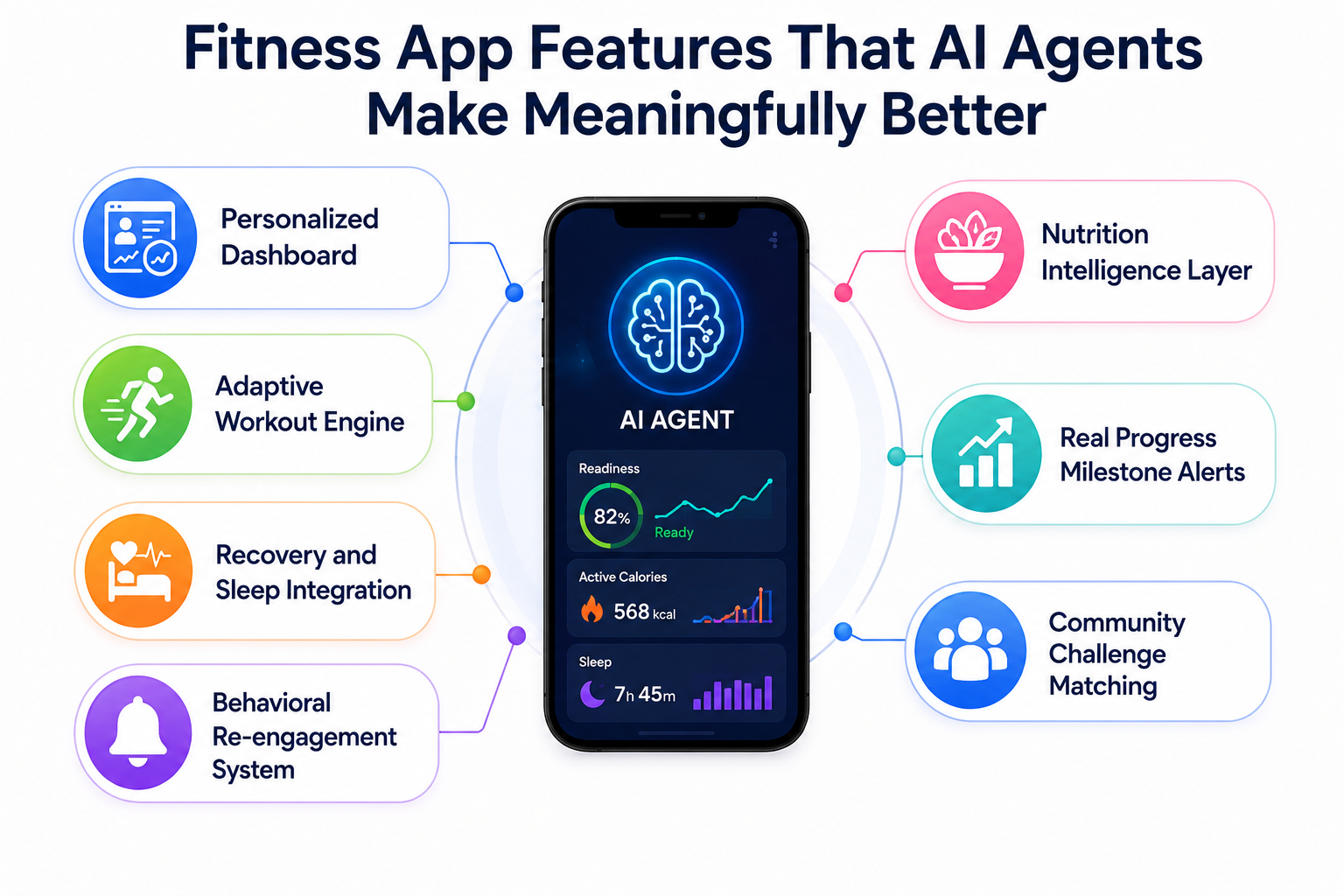
These are the specific features where having an AI agent under the hood creates a noticeable difference in the user experience:
- Personalized dashboard - surfaces what's relevant to this user today, not a fixed template of every metric the app can track
- Adaptive workout engine - adjusts intensity, volume, exercise selection, and rest periods based on actual performance and recovery data
- Recovery and sleep integration - feeds directly into next-day plan adjustments so users aren't training hard on days their body isn't ready
- Behavioral re-engagement system - detects early drop-off signals and triggers the right message at the right moment
- Nutrition intelligence layer - connects food intake to energy forecasts, training load, and goal timelines
- Real progress milestone alerts - based on actual trajectory, not a countdown timer
- Community challenge matching - pairs users with others at a similar fitness level and goal stage, increasing completion rates
For teams building a health monitoring app alongside a fitness platform, these features can also connect into chronic condition management where the stakes for getting personalization right are considerably higher.
Who Uses AI-Powered Fitness Apps Beyond Individual Consumers
AI agents in fitness apps aren't only for consumer wellness products. The same architecture applies across several sectors that are actively investing in this space right now.
- Gym chains and fitness studios use AI agents to extend their service beyond in-person sessions member retention analytics, virtual coaching between visits, and automated check-ins that flag when a member is drifting.
- Corporate wellness programs use them to run company-wide fitness challenges, track aggregate health metrics for insurance negotiations, and deliver personalized recommendations to employees without a human coach in the loop.
- Telehealth and remote care providers are building AI-monitored physical rehabilitation programs where the agent tracks adherence and flags deviations from prescribed protocols in real time.
- Sports performance teams at the semi-professional and professional level use AI agents for athlete load management ensuring training volume stays within safe ranges and recovery periods are correctly calibrated across a season.
Three Real Challenges to Plan For Before You Build
Understanding what's possible is one part of the picture. Understanding what can go wrong is equally important.
- Data privacy and compliance requirements are more complex than most teams expect. Fitness apps collect biometric data, sleep patterns, heart rate trends, and in some cases health history. Depending on where your users are located and how data is stored, that can trigger HIPAA requirements in the US, GDPR obligations in Europe, or both. Building compliant infrastructure from day one costs less than retrofitting it later.
- AI features need to actually behave like AI. Users have encountered enough "smart" apps that aren't to be skeptical. If your app labels a rule-based calorie calculator as an AI recommendation engine, users will figure that out quickly and trust, once broken, is hard to rebuild. The expectation is that the system learns and adapts. If it doesn't, the label works against you.
- Wearable fragmentation is a real development challenge. Apple Watch, Garmin, Fitbit, WHOOP, Samsung Galaxy Watch, and Oura Ring all have different APIs, different data structures, and different permission models. Building for all of them simultaneously adds significant time to your timeline. Planning which integrations to prioritize in version one versus what comes later is a conversation worth having early.
How to Plan Your AI Fitness App Development
If you're moving from "interested" to "actually building this," here's how to approach the planning phase:
- Start with one specific user problem. Weight loss, athletic performance, habit building, and rehabilitation all require different agent behaviors. Pick one to build around first and do it well.
- Define your data inputs upfront. Manual logs, wearable integrations, camera-based tracking, or a combination? Each option has different technical requirements, privacy implications, and development timelines.
- Map the agent's decision logic before writing code. What should the app do when a user skips three consecutive sessions? When HRV drops below their baseline for four days? When they've hit a performance plateau? The decisions need to be designed before they can be built.
- Build for privacy from the first line of code. Encrypted storage, role-based access control, and data minimization policies aren't features you add in version two. They need to be part of the foundation.
- Work with a team that has both AI expertise and fitness domain experience. General mobile app development teams can build the interface. But the behavioral logic, biometric data handling, and wearable integrations require people who have done this before in this specific domain.
Nyusoft's fitness app development work covers all of this from the initial product architecture through wearable integrations, AI model integration, and post-launch performance optimization.
The Opportunity Is Real - But So Is the Window
The fitness app market isn't waiting. Grand View Research sees it growing past $33 billion by 2033. Future Market Insights puts the hyper-personalized fitness segment at $31 billion by 2036. The apps that will capture that growth aren't the ones with the most features, they're the ones where users feel like the app actually knows them.
AI agents make that possible. Not as a marketing claim, but as something users experience on day one and every session after.
If you're building a fitness platform and want to get the AI architecture right from the start, Nyusoft has built exactly this AI agent, wearable integrations, adaptive training logic, and health app infrastructure for clients in the US market and beyond. Their team works with founders and product leads at every stage, from early scoping through to a shipped product.
Schedule a free consultation with Nyusoft
FAQs
Q1. What is an AI agent in a fitness app?
An AI agent is a system that perceives user behaviour and biometric data, makes decisions based on what it observes, and takes action automatically without needing manual input each time. Unlike a basic feature that responds once, an AI agent monitors, decides, and acts continuously in the background.
Q2. What is the difference between a basic AI feature and an AI agent in a fitness app?
A basic AI feature makes a suggestion once like a fixed calorie target at onboarding. An AI agent continuously monitors real data and adapts adjusting calorie guidance based on what you burned, how you slept, and what you're doing tomorrow. The key difference is autonomy: one reacts, the other anticipates.
Q3. Why are most fitness apps not truly personalised despite claiming to be?
Most apps ask a few onboarding questions and generate a static plan that never changes unless you manually update it. It doesn't know you slept badly, that you've skipped sessions, or that you're heading toward burnout. That's a template with your name on it not real personalisation.
Q4. How do AI agents help reduce churn in fitness apps?
AI agents watch for specific behavioural signals that precede churn sessions getting shorter, consistent workout days being skipped, app opens slowing down. When these signals appear together, the agent triggers a personalized re-engagement nudge timed to that user's situation, not a generic push notification sent to everyone.
Q5. What is predictive recovery in an AI fitness app and why does it matter?
Predictive recovery uses biometric data HRV, resting heart rate, and sleep duration to tell users whether their body is ready for a hard session or needs rest. When users trust that the app is making decisions based on real data, they keep opening it even on rest days, which directly improves long-term retention.
Q6. How do AI agents make workout planning different from traditional fitness apps?
Traditional apps build a plan at sign-up and leave it unchanged. An AI agent continuously reads performance trends if a user is consistently hitting high intensity, it increases the challenge; if sessions are being missed, it resets to a lower baseline. It behaves the way a personal trainer would after watching someone train for a month.
Q7. What are goal-based progress milestones and why do they work better than badges?
Goal-based milestones are triggered by real tracked data like "your average pace improved 12% over 6 weeks" rather than arbitrary calendar events or generic rewards. Because they're tied to actual performance, users feel genuine progress, which builds habit, extends subscriptions, and drives word-of-mouth.
Q8. Who uses AI-powered fitness apps beyond individual consumers?
Gym chains use them for member retention analytics and virtual coaching between visits. Corporate wellness programmes use them to run company-wide challenges and deliver personalised recommendations without a human coach. Telehealth providers use them for remote rehabilitation monitoring. Sports performance teams use AI agents to manage athlete training load across a season.
Q9. What is the data flywheel effect in AI fitness apps?
The longer users stay, the more behavioural data the AI collects and the smarter the personalisation becomes, both for that user and for new users with similar patterns. This creates a compounding advantage that competitors can't quickly replicate, making the app harder to leave and more difficult to copy.
Q10. What are the three biggest challenges to plan for before building an AI fitness app?
First, data privacy biometric data can trigger HIPAA and GDPR obligations depending on your market. Second, AI authenticity users notice quickly if a rule-based calculator is labelled as AI, and broken trust is hard to recover. Third, wearable fragmentation Apple Watch, Garmin, WHOOP, and Fitbit all have different APIs and need to be prioritised carefully in version one.