


 Front End Development
  Back End Development
  CMS / ECommerce Development
  Mobile Apps Development
  Cloud Services
  Fullstack Services
  Solution


What Is Jev AI? A Complete Guide to TypeSafe’s System One Model
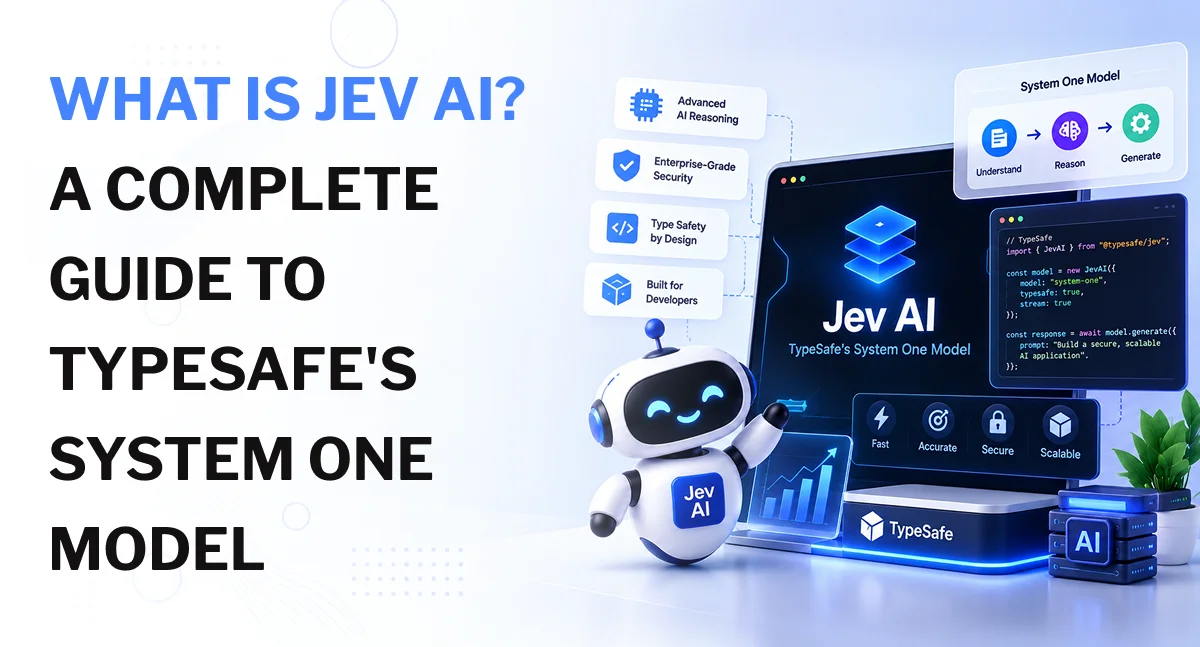
Jev AI is TypeSafe's first public System One Model, designed to make fast, structured decisions that software can use directly. Instead of generating paragraphs of text like a conventional large language model, Jev takes an input state and returns typed decisions with probabilities and confidence information. It is aimed at tasks such as classification, routing, scoring, verification and other repeated decisions inside software systems. TypeSafe introduced Jev in September 2026 and released it through early access.
That distinction is the easiest way to understand Jev. It is not intended to be another chatbot. The idea is to use a model for the many smaller decisions that sit inside an application, while leaving open-ended generation to models built for that purpose.
TypeSafe's launch material describes Jev as a model built around a different architecture, parallel sampling and a training approach called Reinforcement Learning for Calibrated Decisions, or RLCD. The company reports end-to-end response times of 70 to 500 milliseconds for Jev and describes it as a software-oriented decision model rather than a text-generation system.
What Is Jev AI?
Jev AI is a decision-oriented AI model developed by TypeSafe. Its job is to evaluate information and return a defined result that another piece of software can act on.
Consider a customer-support application. The application may receive this message:
"My payment went through twice and I need one of the charges reversed."
A generative AI system could write a response to the customer. A decision model could answer a different question:
Which department should handle this request?
The possible answers might be:
- Billing
- Technical support
- Sales
- Other
Jev is designed for the second type of problem. The application defines the decision space, sends the relevant state to the model, and receives a structured result.
That makes Jev particularly interesting for software developers. The output is intended to fit directly into application logic instead of requiring a developer to interpret a paragraph of generated text.
The model is currently in early access, so it is better viewed as an emerging approach that developers should evaluate against their own workloads rather than as a universal replacement for existing AI models.
What Is a System One Model?
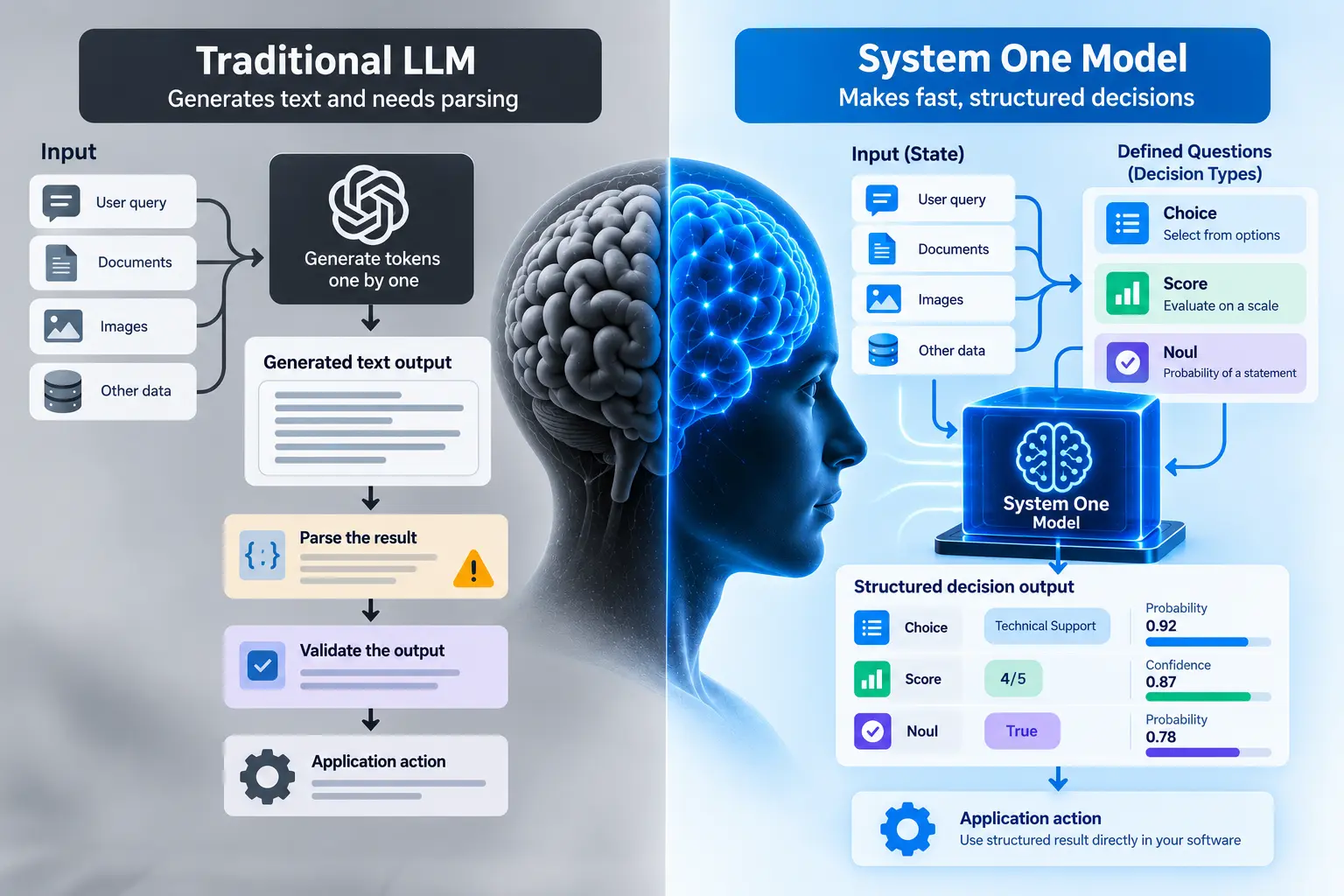
The term System One Model is TypeSafe's name for a model class focused on fast, repeated decisions.
The name draws inspiration from the distinction between System 1 and System 2 thinking described by psychologist Daniel Kahneman. TypeSafe uses the concept to describe the difference between fast, intuitive decisions and slower, deliberate reasoning.
The important point is not the psychology itself. It is how that idea is applied to software.
Many applications make decisions constantly:
- Is this request relevant?
- Which category does this document belong to?
- Should this ticket go to a human?
- Does this answer meet the quality threshold?
- Is this claim supported by the supplied information?
- Which workflow should run next?
These decisions are often small, but an application may need to make them thousands or millions of times.
A conventional LLM can perform many of these tasks, but it is primarily designed around generating language. Jev is designed around the decision itself.
How System One differs from a traditional LLM
A useful way to think about the distinction is:
Traditional LLM
Input → generate tokens → produce text → parse the result → validate it → application action
Jev
Input state → evaluate defined decision → return typed result → application action
That difference affects the architecture around the model.
TypeSafe describes conventional LLM output as strings that need to be parsed and validated before software can safely consume them. Jev instead defines the possible output structure in advance.
How Does Jev AI Work?
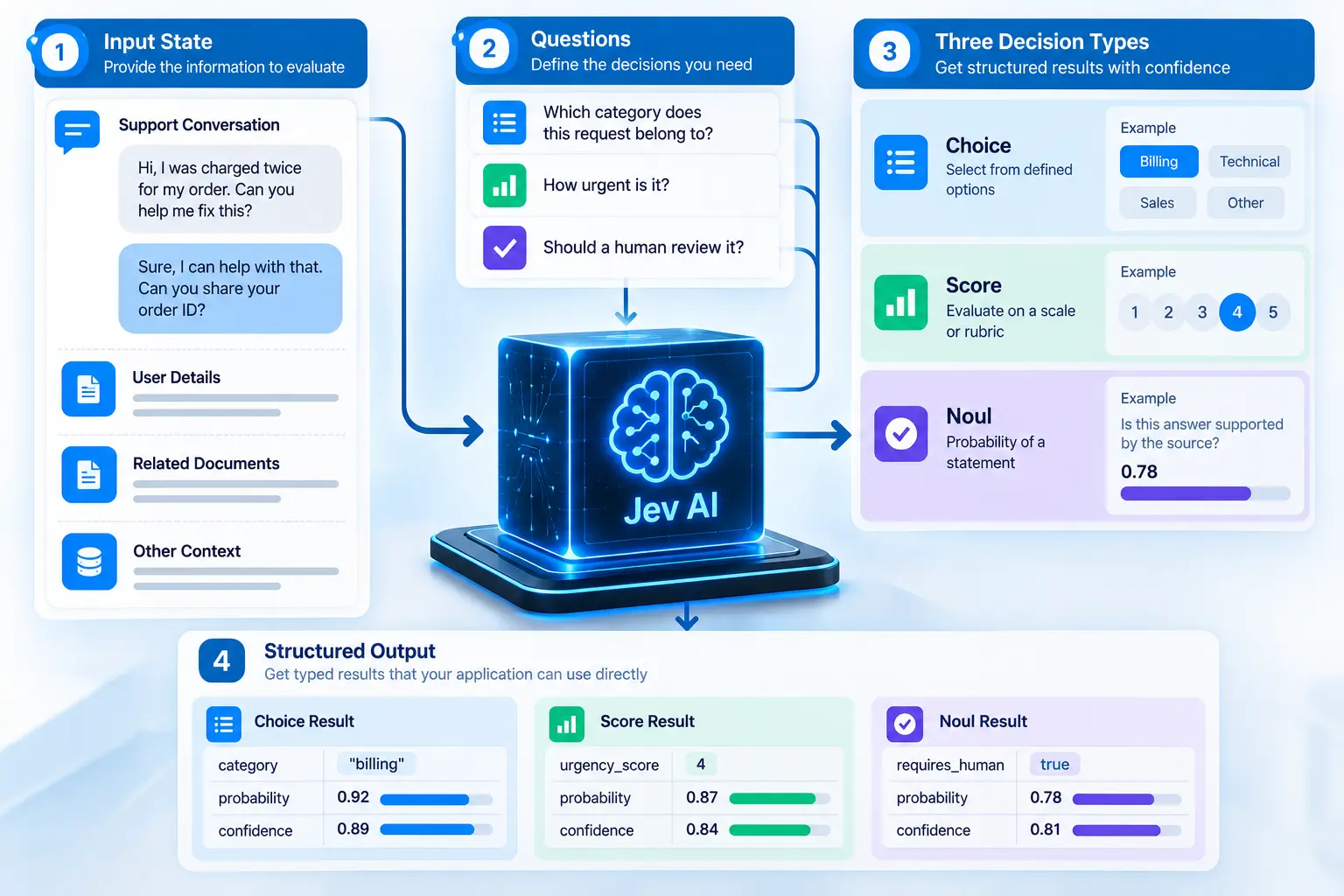
At a basic level, Jev works with two important pieces of information: state and questions.
The state contains the information the model should evaluate. The questions describe the decisions the application wants Jev to make.
For example, an application could provide a support conversation as state and ask:
- Which category does this request belong to?
- How urgent is it?
- Should a human review it?
The application does not need Jev to write a paragraph explaining the answer. It needs defined values that its code can use.
This is why Jev's output model matters as much as the underlying intelligence.
Jev's three main decision types
Jev's current approach can be understood through three basic decision primitives: Choice, Score and Noul.
Choice
Choice is used when the model needs to select from a defined set of options.
For example:
Which type of request is this?
Possible values:
billing, technical, sales, other
The result includes the selected option along with probability and confidence information.
This makes Choice useful for classification, routing and branching workflows.
Score
Score is used when something needs to be evaluated against an ordered scale or rubric.
For example:
Rate this support response from 1 to 5 for factual accuracy.
The application can define what each score means, then use Jev to evaluate the input.
This can be useful for quality checks, content evaluation and AI-output assessment.
Noul
Noul is used when the application wants a probability that a proposition is true.
For example:
Is this answer supported by the supplied source?
The result can be represented as a probability between 0 and 1.
That type of output can be useful when an application needs more than a simple yes/no response. A developer can establish a threshold and decide what should happen when confidence is high, moderate or low.
The three primitives can also be combined. A workflow might classify a request, score it and then perform an additional verification check before deciding what happens next.
What Makes Jev AI Different From a Large Language Model?
The difference is less about the amount of intelligence and more about what the model is built to produce.
A traditional LLM is optimized for generating sequences of tokens. That flexibility is what makes it useful for writing, coding, conversation and many other open-ended tasks.
Jev gives up free-form text generation and focuses on structured decisions.
That creates several practical differences.
The output is defined in advance
With a conventional LLM, a developer might ask for JSON and provide a schema. The model still generates the response as text, after which the application has to parse and validate it.
Jev's decision space is part of the model's intended interface.
This does not mean Jev cannot make a wrong decision. It means the model's output can stay within the defined structure.
That distinction is important.
Type-safe does not mean factually correct.
A model can return a perfectly valid value such as billing when the correct answer was actually technical. The output has the right type, but the decision can still be wrong.
Jev uses parallel sampling
Traditional autoregressive language models generate tokens sequentially. Each generated token becomes part of the context for the next one.
TypeSafe describes Jev as using parallel sampling for its decision outputs. Instead of generating a response token by token, it evaluates the predefined decision space in parallel.
For a bounded classification problem, that difference can reduce unnecessary generation.
Jev returns probabilities and confidence
Jev's results are designed to include probability and confidence information.
That matters when software needs to decide what to do with uncertainty.
A simple application might use logic such as:
- High confidence → proceed automatically
- Medium confidence → use a conservative workflow
- Low confidence → request human review or use another model
The exact thresholds should be determined through testing. A confidence score should not be treated as a guarantee of correctness.
Why Does Type Safety Matter for AI Applications?
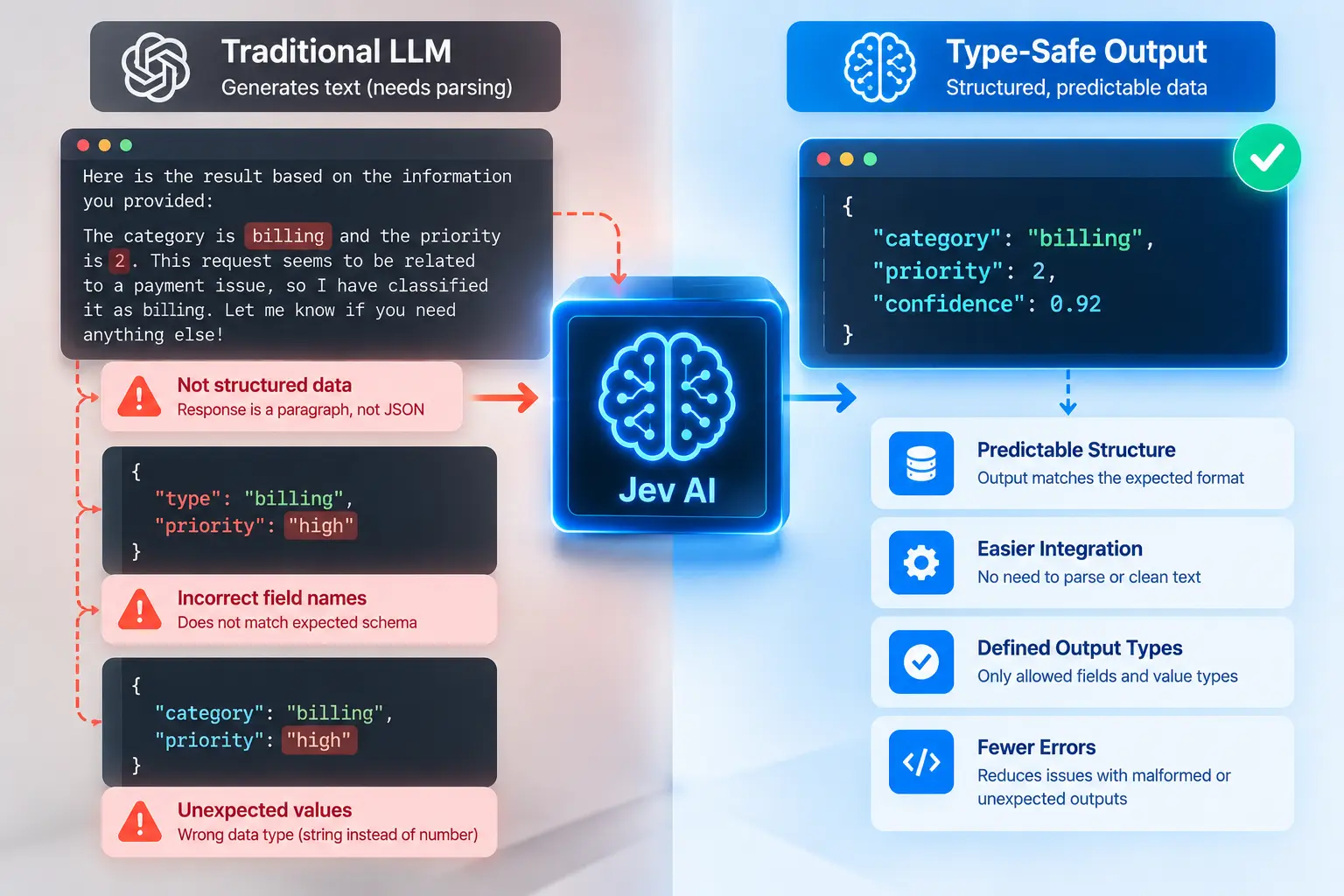
AI-generated text is flexible, but software usually needs predictable data.
Suppose an application expects:
{

"category": "billing",

"priority": 2

}
If a language model returns a paragraph around that data, changes the field name, uses an unexpected value, or produces malformed JSON, the application has another problem to solve before it can use the response.
Jev takes a different approach. Its output structure is defined before inference.
This can remove a particular class of integration problem: the application does not have to treat arbitrary generated text as if it were a reliable data structure.
There is still a separate problem to solve: decision accuracy.
A correctly typed answer can still be incorrect. That is why evaluation, thresholds, monitoring and fallback paths remain important even when the output itself is structurally safe.
This is also why claims around Jev's "zero hallucinations" language need to be understood carefully. The architectural guarantee concerns the model's predefined output space. It should not be interpreted as a guarantee that every semantic judgment is correct.
What Do Jev AI's Confidence Scores Tell You?
Confidence is particularly relevant when an AI decision triggers an automated action.
Imagine a document-classification system that has to decide whether an uploaded file is an invoice.
A binary result tells the application only:
Invoice: Yes
A probability gives it more information:
Invoice: Yes, probability 0.94
The application can then decide whether 0.94 is sufficient for automatic processing.
The value of this approach depends on calibration. If a model consistently says it is 90% confident but is correct only 65% of the time, that number is not useful as an operational threshold.
An independent 2026 evaluation tested Jev across 37 datasets and 346,009 requests. The study reported strong performance on several classification and reasoning datasets and found that Jev's choice probabilities were well calibrated for selective prediction. It also found degradation across low-resource languages, fine-grained or noisy labels, and rubric-based quality judgments.
That combination of findings is more useful than simply saying that Jev is accurate. It shows where the approach worked well and where developers should test carefully.
How Fast and Affordable Is Jev AI?
Performance and pricing are part of Jev's appeal, especially for applications that make large numbers of small decisions.
The current Jev site lists:
- 70 to 500 ms end-to-end latency
- $0.084 per million input tokens
- Free output tokens
- Type-safe structured outputs
These are current figures published by the product site, so developers should check the pricing and performance information before making infrastructure decisions.
TypeSafe's original launch announcement listed a lower launch-context input figure of $0.042 per million tokens and reported 70 to 500 ms end-to-end response times. The company later published a workflow comparison showing 193.6x faster and 444.6x cheaper results for its particular test setup.
Those benchmark figures need context.
The workflow tests were designed by people on TypeSafe's model capabilities team, and the LLMs in the comparison were constrained to produce structured decisions through TypeSafe's wrapper. TypeSafe itself notes that the reported gains could be toward the higher end of what developers see in real applications.
So the useful takeaway is not that every Jev deployment will automatically be hundreds of times cheaper. The more defensible point is that a model built specifically for structured decisions can have a very different cost and latency profile from a general-purpose text-generation model.
A separate article can examine the economics in much more detail.
What Can Jev AI Be Used For?
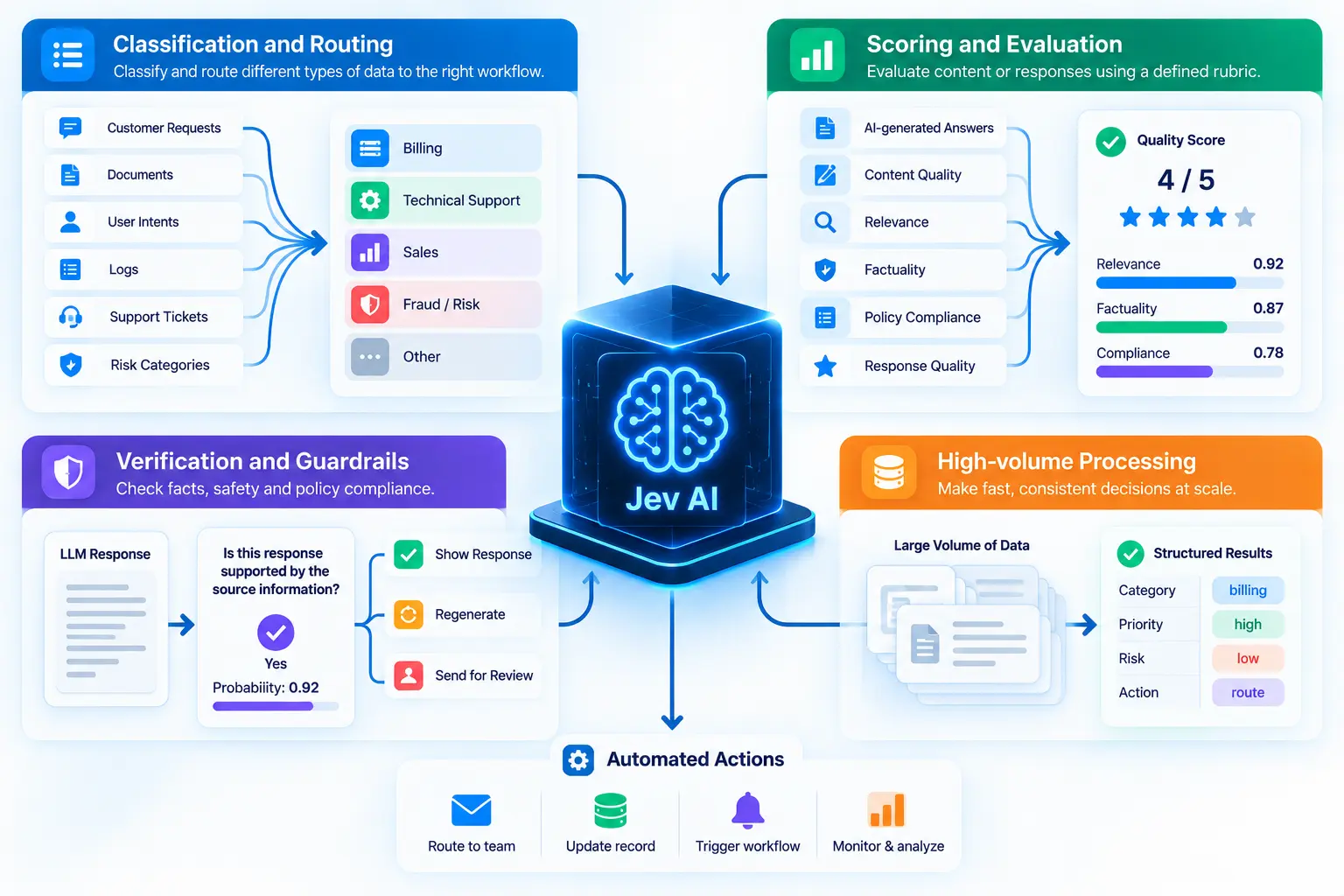
Jev makes the most sense when an application needs repeated decisions with a defined output.
Classification and routing
A system can use decision models to classify:
- customer requests
- documents
- user intents
- logs
- support tickets
- risk categories
The result can determine which workflow runs next.
Scoring and evaluation
A defined rubric can be used to score:
- AI-generated answers
- content quality
- relevance
- factuality
- policy compliance
- response quality
This is particularly interesting for applications that need to evaluate large volumes of AI-generated content.
Verification and guardrails
Jev can also be used around another AI model.
For example, an application could generate an answer with an LLM and then ask a decision model:
Is this response supported by the retrieved information?
The result can determine whether the response is shown, regenerated or sent for review.
High-volume processing
The economics become more interesting when a decision happens at high volume.
An application processing millions of records may not need a long generated explanation for every record. It may need a small number of structured values that become features, classifications or workflow instructions.
That is the kind of environment where a decision-oriented model is worth evaluating.
How Can Jev AI Fit Into an AI Application?
A simple architecture looks like this:
Application data → Jev → structured decision → application logic → action
For example:
- A user submits a request.
- The application collects the relevant state.
- Jev evaluates one or more predefined questions.
- The application receives the structured results.
- Software checks the decision and confidence.
- The appropriate workflow runs.
This approach does not require the application to remove traditional software logic. Jev can sit between unstructured information and deterministic code.
That is a useful distinction. AI does not have to replace application logic. It can supply a decision that application logic then uses.
For teams building applications that combine model inference with existing software systems, AI development services can cover areas such as model integration, application architecture, testing and deployment.
Can Jev AI Work Alongside an LLM?
Yes. In many applications, a hybrid approach makes more sense than choosing one model for everything.
An LLM can handle tasks such as:
- generating text
- writing code
- summarizing information
- handling open-ended conversations
- producing plans or explanations
Jev can handle tasks such as:
- routing
- classification
- scoring
- verification
- confidence-based branching
- evaluating another model's output
A workflow could therefore look like:
User request → LLM → Jev verification → application action
Or:
User request → Jev routing → appropriate LLM or workflow
This separation lets each model type handle the kind of work it was designed for.
It can also fit into systems that use agentic AI development patterns, where an agent needs to decide which tool, workflow or action should run next.
The important point is that Jev does not need to replace an LLM to be useful.
What Does the Jev AI API Look Like?
The API is designed around the same decision-oriented idea.
The current TypeSafe API exposes a System One endpoint where applications send state and questions and receive structured decisions. Model information can also be discovered through the API.
The TypeSafe System One API documentation is the right place to check the current request format, available model names and response structure.
For developers, the conceptual flow is straightforward:
State
↓
Question definitions
↓
Jev
↓
Typed decision + probability + confidence
↓
Application logic
The benefit is less about having another AI endpoint and more about having an AI interface designed around software decisions.
What Are the Limitations of Jev AI?
Jev's architecture makes it a poor fit for some tasks.
It does not replace free-form generation
If an application needs an article, a detailed email, a block of code or a conversational response, a generative model remains the more natural choice.
A valid output can still be wrong
Type safety solves output structure. It does not solve every accuracy problem.
A classification can be wrong even when the returned value is perfectly valid.
Decision definitions matter
The model can only work within the decision space the application gives it.
Poorly defined categories can create ambiguous results. A useful implementation therefore requires careful thought about what each option, score or proposition actually means.
Confidence needs testing
A confidence value should be evaluated against real outcomes.
Teams should measure whether high-confidence decisions are actually more accurate and determine where human review or another model should take over.
Early access changes the evaluation picture
Jev is still in early access. Production teams should test it on their own data, measure failure cases and compare it with the alternatives already available to them.
The independent evaluation mentioned earlier also shows why benchmark results should not be generalized blindly. Performance varied by task type, language resources and evaluation format.
Is Jev AI a Smaller LLM?
No. Describing Jev simply as a smaller LLM misses the main reason it exists.
Its intended output is different, its architecture is different, and its interface is built around structured decisions instead of unrestricted text generation.
That distinction also explains why Jev can be useful even when an application already uses a large language model.
A smaller version of an LLM would still primarily be a text-generation model. Jev is designed around a different problem: making bounded decisions that software can consume directly.
When Should Developers Consider Jev AI?
Jev is worth evaluating when an application has a decision that is:
- repeated frequently;
- clearly definable;
- suitable for a finite choice, score or proposition;
- sensitive to latency;
- likely to benefit from probability or confidence;
- consumed directly by application logic.
It may not be a good fit when the task requires:
- long-form generation;
- unrestricted conversation;
- code generation;
- open-ended exploration;
- complex derivation where the output itself must be a detailed reasoning artifact.
The best approach is to test the actual workload instead of deciding from the model's specifications alone.
How Should You Evaluate Jev AI Before Using It?
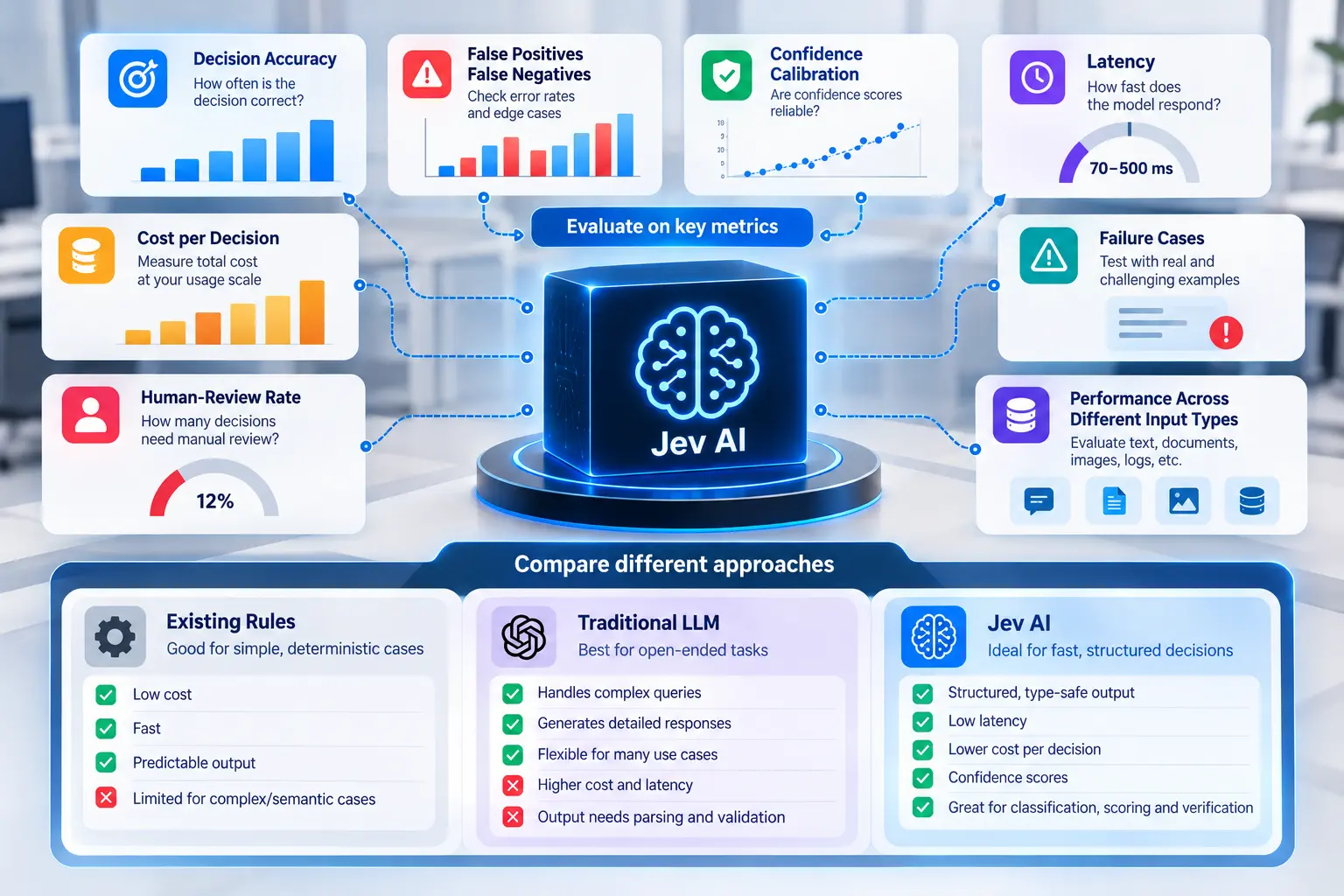
A useful evaluation should compare Jev against the system you would actually replace.
Start with a representative sample of your application's decisions. Then measure:
- decision accuracy;
- false positives and false negatives;
- confidence calibration;
- latency;
- cost per decision;
- human-review rate;
- failure cases;
- performance across different input types.
It is also useful to compare three approaches:
Existing rules → LLM → Jev
In some workflows, traditional rules will still be the best option. In others, an LLM may be necessary because the task is open-ended. Jev becomes interesting when the decision is too semantic for rigid rules but too small to justify a full generative call every time.
For applications that need custom predictive, classification or recommendation models rather than a decision model like Jev, machine learning development services may be a more appropriate path.
Where Jev AI Fits in an AI Application Stack
A practical AI system does not have to depend on one model.
A simplified architecture could look like this:
Generative AI
Creates text, code, summaries or other open-ended content.
Decision AI
Classifies, scores, routes and verifies information.
Traditional software
Applies deterministic rules, manages data and executes actions.
Each layer has a different job.
Jev is interesting because it occupies the middle layer. It can turn unstructured information into a structured decision without asking a general-purpose language model to generate a response that the application then has to interpret.
That does not make the decision model universally better. It makes it useful for a particular class of software problems.
Building AI Applications With the Right Model for the Task
The main lesson from Jev AI is fairly practical: the best AI model for an application depends on what the application needs the model to produce.
A generative model is a natural choice when the output needs to be language, code or another flexible form of content. A decision model can make more sense when the output is a bounded choice, score or probability that software will immediately use.
For companies evaluating this kind of architecture, Nyusoft works on AI application development where model selection, software logic, integrations and deployment all need to fit together. The right implementation may involve a generative model, a decision model, a machine learning system, or a combination of them.
Jev is still an early technology, so the sensible approach is to test it against real application requirements rather than treating it as a universal replacement for LLMs.
The more interesting question is not whether Jev will replace generative AI. It is whether AI applications will increasingly use different types of models for different jobs.
FAQs
1. What does Jev AI return after making a decision?
Jev AI returns a structured decision based on the question defined by the application. Depending on the decision type, the result can include a selected choice, score, probability, and confidence information that software can use in its next step.
2. What are Choice, Score, and Noul in Jev AI?
Choice, Score, and Noul are Jev's three main decision primitives. Choice selects from predefined options, Score evaluates something against an ordered scale, and Noul provides a probability for whether a proposition is true or false.
3. Can Jev AI be used to verify an LLM's response?
Yes. An application can use Jev to evaluate an answer generated by another AI model. For example, Jev could assess whether a response is supported by retrieved information and return a probability that the claim is valid. The application can then decide whether to show, regenerate, or review the response.
4. Does Jev AI eliminate AI hallucinations?
No. Jev's predefined output structure can prevent the model from returning arbitrary values outside the defined decision space, but it does not guarantee that the decision itself is factually correct. A model can return a valid choice while still making the wrong judgment.
5. How should developers test Jev AI before using it in production?
Developers should test Jev using representative data from the intended application and measure factors such as decision accuracy, false positives, false negatives, confidence calibration, latency, cost per decision, and human-review rates. Comparing Jev with the existing rules or model used for the same task can provide a more useful result than relying only on published benchmarks.
6. Can Jev AI replace traditional business rules?
Not generally. Traditional rules are still useful when a decision can be expressed deterministically. Jev is more relevant when the application needs a semantic judgment that is difficult to capture with fixed rules, such as classifying a customer request or evaluating whether an answer is supported by a source.
7. What kinds of applications can benefit from Jev AI?
Jev can be useful in applications that make frequent, defined decisions, including customer-support routing, document classification, content evaluation, AI-response verification, workflow selection, scoring, and confidence-based escalation. The strongest fit is usually a task with a clearly defined output space.
8. Does Jev AI require an application to stop using large language models?
No. Jev can work alongside an LLM. An LLM can handle tasks such as conversation, content generation, summarization, or code, while Jev handles classification, routing, scoring, verification, or other bounded decisions within the same application.
9. Is Jev AI suitable for open-ended tasks such as writing or coding?
Jev is not primarily designed for open-ended generation. Tasks such as writing articles, generating code, producing detailed explanations, or carrying on unrestricted conversations are generally better suited to generative AI models designed for those purposes.
10. Is Jev AI ready for production use?
Jev is described as an early-access technology, so production teams should evaluate it against their own workloads before adopting it. Testing should include real application data, failure cases, latency, cost, confidence calibration, and fallback or human-review processes rather than relying solely on vendor benchmarks.