


 Front End Development
  Back End Development
  CMS / ECommerce Development
  Mobile Apps Development
  Cloud Services
  Fullstack Services
  Solution


Jev AI vs ChatGPT: How Are They Actually Different?
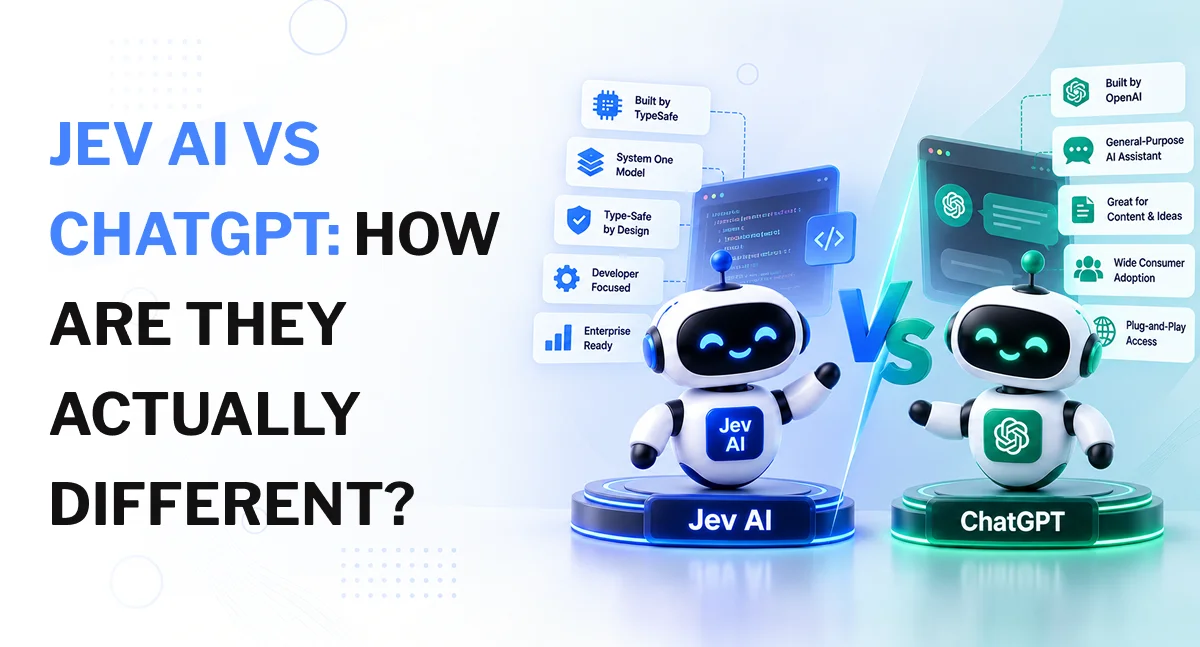
Jev AI and ChatGPT are built for different kinds of AI work. ChatGPT is a general-purpose conversational AI that can write, explain, code, analyze information, work with files, and handle open-ended requests. Jev is designed for a narrower job: giving software a structured decision, such as choosing an option, assigning a score, or estimating the probability of a yes/no answer.
That difference matters more than a simple question of which model is "better." If an application needs an AI to write something for a person, ChatGPT is a natural fit. If a program needs an AI judgment that can be passed directly into application logic, Jev is designed around that kind of task.
The short answer: Jev makes decisions, ChatGPT generates responses
The easiest way to understand the difference is to look at what the application needs back.
ChatGPT is built around conversation and generation. A user can ask it to explain a programming error, rewrite a paragraph, summarize a document, create code, brainstorm product ideas, or work through a complicated question. The answer can change in length and format depending on the request.
Jev starts from a different assumption. The software already knows what kind of decision it needs to make. Instead of asking for an open-ended response, a developer defines a focused judgment and the possible shape of the result.
developer defines a focused judgment and the possible shape of the result.
That could be:
- Which department should receive this support ticket?
- How relevant is this document to a particular request?
- Should this case be sent for human review?
- Which available tool should an AI agent use?
- How urgent is this customer message?
TypeSafe's documentation describes three decision types called Choice, Score and Noul. A Choice selects from defined options, a Score represents an ordered rating, and Noul represents the probability of a yes/no statement.
The important distinction is not that ChatGPT cannot make a decision. It can. The distinction is that Jev is designed so the decision itself becomes the output that software can use.
Jev AI and ChatGPT are built around different jobs
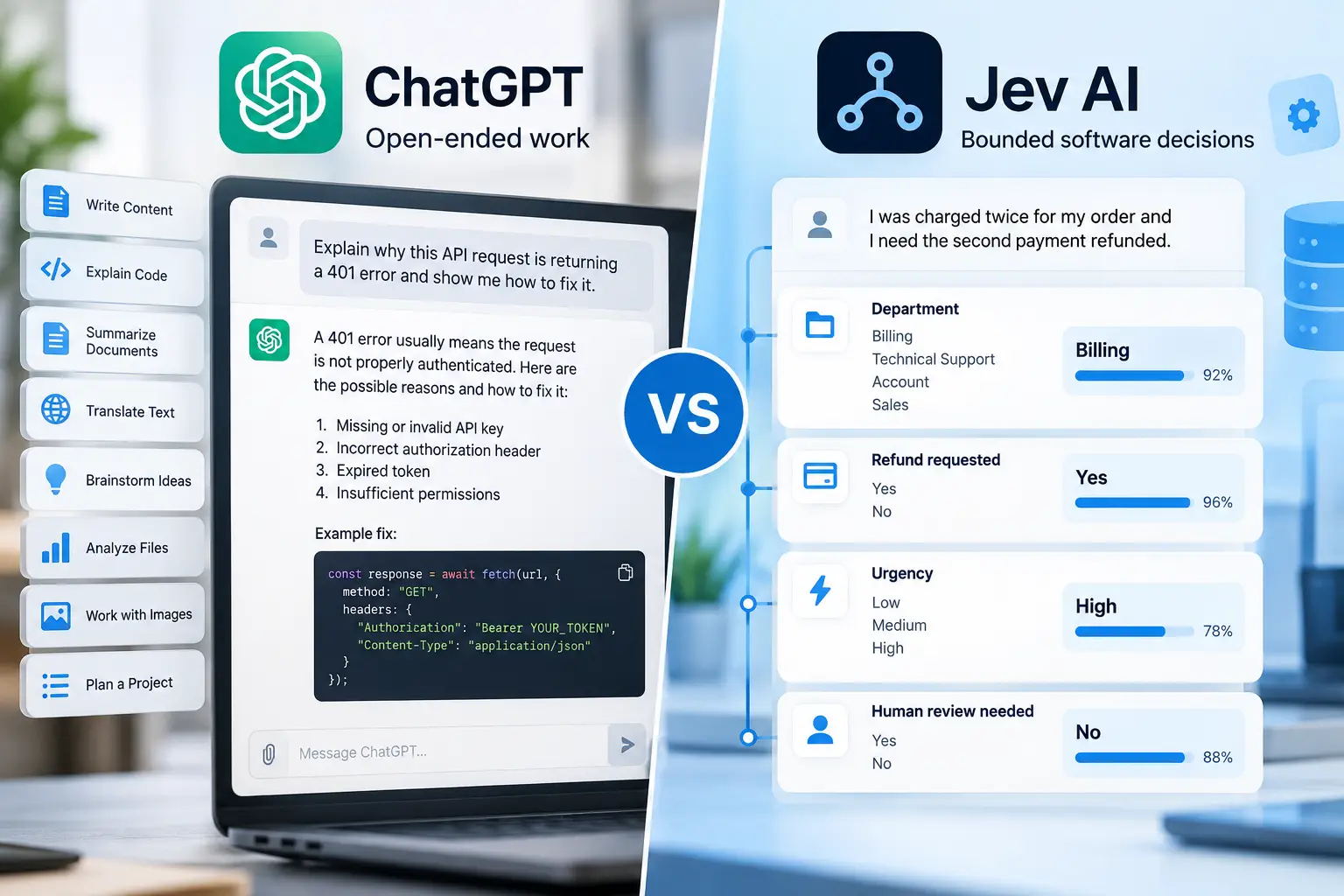
ChatGPT is suited to open-ended work
Suppose a developer asks:
"Explain why this API request is returning a 401 error and show me how to fix it."
There is no predefined list of acceptable answers. The system needs an explanation, possibly code, and enough context to help the developer understand the problem.
That is a good fit for ChatGPT.
The same applies to tasks such as:
- Writing or rewriting content
- Explaining technical concepts
- Summarizing documents
- Translating text
- Generating code
- Reviewing code
- Brainstorming ideas
- Planning a project
- Answering follow-up questions
- Analyzing uploaded files
- Working with images and data
OpenAI describes ChatGPT as a conversational assistant that can handle questions, writing, reasoning, translation, files, images, data analysis and other tasks depending on the tools and features available.
The common thread is flexibility. The developer or user does not always know exactly what the final response will look like before asking the question.
Jev is suited to bounded software decisions
Now consider a customer support system receiving this message:
"I was charged twice for my order and I need the second payment refunded."
The application might need several separate judgments:
- Department: billing or technical support?
- Refund requested: yes or no?
- Urgency: low, medium or high?
- Human review needed: yes or no?
The application can define those questions before the model sees the message.
That changes the design of the system. The model is no longer being asked to write a useful paragraph. It is being asked to answer a specific question in a form the application understands.
This is where Jev's approach becomes relevant.
The biggest technical difference is the output
A useful comparison starts with the result rather than the interface.
ChatGPT can produce natural language, code, explanations, summaries and other generated content. Its output can also be structured when a developer asks for a particular format, but the underlying task can still be open-ended.
Jev is designed around typed decisions.
For example, a program might define:
Question: Which department should handle this message?
Choices:
- Billing
- Technical Support
- Account
- Sales
The result can then be consumed by the application without asking another model to interpret a paragraph.
The same idea works for scoring.
A relevance task might define levels such as:
- Unrelated
- Tangential
- Useful
- Directly relevant
The application can use the resulting score to determine what happens next.
This distinction is easy to miss because a general language model can also be instructed to return JSON. But JSON formatting and decision-oriented model design are not the same thing.
A response such as:
{

"department": "billing"

}
has a structured shape. That does not automatically make the underlying judgment reliable or well-defined.
The quality of the decision still depends on the question, the available context, the definitions of the choices, and the model's performance.
Jev vs ChatGPT for AI agents and automation
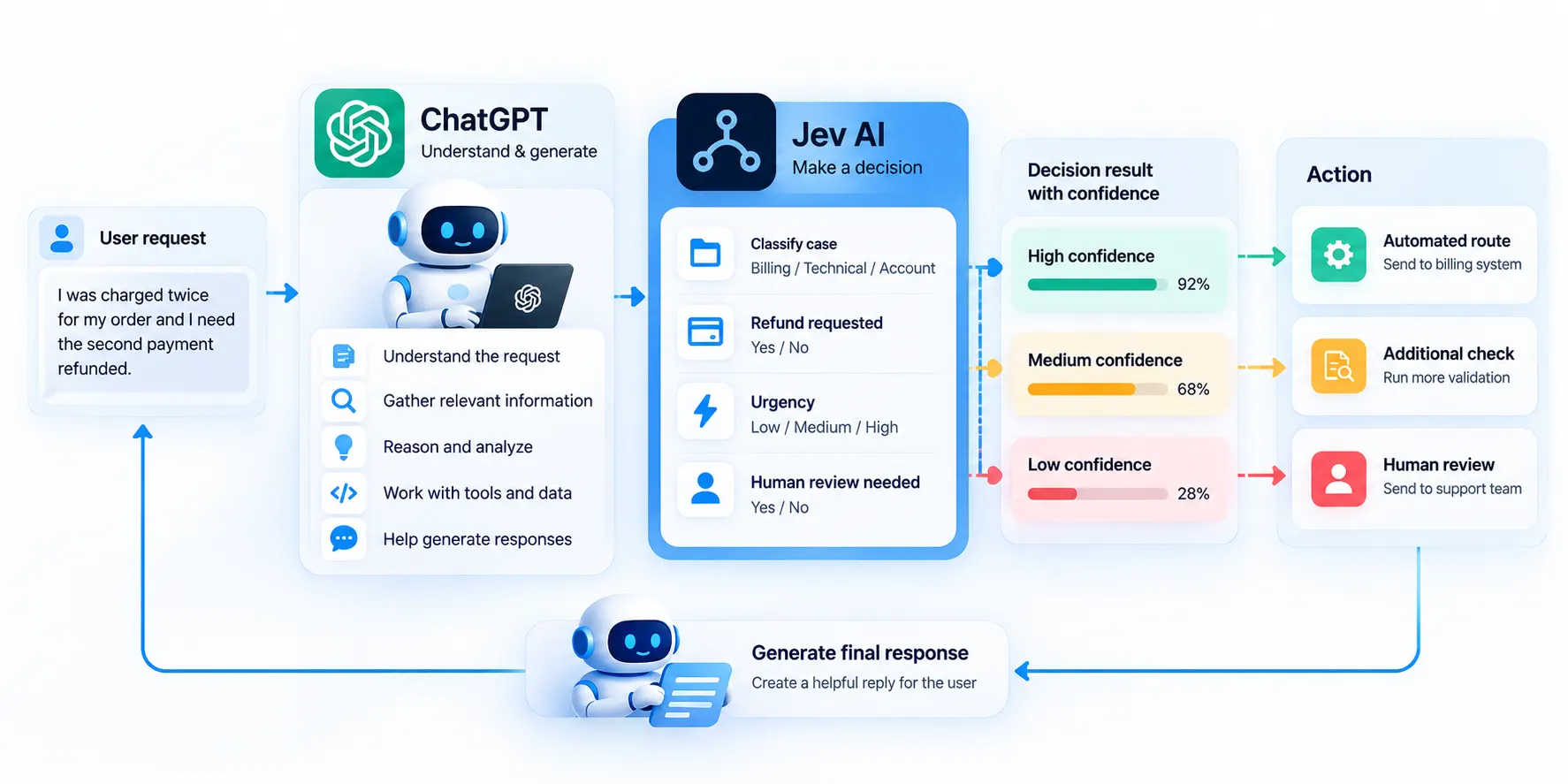
AI agents make this comparison more interesting because an agent usually needs several different capabilities.
An agent may need to:
- Understand a user's request.
- Gather information.
- Decide what to do next.
- Call a tool.
- Check the result.
- Continue, stop, or ask for human help.
- Produce a response.
A general-purpose model such as ChatGPT can handle many parts of this process, especially tasks involving language, reasoning, and generation.
Jev can fit at a specific decision point.
For example:
Customer message → understand request → classify case → choose route → execute action
The generative model could help interpret the conversation. Jev could handle a bounded routing decision. Application code could then send the case to the correct workflow.
That separation can make the system easier to reason about.
It also keeps ordinary software in charge of actions. A model can provide a judgment, while the application decides what that judgment actually permits.
For example:
Jev result → high confidence → automated route
Jev result → medium confidence → additional check
Jev result → low confidence → human review
The thresholds and actions can remain in code instead of being hidden inside a long prompt.
That does not mean every AI agent needs Jev. An agent that mainly writes reports, answers questions or reasons through complex instructions may get more value from a general-purpose model.
Jev AI vs ChatGPT: where each one fits best
The choice becomes easier when the task is stated precisely.
| Task | More natural fit | Reason |
| Writing an article | ChatGPT | The output is generated language |
| Explaining code | ChatGPT | The response needs explanation and examples |
| Summarizing a document | ChatGPT | The system needs to generate a summary |
| Brainstorming product ideas | ChatGPT | The answer space is open |
| Classifying support tickets | Jev | The possible categories can be defined |
| Routing a request | Jev | The application needs one of several choices |
| Scoring relevance | Jev | The result can use an ordered scale |
| Choosing between predefined tools | Jev | The application has a defined set of options |
| Deciding whether a case needs review | Jev | A yes/no judgment can control the next step |
| Exact arithmetic | Code | Deterministic computation is usually preferable |
| Permissions and access control | Application code | Rules should not depend on model judgment |
| Complex natural-language reasoning | ChatGPT or another reasoning model | The task may not have a small predefined answer space |
This also shows why the comparison should not end with a single winner.
There are tasks where ChatGPT is the obvious choice. There are tasks where a decision-focused model is worth evaluating. There are also tasks where neither should be responsible for the final answer.
If a company needs to check whether a user has permission to delete an account, for example, that should normally be determined by application rules and identity data. An AI model can help interpret a natural-language request, but it should not replace the underlying permission system.
Jev AI vs ChatGPT: where each one fits best

There is a reasonable architectural argument for using a decision-focused model for repeated, narrow decisions. If the application needs a small judgment thousands or millions of times, generating a full natural-language answer for every request may be unnecessary.
Cost and speed still depend on the actual implementation.
TypeSafe currently publishes a comparison showing 193.6× faster and 444.6× cheaper for particular System One workflows. Those figures come from TypeSafe's own evaluation and should be treated as vendor-reported results, not as a universal benchmark for every Jev and ChatGPT workload.
That distinction matters.
A workflow that asks an AI to classify a short support message is very different from one that asks it to read several documents, reason across them and produce a detailed report.
The better question is:
What work does the model actually need to perform?
If the application needs a written answer, using a decision model simply because it may cost less would solve the wrong problem.
If the application needs a small classification or routing decision at high volume, using a large generative model for every call may also be unnecessary.
The right comparison should use the application's own data, request volume, latency requirements and accuracy targets.
What ChatGPT can do that Jev cannot
Jev should not be treated as a replacement for a general-purpose conversational model.
Consider a request such as:
"Take these meeting notes and turn them into a clear project update for the client. Keep the tone professional and mention the three outstanding risks."
The system needs to create new language. It has to understand the notes, decide what matters, organize the information and produce a readable document.
That is fundamentally different from selecting one category from a fixed set.
ChatGPT is designed for this kind of interaction. It can work with text, files, images and other supported inputs, and it can produce or revise content based on instructions.
The same applies to:
- Long-form writing
- Conversation
- Creative work
- Code generation
- Code explanation
- Document summarization
- Translation
- Brainstorming
- Natural-language answers
- Multi-step discussions
A decision model does not become a general writing assistant simply because it can understand language.
That is an important boundary.
What Jev can do differently inside software
The useful question for a developer is often not "Can the model answer this?"
It is:
"Can my application use the answer directly?"
Suppose a SaaS product receives a large number of documents. The software needs to decide which documents are relevant enough to send to a human reviewer.
A conventional workflow might look like:
Document → general LLM → generated explanation → application parses explanation → action
A decision-oriented workflow can look more like:
Document → focused judgment → score/probability → application rule → action
The second approach can be easier to control when the decision has a clear definition.
There is another useful point here: uncertainty can become part of the workflow.
If a model gives the application a decision and an associated confidence or probability estimate, the software can use thresholds rather than treating every prediction as equally certain.
For example:
- High confidence: continue automatically
- Moderate confidence: run a second check
- Low confidence: send to a person
That still does not guarantee correctness.
A probability or confidence value is useful information about the model's judgment. It is not proof that the judgment is true.
The quality of the decision also depends on how clearly the choices or scoring levels are defined. TypeSafe's guidance specifically recommends defining the answer shape and making the boundaries between choices clear.
Where Jev and ChatGPT can work together
There is no technical rule saying a software system must choose one.
In fact, a combination can make more sense.
Consider an AI support agent.
A generative model could read the conversation and extract the relevant information. A decision model could then answer specific questions:
- What type of request is this?
- Which team should handle it?
- Does the case require escalation?
- How urgent is it?
The application's normal code can then apply business rules.
Finally, a generative model can write the response that the customer sees.
The architecture might look like this:
Conversation → generative model → structured context → Jev decision → application rules → action → generated response
Each component has a defined job.
This can be easier to maintain than asking one general-purpose model to interpret the request, choose an action, apply business rules and write the final response in one large prompt.
It also makes testing more focused. A team can evaluate the routing decision separately from the quality of the customer-facing message.
Common mistakes when comparing Jev AI with ChatGPT

Treating Jev as another chatbot
Jev's purpose is different. If the expected experience is a conversation with an AI assistant, a decision model is being evaluated against the wrong requirement.
Comparing them only by benchmark numbers
A benchmark does not tell you whether a model fits your application.
The important questions are about your workload, output requirements, latency, cost and acceptable error rate.
Assuming structured output means correct output
A neatly typed response can still be wrong.
JSON, schemas and typed decisions help software understand the result. They do not remove model uncertainty.
Using a decision model for open-ended generation
If the system needs a detailed explanation, article, email or code sample, the application needs generation.
A bounded decision model is not a shortcut around that requirement.
Using a general-purpose model for every small decision
The opposite mistake is just as common.
If a system repeatedly needs to classify, score or route short inputs, a general-purpose model may be doing more work than the application needs.
Treating vendor performance figures as universal
A published benchmark should be read in the context of the workload used to produce it.
Before changing architecture based on a speed or cost claim, run the comparison on representative production-style inputs.
Which should you choose: Jev AI or ChatGPT?
Start with the output your application needs.
Choose ChatGPT when:
- The output needs to be natural language.
- Users need to have a conversation with the system.
- The task is open-ended.
- You need writing or rewriting.
- You need code generation or explanation.
- The system needs broad language understanding.
- The response may take many different forms.
Evaluate Jev when:
- The application has a defined set of possible choices.
- You need classification or routing.
- You need an ordered score.
- You need a yes/no judgment with probability information.
- The same type of decision happens repeatedly.
- The result goes directly into application logic.
- You want uncertainty to affect whether the application acts automatically.
Use both when:
- A generative model handles conversation or content.
- Jev handles bounded decisions.
- Application code controls permissions, business rules and actions.
A simple rule is useful here:
If you need the AI to create something, ChatGPT is usually the better fit. If you need the AI to choose, classify, score or gate within a defined decision space, Jev is the more relevant model to evaluate.
There will be exceptions, but this rule gives a development team a sensible starting point.
What this difference means for software development teams
The bigger lesson is about choosing AI components based on the job they need to perform.
A single application can contain several AI tasks:
- A conversational interface
- Document processing
- Classification
- Search
- Recommendation
- Content generation
- Prediction
- Workflow routing
- Tool selection
There is no requirement for every one of those tasks to use the same model.
A development team can decide where a general language model adds value and where a more focused model, conventional machine learning system or ordinary application code is the better choice.
That is also why model selection should happen alongside application architecture. The question is not simply which model has the strongest general performance. It is whether the model's input, output and uncertainty fit the way the software needs to operate.
For teams building AI products, AI development services can cover different model types and application requirements rather than treating every AI feature as a chatbot.
Choosing the right AI model for your application
Jev AI and ChatGPT solve different problems.
ChatGPT is a broad conversational and generative system. It makes sense when people need explanations, content, code, analysis or an interactive assistant.
Jev is aimed at a more specific software problem: making defined judgments that an application can consume as typed decisions.
That distinction also explains why they can appear in the same application without competing for the exact same role.
A product might use an LLM to understand a user's request, a decision model to classify or route it, and ordinary code to enforce business rules. Another product may need only a conversational model. A third may not need an AI model for a particular task at all.
For companies building these kinds of systems, Nyusoft works across generative AI development, agentic AI development and machine learning applications. The appropriate approach depends on the product, data, workflow and type of decision the software needs to make.
The useful starting point is therefore simple: define the task first, define the output second, and choose the model that fits those requirements.
FAQs
1. Is Jev AI a replacement for ChatGPT?
No. Jev AI and ChatGPT are designed for different types of AI work. ChatGPT is suited to open-ended tasks such as writing, coding, analysis, and conversation, while Jev is designed for defined software decisions such as classification, scoring, routing, and yes/no judgments.
2. What is the main difference between Jev AI and ChatGPT?
The main difference is the type of output they are designed to produce. ChatGPT generates responses and other content, while Jev focuses on structured decisions that software can use directly.
3. Is Jev AI a chatbot like ChatGPT?
Jev is not primarily designed as a chatbot. Its focus is on making bounded decisions inside software workflows, rather than carrying on an open-ended conversation with a user.
4. Which is better for writing and content generation, Jev AI or ChatGPT?
ChatGPT is the more suitable choice for writing, rewriting, summarization, translation, brainstorming, and other tasks that require generated language. Jev is designed for defined decisions rather than long-form content generation.
5. Can Jev AI and ChatGPT be used together?
Yes. A software application can use a generative model to understand a conversation or create a response, while Jev handles specific decisions such as classification, routing, scoring, or escalation. Application code can then control the resulting action.
6. Which is better for AI agents, Jev AI or ChatGPT?
It depends on what the agent needs to do. ChatGPT can handle language, reasoning, tool use, and response generation, while Jev can be useful at specific decision points where an agent needs to choose from defined options or determine whether a condition is met.
7. Is Jev AI faster and cheaper than ChatGPT?
Jev may be more efficient for certain narrow, repeated decision tasks. TypeSafe publishes its own speed and cost comparisons, but those figures should not be treated as universal results. The practical difference depends on the workload, model configuration, request volume, latency requirements, and implementation.
8. Does structured output from Jev AI guarantee that the decision is correct?
No. A structured or typed result makes it easier for software to consume the model's output, but it does not guarantee that the underlying decision is correct. Model uncertainty and the quality of the input still need to be considered.
9. When should developers use Jev AI instead of a general-purpose AI model?
Jev is worth evaluating when an application repeatedly needs defined decisions such as classification, routing, scoring, tool selection, or yes/no judgments. If the application needs explanations, conversations, code, or other open-ended content, a general-purpose generative model may be a better fit.
10. How should a business decide between Jev AI and ChatGPT?
Start with the task rather than the model. Define what the AI needs to receive, what output the application needs, the acceptable error rate, latency requirements, cost, and how the result will be used. For open-ended generation, ChatGPT is generally the more natural fit; for bounded software decisions, Jev is the more relevant option to evaluate.