


 Front End Development
  Back End Development
  CMS / ECommerce Development
  Mobile Apps Development
  Cloud Services
  Fullstack Services
  Solution


How to Develop a P2P Payment App: Features, Cost & Development Process
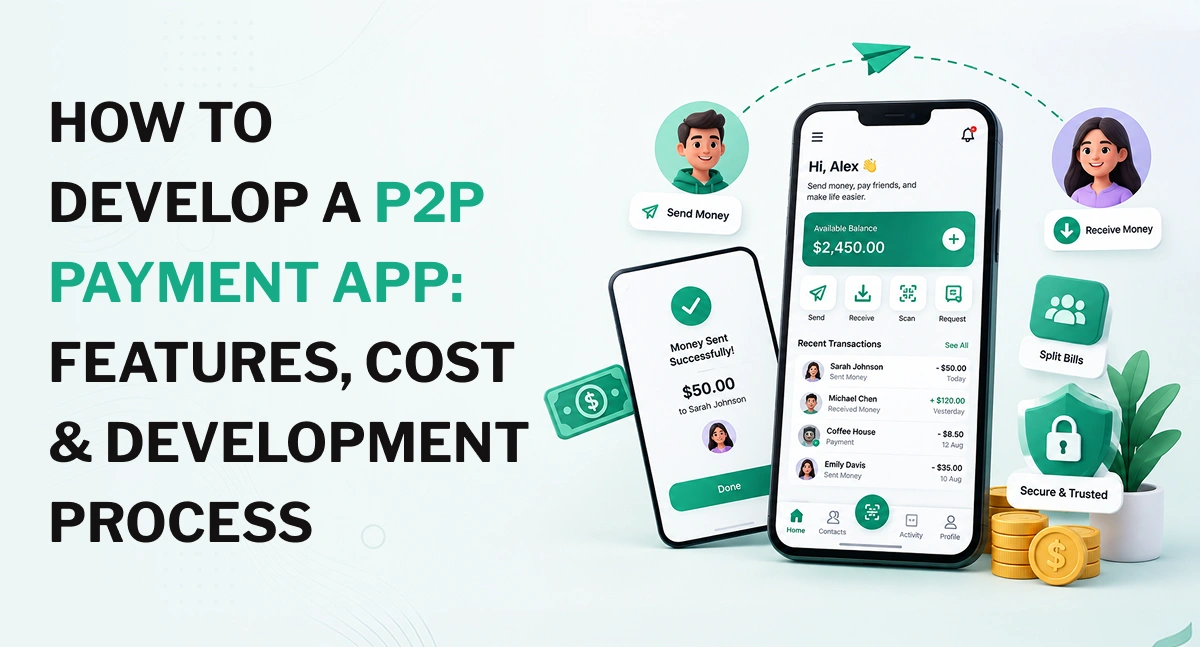
P2P payment app development can cost around $4,000 to $25,000+, depending on the payment model, features, integrations, security requirements, compliance scope, platforms, and countries served. A focused MVP may take around 3 to 5 months, while a more advanced multi-market payment platform can take 8 to 12 months or longer. The growth of digital payments also shows the scale of the opportunity.
Worldpay reported that digital payment spending across e-commerce and in-person shopping increased from $1.7 trillion in 2014 to $18.7 trillion in 2024, with its 2025 report projecting the figure to exceed $33.5 trillion by 2030. Worldpay's Global Payments Report provides further market context.
A P2P payment app allows people to send, receive, or request money digitally. Although the user interface can be simple, the technology behind it needs to handle authentication, identity verification, payment processing, transaction records, fraud prevention, reconciliation, notifications, disputes, and data protection.
There is also no single compliance framework for P2P payment apps worldwide. A product serving customers in the US may face different requirements from one operating in the UK, Canada, Australia, the European Union, or the UAE. The applicable rules depend on the business model, payment services offered, whether funds are held, the role of financial partners, and the markets served.
For that reason, development should start by defining how money moves, who the users are, which markets will be served, and which regulatory requirements apply.
What Is a P2P Payment App?
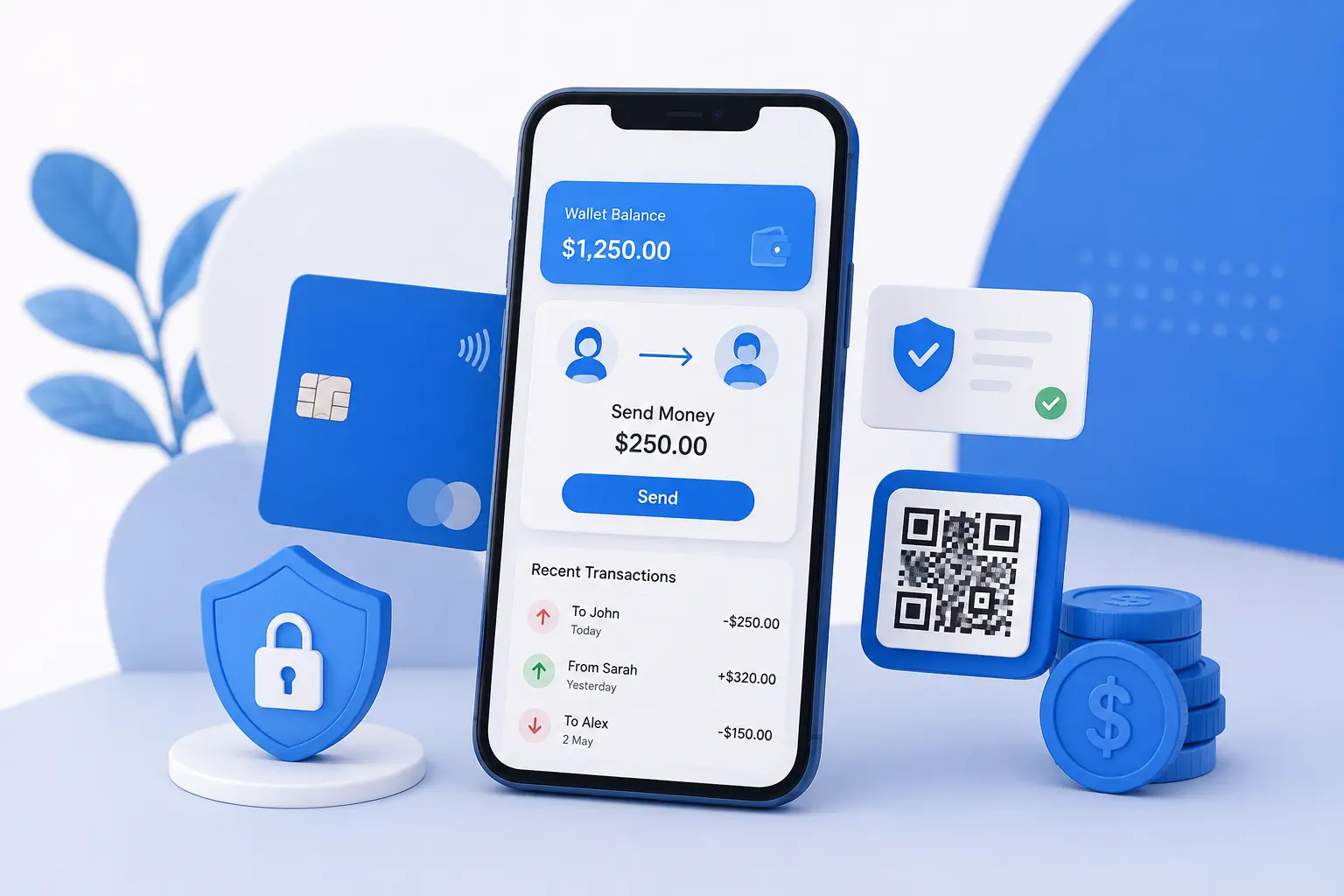
P2P means peer-to-peer. A P2P payment application lets one person transfer money electronically to another person.
The basic flow is:
Choose a recipient → enter the amount → review the payment → authenticate → send.
The underlying infrastructure can be much more involved.
Depending on the product, the app may connect with:
- Bank accounts
- Debit or credit cards
- Payment processors
- Digital wallets
- Open Banking providers
- Identity verification services
- Fraud detection platforms
- Financial data APIs
Some applications maintain user balances inside the platform. Others use external banks or payment providers to move funds. A product can also combine both models.
The chosen model affects the ledger, transaction processing, integrations, security controls, and compliance requirements.
For a broader financial product, FinTech app development can cover areas such as payment APIs, digital wallets, financial integrations, KYC, transaction monitoring, and fraud management.
How Does a P2P Payment App Work?
A typical transaction can follow these steps:
- The user logs in.
- The system verifies the account and session.
- The sender selects a recipient.
- The sender enters the amount and payment method.
- The app displays the transaction details.
- Additional authentication or risk checks are performed when necessary.
- The payment request is sent to the relevant provider.
- Fraud and other applicable compliance checks are performed.
- The provider returns a transaction status.
- The application records the transaction.
- The user receives a confirmation or pending status.
- The transaction is reconciled with the provider.
A payment submitted to a provider is not necessarily a completed payment. It can remain pending, fail later, be reversed, or require investigation.
A reliable payment application therefore needs clear transaction states and a reconciliation process.
How Much Does It Cost to Develop a P2P Payment App?
A practical development budget can be divided into three broad levels:
| App type | Estimated cost | Typical scope |
| Basic MVP | $4,000-$8,000 | Registration, verification, send/receive money, basic payment integration, history and admin |
| Mid-level app | $6,000-$15,000 | Wallet, multiple payment methods, QR payments, stronger security and analytics |
| Advanced platform | $15,000-$25,000+ | Multiple financial integrations, advanced fraud controls, multi-currency and complex compliance workflows |
These are planning ranges, not fixed industry prices.
The cost can vary significantly even between two apps with similar screens. A payment product with fewer screens can require more engineering if it has complex banking integrations, a wallet ledger, real-time transaction processing, fraud controls, or multi-country support.
What Affects P2P Payment App Development Cost?
The main factors include:
Payment integrations: Connecting banks, payment processors, card services, Open Banking providers, KYC platforms, and fraud systems adds development and testing work.
Security: MFA, encryption, secure APIs, access controls, fraud monitoring, penetration testing, and audit logging increase the technical scope.
Compliance: Requirements for identity verification, transaction monitoring, reporting, safeguarding, privacy, or licensing can affect both product design and infrastructure.
Platforms: Supporting iOS, Android, web, or all three changes the development scope.
Wallet functionality: Holding balances requires a reliable ledger and balance-management system.
Transaction complexity: Refunds, reversals, pending payments, disputes, chargebacks where applicable, and recurring transfers all add backend logic.
Geographic coverage: Each additional market can introduce different currencies, payment providers, regulatory requirements, and operational processes.
Admin tools: Operations teams need systems for reviewing users, transactions, KYC status, fraud alerts, and disputes.
The biggest budgeting mistake is estimating a financial application from its mobile screens alone. The backend and financial infrastructure often represent a substantial part of the work.
Have a P2P Payment App Idea?
Share your product concept, target market, required features, payment methods, and third-party integrations. Get a clearer understanding of the development scope, technical requirements, estimated timeline, and resources your project may need.
Get Your Project Estimate
Essential Features of a P2P Payment App
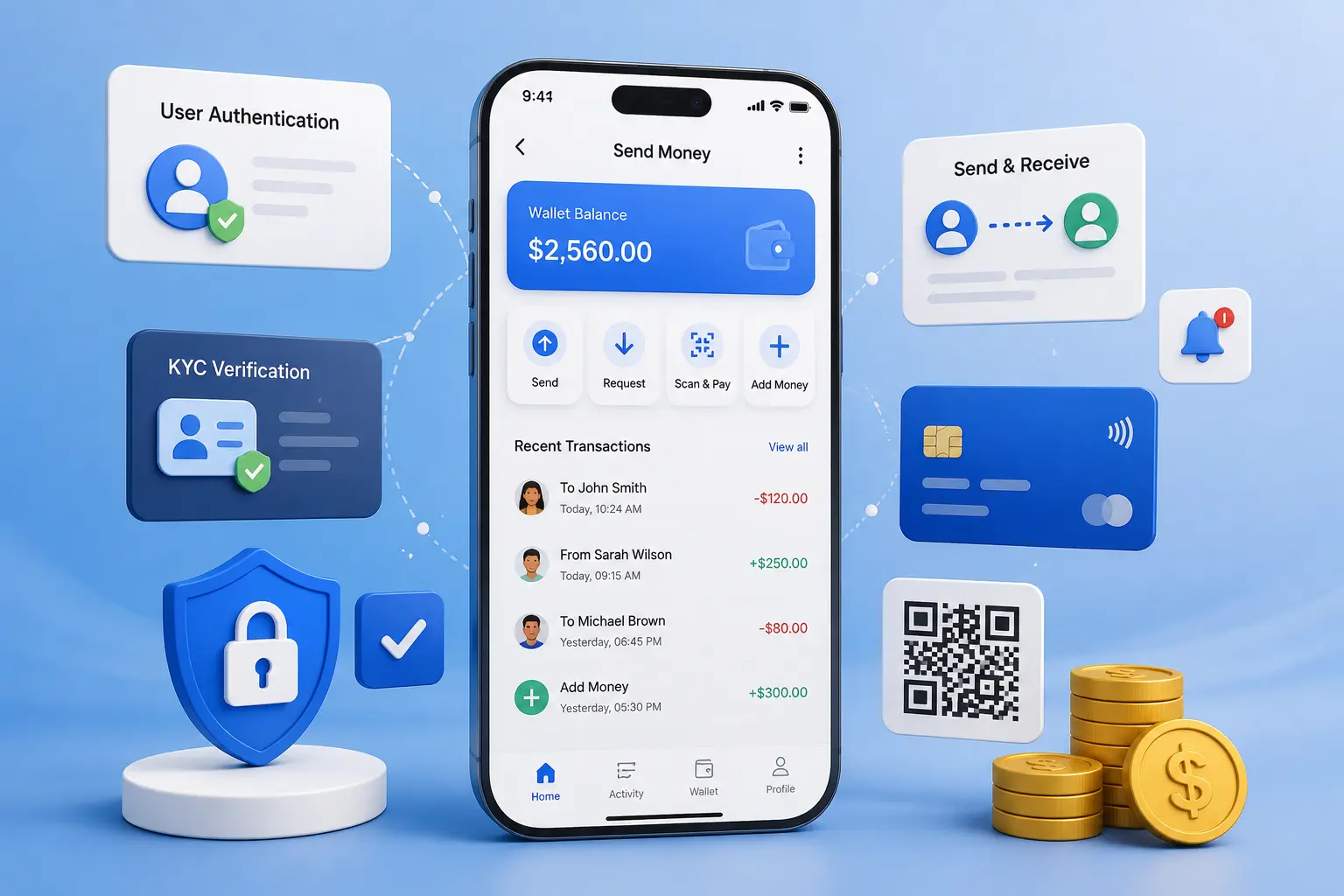
An MVP should focus on the functions required to complete and manage a payment safely.
User Registration and Authentication
Core functionality can include:
- Account registration
- Email or phone verification
- Secure login
- Multi-factor authentication
- Device verification
- Password or passcode management
- Account recovery
- Login activity
Authentication requirements can vary according to the action. A user viewing their transaction history may not need the same level of verification as someone changing a withdrawal account.
KYC and Identity Verification
Depending on the business model and jurisdiction, users may need to verify their identity.
Possible requirements include:
- Government-issued ID
- Document verification
- Date of birth
- Address information
- Selfie or liveness checks
- Identity status
- Manual review
- Sanctions screening where applicable
KYC can also affect transaction limits and access to specific features.
Send and Receive Money
The core payment flow should be simple.
Recipients can potentially be selected through:
- Phone number
- Username
- Contacts
- QR code
- Payment link
Before confirmation, the user should be able to see the recipient, amount, payment method, and applicable fee.
Request Money
Payment requests are useful for:
- Splitting bills
- Shared expenses
- Personal repayments
- Family payments
- Small-business transactions
The recipient should be able to review the request before authorising payment.
Digital Wallet
If the application maintains user balances, wallet functionality may include:
- Available balance
- Pending balance
- Add funds
- Send money
- Receive money
- Withdraw funds
- Transaction history
- Refunds
- Statements
A wallet should be supported by a proper ledger rather than simply changing a balance value.
Payment Method Integration
Depending on the target market, the app may support:
- Bank accounts
- Debit cards
- Credit cards
- Payment processors
- Open Banking connections
The selected payment method should be clearly displayed before the transaction is confirmed.
Transaction History
Users should be able to understand exactly what happened with each payment.
Useful information includes:
- Transaction ID
- Amount
- Sender
- Recipient
- Date and time
- Payment method
- Fee
- Status
- Reference
- Refund or reversal information
The system should distinguish between pending, completed, failed, cancelled, and reversed transactions.
Notifications
Notifications can cover:
- Payment received
- Payment sent
- Payment request
- Failed transaction
- Withdrawal
- New-device login
- Security alerts
- KYC status
Sensitive information should not be unnecessarily displayed in lock-screen notifications.
QR Payments
QR codes can make recipient selection faster.
The application should still display the recipient's identity before the payment is authorised to reduce mistakes.
Customer Support and Disputes
A payment app should provide a clear way to report:
- Unauthorised payments
- Failed transfers
- Missing funds
- Incorrect transactions
- Suspicious activity
- Account-access problems
A transaction-specific support workflow makes it easier to investigate a particular payment.
Build the Right Features for Your First Release
Not every payment feature needs to be included from day one. Discuss your idea with a development team to prioritise the right user flows, payment functionality, integrations, security controls, and administrative features for your initial product.
Advanced Features for a P2P Payment App
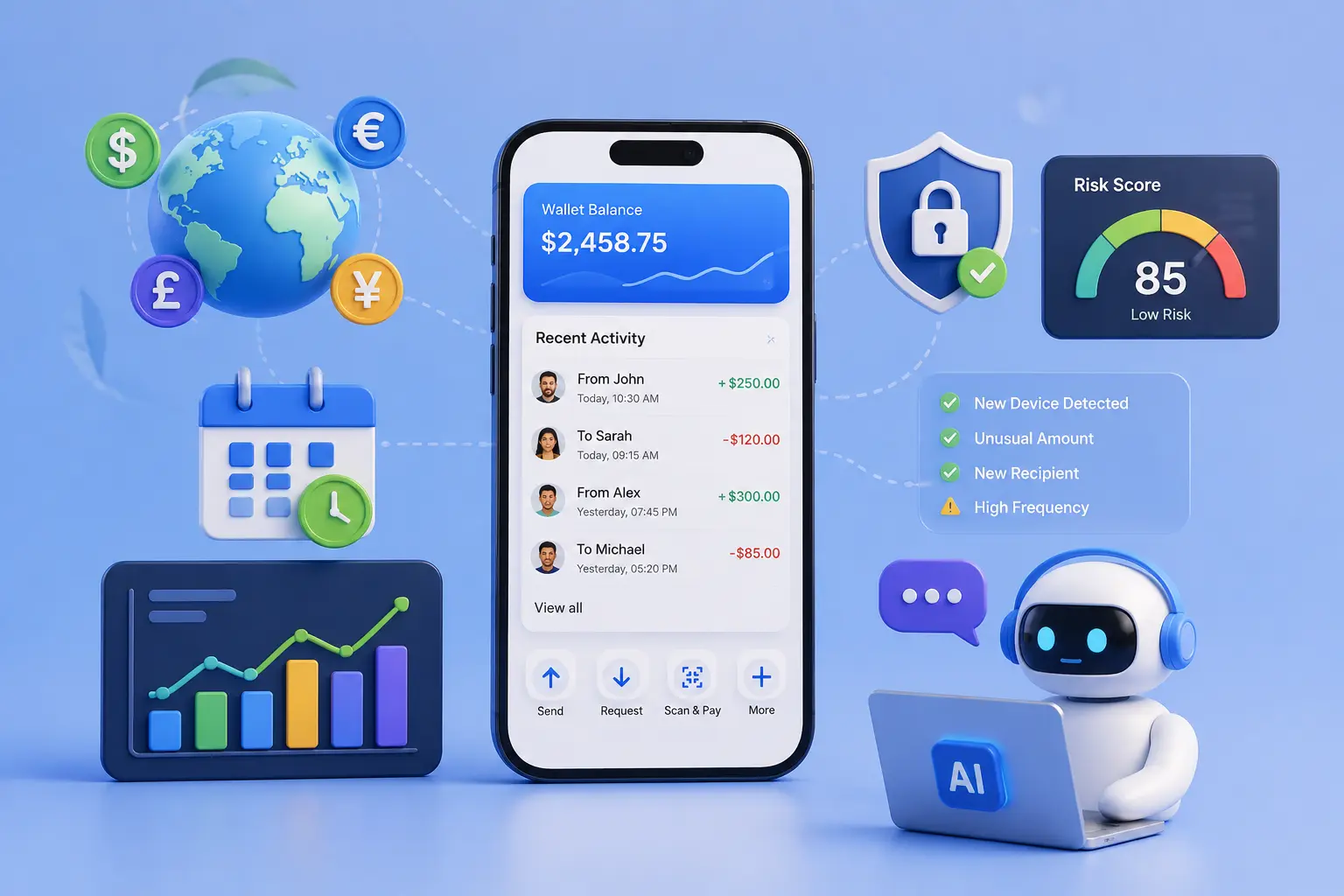
These features can be introduced after the core payment journey has been validated.
Multi-Currency Payments
A global product may need:
- Multiple currency balances
- Currency conversion
- Exchange-rate information
- Conversion fees
- International transfers
- Country restrictions
The user should see the applicable rate, fees, and final amount before confirming the transaction.
Scheduled and Recurring Payments
These can support regular personal payments, shared expenses, and scheduled transfers.
The app should allow users to review, change, and cancel future payments.
Payment Analytics
A dashboard can show:
- Incoming payments
- Outgoing payments
- Monthly activity
- Average transaction value
- Frequent recipients
- Transaction trends
Analytics can also help internal teams identify unusual account activity.
Fraud Detection and Risk Scoring
Fraud detection should operate alongside authentication.
Risk systems can evaluate:
- Unusual transaction amounts
- New devices
- Rapid transfers
- New recipients
- Failed authentication attempts
- Unusual transaction frequency
- Changes in account behaviour
Rules can identify known risk patterns, while machine-learning models can help identify unusual behaviour across larger datasets.
AI development services can be relevant when implementing AI-based anomaly detection, fraud analysis, predictive models, or other financial AI use cases.
AI-Assisted Support
AI can assist with:
- Transaction-status questions
- Customer support
- Support-ticket classification
- Account guidance
- Fraud-investigation assistance
The system should have defined boundaries for sensitive financial decisions rather than allowing an AI model to make unexplained decisions independently.
P2P Payment App Security
Security needs to be considered during architecture and development, not added immediately before launch.
Authentication and Authorisation
Authentication determines who is accessing the account.
Authorisation determines what that user is permitted to do.
Keeping these controls separate is important. A successfully authenticated user may still need additional verification before performing a high-risk action.
Encryption
Sensitive information should be protected both during transmission and while stored.
The architecture should consider:
- TLS
- Encryption at rest
- Key management
- Secrets management
- Database permissions
- Secure backups
Multi-Factor Authentication
MFA can combine:
- Password or PIN
- OTP
- Authenticator applications
- Device verification
- Biometrics
Higher-risk actions may require additional authentication.
Tokenisation and Card Data
Where appropriate, payment-provider tokenisation can reduce the amount of sensitive card information handled directly by the application.
This can reduce exposure, but using a third-party processor does not automatically remove every compliance responsibility. The actual payment architecture determines the applicable scope.
Fraud Controls
Fraud prevention can include:
- Transaction limits
- Velocity checks
- Device analysis
- Risk scoring
- Suspicious-activity alerts
- Manual review
- Account protection
The system also needs a process for legitimate users who are incorrectly flagged.
Audit Logging
Important actions should produce reliable records, including:
- Login events
- Payment attempts
- Account changes
- Authentication changes
- KYC decisions
- Fraud reviews
- Administrative actions
These records can support security investigations, operational troubleshooting, and applicable regulatory processes.
P2P Payment App Compliance: Requirements Differ by Market
There is no universal compliance framework for P2P payment applications.
The applicable requirements depend on:
- Country
- State or province
- Business model
- Payment services offered
- Whether customer funds are held
- Financial partners
- Customer type
- Transaction flows
A useful approach is to create a market-specific compliance matrix before development begins.
| Market | Key areas to assess |
| United States | FinCEN, BSA/AML, OFAC, EFTA/Regulation E, CFPB requirements, state money-transmission rules, PCI DSS where applicable |
| United Kingdom | FCA requirements, Payment Services Regulations, Electronic Money Regulations, safeguarding, AML requirements |
| European Union/EEA | PSD2 and related payment rules, Strong Customer Authentication, AML requirements, GDPR |
| Canada | Retail Payment Activities Act, Bank of Canada requirements, FINTRAC obligations where applicable, privacy requirements |
| Australia | AUSTRAC AML/CTF requirements, remittance rules where applicable, Privacy Act, APRA requirements for relevant regulated entities |
| UAE | CBUAE payment-services regulations, AML/CFT, sanctions controls, applicable data and privacy requirements |
This is a starting point rather than a legal checklist. A company can fall under different rules depending on exactly how its payment service operates.
United States
A US P2P payment product may need to assess FinCEN, the Bank Secrecy Act, AML requirements, OFAC sanctions requirements, EFTA and Regulation E, applicable CFPB requirements, state money-transmission laws, and payment-card requirements where applicable.
The exact scope depends on the company's role and business structure.
United Kingdom
Payment services in the UK can fall under the Payment Services Regulations 2017, while electronic-money activities can involve the Electronic Money Regulations 2011.
The Financial Conduct Authority also has requirements concerning safeguarding for relevant payment and e-money institutions.
A wallet-based product should therefore establish how customer funds are held and protected before the financial architecture is finalised.
European Union and EEA
Payment applications serving the EU/EEA may need to consider PSD2, Strong Customer Authentication requirements, AML obligations, and GDPR.
Strong Customer Authentication can require two or more independent authentication elements, subject to applicable exemptions.
A product operating across multiple European countries should also check national requirements rather than assuming that one regulatory implementation covers every local obligation.
Canada
Canada has its own payment-services framework.
The Retail Payment Activities Act (RPAA) establishes a supervisory framework for certain retail payment service providers, with the Bank of Canada responsible for supervising PSPs that fall within its scope.
Depending on the activities and business structure, FINTRAC requirements may also be relevant for AML purposes.
Privacy obligations should also be assessed, including PIPEDA where applicable.
Australia
Australian payment and money-transfer products may need to consider AUSTRAC requirements under the AML/CTF framework.
Depending on the service, this can involve obligations relating to customer identification, transaction monitoring, reporting, and remittance services.
The Privacy Act can also be relevant to personal information handling, while APRA requirements may apply to certain regulated entities.
Australia's AML/CTF framework has undergone significant changes, so current regulatory requirements should be checked before implementation.
UAE
For the UAE, payment businesses need to assess the regulatory framework administered by the Central Bank of the UAE (CBUAE).
Depending on the service, requirements can involve payment-service licensing, customer protection, safeguarding, operational controls, AML/CFT, and sanctions compliance.
The UAE should therefore be treated as its own regulatory market rather than simply applying a US or UK payment framework.
What About Other Countries?
The same principle applies elsewhere.
Markets such as Singapore, Switzerland, Saudi Arabia, Japan, South Korea, New Zealand, Brazil, and other countries have their own payment regulations, licensing requirements, AML/CFT frameworks, privacy laws, and financial regulators.
A global P2P payment platform should therefore use a common technical foundation with market-specific compliance controls.
For example:
Common platform:
Authentication, transaction engine, ledger, notifications, fraud engine, APIs.
Market-specific controls:
KYC requirements, transaction limits, disclosures, reporting, payment providers, safeguarding, sanctions screening, and data-handling rules.
This approach makes international expansion more manageable than building a completely separate application for every country.
Planning a Secure P2P Payment Platform?
Payment applications require careful consideration of authentication, encryption, KYC, AML, fraud prevention, transaction monitoring, data protection, and market-specific regulations. Discuss your target markets and payment model before development begins.
P2P Payment App Architecture
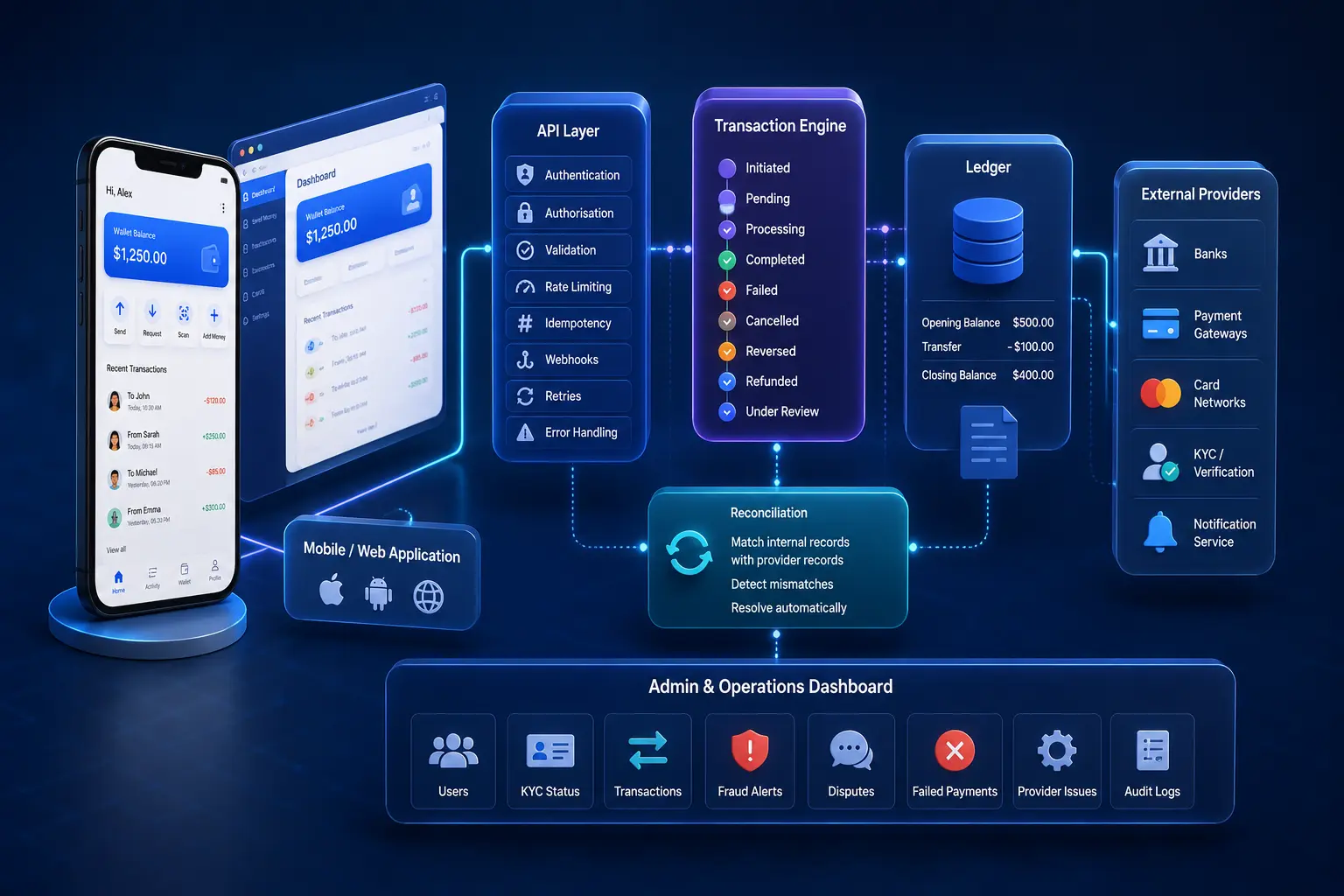
The architecture should be designed around the movement and recording of money.
Mobile or Web Application
The client handles:
- Registration
- Authentication
- Recipient selection
- Payment initiation
- Transaction history
- Notifications
- Security prompts
Critical financial validation should happen on trusted backend systems rather than relying on the mobile application.
API Layer
The API layer connects the application with internal services and external financial providers.
It needs to manage:
- Authentication
- Authorisation
- Validation
- Rate limiting
- Idempotency
- Webhooks
- Retries
- Error handling
Idempotency is particularly important.
If a payment request is accidentally submitted twice because of a network retry, the system should be able to recognise the duplicate request and avoid processing the same transaction twice.
Transaction Engine
The transaction engine manages payment states such as:
- Initiated
- Pending
- Processing
- Completed
- Failed
- Cancelled
- Reversed
- Refunded
- Under review
This gives the application a reliable way to handle payments that do not finish immediately.
Ledger
If the application maintains balances, the ledger records financial movements.
For example:
Opening balance: $500
Transfer: -$100
Closing balance: $400
The system should retain the transaction record behind that change.
This makes it possible to investigate discrepancies and reconcile internal records with external providers.
Reconciliation
Reconciliation compares internal transaction records with records from financial providers.
For example, if the application records a payment as submitted but the provider later reports a failure, the system needs to detect the mismatch and handle it correctly.
Reconciliation is one of the areas that becomes increasingly important as transaction volume grows.
Admin and Operations Dashboard
Operations teams may need to review:
- Users
- KYC status
- Transactions
- Fraud alerts
- Disputes
- Failed payments
- Provider issues
- Audit records
Role-based access should limit what individual administrators can view or change.
Technology Stack for a P2P Payment App
There is no single technology stack that fits every payment product.
Mobile Development
Common options include:
- Flutter
- React Native
- Swift
- Kotlin
Cross-platform development can work well when iOS and Android share most functionality. Native development can be preferable where deeper platform-specific capabilities are required.
Mobile app development can cover application development, integrations, APIs, and testing for products requiring mobile financial experiences.
Backend Development
Common technologies include:
- Node.js
- Python
- Java
- .NET
The important consideration is whether the chosen stack can support secure APIs, reliable transaction processing, third-party integrations, testing, and long-term maintenance.
Node.js development can be suitable for API-driven and real-time application architectures where the technology aligns with the product requirements.
Database
Relational databases such as PostgreSQL or MySQL can be suitable for structured financial transaction records.
The architecture should also plan for:
- Backups
- Replication
- Encryption
- Access controls
- Monitoring
- Disaster recovery
Cloud Infrastructure
Cloud infrastructure can support:
- Scalable computing
- Managed databases
- Load balancing
- Monitoring
- Backups
- Disaster recovery
For a multi-tenant financial platform, SaaS product development can be relevant where shared infrastructure, tenant management, APIs, and cloud operations are required.
DevOps
A controlled deployment process is important for financial software.
Useful practices include:
- CI/CD
- Infrastructure automation
- Secrets management
- Environment separation
- Monitoring
- Centralised logging
- Rollback procedures
DevOps development services can support deployment automation, infrastructure management, monitoring, and release processes.
How to Develop a P2P Payment App: Step-by-Step Process
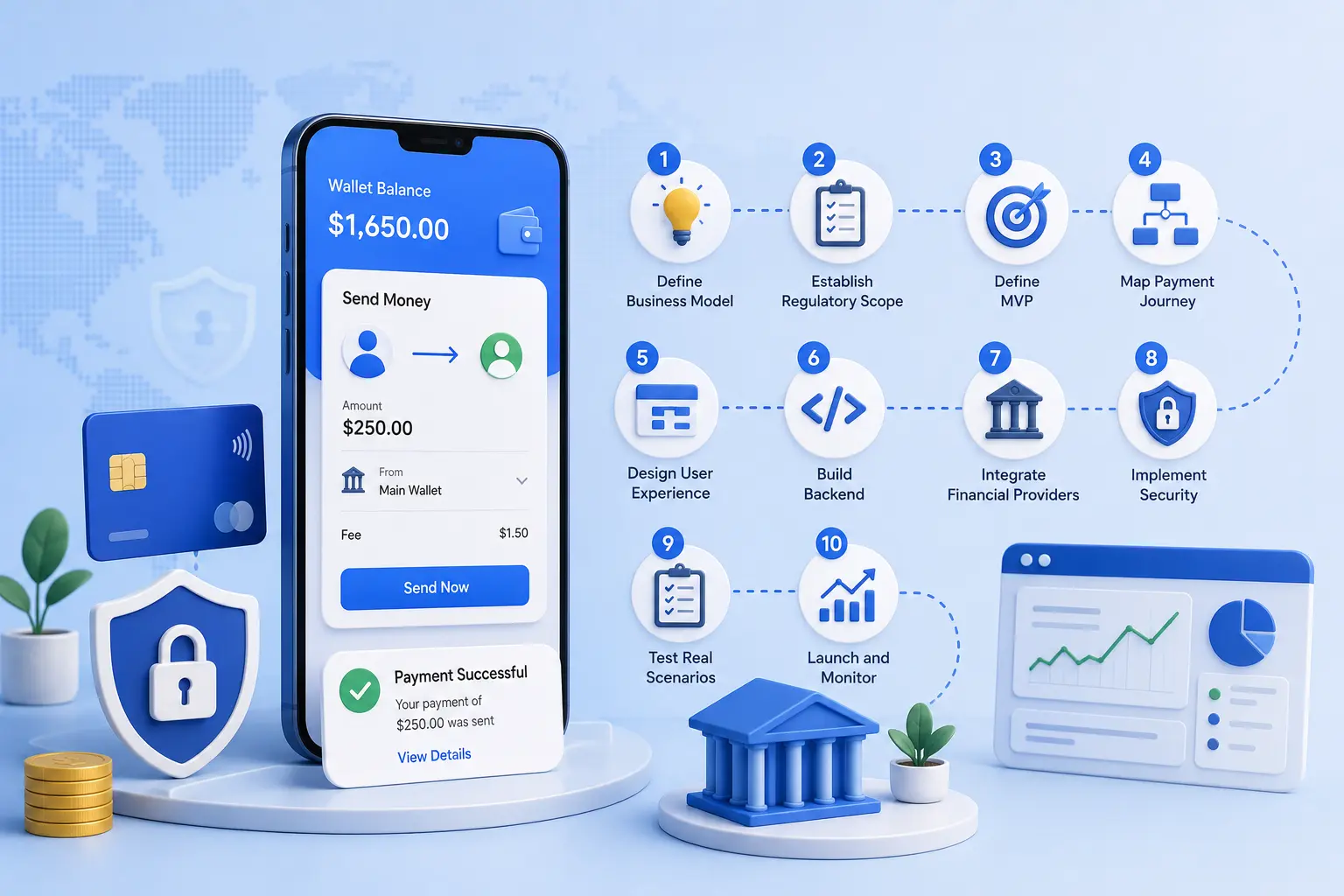
1. Define the Business Model
Start by deciding:
- Who sends money?
- Who receives it?
- Will the app hold balances?
- Which payment methods are supported?
- Which markets will be served?
- Which currencies are needed?
- Who holds customer funds?
- Which financial partners are involved?
- How will the business earn revenue?
These decisions affect both technology and compliance.
2. Establish the Regulatory Scope
Create a market-by-market requirements matrix.
Identify:
- Licensing requirements
- KYC requirements
- AML/CFT obligations
- Sanctions screening
- Consumer protection
- Privacy
- Safeguarding
- Reporting
- Payment-provider requirements
Legal and regulatory professionals should confirm the requirements that apply to the actual business model.
3. Define the MVP
A focused MVP can include:
- Registration
- Authentication
- KYC
- Payment method
- Send money
- Receive money
- Transaction history
- Notifications
- Basic fraud controls
- Support/dispute handling
- Admin dashboard
The goal is to validate the main payment journey before adding unnecessary functionality.
4. Map the Payment Journey
Document both successful and failed transactions.
Successful flow:
Sign up → verify → fund → select recipient → review → authenticate → send → receive status.
Failure flow:
Submit → provider timeout → pending → provider response → status update → user notification.
The failure flow deserves the same attention as the successful one.
5. Design the User Experience
The payment screen should make these details obvious:
- Recipient
- Amount
- Fee
- Funding source
- Expected status
UI/UX design services can support wireframes, prototypes, user flows, and usability testing before the complete application is built.
6. Build the Backend
Develop the:
- User system
- Authentication
- Wallet
- Ledger
- Transaction engine
- Payment integrations
- Fraud controls
- Notifications
- Dispute system
- Admin tools
7. Integrate Financial Providers
Depending on the product, integrations may include:
- Payment processors
- Banks
- Open Banking services
- KYC providers
- Identity verification
- Sanctions screening
- Fraud systems
- SMS and email services
Each provider should have defined handling for failures, timeouts, retries, and delayed responses.
8. Implement Security
Add:
- MFA
- Encryption
- Secure APIs
- Access controls
- Rate limiting
- Audit logging
- Device security
- Vulnerability testing
Security testing should take place throughout development.
9. Test Real Transaction Scenarios
Test more than successful payments.
Important scenarios include:
- Duplicate requests
- Insufficient funds
- Provider timeout
- Failed payments
- Delayed webhooks
- Refunds
- Reversals
- Unauthorised transactions
- Suspicious activity
- Account takeover
- Disputes
10. Launch and Monitor
After launch, monitor:
- Payment success rate
- Failed transactions
- Pending payments
- Fraud alerts
- False positives
- KYC completion
- API errors
- Provider response times
- Support requests
- Transaction volume
A payment platform needs ongoing monitoring because real-world behaviour can expose problems that controlled testing does not reveal.
Ready to Plan Your P2P Payment App?
Get your core features, payment workflows, backend architecture, financial integrations, technology requirements, development timeline, and launch considerations mapped out before development starts.
How Long Does It Take to Develop a P2P Payment App?
A reasonable planning range is:
| Product scope | Approximate timeline |
| Focused MVP | 2-5 months |
| Mid-level app | 5-8 months |
| Advanced multi-market platform | 8-12+ months |
The timeline can increase because of:
- Financial-provider onboarding
- Compliance reviews
- Security testing
- Multiple platforms
- Multiple currencies
- International payment integrations
- Complex transaction workflows
Software development is only one part of the launch schedule.
How Do P2P Payment Apps Make Money?
Several revenue models are possible.
Transaction Fees
Charge users for selected types of transfers or financial services.
Instant Withdrawal Fees
Offer faster access to funds for an additional fee.
Currency Conversion
International products may generate revenue through currency conversion, depending on the business model and applicable requirements.
Business Accounts
A consumer P2P application can later support businesses with:
- Higher limits
- Payment management
- Reporting
- Multiple users
- Business profiles
Premium Features
Paid functionality can include:
- Advanced analytics
- Higher limits
- International transfers
- Business tools
- Priority support
The revenue model should account for payment-provider fees, fraud losses, compliance costs, customer support, and infrastructure.
Common P2P Payment App Development Mistakes
Building Too Many Features
A large MVP can increase cost without proving the core payment concept.
Designing Only the Successful Payment Flow
Payments can fail, remain pending, reverse, or require investigation.
Ignoring Reconciliation
Internal records need to remain consistent with external payment-provider records.
Treating Compliance as Documentation
Compliance requirements can directly influence product and technical decisions.
Adding Security at the End
Authentication, encryption, permissions, fraud controls, and logging need to be part of the architecture.
Using One Compliance Model Worldwide
A payment application operating in the US, UK, Canada, Australia, EU, and UAE may need different regulatory controls in each market.
The technical foundation can be shared, but market-specific requirements should be configurable.
What Should Be Included in a P2P Payment App MVP?
A practical MVP can include:
- User registration
- Secure authentication
- Identity verification
- Payment method connection
- Send and receive money
- Transaction history
- Payment status
- Notifications
- Basic fraud controls
- Support and dispute handling
- Admin dashboard
- Audit logging
Later releases can add:
- QR payments
- Recurring transfers
- Scheduled payments
- Multi-currency wallets
- International payments
- Advanced fraud detection
- AI-assisted support
- Business accounts
- Advanced analytics
The MVP should solve one clear payment problem well before expanding into a larger financial platform.
What to Consider Before Launching a P2P Payment App?
Before launch, answer five questions.
What problem does the product solve?
A focused use case is easier to build, test, and explain than a generic "send money" application.
How does the money move?
Define the funding source, payment route, wallet model, settlement process, and financial partners.
Which regulations apply?
Create a separate regulatory assessment for every target market.
What happens when a payment goes wrong?
Define processes for fraud, disputes, failed payments, reversals, account takeovers, provider outages, and verification problems.
Can the platform support additional markets?
Build common infrastructure where possible, while keeping payment providers, KYC, transaction limits, reporting, disclosures, and other regulatory controls configurable by market.
Build a P2P Payment App With the Right Technical Foundation
A P2P payment product needs more than mobile development. It requires reliable transaction processing, financial APIs, identity verification, security controls, fraud management, testing, and a clear approach to market-specific compliance.
Nyusoft offers FinTech application development alongside mobile app development, AI development, API integration, SaaS, cloud, UI/UX, and DevOps services.
The practical starting point is to define the payment model, target markets, regulatory scope, financial integrations, transaction flow, and MVP before fixing the development budget. Once those requirements are clear, the architecture, technology stack, timeline, and feature roadmap can be planned around the actual product.
FAQs
1. How much does it cost to develop a P2P payment app?
A P2P payment app can cost approximately $4,000-$25,000+, depending on the product scope. A basic MVP may cost $4,000-$8,000, a mid-level app around $6,000-$15,000, and an advanced platform $15,000-$25,000+. Payment integrations, security, KYC, fraud controls, multiple platforms, and international requirements can increase the overall budget.
2. How long does it take to develop a P2P payment app?
A focused P2P payment MVP can take around 2-5 months to develop, while a mid-level application may require 5-8 months. A more advanced platform supporting multiple markets, currencies, payment providers, and complex financial workflows can take 8-12 months or longer. Third-party provider onboarding, compliance reviews, and security testing can also affect the launch timeline.
3. What features should a P2P payment app have?
A basic P2P payment app should include user registration, secure authentication, identity verification, payment methods, sending and receiving money, transaction history, notifications, fraud controls, and an admin dashboard. Depending on the business model, a digital wallet, payment requests, QR payments, disputes, and withdrawals may also be required. Advanced products can later add multi-currency payments, analytics, recurring transfers, and AI-based fraud detection.
4. What security measures are needed for a P2P payment app?
A P2P payment app should use multi-factor authentication, encryption, secure APIs, access controls, device verification, transaction monitoring, fraud detection, and audit logging. High-risk actions may require additional authentication or risk checks. If cardholder data is within the applicable environment, PCI DSS requirements also need to be assessed. Security should be designed into the architecture rather than added only before launch.
5. What compliance is required for a P2P payment app?
There is no single global compliance framework for P2P payment apps. Requirements depend on the country, business model, payment services, handling of customer funds, and financial partners. Depending on the market, a business may need to assess frameworks involving FinCEN and BSA/AML in the US, FCA rules in the UK, PSD2/GDPR in the EU, RPAA in Canada, AUSTRAC requirements in Australia, and CBUAE rules in the UAE. The exact obligations should be confirmed with qualified regulatory professionals.
6. Does a P2P payment app need KYC and AML?
KYC and AML requirements depend on the services offered and the jurisdiction in which the business operates. Where applicable, KYC can involve identity documents, address information, verification checks, sanctions screening, and ongoing monitoring. AML controls may include transaction monitoring, suspicious-activity processes, recordkeeping, and risk assessment. These requirements should be incorporated into the product architecture instead of treated as a separate process after development.
7. Can a P2P payment app support multiple countries and currencies?
Yes. A P2P payment platform can be designed to support multiple countries, currencies, payment providers, and regulatory requirements. The most practical approach is usually to keep the core transaction engine, ledger, authentication, and fraud infrastructure shared while making KYC, transaction limits, payment providers, disclosures, and reporting configurable by market. This makes international expansion easier than creating a completely separate application for every country.
8. How does a P2P payment app handle failed or pending transactions?
A reliable payment application should have separate transaction states such as initiated, pending, processing, completed, failed, cancelled, reversed, and refunded. The system should also use webhooks, retries, idempotency, and reconciliation to keep internal records aligned with external payment providers. This is important because a payment request can be submitted successfully but later remain pending or fail. Users should always be able to see the current transaction status.
9. What technology stack is suitable for P2P payment app development?
The technology stack depends on the product's requirements, development team, integrations, security needs, and expected scale. Flutter or React Native can be suitable for cross-platform mobile development, while Swift and Kotlin can be used for native iOS and Android applications. Backend systems can use technologies such as Node.js, Python, Java, or .NET, with relational databases such as PostgreSQL or MySQL commonly suitable for structured transaction data.
10. Can AI be used in a P2P payment app?
Yes. AI can be useful for fraud detection, transaction anomaly detection, risk scoring, customer support, and financial insights. For example, a model can identify transaction behaviour that differs significantly from a user's normal activity and send it for additional review. AI should work alongside established security and compliance controls rather than making unexplained financial decisions on its own. The model should also be monitored for accuracy and false positives.
Ready to Move From Idea to Development?
Whether you're building a consumer payment app, digital wallet, or multi-market P2P platform, the right technical approach depends on your business model and target markets. Share your requirements and discuss the next steps for your product.