


 Front End Development
 Back End Development
 CMS / ECommerce Development
 Mobile Apps Development
 Cloud Services
 Fullstack Services
 Solution


How to Build an Online Tutoring Marketplace: Features, Process & Cost
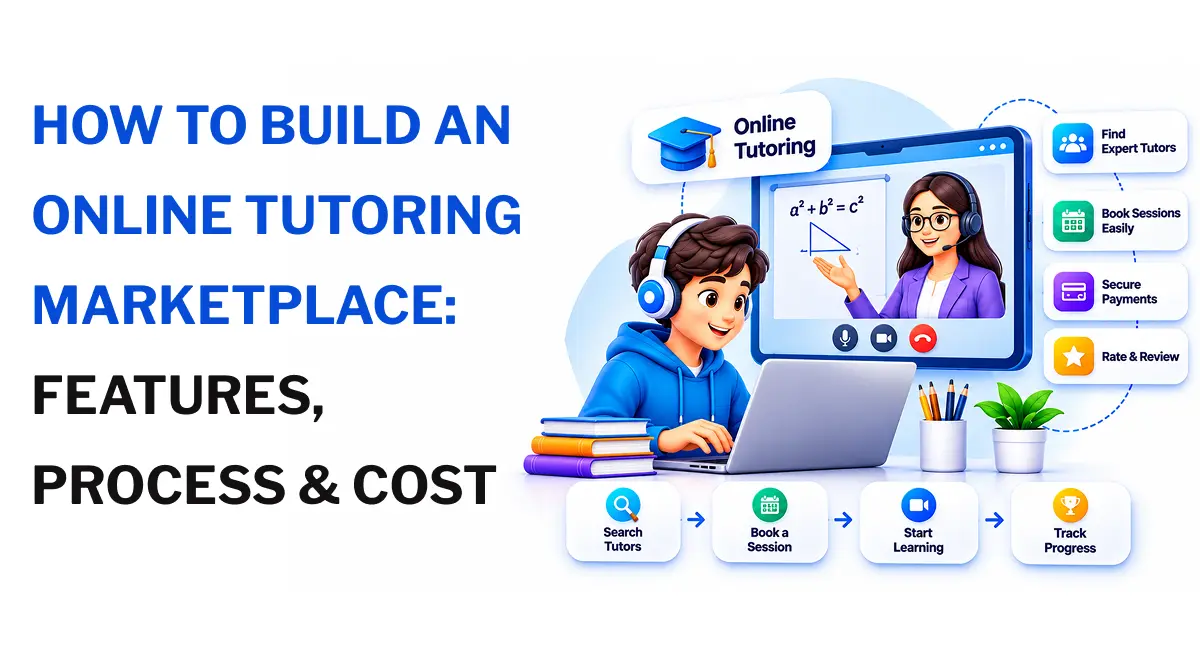
Key Insights:
- Development Cost: Build a basic online tutoring marketplace for $3,000–$5,000+, a mid-level platform for $5,000–$10,000+ or an advanced marketplace for $10,000–$25,000+.
- Development Timeline: A basic MVP may take 4–6 weeks, a mid-level marketplace 6–9 weeks, and an advanced platform 9–12 weeks or longer.
- Essential Features: Include student and tutor dashboards, tutor search, profile management, lesson booking, payments, messaging, and live classrooms.
- AI-Powered Capabilities: Add AI tutor matching, personalised learning recommendations, AI tutoring assistants, and learning analytics.
- Technology Stack: Choose suitable frontend, backend, database, cloud infrastructure and third-party integrations.
- Security and Privacy: Implement secure authentication, data encryption, payment protection, tutor verification, and child privacy controls.
- Business Models: Generate revenue through tutor commissions, subscriptions, pay-per-session bookings, and featured tutor listings.
- Launch and Growth: Start with an MVP, validate demand and expand marketplace functionality based on user requirements.
Building an online tutoring marketplace involves creating a platform where students can find tutors, compare their qualifications, book lessons and make payments. The global online tutoring services market is estimated to reach $13.9 billion in 2026 and is projected to grow to $34.6 billion by 2033, according to Grand View Research's online tutoring market report. For businesses planning to enter this market, the first step is to define the tutoring model, user requirements, platform features and development scope.
A successful marketplace needs to support three main user groups: students, tutors and administrators. Each group has different responsibilities, so the platform must connect tutor discovery, scheduling, payments, online lessons and account management through a consistent workflow.
What Is an Online Tutoring Marketplace and How Does It Work?
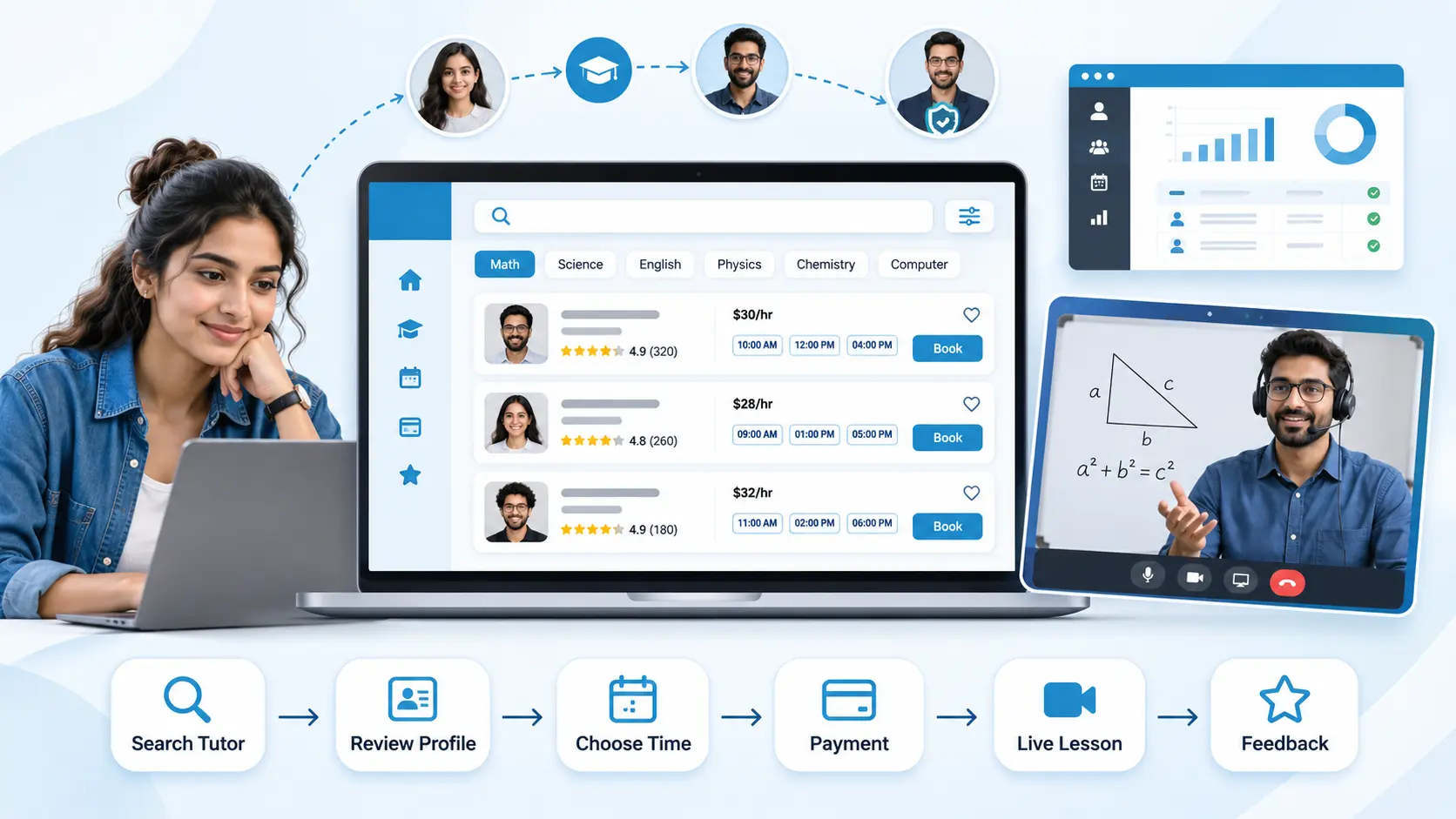
An online tutoring marketplace is a digital platform that connects students with independent tutors who provide lessons in different subjects, skills or academic areas. Students can search for suitable instructors, review their profiles, check availability and book sessions through the platform.
Unlike a traditional tutoring website that promotes lessons from one education provider, a marketplace can host multiple tutors who manage their own profiles, schedules and teaching services. The platform owner manages user accounts, transactions, service rules and marketplace operations.
A typical tutoring marketplace has three main components:
Student Platform
Students use the platform to find tutors and manage their learning activities. They can create accounts, search by subject, compare tutor profiles, check lesson prices and schedule sessions.
After booking a lesson, students can complete payments, join online classes, communicate with tutors and submit feedback. Some platforms also provide lesson history, learning materials and progress records.
Tutor Platform
Tutors use their dashboards to manage their teaching services. After registration, they can submit their qualifications, add subjects, set hourly rates and publish available time slots.
Once approved, tutors can receive booking requests, communicate with students, conduct lessons and monitor their earnings. A well-designed tutor dashboard should make these activities easy to manage without requiring tutors to contact the platform administrator for routine tasks.
Admin Platform
The administrator manages the marketplace and oversees its operations. This includes reviewing tutor applications, managing student accounts, handling payments, setting commissions, monitoring bookings and resolving disputes.
Administrators also need access to reports that show booking activity, revenue, tutor performance and student engagement.
How a typical tutoring session works:
- A student searches for a tutor based on subject, price, language or availability.
- The student reviews tutor profiles and selects an instructor.
- The platform displays available lesson times.
- The student chooses a time slot and completes the booking.
- The payment system processes the transaction.
- The tutor and student receive booking confirmation.
- Both users access the scheduled online lesson.
- After the session, the booking is marked as completed and the student can leave a review.
The platform should maintain consistent booking and payment records throughout this process. For example, a cancelled lesson should not be treated as a completed session for tutor commission calculations.
Ready to Build Your Tutoring Marketplace?
Create a platform where students can find tutors, book lessons and make payments. Get a solution planned around your business needs.
Discuss Your Project Idea
Different Types of Online Tutoring Marketplaces
The type of tutoring marketplace you plan to build will affect its features, pricing structure, tutor requirements and classroom functionality. Defining the target learning category early helps prevent unnecessary development work.
Academic Tutoring Marketplace
An academic tutoring marketplace connects students with instructors who teach school subjects, university courses and other academic topics.
Common subjects include mathematics, physics, chemistry, biology, English and computer science. Students may need help with homework, individual topics, exam preparation or ongoing academic support.
Useful platform features include subject-based tutor search, lesson scheduling, file sharing, interactive whiteboards and student progress records.
Language Learning Marketplace
A language tutoring marketplace connects learners with instructors who teach different languages. Students may look for tutors based on their native language, teaching experience, proficiency level or availability.
The platform may need features such as:
- Language and proficiency filters.
- Trial lesson bookings.
- Recurring lesson schedules.
- Speaking and listening exercises.
- Learning materials and file sharing.
- Lesson notes and progress tracking.
Platforms such as Preply demonstrate how tutor discovery and individual lesson bookings can support a language-learning marketplace.
Test Preparation Marketplace
A test preparation marketplace connects learners with tutors who specialise in entrance examinations, professional certifications and standardised tests.
It may cover exams such as the SAT, ACT, GRE, GMAT and other qualifications.
Along with live tutoring, the platform can support practice questions, mock examinations, study materials and performance reports. Students should be able to find tutors based on their target examination and the subjects they need help with.
Professional Skills and Certification Marketplace
This type of marketplace focuses on professional learning and skill development. It can connect learners with instructors who teach programming, business management, design, finance, communication and other professional subjects.
Useful features include mentor profiles, individual coaching sessions, group workshops, course materials and certification-related learning paths.
How to Build an Online Tutoring Marketplace: Step-by-Step Process

Developing an online tutoring marketplace requires decisions about the business model, user roles, platform architecture, integrations and launch requirements. The development process should follow the actual needs of the marketplace rather than adding every possible feature from the beginning.
Step 1. Research the Market and Identify Your Target Audience
Start by deciding who the marketplace will serve and what type of tutoring it will support.
A platform designed for school students will have different requirements from one connecting professionals with programming mentors. The target audience also affects tutor verification, pricing, communication methods and learning features.
Research the following areas:
- Tutoring niche: Decide whether the platform will focus on academic subjects, languages, test preparation or professional skills.
- Target users: Identify the age groups, locations and learning requirements of potential students.
- Tutor availability: Determine whether qualified tutors are available in the subjects and time zones you plan to support.
- Competitor platforms: Examine their tutor profiles, booking processes, pricing models and user experience.
- Customer expectations: Speak with prospective students, parents and tutors to understand what they need from the platform.
Do not rely on the overall online tutoring market size to validate a specific business idea. A large market does not guarantee demand for every subject, location or pricing model.
For example, a marketplace targeting professional programming tutors may need portfolio reviews, technical specialisations and mentor experience filters. A platform for school mathematics may place more emphasis on grade levels, curriculum knowledge and parental account access.
Step 2. Choose the Right Business and Revenue Model
The business model determines how tutors and students interact and how the platform earns revenue.
Several models are suitable for a tutoring marketplace.
Commission-based marketplace
The platform charges a percentage of each completed lesson. Tutors receive the remaining amount after the platform commission and applicable payment fees are deducted.
For example, if a lesson costs $50 and the platform charges a 15% commission, the platform receives $7.50 before other applicable expenses, while the tutor receives $42.50 before any additional deductions.
Subscription-based marketplace
Tutors or students pay a recurring fee to access selected platform features. A tutor subscription might include profile promotion, additional visibility or access to booking tools. Student subscriptions could provide membership benefits or discounted lessons.
Pay-per-session model
Students pay for individual tutoring sessions. This model works well when learners need occasional assistance instead of a recurring subscription.
Featured tutor listings
Tutors can pay for additional visibility in selected search results or promotional placements. Paid placements should be clearly identified so students can distinguish sponsored profiles from ordinary search results.
Hybrid revenue model
A marketplace can combine commissions, subscriptions and promotional listings. This gives the business different revenue options, although the pricing structure should remain understandable for both tutors and students.
Choose the model before developing the payment system. Commission calculations, subscription renewals, refunds and tutor payouts all affect the platform's backend requirements.
Step 3. Define Student, Tutor and Admin Requirements
Each user role needs different permissions and functionality. Documenting these requirements before development helps prevent confusion later.
| User role | Main responsibilities | Required capabilities |
| Student | Find and book tutors | Search, profiles, bookings, payments and lesson access |
| Tutor | Provide tutoring services | Registration, verification, availability, lessons and earnings |
| Administrator | Manage marketplace operations | Approvals, users, payments, reports and dispute handling |
If the platform serves children, consider whether parents or guardians need separate accounts to manage registrations, bookings and payments.
Also decide which actions require administrator approval. For example, tutors may be allowed to edit their biographies immediately, while changes to verified qualifications or payout details may require additional checks.
Step 4. Plan the Marketplace Architecture
The marketplace architecture defines how its different components exchange information and manage user activities.
A typical architecture includes:
- User authentication and account management.
- Student and tutor profile services.
- Subject and category management.
- Tutor search and matching.
- Availability and scheduling.
- Booking and cancellation management.
- Payment and payout processing.
- Messaging and notifications.
- Live classroom integration.
- Reporting and analytics.
The booking system deserves particular attention. It should check tutor availability before confirming a session and prevent two students from reserving the same time slot.
Use clear booking statuses, such as pending, confirmed, completed, cancelled and refunded. Payment statuses should be tracked separately because a booking can be confirmed before a lesson is completed and the tutor payout becomes eligible.
For a platform with several user types and connected services, tutoring marketplace software development can involve features such as tutor onboarding, student dashboards, booking management, calendar integration and payment distribution.
Step 5. Design the Student, Tutor and Admin Interfaces
The user interface should reflect the tasks each person needs to complete.
The student experience should make it easy to search for instructors, compare profiles and book a lesson. Tutor interfaces should provide clear controls for managing schedules, accepting bookings and checking earnings. Administrators need access to operational information without having to navigate through student or tutor screens.
Start by creating wireframes for the main journeys:
- Student registration and tutor search.
- Tutor registration and profile approval.
- Availability management and lesson booking.
- Payment and booking confirmation.
- Online classroom access.
- Administrator review and account management.
Test these wireframes with people who represent the intended users. A student who struggles to find the booking button or a tutor who cannot understand the availability settings may abandon the process before using the platform.
The design should also work across desktop, tablet and mobile devices. Students may discover tutors on a phone and attend lessons from a laptop, so the booking experience and classroom access should remain consistent across supported devices.
Step 6. Develop the Core Marketplace Functionality
Once the requirements and interface designs are ready, development can begin.
The main components usually include the following:
User registration and authentication: Allow students and tutors to create accounts, manage their details and securely access their dashboards.
Tutor profiles: Store tutor biographies, subjects, qualifications, teaching experience, languages, hourly rates and profile images. Provide an approval workflow before profiles become publicly visible.
Tutor search and filters: Allow students to search by subject, price, language, experience, rating and available time slots. Search results should show useful information without requiring students to open every profile.
Booking management: Let students select available lesson times and receive booking confirmations. Tutors should be able to manage their schedules and view upcoming sessions.
Payment management: Process student payments, calculate platform commissions and maintain transaction records. Support the required refund and payout workflows.
Communication tools: Provide messaging, booking notifications and lesson reminders. The communication system should follow the platform's privacy and safety requirements.
Reviews and ratings: Allow eligible students to review completed lessons. Provide moderation controls to handle inappropriate or fraudulent reviews.
These components should share consistent data. For example, when a student cancels a booking, the platform should update the calendar, notify the tutor, apply the cancellation policy and adjust the payment record where required.
Step 7. Integrate Video Conferencing and Learning Tools
Online tutoring platforms need a reliable way for students and tutors to conduct lessons.
A video conferencing integration can support:
- Live audio and video sessions.
- Screen sharing.
- Interactive whiteboards.
- File sharing.
- Session links and reminders.
- Participant controls.
- Attendance records.
The choice between building a custom classroom and integrating an existing video service depends on the product requirements.
A third-party video API can reduce initial development work and provide established communication features. A custom classroom gives the platform more control over the learning experience, but requires additional engineering, testing and ongoing maintenance.
Consider network interruptions as part of the design. If a student's connection drops, the session should not automatically be marked as completed. The platform may need to support reconnection and record the actual session status.
Recording lessons also requires careful planning. Decide whether recordings are necessary, who can access them, how long they are retained and whether consent is required.
Step 8. Test the Platform Before Launch
Testing should cover complete user journeys, not just individual screens.
For example, a booking test should include tutor availability, time-zone conversion, payment processing, confirmation messages and calendar updates.
Important test cases include:
- Two students attempting to book the same available time slot.
- A tutor changing availability after receiving a booking.
- A payment succeeding while the booking confirmation fails.
- A student cancelling within and outside the permitted cancellation period.
- A tutor becoming unavailable before a scheduled lesson.
- A refund being issued after payment.
- A tutor receiving the correct payout after commission deductions.
- A student joining a live class from a supported mobile device.
Also test account permissions, data protection, application performance and accessibility.
Payment testing should use the gateway's test environment before real transactions are enabled. The development team should verify successful payments, declined transactions, duplicate requests and refund handling.
Step 9. Launch the MVP and Improve the Platform
A minimum viable product (MVP) includes the features needed to operate the marketplace and test its business model.
A basic tutoring marketplace MVP might include:
- Student and tutor registration.
- Tutor profiles and approval.
- Subject-based search.
- Availability management.
- Lesson booking.
- Payment processing.
- Basic notifications.
- An administrator dashboard.
Advanced features such as AI recommendations, detailed learning analytics, group classes and automated marketing can be introduced after the main workflows have been tested.
Start with a manageable number of subjects and tutors. Monitor how quickly students find suitable instructors, how many bookings are completed and where users leave the process.
A marketplace can have many registered tutors and still struggle to meet student demand. What matters is whether suitable tutors are available for the required subject, location and time.
Ready to Launch Your Own Online Tutoring Marketplace?
Turn your tutoring business idea into a working platform. Get a custom marketplace with student and tutor profiles, lesson booking, online payments and the features your business needs.
Get A Free Consultation
Essential Features of an Online Tutoring Marketplace

The feature requirements should be based on what students, tutors and administrators need to do. A marketplace does not need every advanced feature at launch, but its basic workflows must work reliably.
Student Features
| Feature | Purpose |
| Registration and login | Allow students to create and manage accounts |
| Tutor search | Find instructors by subject and teaching requirements |
| Advanced filters | Narrow results by price, experience, language and availability |
| Tutor profiles | Review qualifications, experience and ratings |
| Booking calendar | Select available lesson times |
| Secure payments | Pay for individual lessons or subscriptions |
| Live classroom | Attend scheduled tutoring sessions |
| Messaging | Communicate with tutors |
| Notifications | Receive booking updates and reminders |
| Reviews and ratings | Share feedback after completed sessions |
| Lesson history | View previous and upcoming bookings |
A useful search experience should help students compare tutors based on information that affects their decision. For example, an English learner may prioritise a tutor's native language, teaching experience and speaking practice options.
Tutor Features
Tutors need tools to manage their teaching services without depending on administrators for everyday activities.
Important features include:
- Registration and profile creation.
- Qualification and identity verification.
- Subject and language selection.
- Hourly rate configuration.
- Availability management.
- Booking acceptance and cancellation.
- Student messaging.
- Live lesson access.
- Earnings and payout history.
- Reviews and ratings.
The availability calendar should account for time zones, recurring sessions and schedule changes. If a tutor teaches students in several countries, displaying all booking times in the correct local time is especially important.
Admin Dashboard Features
The administrator dashboard provides control over marketplace operations.
It should include:
- Student and tutor account management.
- Tutor application review and approval.
- Subject and category management.
- Booking and cancellation monitoring.
- Payment and commission management.
- Refund and dispute handling.
- Review moderation.
- Platform configuration.
- User activity reports.
- Revenue and transaction analytics.
Administrators should also be able to manage permissions for support staff. For example, a customer support representative may need to view booking information but should not have permission to change payment settings.
Advanced Features to Add as the Marketplace Grows
Once the basic platform is working, additional capabilities can improve discovery and marketplace management.
AI-assisted tutor recommendations: Suggest tutors based on subjects, student preferences, availability and previous interactions. These recommendations need reliable profile and booking data to produce useful results.
Group tutoring sessions: Allow one tutor to teach multiple students in a scheduled class. The booking system should manage participant limits and available seats.
Learning analytics: Provide information about completed lessons, attendance, booking patterns and student activity.
Calendar synchronization: Connect tutor schedules with supported calendar services to reduce manual updates and scheduling conflicts.
Multi-language and multi-currency support: Help the marketplace operate across countries by supporting translated interfaces, local currencies and appropriate payment methods.
Subscription management: Support recurring payments, plan changes, renewals and cancellations.
Add these features according to user demand and operating requirements. An advanced matching system has limited value if students cannot find enough available tutors in the first place.
AI-Powered Features for an Online Tutoring Marketplace
AI can help an online tutoring marketplace improve tutor discovery, personalise learning recommendations and reduce manual administrative work. Businesses can introduce AI features based on their platform requirements and the needs of students and tutors.
AI-Based Tutor Matching: Recommend tutors based on student requirements, preferred subjects, learning goals, budget, language, availability and previous booking activity.
Personalised Learning Recommendations: Analyse student preferences, learning activity and performance data to suggest relevant tutors, lessons and learning resources.
AI Tutoring Assistant: Integrate an AI-powered assistant that can answer common subject-related questions, explain concepts and provide practice suggestions between live tutoring sessions.
AI Chatbot for Student Support: Help students with common questions about tutor profiles, bookings, payments, cancellations and platform navigation.
Automated Tutor Recommendations: Analyse tutor profiles, qualifications, teaching experience and availability to help students find suitable instructors.
AI-Based Learning Analytics: Analyse lesson attendance, student activity and assessment results to provide insights into learning progress and areas that may need additional support.
AI features should support the teaching and marketplace experience rather than replace qualified tutors. Their recommendations and generated responses should also be reviewed for accuracy, privacy and suitability.
How to Choose the Right Revenue Model for a Tutor Marketplace
The revenue model affects payment processing, pricing, commissions and the relationship between the platform and its tutors.
A commission-based model is suitable when the marketplace earns from completed sessions. A subscription model may work when tutors or students receive ongoing platform benefits. A pay-per-session model is useful for occasional tutoring, while featured listings can provide additional revenue once the platform has sufficient traffic.
A hybrid model can combine these approaches, but each charge should be clearly explained before users make a payment.
For example, a marketplace might charge students for individual lessons while deducting a platform commission from the tutor's earnings. If the same marketplace also offers tutor subscriptions, the system must prevent users from being charged twice for the same benefit.
Payment functionality should account for:
- Transaction fees.
- Platform commissions.
- Tutor payouts.
- Refunds.
- Discounts and promotional codes.
- Subscription renewals.
- Currency conversion.
- Payment disputes.
For international platforms, payment gateway availability and payout rules vary by country. Confirm that the chosen provider supports the locations where the business, tutors and students operate.
Technology Stack for Online Tutoring Marketplace
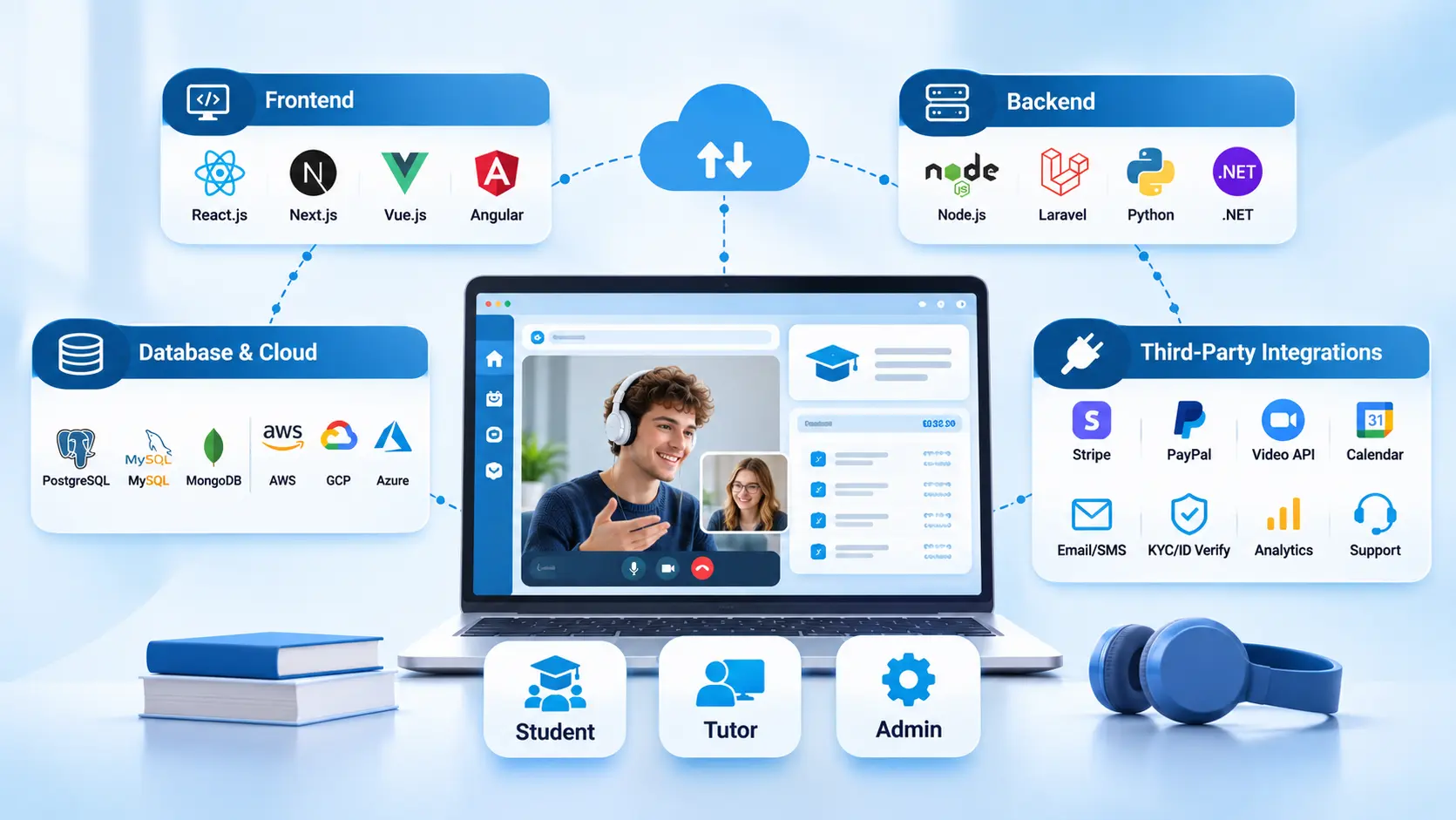
The technology stack should be selected according to the platform's features, expected usage, integrations and maintenance requirements. There is no single technology combination that suits every tutoring marketplace.
Frontend Development Technologies
The frontend contains the screens students, tutors and administrators use.
Common options include:
- React.js: Suitable for interactive dashboards, tutor search interfaces and booking experiences.
- Next.js: Supports React applications with server-side rendering and routing capabilities.
- Vue.js: Can be used to build responsive interfaces and interactive user dashboards.
- Angular: Provides a structured framework for larger applications with complex interface requirements.
The choice should account for the development team's experience and the platform's long-term maintenance needs.
Backend Development Technologies
The backend handles account management, permissions, bookings, payments and communication between different platform components.
Common options include:
- Node.js: Suitable for API-driven applications and real-time communication features.
- Laravel: A PHP framework that provides tools for authentication, database operations and application development.
- Python: Can be used for backend services, data processing and recommendation functionality.
- .NET: Suitable for applications that require structured backend services and integration with Microsoft technologies.
For example, a marketplace using Laravel may manage tutor profiles, bookings and payments through backend APIs, while a Vue.js frontend provides separate dashboards for students, tutors and administrators.
Database and Cloud Infrastructure
A tutoring marketplace stores several types of information, including user accounts, tutor profiles, schedules, bookings, transactions and reviews.
PostgreSQL and MySQL are suitable options for structured relational data. MongoDB may be considered for specific document-oriented requirements.
Cloud infrastructure can support application hosting, file storage, database services, backups and monitoring. The architecture should also account for traffic increases, data recovery and service availability.
Third-Party Integrations
Integrations can reduce the amount of functionality that needs to be developed from scratch.
Common integrations include:
- Stripe, PayPal or other supported payment providers.
- Video conferencing APIs.
- Email and SMS notification services.
- Calendar services.
- Identity verification providers.
- Analytics platforms.
- Customer support tools.
Evaluate each provider's pricing, supported countries, API limits, privacy practices and technical requirements before integrating it.
Need the Right Technology for Your Tutoring Platform?
Choose the right frontend, backend, database and third-party integrations for your marketplace. Get a development plan based on your platform requirements, expected users and future growth.
Discuss Your Tech Requirements
How Much Does It Cost to Build an Online Tutoring Marketplace?
The cost of building an online tutoring marketplace depends on its features, platform type, integrations and development complexity. A basic MVP costs less than a full-featured marketplace with mobile apps, AI-based tutor matching and custom virtual classrooms.
Estimated Development Cost
| Development scope | Estimated cost |
| Basic MVP | $ 3,000–$ 5,000+ |
| Mid-level marketplace | $ 5,000–$ 10,000+ |
| Advanced marketplace | $ 10,000–$ 25,000+ |
Factors Affecting Development Cost
- User roles: Separate student, tutor, parent and admin dashboards increase development costs.
- Platform type: Web platforms, native mobile apps and cross-platform apps have different costs.
- Booking and scheduling: Calendar integration, recurring bookings and time-zone support add development work.
- Payment integration: Subscriptions, commissions, refunds and tutor payouts increase payment system complexity.
- Video functionality: Third-party video integration generally costs less than building a custom virtual classroom.
- Custom features: AI matching, advanced analytics and group classes increase the overall budget.
Ongoing Costs
- Cloud hosting and database services
- Video conferencing services
- Payment processing fees
- Email and SMS services
- Maintenance and security updates
- Storage and backups
These recurring expenses depend on platform usage and the services selected.
Security and Privacy Requirements for a Tutoring Marketplace

A tutoring marketplace handles personal profiles, communications, educational information and payment records. Its security requirements should be included in the initial architecture and development plan.
Secure Authentication and Access Control
Use secure authentication, account recovery and session management. Apply role-based access controls so students, tutors, administrators and support staff can only access information required for their responsibilities.
For example, a tutor should be able to view their own bookings and earnings but should not be able to access another tutor's payment records.
Data Encryption and Payment Security
Protect personal information during transmission and storage. Use secure connections and follow the payment provider's recommended integration practices.
Avoid storing sensitive card details directly unless the business has the required payment security infrastructure. Using a recognised payment processor can reduce the amount of payment data the marketplace needs to handle.
Tutor Verification
Tutor profiles may contain claims about qualifications, professional experience and teaching credentials. Provide a verification process that allows administrators to review relevant documents and approve profiles.
The platform should also define how users can report suspicious profiles and how administrators investigate complaints.
Protecting Children on Tutoring Platforms
Marketplaces serving children need additional privacy and safety controls.
Depending on the target age group and operating location, requirements may include:
- Parent or guardian registration.
- Age verification or age-appropriate account controls.
- Parental consent where legally required.
- Restricted communication features.
- Tutor screening procedures.
- Reporting and moderation tools.
- Controlled access to lesson recordings.
- Clear data retention and deletion policies.
For platforms covered by the US Children's Online Privacy Protection Act, the Federal Trade Commission's COPPA compliance guidance explains requirements concerning children's personal information, parental notice and consent, access, security and deletion.
COPPA applies to covered online services directed to children under 13 and certain services with actual knowledge that they collect personal information from children under 13. Businesses serving children in other countries should assess the relevant local privacy and child protection laws as well.
Common Development Mistakes to Avoid
Some development decisions can create operational problems even when the main features appear to work.
Building too many features before validating demand: Developing AI recommendations, complex analytics and several classroom tools before testing basic bookings can increase the initial budget without proving that users need those features.
Ignoring tutor availability: A search result is useful only if the tutor can accept the requested lesson. Availability should be updated when bookings are confirmed, cancelled or rescheduled.
Using unclear payment rules: Students and tutors should understand how commissions, cancellations, refunds and payouts work. Unclear rules can lead to payment disputes.
Treating tutor verification as optional: A profile with an uploaded certificate does not automatically mean the qualification has been verified. Define who reviews the information and how approval is recorded.
Overcomplicating tutor discovery: Too many filters can make searching difficult. Start with the attributes that genuinely help students select an instructor.
Ignoring marketplace liquidity: A platform needs enough active tutors in the right subjects and time slots. Large registration numbers do not necessarily indicate that students can find suitable instructors.
Adding AI without reliable data: Recommendations depend on accurate tutor profiles, subject categories, availability and student preferences. Establish these data foundations before investing in advanced matching.
Planning privacy controls after development: Changes to parental consent, account permissions and data collection can affect registration, messaging, storage and third-party integrations. Address these requirements early.
How to Launch and Scale an Online Tutoring Marketplace
Launching a tutoring marketplace requires both a working platform and an initial supply of tutors. Students will have little reason to return if they cannot find instructors who match their subjects, budgets and schedules.
Start with a focused category or geographical market. Recruit qualified tutors, verify their profiles and make sure their schedules are accurate before investing heavily in student acquisition.
Once the first bookings begin, monitor the complete experience. Look at how students discover tutors, how often bookings are completed, where cancellations occur and whether students return for additional lessons.
Marketplace Metrics to Monitor
| Metric | What it measures |
| Tutor activation rate | Percentage of registered tutors who complete onboarding and become available |
| Booking conversion rate | Percentage of relevant visitors or searches that result in bookings |
| Booking completion rate | Percentage of confirmed lessons that are completed |
| Repeat booking rate | Percentage of students who book again |
| Tutor response time | Time taken by tutors to respond to booking requests |
| Cancellation rate | Percentage of bookings cancelled |
| Gross transaction value | Total value of completed marketplace transactions |
| Net marketplace revenue | Revenue retained after applicable deductions |
These measurements help identify specific problems. For example, a high number of tutor profile views but few bookings may indicate that students need better profile information, clearer pricing or more available time slots.
As activity grows, the marketplace can introduce more subjects, additional tutor categories, group lessons, subscription plans and advanced matching. Expansion should follow actual demand and the platform's ability to support additional users and transactions.
Build Your Online Tutoring Marketplace with Nyusoft
Developing a tutoring marketplace requires a clear understanding of how students, tutors and administrators will use the platform. The right development approach should account for the business model, user workflows, payment requirements, scheduling rules and learning experience from the beginning.
Nyusoft develops EdTech platforms and tutoring marketplace solutions for businesses planning to connect students with independent tutors. Its on-demand e-learning marketplace development solution covers student and tutor functionality, search, booking, payments, live learning and marketplace administration.
For businesses exploring a wider education app development project, the platform scope can also include learning management, virtual classrooms, assessments and other educational features.
The first step is to define the type of tutoring marketplace you want to launch, who it will serve and which features are needed for its initial release.
FAQs On Online Tutoring Marketplace
1. How much does it cost to build an online tutoring marketplace?
The estimated development cost ranges from $3,000 to $5,000+ for a basic MVP, $5,000 to $10,000+ for a mid-level marketplace, and $10,000 to $25,000+ for an advanced marketplace. The final cost depends on the required features and development scope.
2. How long does it take to build an online tutoring marketplace?
Building an online tutoring marketplace typically takes 4–12 weeks, depending on the platform's complexity, features, integrations and testing requirements. A basic MVP may take 4–6 weeks, while a mid-level marketplace may take 6–9 weeks and an advanced marketplace may take 9–12 weeks or longer.
3. What features should an online tutoring marketplace have?
Essential features include student and tutor registration, tutor profiles, search and filters, booking and scheduling, online payments, video sessions, reviews, notifications and an admin dashboard.
4. How does an online tutoring marketplace make money?
An online tutoring marketplace can generate revenue through commission on tutor bookings, subscription plans, paid tutor listings, booking fees and premium platform features.
5. Can I build an online tutoring marketplace with mobile apps?
Yes. You can develop a responsive web platform along with Android and iOS applications. Mobile apps allow students and tutors to manage profiles, schedule lessons, receive notifications and access learning sessions.
6. How can students find the right tutors on a marketplace?
Students can find tutors through search filters such as subject, language, teaching experience, hourly rate, availability, ratings and teaching format. AI-assisted matching can also suggest tutors based on student requirements.
7. How are payments and tutor commissions managed?
The platform can integrate payment gateways to collect lesson fees, calculate marketplace commissions, process refunds and manage tutor payouts. The payment workflow depends on the selected business model.
8. Can an online tutoring marketplace support live video classes?
Yes. It can support live video classes through third-party video conferencing services or a custom virtual classroom. Additional features may include screen sharing, chat, file sharing and interactive whiteboards.
9. How do I verify tutors on an online tutoring platform?
Tutor verification can include identity checks, qualification documents, teaching experience, profile reviews and manual administrator approval. The verification process depends on the platform's requirements.
10. Can an online tutoring marketplace use AI features?
Yes. An online tutoring marketplace can integrate AI-powered tutor matching, personalised learning recommendations, AI tutoring assistants, chatbots and learning analytics. These features can help students find suitable tutors and access additional learning support.
Planning an online tutoring marketplace?
Discuss your project requirements, preferred business model, and development scope to identify the right approach for your platform.

