

 Front End Development
  Back End Development
  CMS / ECommerce Development
  Mobile Apps Development
  Cloud Services
  Fullstack Services
  Solution


How Claude Helps Improve Student Retention in LMS Platforms
One of the most expensive issues in education is student drop-out. Any student who leaves prematurely is a waste to universities and edtech companies’ reputations. However, it is not the matter of course material that is typically a problem. It’s the lack of support around it. Students lose focus when they are at a loss for what to do at midnight, when the material is too slow or too fast, or when they silently forget what is next, or what they are supposed to do.
The AI developed by Anthropic, Claude, can be directly integrated into EdTech LMS platforms such as Canvas to bridge these support gaps effectively. This blog post takes a stroll through the way Claude uses an LMS to operate within an organization, the specific elements it enhances in retention, and how development and companies can install it.
Why Students Drop Off in LMS Platforms
The majority of learning management systems are constructed in a way that they do not accommodate individual learners; they present content. The student with calculus difficulties shares the course page with a student who is sailing through the course. It does not have a real-time feedback loop. Nudge is not applied if another has not signed in within a week.
There was no means of answering a question at 2 AM. It is that disconnect between what is taught and what is actually learned by the student, and it is that disconnection that kills retention. Those students who are at the highest risk tend to be the ones who are least likely to seek help.
How Claude Fits Inside an LMS
Claude is not an independent app that students need to enroll in. It integrates with the workflows of existing LMS through the Claude for Education program of Anthropic. The largest integration currently is the one with Canvas. Claude is compatible with Canvas LTI (Learning Tools Interoperability), so students can open Claude within their course, without tab-switching or even logging in. Anthropic has collaborated with Instructure (maker of Canvas) to natively make this work.
Claude links to other tools via the Anthropic Model Context Protocol (MCP) besides Canvas. That covers Panopto of lecture transcripts, Wiley of peer-reviewed textbook material, Google Workspace of documents, and GitHub of courses heavy on code. All this leads to a single conversation, and thus, a student will be able to ask Claude about the lecture on Tuesday and receive a response based on the real-life recording of the lecture.
Claude can also be used by businesses investing in custom LMS development, using the API and Amazon Bedrock, along with institutional procurement via AWS Marketplace.
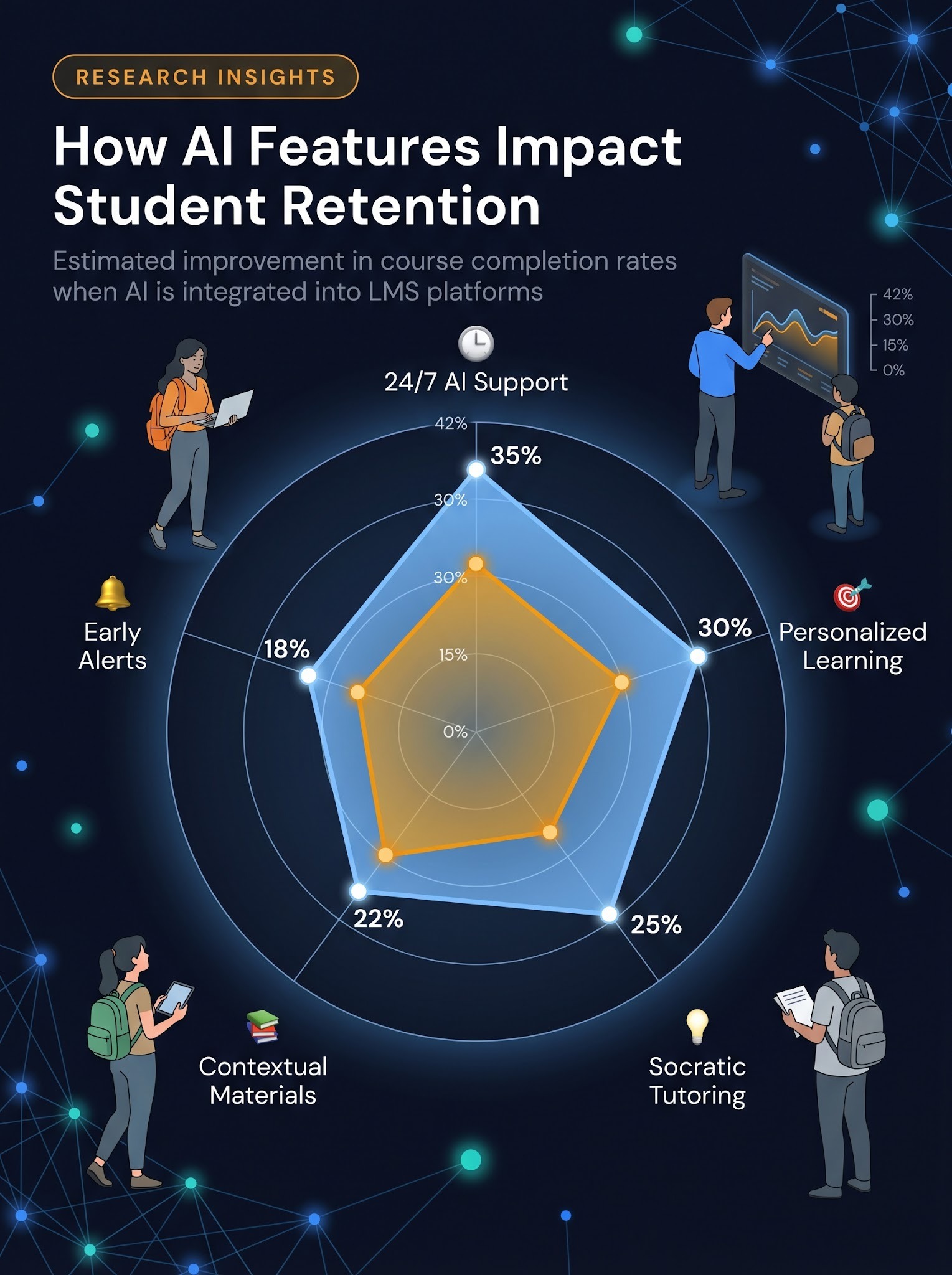
Five Ways Claude Helps Improve Student Retention
This is what Claude literally does when it is within your LMS, and why all of this is critical to retaining and engaging students.
| What Claude Does | How It Helps Retention | Example |
| Personalized explanations | Responds to the level of each student rather than responding generally. A graduate student and a first-year student have different levels of depth. | A student of biology inquires about the division of cells and receives a visual description, but not a textual one. |
| 24/7 availability | Students can receive assistance when they require it, and not only during office hours. The majority of questions are asked on weekends or at night, the time when human assistance is unavailable. | A student with the coding problem is not able to get out of a problem in the middle of the night, but is able to do it right away, without a 14-hour waiting time to get a TA. |
| Learning Mode (Socratic tutoring) | Claude does not give over answers but asks guiding questions. This develops real knowledge, which implies that students are more confident and less prone to giving up. | Student asks: How do I solve this equation? Claude answers: You can do it first by isolating x on one side. |
| Course materials in context | Drag’s lecture notes, textbook excerpts, and assignment information into the discussion. Students do not need to search over five tabs to locate what they need. | A student revising exam requests Claude to explain one of the concepts covered in Week 3, and Claude makes reference to the actual recording of the lecture. |
| Spotting disengagement early | AI-assisted analytics allow faculty and admins to identify students who aren’t learning in 10 days and take the initiative to reach out to them. | An instructor notices three students who have not engaged with course materials within 10 days and takes the initiative to reach out to them. |
Real-World Results: Universities Already Using Claude
This isn’t theoretical. A few institutions are already at scale with Claude and are experiencing results.
• Northeastern University
Claude is now fully accessible to 50,000 students, faculty, and staff across 13 campuses worldwide. They were Anthropic’s first university design partners.
• London School of Economics (LSE)
Campus-wide implementation that provides AI-assisted learning support to all students.
• University of San Francisco School of Law
Claude is in the law school curriculum to enhance student engagement and pragmatic AI literacy.
• Northumbria University
As one of the first to do so in the UK, the university is moving towards responsible AI use.
• Champlain College
A full campus access agreement, which would allow Claude to have access everywhere in the institution.
How to Integrate Claude Into Your LMS
The following are the ways you can use to integrate Claude into your Learning Management System:
1. Canvas LTI (quickest route)
Sign up with Canvas and create a developer key with Claude, add the placements of Course Navigation and Assignment Edit, and install it into your app settings. Next, attach it to the Claude for Education administrator side on Organization Settings > Connectors. Claude will be perceived as part of the courses students are taking.
2. Claude API + MCP for custom builds
Claude API can be used directly in case you would like to have more control, such as a custom tutoring bot trained on the specific materials of your institution. MCP servers allow you to programmatically connect Claude with Canvas, Panopto, Wiley, and other tools. It even has an open-source Canvas MCP server on GitHub and 87+ course management, grading, and analytics tools.
3. AWS Marketplace for procurement
Claude can be accessed by institutions that require enterprise procurement and billing on the AWS marketplace, which opened in mid-2025.
A practical tip: Start with small things. Select a course or a department to implement for a semester, compare it with a control group, and scale completion rates.
Read Also: How an All-In-One EdTech Platform Simplifies Learning for Students, Parents & Tutors
How Claude Compares to Other Options
Claude is not the only AI tool for LMS retention. QuadC provides tutor escalation and sentiment analysis for various LMS systems. D2L Brightspace has built-in predictive nudges. Docebo specializes in company upskilling based on responsive content paths. The difference between Claude and other LMS offerings is their heavy LMS integration (with a focus on Canvas), a Socratic learning style, focusing on understanding over answering, and private defaults in general: student discussions are not automatically trained by AI. That is important to institutions, which are concerned with pedagogy, and not with automation alone.
Getting Started!
Retention of students is not a one-sided issue that has a one-sided solution. However, much of why students drop out, a lack of direction, the inability to receive help as quickly as they would like, a lack of motivation, etc., can be directly tackled by AI support within an LMS.
If you are self-assembling it or want help integrating Claude AI into your current LMS, we at Nyusoft Solutions can help you. We have been serving several industries for years and have successfully delivered projects, achieving 75% client retention. Reach out to us today, and let’s take your LMS system to the next level!