


 Front End Development
 Back End Development
 CMS / ECommerce Development
 Mobile Apps Development
 Cloud Services
 Fullstack Services
 Solution


Benefits of AI in Education: Use Cases for Schools and EdTech Businesses
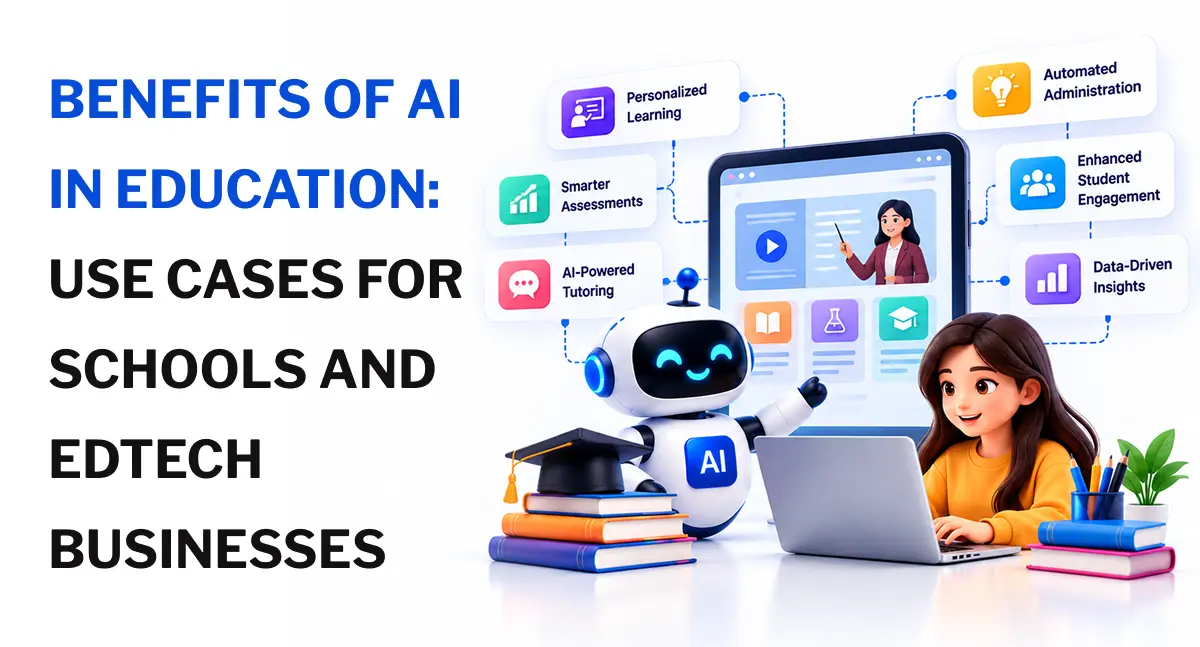
Artificial intelligence is helping schools personalize learning, assist teachers, automate routine tasks, and deliver more interactive educational experiences. According to Grand View Research's AI in education market report, the global market is estimated to reach $11.4 billion in 2026 and is projected to grow to $57.2 billion by 2033, at a compound annual growth rate of 25.9%. These are market forecasts, not guaranteed educational outcomes. The real benefits of AI in education depend on how schools, universities, and EdTech businesses use the technology to address specific learning, teaching, and operational challenges.
What Are the Main Benefits of AI in Education?
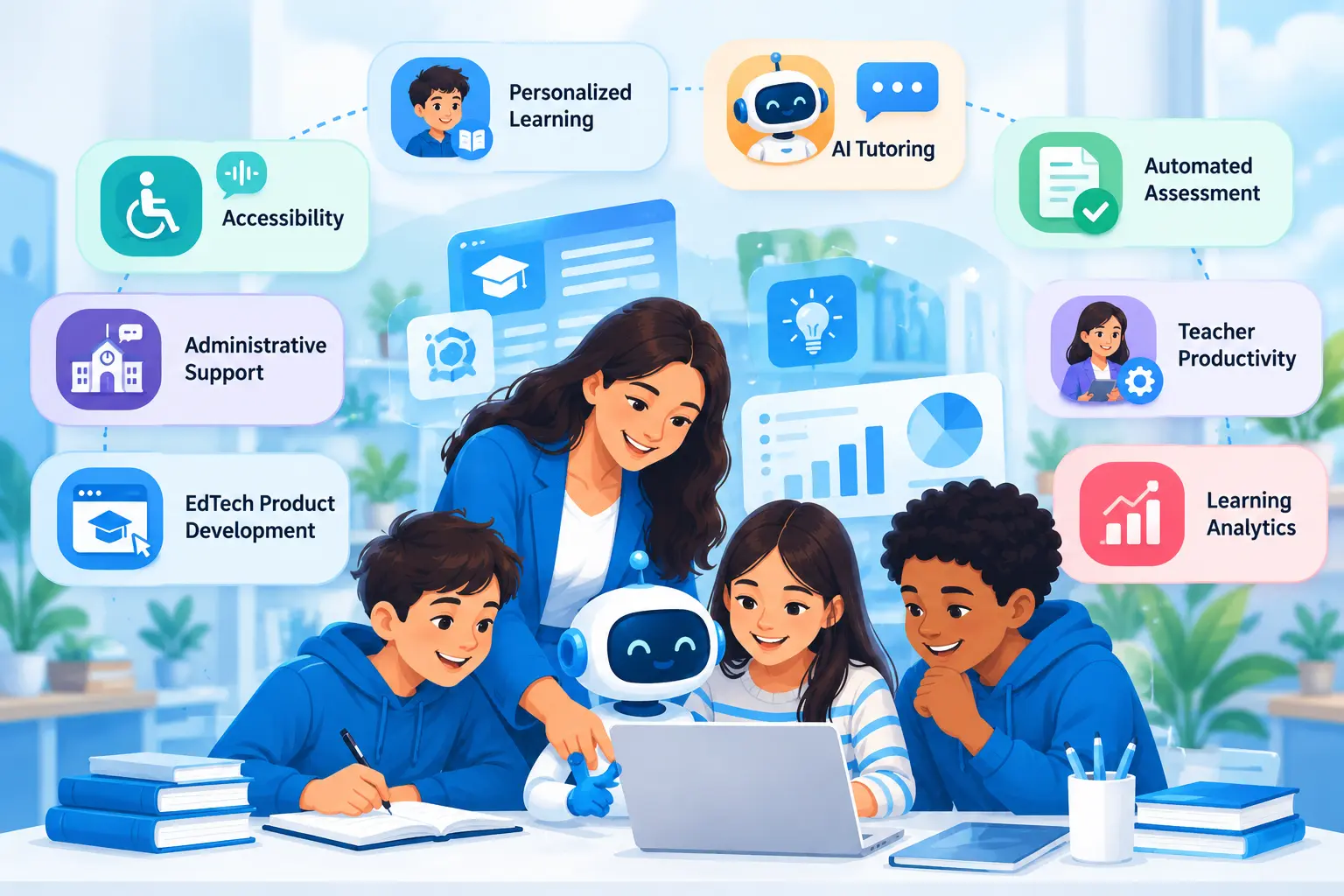
AI can help students receive more relevant learning support, give teachers additional time for instruction, and help education businesses develop new digital learning products.
The main benefits include:
- Personalized learning: Adapting learning activities to student progress and knowledge gaps.
- AI tutoring: Providing explanations, hints, and practice outside scheduled lessons.
- Automated assessment: Assisting with grading and feedback.
- Teacher productivity: Helping prepare lessons, quizzes, and educational materials.
- Learning analytics: Identifying patterns that may require a teacher's attention.
- Accessibility: Supporting captions, transcription, translation, and alternative explanations.
- Administrative support: Answering routine questions and helping staff retrieve information.
- EdTech product development: Adding AI assistants, recommendations, and intelligent assessment features to education software.
These benefits are most useful when a tool solves a defined problem and its results can be measured.
Build an AI-Powered Education App for Your Business
Planning an education app with personalized learning, AI tutoring, or student progress tracking? Turn your idea into a practical digital learning product with features designed around your users, learning goals, and business requirements.
1. Personalized Learning Based on Student Progress
Students in the same class often have different learning needs. Some understand a topic quickly, while others need additional practice or a different explanation.
AI-powered learning platforms can analyze quiz results, completed lessons, and previous answers to recommend suitable learning activities.
For example, a student struggling with fractions could receive additional exercises and visual explanations before progressing to more advanced mathematics.
AI can support personalized learning through:
- Recommending lessons based on identified knowledge gaps.
- Adjusting practice difficulty according to demonstrated progress.
- Suggesting revision activities before examinations.
- Helping teachers review individual and class-level performance.
- Providing alternative explanations for difficult concepts.
For EdTech businesses, these features can be developed through education app development, with student profiles, adaptive learning modules, assessments, and progress dashboards.
The system should allow teachers to review recommendations. A few incorrect answers do not provide enough evidence to judge a student's overall ability.
2. AI Tutors for On-Demand Learning Support
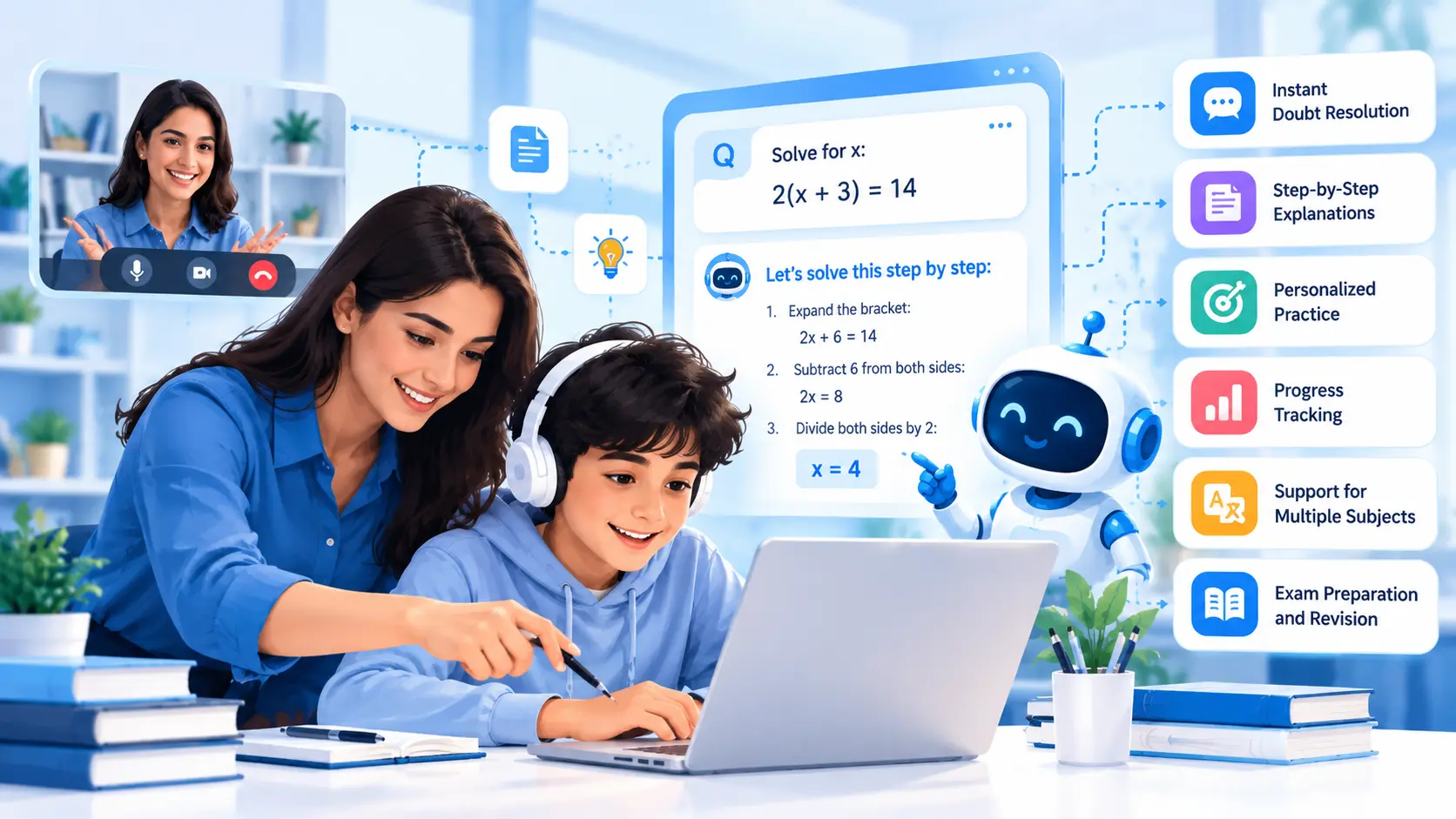
AI tutors can answer questions, explain concepts, provide hints, and guide students through practice exercises. They can supplement classroom teaching and human tutoring when learners need help outside scheduled sessions.
A student solving an algebra problem, for example, might receive an explanation of the rule they misunderstood, followed by a similar problem to practise independently.
Useful AI tutoring features include:
- Step-by-step explanations.
- Subject-specific question answering.
- Personalized practice exercises.
- Revision support for examinations.
- Conversational language-learning activities.
- Progress summaries and learning recommendations.
Accuracy needs careful attention. Generative AI can produce incorrect explanations, particularly when questions are ambiguous or require specialist knowledge.
Education platforms should use approved course materials as reference sources, test responses against known answers, and provide a way to report mistakes.
Businesses planning these features can explore AI-powered tutoring software development for the product requirements involved in tutor discovery, scheduling, student accounts, and interactive learning workflows.
Develop Your Own AI Tutoring Platform
Create an AI-powered tutoring platform that helps students get instant answers, practise difficult subjects, and track their progress. Build features that support tutors, improve the learning experience, and fit your education business model.
3. Faster Assessment and More Useful Feedback
Teachers spend time marking assignments, reviewing answers, and identifying recurring mistakes. AI can assist with parts of this work so students receive feedback sooner.
Common applications include:
- Automatic scoring for objective questions.
- Draft feedback against predefined assessment criteria.
- Identification of common errors across a class.
- Generation of practice questions from approved material.
- Performance reports for teachers and administrators.
For example, an assessment system could flag a topic that many students answered incorrectly. The teacher can investigate whether students misunderstood the lesson or whether the question itself was unclear.
AI-generated scores should not automatically be accepted for high-stakes examinations or subjective assessments. Human review, clear rubrics, and the ability to correct errors remain important.
A relevant example is this AI student assessment platform case study, which provides an education software example for readers exploring assessment and AI-assisted student support.
4. Less Time Spent on Routine Teaching Tasks
AI can help teachers prepare classroom materials and complete repetitive administrative work.
A teacher preparing a lesson on the water cycle could use an AI tool to draft a lesson outline, create revision questions, and prepare simpler explanations for younger students. The teacher would review the material before using it in class.
Practical applications include:
- Drafting lesson plans and classroom activities.
- Creating quizzes at different difficulty levels.
- Preparing worksheets and discussion prompts.
- Summarizing teaching documents.
- Drafting routine communications for parents.
- Adapting reading materials to different levels.
The aim is to reduce preparation time without compromising teaching quality. Teachers still need to check factual accuracy, curriculum alignment, and age suitability.
Schools should measure the time saved after accounting for the effort required to review and correct AI-generated content.
5. Improved Accessibility for Students
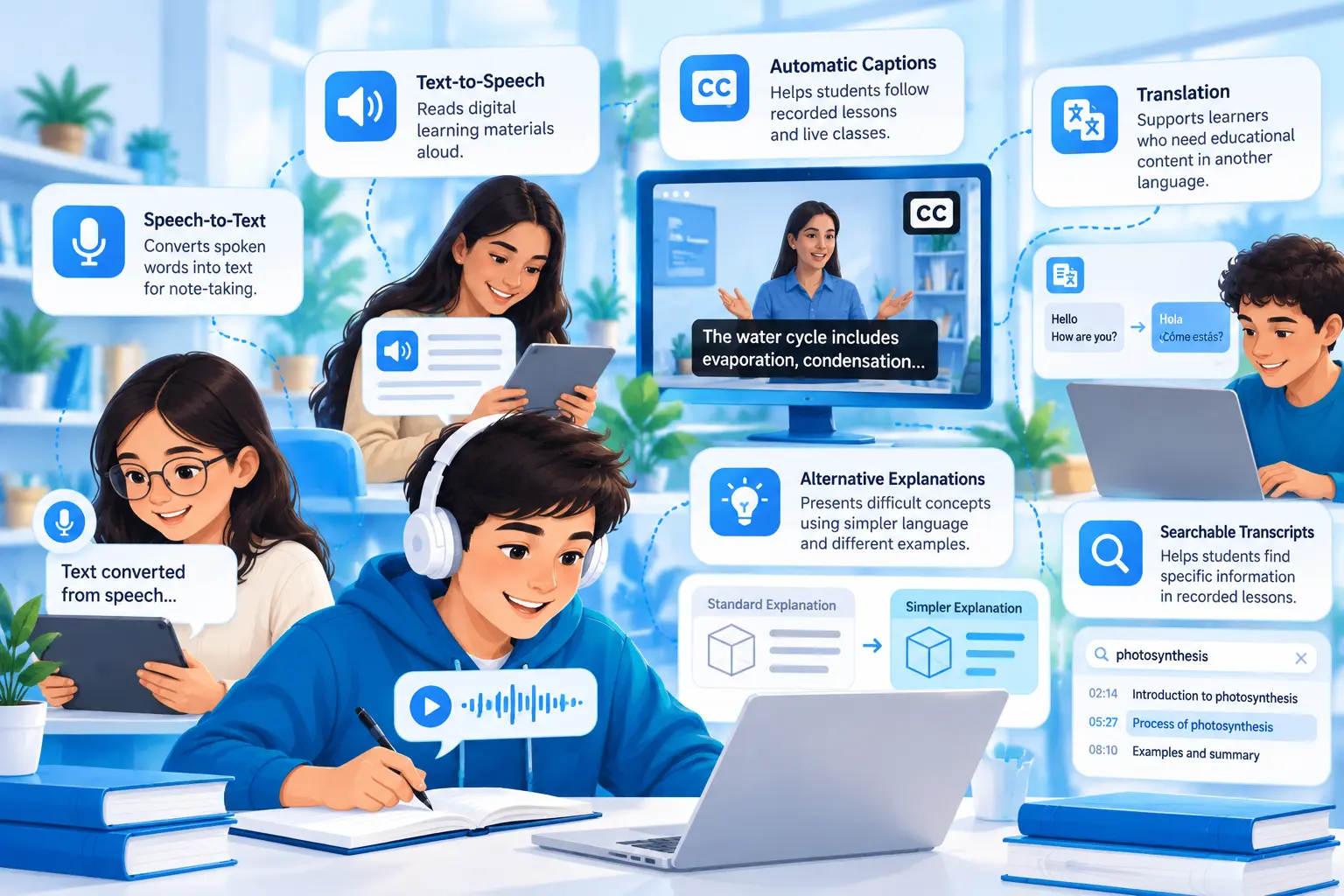
AI can help students access educational materials in formats that suit their needs. This can benefit learners who face language barriers, hearing or visual impairments, or reading difficulties.
Useful features include:
- Speech-to-text: Converts spoken words into text for note-taking.
- Text-to-speech: Reads digital learning materials aloud.
- Automatic captions: Helps students follow recorded lessons and live classes.
- Translation: Supports learners who need educational content in another language.
- Alternative explanations: Presents difficult concepts using simpler language and different examples.
- Searchable transcripts: Helps students find specific information in recorded lessons.
These tools need testing with actual users. Automatic captions can miss specialist terminology, and translations can change the meaning of important instructions.
Accessibility should be considered during the initial design and testing of educational software, not treated as an optional feature added after launch.
6. Identifying Learning Gaps Earlier
AI can analyze patterns in assessment results, attendance, and assignment completion to help teachers identify students who may need additional support.
For instance, a sustained decline in quiz scores combined with incomplete assignments could prompt a teacher to check whether a student is struggling with a particular subject.
Potential applications include:
- Identifying recurring difficulties with specific concepts.
- Tracking changes in assessment performance.
- Flagging incomplete coursework.
- Helping teachers prioritize student support.
- Summarizing progress across several assessments.
These systems should generate alerts for human review, not make decisions about students independently. A change in performance can have many causes, and incomplete data can lead to misleading conclusions.
Schools should also review whether the system produces unfair results for particular groups of students.
7. AI Chatbots for Schools and EdTech Businesses
Schools and education businesses receive recurring questions about admissions, enrollment, fees, course schedules, deadlines, and technical support.
An AI chatbot can answer routine queries using approved information and direct complex requests to the appropriate staff member.
Common applications include:
- Answering admissions and enrollment questions.
- Explaining course schedules and deadlines.
- Helping students find relevant learning materials.
- Providing basic account and platform support.
- Retrieving information from institutional documents.
- Routing unresolved queries to staff.
For example, a prospective student could ask which documents are required for admission and receive an answer based on the institution's published policy.
A reliable chatbot needs current information, clear access permissions, and an escalation process for questions it cannot answer. It should not disclose private student records or make unsupported promises about admissions.
Businesses developing these products can use AI chatbots for conversational interfaces, knowledge retrieval, and integrations with existing systems.
8. AI-Powered Learning Management Systems
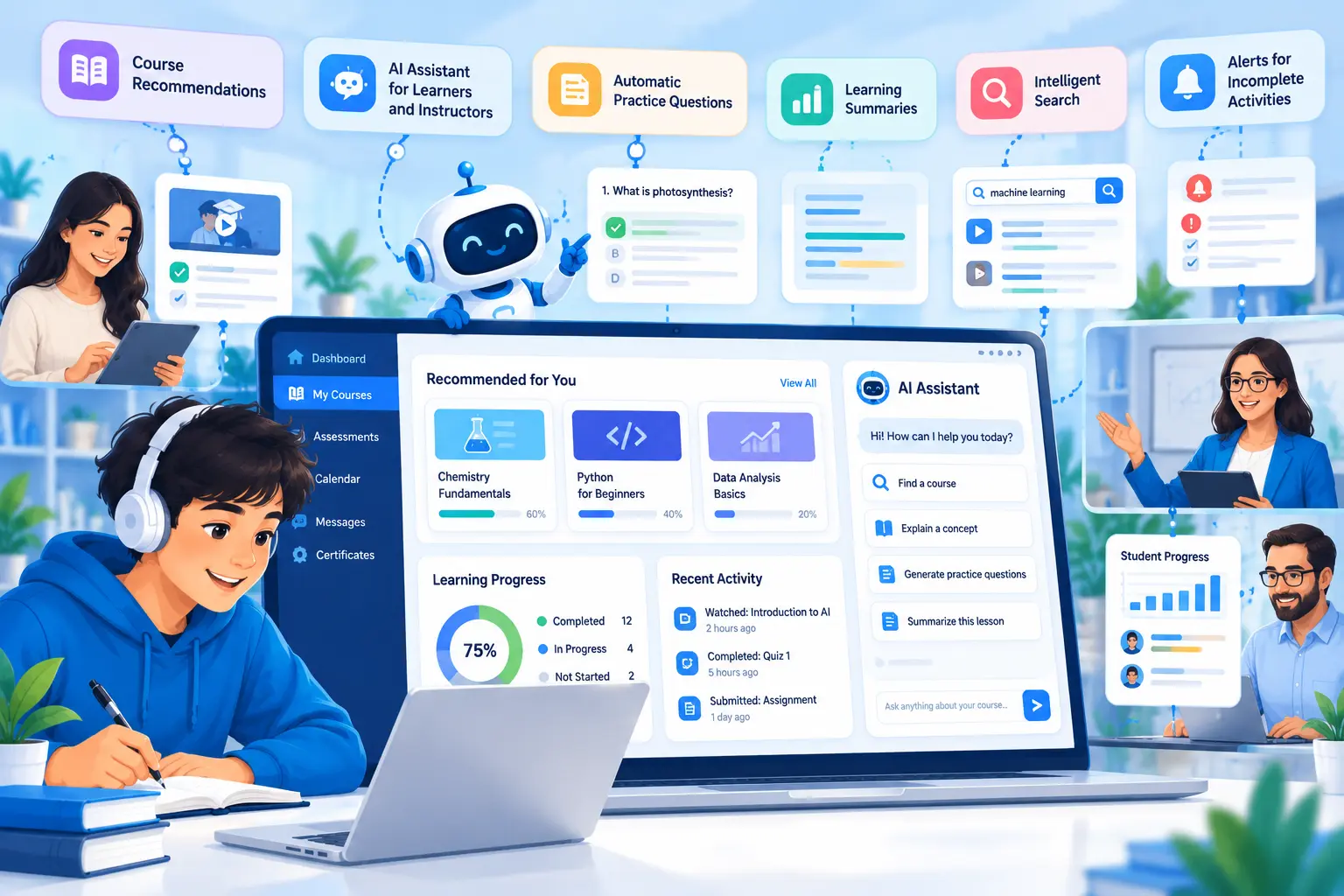
Learning management systems (LMS) organize courses, learning materials, assessments, and student progress. AI can add features that make these platforms more responsive to learners and instructors.
Potential features include:
- Course recommendations based on learner progress.
- AI assistants that answer questions using approved course materials.
- Automatic generation of practice questions.
- Summaries of student learning activity.
- Intelligent search across course libraries.
- Alerts for incomplete learning activities.
An AI assistant integrated into an LMS could help a student locate a lesson, understand a difficult concept, and find related exercises without leaving the course platform.
Development teams need to consider content permissions, student and teacher roles, data synchronization, and answer accuracy. Integrating AI into an existing LMS may be more appropriate than replacing the entire platform.
Businesses evaluating these capabilities can review learning management system development for relevant platform requirements.
Develop an AI-Powered Learning Management System
Build an LMS with AI-powered tutoring, personalized course recommendations, automated assessments, and student progress tracking. Develop a learning platform that meets your institution's requirements and supports engaging digital learning experiences.
9. AI Use Cases for EdTech Businesses
For EdTech businesses, artificial intelligence can support new education products and improve existing platforms. The right use case depends on the target audience, business model, learning objectives, and current software capabilities.
Different education products can benefit from different AI features.
| Education Product | Potential AI Features |
| E-learning platforms | Personalized learning paths, course recommendations, and intelligent search |
| Tutoring marketplaces | AI learning assistance, tutor matching, and student support |
| Assessment platforms | Automated scoring for objective questions, feedback generation, and performance analysis |
| Virtual classrooms | Lesson transcription, captions, and session summaries |
| Corporate training applications | Skill recommendations, practice activities, and learning progress reports |
| School management software | AI chatbots, document search, and automated responses to routine enquiries |
AI Opportunities for EdTech Startups
Startups can use AI to build education products around specific learning needs. For example, a business could develop an AI tutoring application for a particular subject, a language-learning platform with conversational practice, or an assessment application that provides feedback on practice questions.
Starting with a focused use case helps businesses define the essential features, identify their target users, and evaluate the product before expanding its capabilities.
Depending on the product, development may involve student accounts, content management, AI integration, progress tracking, payment processing, and administrative dashboards. The required features should reflect how the platform will be used and how the business plans to generate revenue.
AI for Existing Education Platforms
Established EdTech businesses may already have a learning platform, tutoring application, or course marketplace but want to improve its capabilities.
AI can support these goals through intelligent course recommendations, conversational student support, automated assessment assistance, and search across educational materials. The appropriate approach depends on the limitations of the existing platform, the data available, and the integrations required.
For example, an e-learning business could introduce an AI assistant that answers questions using approved course materials. A tutoring marketplace could focus on helping students discover relevant tutors and access additional learning support.
Other opportunities include developing an on-demand e-learning marketplace for course discovery and enrollment or using AI avatars for course delivery to provide interactive lessons.
Choosing the Right AI Use Case
Before investing in development, identify a problem that affects learners, educators, or administrators. Determine whether AI is suitable for addressing it, what information the system needs, and how the results will be measured.
For EdTech businesses, the priority should be to build a product that serves a clear educational or business purpose. A focused set of useful features is often a more practical starting point than introducing several AI capabilities at once.
10. What Does It Take to Develop an AI-Powered Education Platform?
Developing an AI-powered education platform involves more than integrating an AI model into an application. The product needs a clear purpose, suitable technology, reliable integrations, appropriate security controls, and a development plan that reflects the needs of its users.
Define the Product Requirements
Start by identifying the target users and the problem the platform should solve. A student-facing learning application has different requirements from a university LMS, tutoring marketplace, or online assessment system.
Define the essential user journeys and features before development begins. These may include student registration, course access, assessments, AI tutoring, progress tracking, payment processing, or educator dashboards.
Clear requirements help determine the project's scope and distinguish essential launch features from enhancements that can be introduced later.
Select the Appropriate AI Technology
Different educational requirements call for different approaches:
- Rules-based automation: Suitable for predictable tasks such as routing enquiries or checking required information.
- Machine learning: Useful for recommendations, classification, and analyzing patterns in learning activity.
- Generative AI: Useful for conversational assistance, summaries, and explanations of educational concepts.
- Retrieval-augmented generation (RAG): Helps an AI assistant retrieve relevant information from approved course materials or institutional documents before generating a response.
These approaches can work together. For example, an AI learning assistant could retrieve information from a course knowledge base and use predefined rules to direct unresolved questions to an educator.
The choice should depend on the required functionality, available data, response accuracy, integration needs, and expected operating costs. Businesses planning generative AI features can explore generative AI development as part of their technical planning.
Plan Integrations and Data Management
An education platform may need to connect with an existing LMS, student information system, assessment engine, payment gateway, content repository, or mobile application.
Development requirements may include:
- API integrations and data synchronization.
- Secure authentication and role-based permissions.
- Access to approved and current learning materials.
- Secure storage and handling of student information.
- Monitoring, error reporting, and performance evaluation.
- Compatibility across supported devices and user groups.
These requirements influence the technical design and overall development effort. Reviewing existing systems early can help identify integration challenges and prevent unnecessary duplication of functionality.
Develop and Test the Initial Version
Businesses do not need to launch every planned feature at once. A focused first release can help establish whether the core product meets user needs.
For example, an AI tutoring application could begin with student accounts, a tutor for a specific subject, approved learning materials, and basic progress tracking. Additional subjects, advanced analytics, and wider integrations can be considered after the initial version has been evaluated.
Testing should cover usability, AI response accuracy, security, accessibility, permissions, and performance under realistic conditions. Feedback from educators and representative learners can help identify issues before wider deployment.
Measure Results and Plan Ongoing Maintenance
Before launch, decide how the product's performance will be evaluated. Depending on the use case, relevant measures may include answer accuracy, response times, course completion, user engagement, teacher workload, error rates, and operating costs.
AI-powered education software also requires ongoing maintenance. Course materials change, integrations need updates, and model usage can affect operating expenses as the number of users grows.
The development plan should account for monitoring, technical support, security updates, AI performance evaluation, and future improvements.
For EdTech businesses, these steps help establish a practical development scope, prioritize the right features, and build a platform that meets both user needs and business objectives.
11. Privacy, Accuracy, and Other Risks to Address
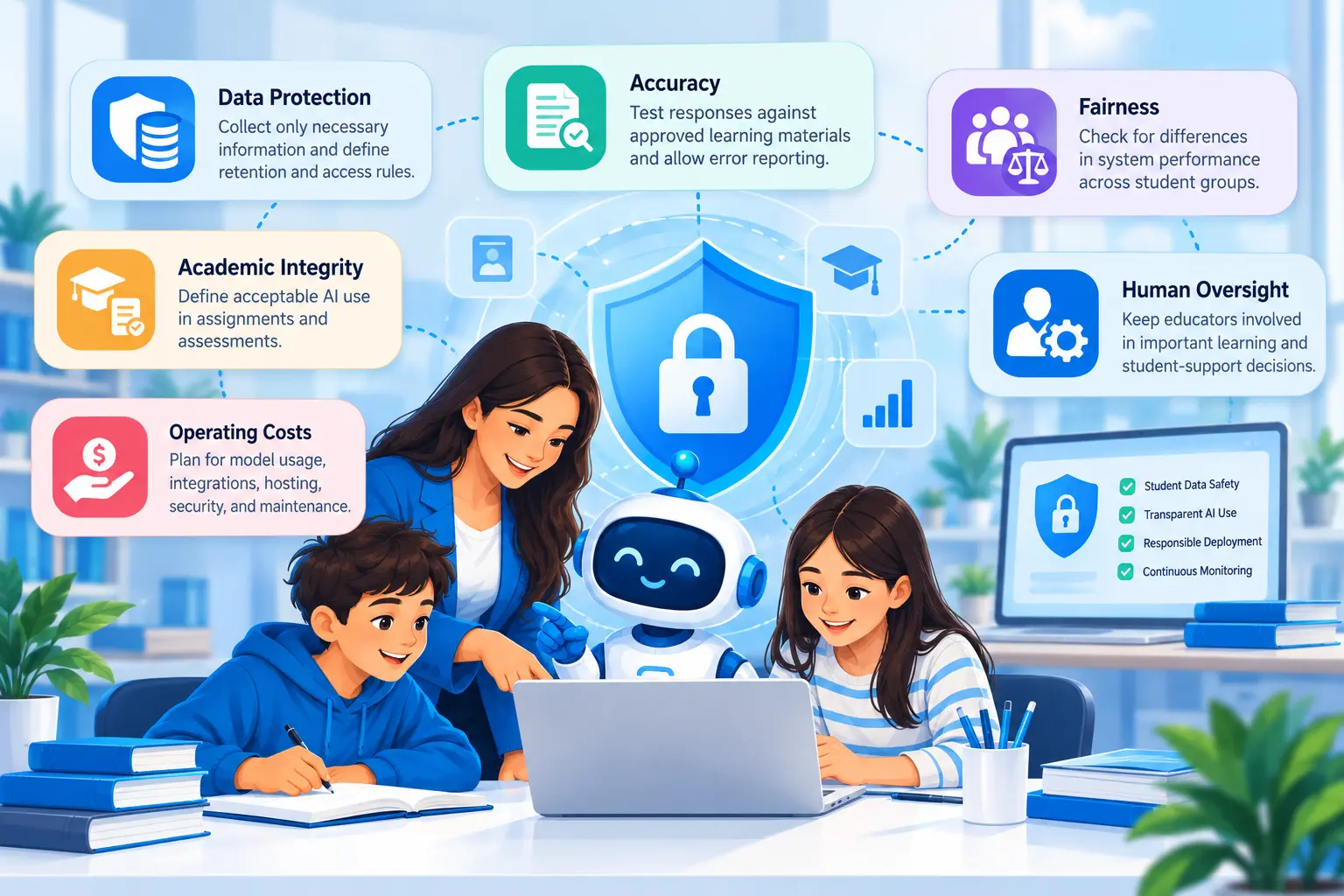
AI tools used in education can affect student records, assessments, and learning decisions. Schools and EdTech businesses should establish appropriate safeguards before deployment.
The UNESCO guidance on generative AI in education and research discusses human-centered implementation, data privacy, and age-appropriate use.
Important considerations include:
- Data protection: Collect only the information required for the intended purpose and define retention and access rules.
- Accuracy: Test responses against approved learning materials and provide a way to report errors.
- Fairness: Check for differences in system performance across relevant student groups.
- Academic integrity: Define acceptable AI use in assignments and assessments.
- Human oversight: Keep educators involved in important learning and student-support decisions.
- Operating costs: Account for model usage, integrations, hosting, security, and ongoing maintenance.
A successful implementation should be evaluated on educational value and operational performance, not simply the number of AI features it includes.
Planning an AI-Powered Education Product?
Schools, universities, tutoring providers, and EdTech companies have different software requirements. Some need a new learning application, while others want to add AI tutoring, assessment automation, intelligent search, or analytics to an existing platform.
The right development approach begins with three questions:
- What problem should the product solve for students, teachers, or administrators?
- Which AI capabilities are appropriate for that problem?
- How will the business measure whether the finished product delivers the intended results?
Nyusoft works across education app development and AI software development, with relevant product areas including tutoring platforms, e-learning marketplaces, learning management systems, assessment applications, and interactive course delivery.
If your business is planning a new EdTech product or evaluating AI integration into an existing application, the next step is to define the use case, required integrations, target users, and expected outcomes. These details help establish a practical development scope and identify which features should be built first.
The benefits of AI in education are strongest when the technology addresses a real need, gives users reliable results, and keeps appropriate human oversight in place.
FAQs
1. What are the main benefits of AI in education?
The main benefits of AI in education include personalized learning, AI tutoring, faster assessment feedback, teacher assistance, improved accessibility, learning analytics, and automated administrative tasks. AI can also help EdTech businesses develop smarter learning platforms and educational applications.
2. How does AI improve personalized learning?
AI can analyze quiz results, learning progress, and previous answers to recommend lessons and practice activities suited to a student's needs. This helps students spend more time working on difficult concepts while progressing through topics they already understand.
3. How can teachers use AI in the classroom?
Teachers can use AI to prepare lesson plans, create quizzes, explain difficult concepts, develop worksheets, summarize educational materials, and analyze student performance to identify learning gaps.
4. Can AI replace teachers and human tutors?
No. AI can support teaching by answering routine questions, providing practice exercises, and explaining concepts, but it cannot fully replace the judgment, encouragement, classroom management, and personal understanding provided by teachers and human tutors.
- How Are AI Education Apps and Software Useful?
AI education apps and software help students learn at their own pace, access instant learning support, practise difficult subjects, and track their progress. They also help teachers manage learning activities, provide feedback, and identify areas where students need additional support.
6. What are the benefits of AI in learning management systems (LMS)?
AI-powered LMS platforms can recommend courses, answer questions about learning materials, generate practice questions, summarize student progress, and identify incomplete activities. These features can make course content easier to access and help instructors monitor learning activity.
7. How can AI help EdTech businesses attract and support more learners?
EdTech businesses can use AI to offer personalized learning paths, on-demand tutoring support, intelligent course recommendations, and faster responses to student enquiries. These features can improve the user experience, but their effect on enrollment, retention, and revenue should be measured rather than assumed.
8. What are the risks of using AI in education?
Common risks include inaccurate answers, student data privacy concerns, algorithmic bias, academic integrity issues, and overdependence on automated tools. Schools and EdTech businesses should use appropriate security controls, test AI outputs, establish clear usage policies, and maintain human oversight.
9. How much does it cost to develop AI-powered education software?
The cost depends on the product's features, AI model, integrations, data requirements, security controls, and ongoing maintenance. Adding a chatbot to an existing platform generally involves a different scope from building a complete AI-powered learning management system. A detailed estimate requires defined features and technical requirements.
10. How can a business develop an AI-powered education platform?
A business can start by identifying a specific educational problem, defining the target users, selecting suitable AI capabilities, and determining how the software will integrate with existing systems. The next steps include designing the application, testing accuracy and security, running a pilot, and measuring results before expanding the product. Working with an experienced education software development team can help establish the technical scope and implementation plan.
Build Your Custom EdTech Software Solution
Turn your EdTech business idea into a functional software product with custom education app development, AI-powered learning features, tutoring platforms, or assessment systems. Plan the right features and integrations for your users and business goals.

