

 Front End Development
  Back End Development
  CMS / ECommerce Development
  Mobile Apps Development
  Cloud Services
  Fullstack Services
  Solution


How Much Does It Cost to Develop an AI Chatbot?
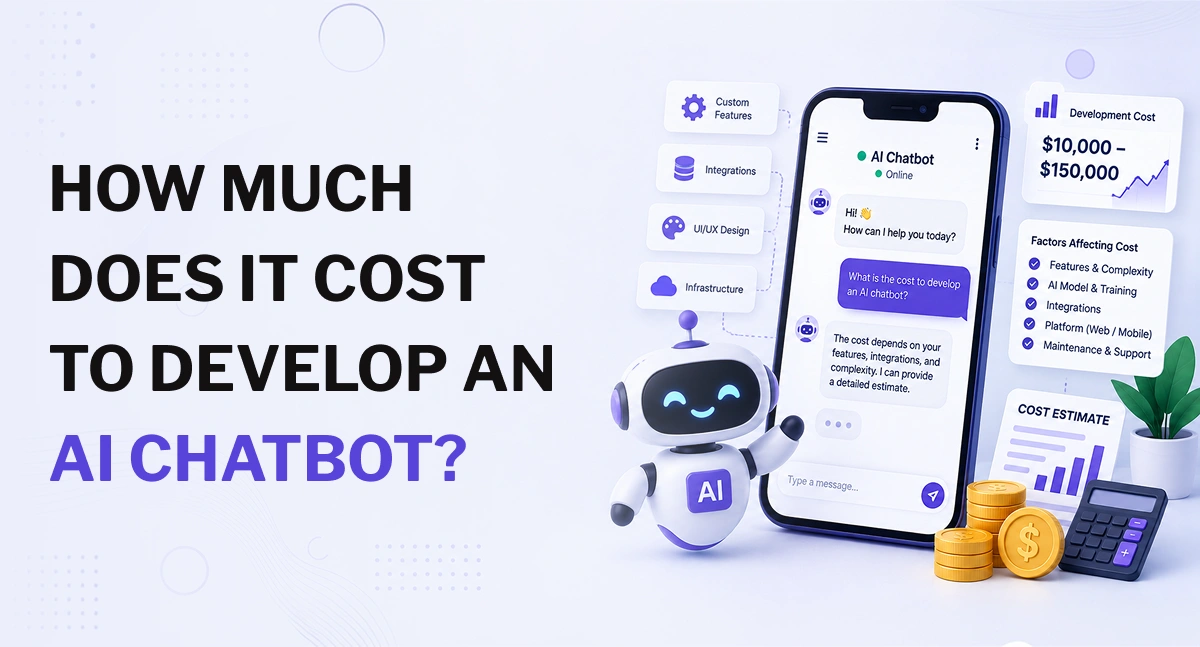
The cost to develop an AI chatbot typically ranges from $2,500 to $5,000 for a basic chatbot, $5,000 to $10,000 for a custom AI chatbot, and $10,000 to $20,000 or more for an advanced enterprise system. The actual price depends on the chatbot's features, AI model, knowledge base, integrations, security requirements, channels, expected usage, and whether it needs to perform actions.
A simple website chatbot that answers common questions is relatively straightforward. A business assistant that can search internal documents, access a CRM, check an order, create a support ticket and hand a conversation to a human requires a much larger development effort.
The development budget is also only part of the picture. AI model usage, cloud hosting, databases, monitoring, third-party services and ongoing maintenance can create recurring costs after launch.
AI Chatbot Development Cost at a Glance
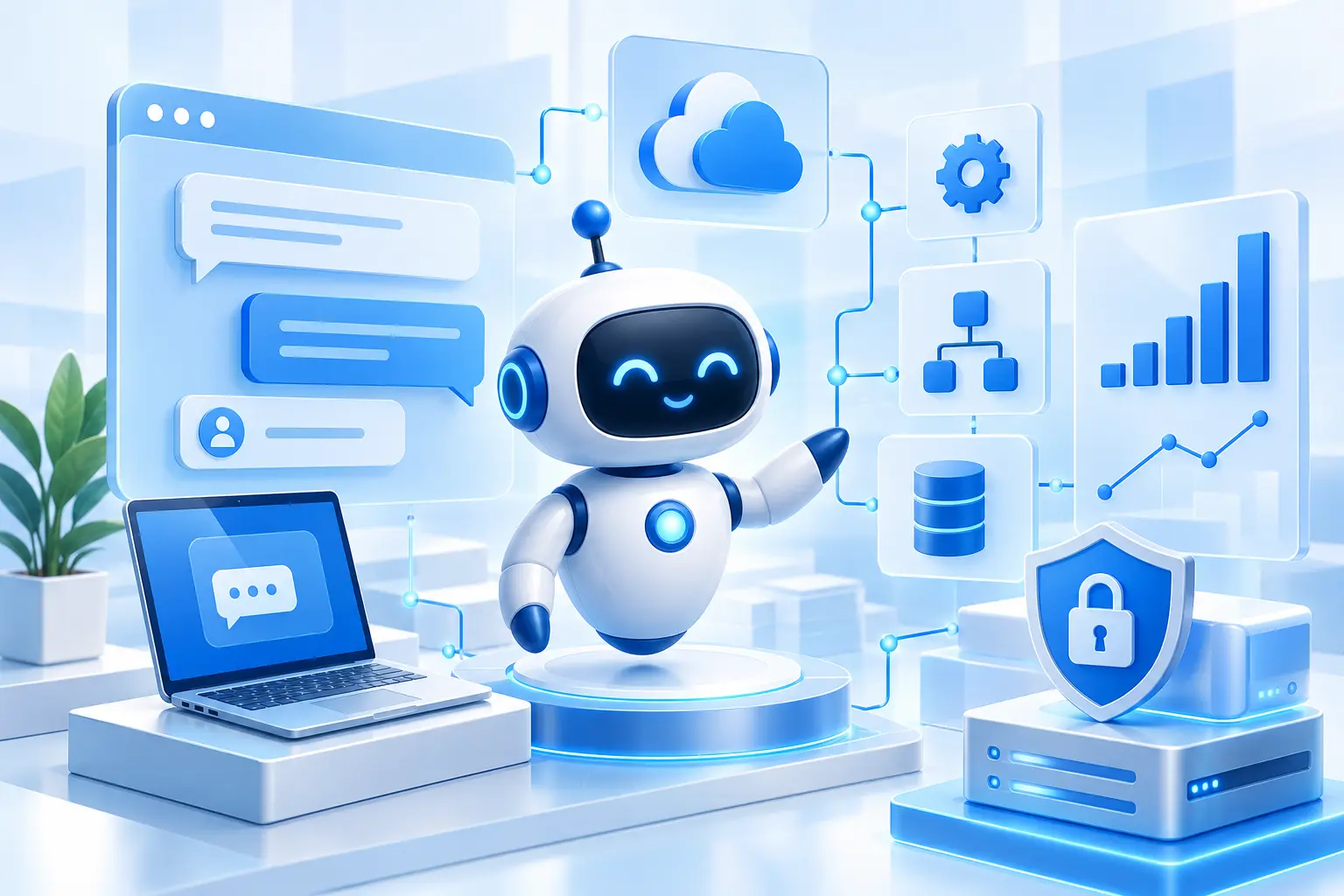
There is no single price for an AI chatbot because two systems can look similar to a user while having very different technical requirements.
| AI chatbot type | Approximate development cost | Typical features |
| Basic AI chatbot | $2,500-$5,000 | Website chat, FAQs, basic AI responses |
| Custom AI chatbot | $5,000-$10,000 | Custom knowledge base, RAG, admin features, selected integrations |
| Advanced AI chatbot | $10,000-$20,000+ | Multiple integrations, voice, multilingual support, advanced workflows |
| Enterprise AI chatbot | $20,000+ | Complex systems, private data, multiple platforms, advanced security and governance |
These figures should be treated as planning ranges rather than fixed quotations. A chatbot with a small knowledge base and one website interface can fall near the lower end. A system connected to several business applications can move well beyond the upper end.
The most useful question is therefore not simply "How much does an AI chatbot cost?" It is "What does the chatbot need to do?"
Need an AI Chatbot Development Cost Estimate?
AI chatbot costs vary based on features, AI models, integrations, data requirements and development complexity. Get a clearer estimate by discussing the functionality and technical requirements involved in the planned chatbot.
What Determines the Cost of AI Chatbot Development?
Several technical decisions affect the budget. Some have a relatively small impact, while others can change the architecture of the entire application.
Chatbot complexity and conversation logic
A basic chatbot may answer questions and provide links. A more advanced system may need to understand conversation history, identify the user's intent, ask follow-up questions and decide what action to take.
For example, consider two customer-support chatbots.
The first answers:
"What are your support hours?"
The second handles:
"My order hasn't arrived. Can you check the status and tell me when I should expect it?"
The second chatbot needs access to order information, authentication, backend APIs and rules for handling different delivery situations. That extra functionality adds development and testing work.
AI model and API usage
Most business chatbots do not require a company to build a large language model from scratch. Developers can connect an existing model through an API and build the application around it.
The choice of model affects both capability and operating cost. Different models have different pricing, context limits and performance characteristics, and API providers generally charge according to usage.
For a chatbot with moderate traffic, model costs may be a relatively small part of the total budget. At higher volumes, token usage can become a significant operating expense.
A sensible architecture may also use different models for different tasks. A simple classification or routing task does not necessarily need the same model used for a complex reasoning request.
Knowledge base and RAG
If the chatbot needs to answer questions using private company information, it may need a knowledge-retrieval system.
Retrieval-augmented generation, commonly called RAG, allows the application to retrieve relevant information from documents or databases and provide that information to the language model when generating an answer.
For example, an insurance company might want its chatbot to answer questions using:
- Policy documents
- Product information
- Claims procedures
- Internal support documentation
- Customer service guidelines
Building this type of system involves more than uploading documents. The development team needs to consider document processing, indexing, retrieval quality, permissions, search, embeddings, storage and response evaluation.
Business system integrations
Integrations can have a major effect on development cost.
A chatbot may need to connect with:
- CRM software
- ERP systems
- Customer support platforms
- E-commerce systems
- Databases
- Appointment systems
- Payment platforms
- Internal applications
- Communication channels
A chatbot that only provides information has fewer technical dependencies than one that can perform actions.
For example, "What are your return conditions?" is an information request.
"Create a return request for order 45821" is an application workflow.
The second task requires authentication, data validation, backend logic, API access and appropriate permissions.
Voice, multilingual and multimodal features
Text is usually the simplest interface to build.
Adding voice introduces speech recognition, text-to-speech and additional testing. Supporting several languages also requires language testing, prompt design and evaluation across those languages.
A multimodal chatbot can go further by processing documents, images or other types of user input.
Each additional capability adds development and testing requirements.
AI Chatbot Development Cost by Feature
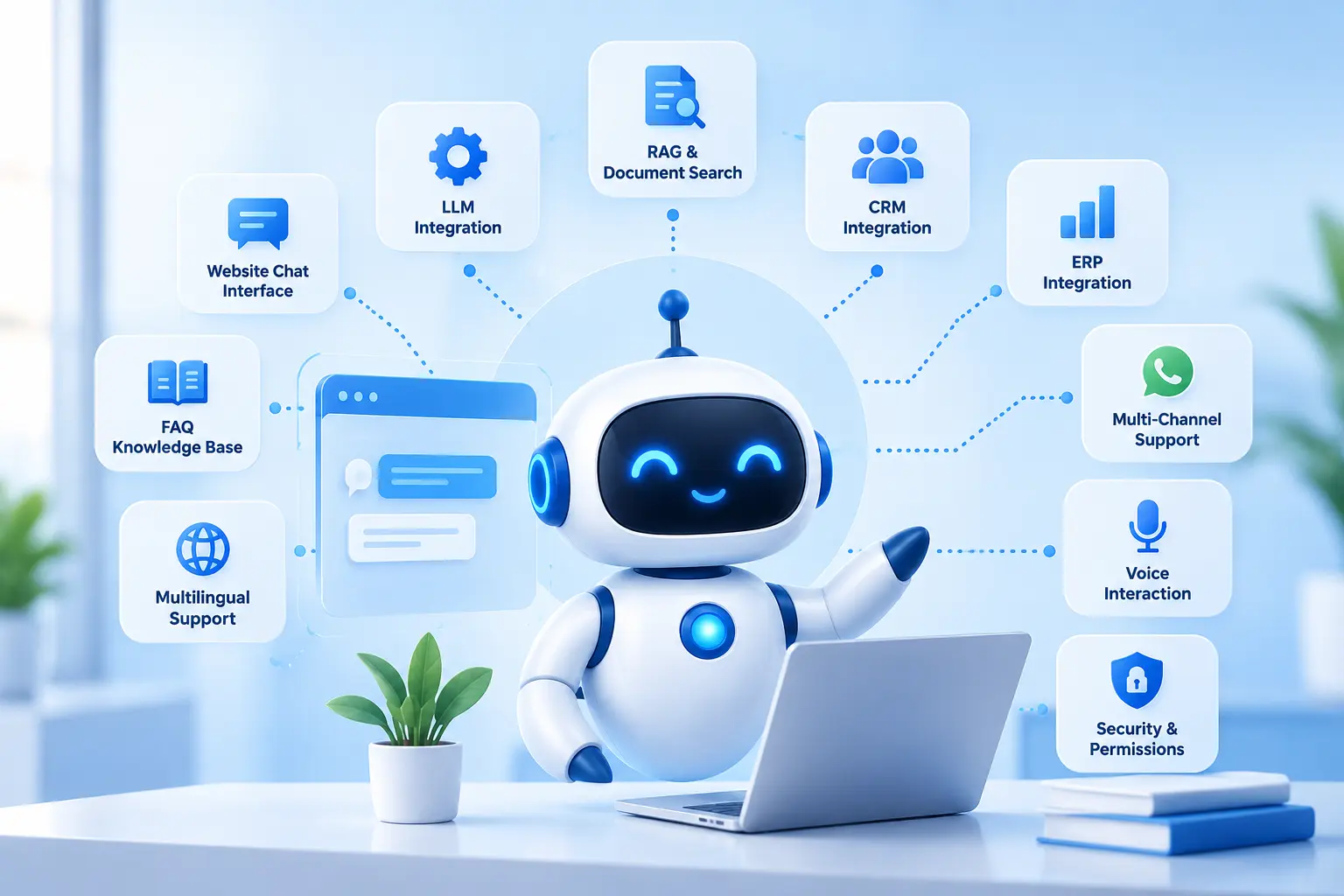
The following gives a general idea of how different features affect project complexity.
| Feature | Typical cost impact |
| Website chat interface | Low |
| FAQ knowledge base | Low |
| LLM API integration | Low to medium |
| Conversation history | Low to medium |
| Custom admin dashboard | Medium |
| RAG and document search | Medium |
| CRM integration | Medium |
| ERP integration | Medium to high |
| WhatsApp or other channels | Medium |
| Multilingual support | Medium |
| Voice interaction | High |
| Complex AI agent workflows | High |
| Multiple business-system integrations | High |
| Enterprise security and permissions | High |
These features should not be priced in isolation. Adding one feature can require changes elsewhere in the system.
For example, giving a chatbot access to customer records may also require authentication, role-based permissions, audit logging and additional security testing.
Find Out What Goes Into AI Chatbot Development Costs
From LLM and API usage to RAG, integrations, authentication and security, several factors can affect the final development cost. Discuss the requirements to understand which components are needed for the chatbot.
How the Development Approach Changes the Cost
There are several ways to build an AI chatbot, and the approach can have a major effect on the budget.
Using an existing LLM API
For many business applications, using an existing language model is the practical starting point.
The development work focuses on the application around the model:
- Conversation design
- Prompts
- Backend services
- Data retrieval
- Business logic
- Integrations
- User authentication
- Testing
- Monitoring
This approach avoids the enormous infrastructure and research requirements involved in creating a foundation model.
It also means the business pays for model usage rather than maintaining its own large-scale model infrastructure.
Fine-tuning a model
Fine-tuning can be useful in specific situations where a pre-trained model needs additional behaviour or domain-specific adaptation.
It should not automatically be treated as the solution for every company knowledge problem.
If the main requirement is for a chatbot to answer questions from changing company documents, RAG may be a more suitable architecture because the underlying information can be updated without retraining the model.
The right choice depends on what the application actually needs to achieve.
Building a model from scratch
Building a foundation model from scratch is a completely different type of project.
It can involve:
- Large training datasets
- Data processing
- Machine learning infrastructure
- Model training
- Evaluation
- Model serving
- Safety testing
- Monitoring
- Specialist ML engineering
For a normal customer-support, sales or internal business chatbot, building a foundation model from scratch is usually unnecessary.
How Much Does an AI Chatbot Cost to Run After Development?
The development invoice is not the end of the budget.
A production chatbot can have recurring costs for:
- LLM API usage
- Cloud hosting
- Database storage
- Vector databases
- Document processing
- Embedding generation
- Monitoring and logging
- Speech services
- Third-party APIs
- Security monitoring
- Maintenance
- Model updates
The amount can vary significantly according to usage.
For example, AWS publishes example configurations showing a simple production chatbot at roughly $200 per month under a particular setup, while a larger configuration handling around 8,000 queries per day across tens of thousands of documents is estimated at around $1,500 per month. These are AWS-specific examples, not universal chatbot prices, and the actual cost changes with architecture, model, traffic and other services.
This is why a project estimate should separate one-time development costs from ongoing operating costs.
AI Chatbot Cost by Business Use Case
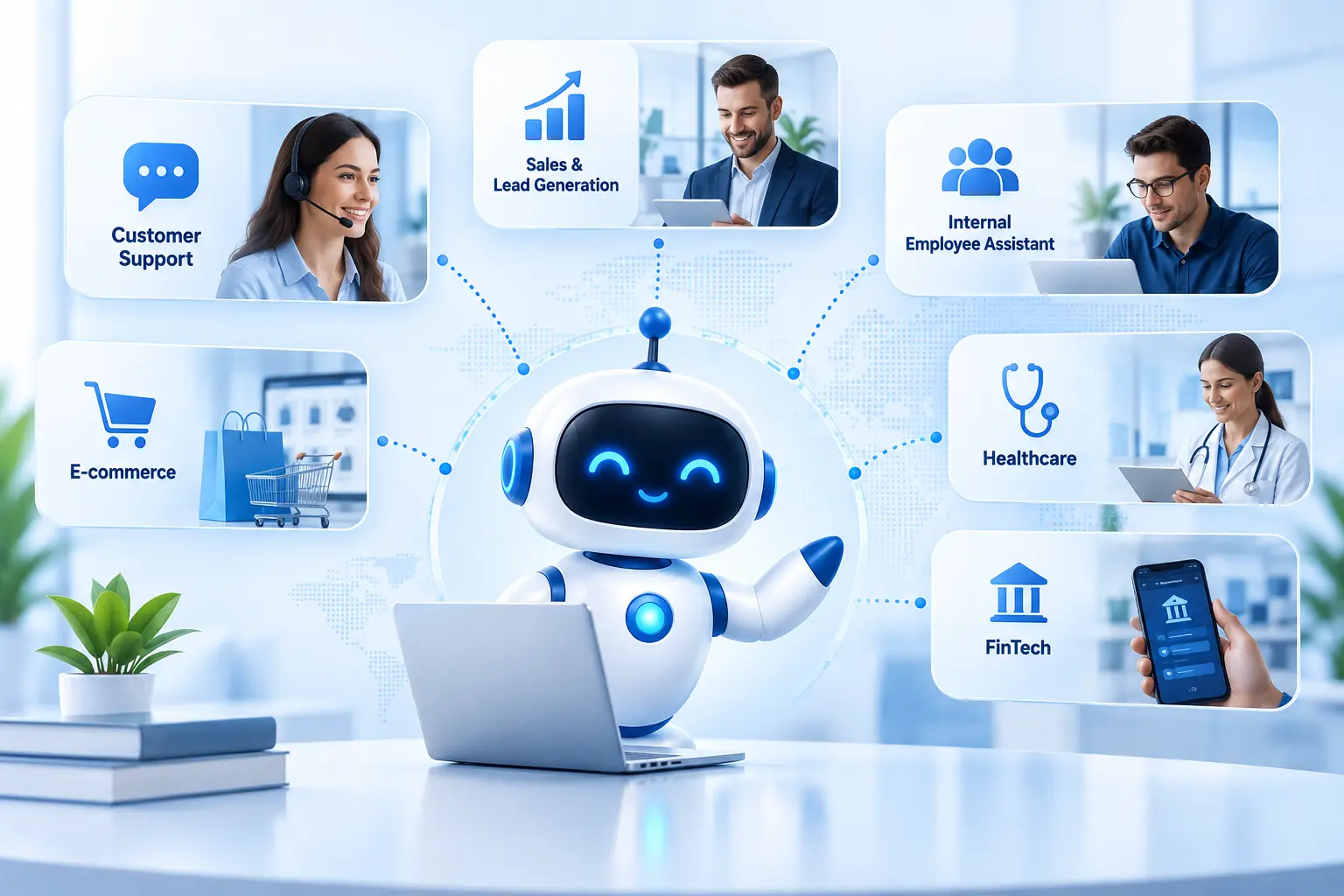
The purpose of the chatbot has a direct effect on the architecture.
Customer support chatbot
A customer-support chatbot may handle:
- Frequently asked questions
- Product information
- Order status
- Returns
- Support requests
- Ticket creation
- Human escalation
A basic support chatbot can be relatively inexpensive. Connecting it to customer records, order systems and ticketing software increases the scope.
Sales and lead-generation chatbot
A sales chatbot may:
- Answer product questions
- Qualify leads
- Recommend products
- Collect contact information
- Schedule appointments
- Connect with a CRM
The cost depends largely on how much of the sales process the chatbot is expected to handle.
Internal employee assistant
An internal assistant can help employees find information from company policies, technical documentation, HR materials or operational procedures.
These systems often require strong access controls because different employees may be permitted to see different information.
E-commerce chatbot
An e-commerce chatbot can assist with:
- Product searches
- Product comparisons
- Recommendations
- Shipping questions
- Order information
- Returns
The technical complexity rises when the chatbot needs live access to inventory, customer accounts or order systems.
Healthcare AI assistant
A healthcare assistant may support administrative tasks such as appointment requests, general information and patient communication.
Projects in this area need careful attention to data access, privacy, security, auditability and human escalation. The exact requirements depend on the countries served and the nature of the data being handled.
FinTech chatbot
A financial services chatbot can handle customer support, product questions and account-related workflows.
If it can access financial information or initiate actions, authentication, permissions, audit logs and security testing become much more important.
Have a Chatbot Idea to Discuss?
A clear development plan helps define the right AI architecture, features, integrations and testing requirements before development begins. Share the intended use case to discuss the technical approach and development scope.
How Long Does It Take to Develop an AI Chatbot?
A realistic development timeline depends on the scope.
| Project type | Approximate development time |
| Basic FAQ chatbot | 3-6 weeks |
| Custom AI chatbot | 6-12 weeks |
| Advanced AI chatbot | 3-6 months |
| Enterprise conversational AI system | 6+ months |
These are planning ranges rather than guaranteed delivery times.
Data preparation, third-party approvals, API availability, security reviews, integration complexity and internal stakeholder feedback can all affect the schedule.
A chatbot that looks simple on the surface can take longer if it needs to interact with several existing systems.
What Does the AI Chatbot Development Process Involve?
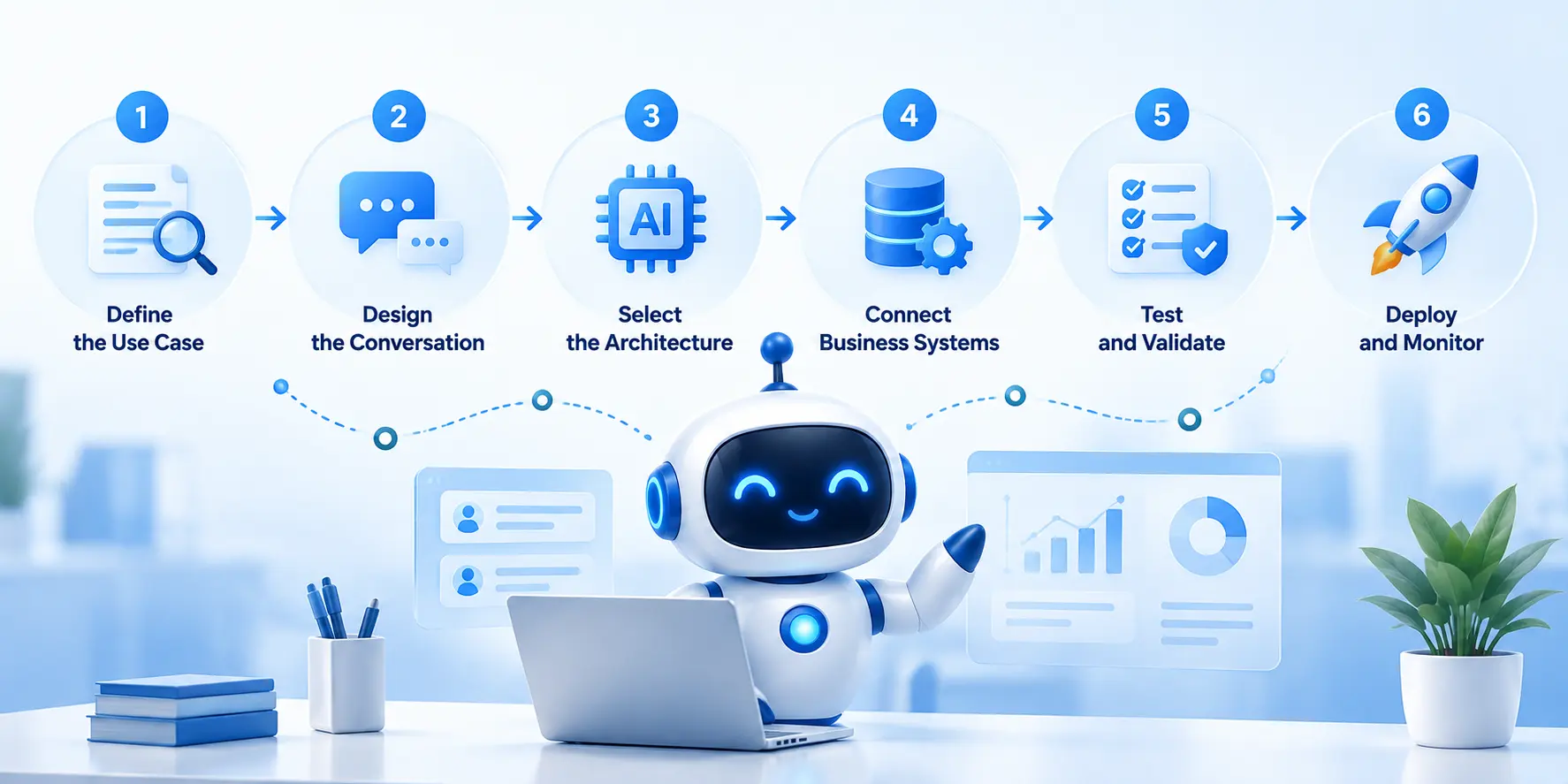
1. Define the use case
Start by deciding exactly what the chatbot should accomplish.
Questions worth answering include:
- Who will use it?
- What questions should it answer?
- What information can it access?
- What actions should it perform?
- What should happen when it cannot answer?
- When should a human take over?
This stage prevents unnecessary development later.
2. Design the conversation
The next step is to map common user journeys.
This includes intents, follow-up questions, fallback responses, escalation paths and error handling.
A good conversation design also considers what happens when a user provides incomplete or unexpected information.
3. Select the AI architecture
The technical architecture may include:
- LLM
- RAG
- Database
- Vector search
- Backend APIs
- Authentication
- Business logic
- Monitoring
The architecture should match the actual requirements. A simple FAQ assistant does not need the same infrastructure as an AI agent connected to several enterprise systems.
4. Connect business data and systems
The chatbot can then be connected to the information and applications it needs.
This might include a CRM, ERP, support platform, internal database or document repository.
Permissions should be designed at this stage rather than added after the chatbot has already been built.
5. Test accuracy and reliability
Testing should cover more than whether the chatbot produces fluent answers.
The team should test:
- Incorrect questions
- Missing information
- Hallucinations
- Prompt injection
- Sensitive data exposure
- Permission failures
- API failures
- Poor-quality documents
- Unexpected conversation paths
- Response times
For generative AI systems, risk management should be considered across design, development, deployment and evaluation. The U.S. National Institute of Standards and Technology provides a dedicated Generative AI Profile within its AI Risk Management Framework for this purpose.
6. Deploy and monitor
After launch, the system needs ongoing monitoring.
Useful metrics include:
- Conversation volume
- Failed responses
- Escalations
- Response time
- API usage
- Token consumption
- Infrastructure costs
- User feedback
The knowledge base also needs maintenance if the chatbot relies on company information that changes over time.
Security Can Increase the Cost of an AI Chatbot
Security requirements vary significantly between chatbot projects.
A public FAQ chatbot may need relatively simple controls.
A chatbot that can access customer accounts, internal documents or business systems needs much stronger protection.
Development may need to include:
- Authentication
- Authorisation
- Role-based access
- Data encryption
- Audit logging
- Secure API connections
- Prompt-injection testing
- Data-loss prevention
- Monitoring
- Human escalation
NIST's Generative AI Profile identifies risks associated with generative AI systems and provides actions organisations can use to manage those risks throughout the AI lifecycle.
The important point for budgeting is simple: the more access a chatbot has, the more carefully its permissions and security need to be designed.
Common Mistakes That Increase AI Chatbot Development Costs
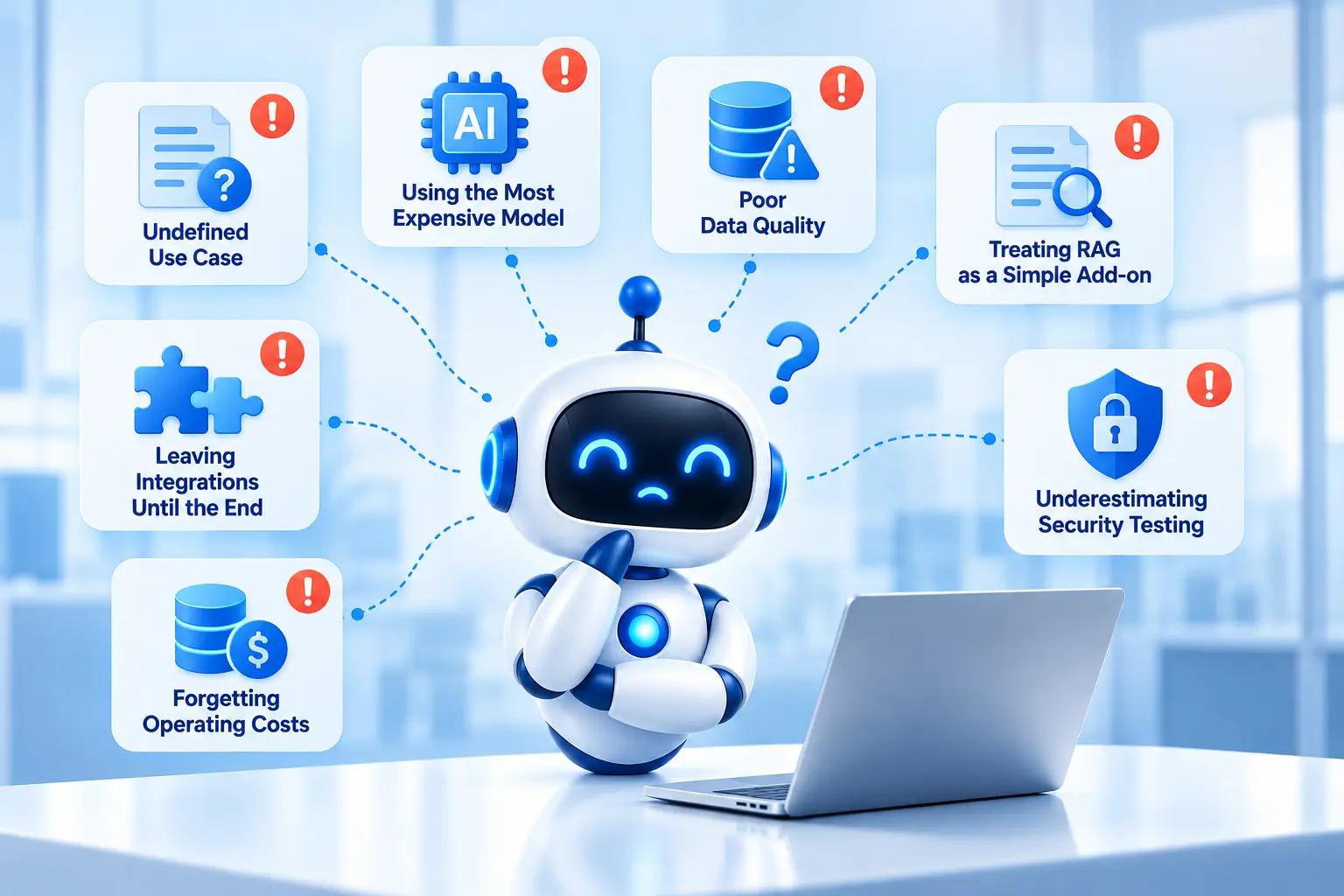
Starting development without a defined use case
A vague requirement such as "build an AI chatbot for customer support" leaves too many technical decisions unanswered.
It is better to define the actual tasks the chatbot needs to handle.
Using the most expensive model for every request
A high-end model may be useful for difficult reasoning tasks, but simple requests may not require the same level of capability.
Model selection should be based on the task, quality requirements, response speed and expected volume.
Ignoring the quality of business data
An AI model cannot compensate for outdated, incomplete or badly organised company information.
If a chatbot is expected to answer questions from internal documents, those documents need to be reviewed and prepared properly.
Treating RAG as a simple add-on
RAG involves retrieval, indexing, embeddings, document processing and evaluation.
Poor retrieval can produce incorrect or incomplete answers even when the underlying language model is capable.
Leaving integrations until the end
If the chatbot needs CRM, ERP or database access, those requirements should be part of the architecture from the beginning.
Adding them late can lead to rework.
Forgetting operating costs
A project can fit the development budget and still become expensive to run if usage grows significantly.
API calls, storage, cloud services and monitoring should be estimated before launch.
Underestimating security testing
A chatbot with access to sensitive information should be tested for misuse, data leakage and unauthorised access before it becomes a production system.
Planning an AI Chatbot Project?
Starting with high-value use cases and essential integrations can keep the first release focused. Discuss the required functionality to identify what should be included initially and what can be added in later development phases.
How to Reduce AI Chatbot Development Costs
Reducing cost does not mean removing useful functionality.
A better approach is to control the scope.
Start with one clear business problem. Build the core workflow, measure how users interact with it and then add functionality that is actually needed.
Other practical ways to control costs include:
- Use an existing LLM instead of building a foundation model.
- Start with text before adding voice if voice is not required.
- Use RAG when the main requirement is access to changing company information.
- Reuse existing APIs where appropriate.
- Use less expensive models for simpler requests.
- Limit unnecessary conversation history.
- Monitor token consumption.
- Design integrations before development begins.
- Build the architecture so additional channels can be added later.
The goal is to avoid paying for complexity that the business does not yet need.
How to Budget for an AI Chatbot Development Project
Before requesting a development quotation, define the following:
| Requirement | Questions to answer |
| Users | Who will use the chatbot? |
| Traffic | How many conversations are expected each month? |
| Conversations | How long are typical conversations? |
| Data | What documents or databases will it use? |
| Integrations | Which systems must it connect to? |
| Actions | Does it only answer questions or perform tasks? |
| Channels | Website, mobile app, WhatsApp, voice or other channels? |
| Languages | Which languages are required? |
| Security | What information can the chatbot access? |
| Operations | What monthly infrastructure and AI budget is available? |
With these details, a development team can produce a much more useful estimate than simply quoting a price for "an AI chatbot."
When Should You Build a Custom AI Chatbot?
A custom chatbot makes sense when the business needs capabilities that a basic chatbot platform cannot provide.
Typical reasons include:
- Private company knowledge
- Custom conversation logic
- CRM or ERP integration
- Business-specific workflows
- Custom authentication
- Advanced reporting
- Multiple channels
- Voice capabilities
- Multilingual support
- AI agents that can perform actions
- Specific security requirements
A ready-made chatbot platform may be enough for a small website that only needs basic FAQs or lead collection.
The decision should be based on the required functionality, expected usage and long-term operating costs.
Choosing an AI Chatbot Architecture
Different requirements call for different architectures.
| Architecture | Best suited for | Cost profile |
| FAQ or rule-based chatbot | Fixed questions and simple workflows | Lower |
| LLM chatbot | General conversational support | Moderate |
| LLM + RAG | Private business knowledge | Moderate to high |
| LLM + RAG + integrations | Business operations | High |
| Agentic AI system | Multi-step actions and automation | High to very high |
An AI agent is different from a chatbot that only generates responses. An agent can be connected to tools and systems and can take actions based on a user's request.
For example, a conventional chatbot might explain a company's refund policy. An agent-based system could potentially check an order, determine whether the request meets the policy and start the appropriate workflow.
That extra capability also introduces additional engineering, permissions and testing requirements.
AI Chatbot Development Services for Different Business Requirements
For businesses, we provide AI chatbot development services covering custom conversational AI, virtual assistants, LLM-based chatbots and business integrations.
The development approach can be adapted to the actual requirement, whether that means a customer-support chatbot, internal knowledge assistant, multilingual conversational system or an AI solution connected to existing business applications.
For projects that require a wider AI architecture, AI development services can cover areas such as generative AI, NLP, machine learning and AI-powered applications. For applications built around private company knowledge, generative AI development can also include model integration, RAG-based systems and connections to existing platforms.
If the chatbot needs to move beyond conversation and perform multi-step tasks, agentic AI solutions are another architectural option to consider.
The right budget depends on what the chatbot needs to accomplish, how many people will use it, which systems it must connect to and how much control it needs over business data and workflows. A clear technical scope is the best starting point for getting an accurate development estimate.
Looking for AI Chatbot Development Services?
Get support with custom AI chatbot development, RAG-based solutions, business-system integrations and advanced conversational features. Discuss the requirements to determine the technology, functionality and development approach.